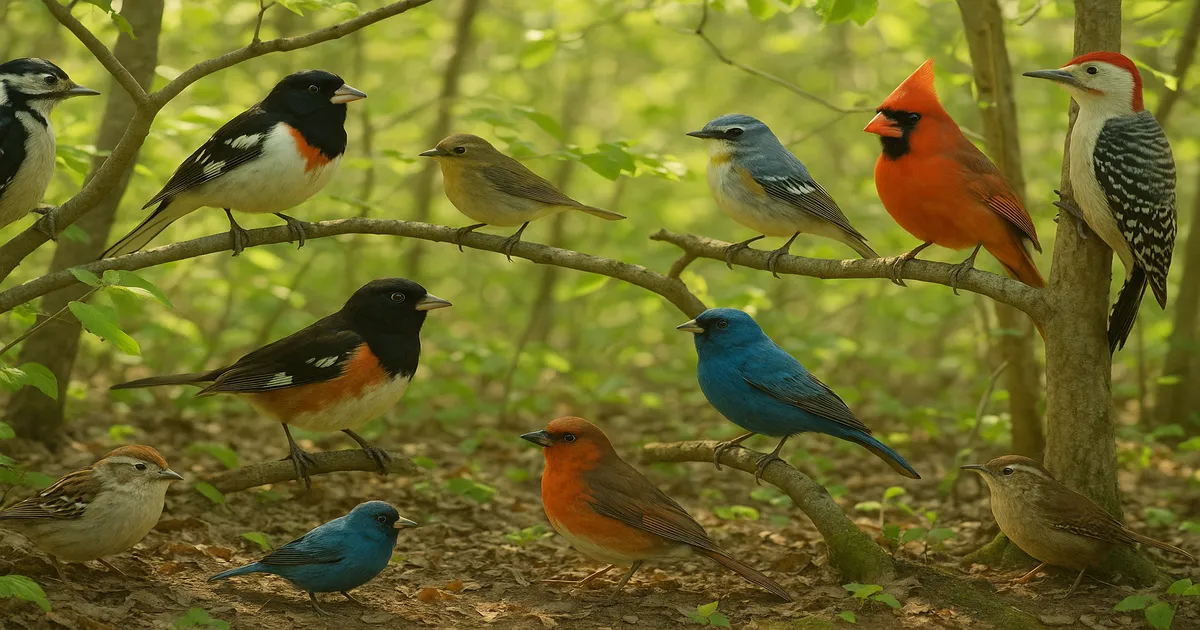
Quick Answer: These four birds — Ruby-throated Hummingbird, Cooper’s Hawk, Downy Woodpecker, and Dark-eyed Junco — show up in backyards and woodlands across North America, yet they trip up birders of all levels. Learn the key field marks for each one and you’ll be able to name these species with confidence the next time they appear.
Can You Name These Species? Four Birds That Fool Everyone
The 4 Field Marks to Check Before Anything Else
Before you reach for your field guide, four things will get you most of the way to a correct ID: size, shape, color pattern, and behavior. Size is relative — always compare to something familiar. Is it sparrow-sized, robin-sized, crow-sized? Shape tells you the family before color even registers. A woodpecker’s chisel bill and stiff tail, an accipiter’s short rounded wings and long tail — these silhouettes are readable even in bad light. Color pattern narrows you to species, and behavior often seals the deal.
Beginners tend to obsess over color and miss the shape entirely. Train yourself to ask “what is this bird doing?” before you start matching plumage to plates.
Which Species Are Featured in This ID Challenge?
Four birds, each a classic puzzle:
- Ruby-throated Hummingbird — that gorget can blaze red or look completely black depending on the angle
- Cooper’s Hawk — the feeder hawk that gets confused with its smaller cousin nearly every time
- Downy Woodpecker — North America’s smallest woodpecker, nearly identical to a much larger species
- Dark-eyed Junco — one species with so many regional looks that beginners routinely think they’re seeing five different birds
Ruby-throated Hummingbird: The Glowing Gorget Trap
How to Identify the Ruby-throated Hummingbird
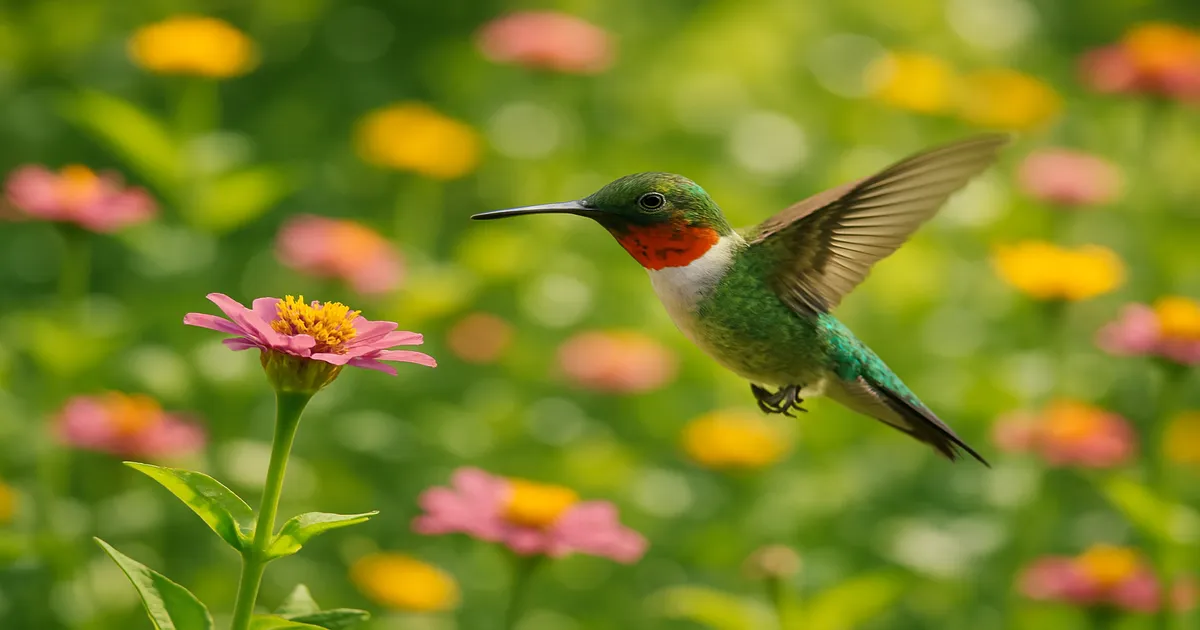
The Ruby-throated Hummingbird (Archilochus colubris) is about 3.75 inches (9.5 cm) long with a wingspan of roughly 4.5 inches (11.4 cm) — genuinely tiny, lighter than a penny. Both sexes share the same iridescent emerald-green back. The needle-like bill is straight and built for probing tubular flowers.
In good light, the male’s gorget blazes like a red traffic light. In shadow or at the wrong angle, it goes flat black — and that’s the trap. If you see a small green hummingbird with what looks like a dark throat, don’t write off the ruby-red gorget yet. Shift your position before you decide.
Male vs. Female:
- Male: Ruby-red gorget, slightly forked tail, white breast
- Female: White throat (sometimes faintly streaked), rounded tail with white tips on outer feathers, no gorget
- Juveniles: Resemble females; young males may show scattered red feathers on the throat by late summer
Look-Alikes: Black-chinned and Rufous Hummingbirds
| Species | Key Difference |
|---|---|
| Black-chinned Hummingbird (Archilochus alexandri) | Western species; male has a black chin with a violet lower gorget band; female nearly identical to Ruby-throated — range is your best separator |
| Rufous Hummingbird (Selasphorus rufus) | Orange-rufous flanks and tail; increasingly appears in the East during fall migration |
| Anna’s Hummingbird (Calypte anna) | Rose-red crown AND gorget; larger overall; year-round West Coast resident |
When and Where to Find Ruby-throated Hummingbirds
Ruby-throateds breed across the entire eastern half of North America, from Nova Scotia west to Alberta and south through Florida and Texas. Males arrive one to two weeks ahead of females in spring — typically March in the South, May in Canada. They winter primarily in southern Mexico and Central America, with small numbers lingering along the Gulf Coast.
One myth worth squashing: they do not hitch rides south on Canada Geese. These birds cross the Gulf of Mexico under their own power, a nonstop flight of up to 500 miles.
Feeder basics:
- 4:1 water-to-white-sugar ratio — no red dye, no honey, no artificial sweeteners
- Clean feeders every 2–3 days in warm weather to prevent fermentation and mold
- Best native plants: trumpet vine (Campsis radicans), cardinal flower (Lobelia cardinalis), bee balm (Monarda spp.)
A reliable nectar feeder makes a real difference — the Aspects HummZinger Ultra 12 oz is easy to clean and holds up through a full season.
Cooper’s Hawk: The Accipiter That Haunts Your Feeder
How to Identify a Cooper’s Hawk
The Cooper’s Hawk (Accipiter cooperii) measures 14.6–17.7 inches (37–45 cm) long with a wingspan of 24.4–35.4 inches (62–90 cm) — note the wide range, since females are substantially larger than males. It has the accipiter family’s signature silhouette: short rounded wings, a long rounded tail, and a head that projects noticeably forward of the wing bend in flight. The flight pattern is equally distinctive: flap-flap-flap-glide, repeated. Buteos soar; accipiters flap.
Adults show a blue-gray back, rusty-orange barring on white underparts, a red eye, and a dark cap that contrasts sharply with a paler nape — a clean “capped” look.
Juveniles are brown above with vertical brown streaking on the breast (adults have horizontal barring) and a yellow eye that matures to orange, then red, over two to three years.
Can You Name These Species? Cooper’s vs. Sharp-shinned Hawk
This is one of the hardest IDs in North American birding, and anyone who tells you it’s easy is either very experienced or overconfident. Here’s what actually works:
| Feature | Cooper’s Hawk | Sharp-shinned Hawk (Accipiter striatus) |
|---|---|---|
| Tail shape | Rounded | Squared or notched |
| Head projection | Prominent — head extends well past wing bend | Minimal — small head barely clears wing bend |
| Overall bulk | Larger, “barrel-chested” | Slimmer, smaller |
| Cap vs. nape contrast | Strong capped look | Less distinct |
Size alone is unreliable because female Sharp-shinneds overlap with male Cooper’s. Focus on the head and tail.
Where and When to Spot Cooper’s Hawks
Cooper’s Hawks have expanded dramatically into suburban and urban areas, following the songbirds that flock to backyard feeders. If a hawk shows up and scatters everything, a Cooper’s is the first suspect. For concentrated migration viewing, head to Hawk Mountain Sanctuary in Pennsylvania, Cape May in New Jersey, or Hawk Ridge Bird Observatory in Duluth, Minnesota. Peak fall migration runs September through November.
The species’ population recovery after the 1972 DDT ban is a genuine conservation success story — numbers crashed mid-century and have rebounded strongly.
Downy Woodpecker: North America’s Smallest Woodpecker
How to Identify the Downy Woodpecker
The Downy Woodpecker (Dryobates pubescens) is 5.5–6.7 inches (14–17 cm) long and weighs less than an ounce. The plumage is bold: black-and-white striped face, white back stripe, black wings with white spotting, clean white underparts. Males have a red patch on the back of the head; females don’t. The undulating flight — several wingbeats, then a closed-wing glide — is classic woodpecker, and you’ll recognize it quickly.
The One Field Mark That Separates Downy from Hairy Woodpecker
The Hairy Woodpecker (Dryobates villosus) is nearly identical in pattern but noticeably larger at 9.25 inches (23.5 cm). The reliable separator is the bill. The Downy’s bill is short and stubby — roughly as long as the head is wide. The Hairy’s bill is long and chisel-like, roughly equal to the full length of the head. If the bill looks almost comically small for the bird’s face, you’ve got a Downy. If it looks like a proper tool, you’ve got a Hairy.
Call is useful too: the Hairy gives a sharp, loud peek; the Downy’s pik is softer and flatter. The Downy also gives a descending whinny call that the Hairy rarely produces.
Behavior, Habitat, and Attracting Downies
Downies specialize in smaller branches and weed stems that larger woodpeckers ignore — goldenrod galls, cattail stalks, the outer twigs of shrubs. In winter, they’re reliable members of mixed-species foraging flocks alongside chickadees, nuthatches, and kinglets. Following a chickadee flock in winter almost always turns up a Downy or two.
Suet is the single best attractant. An upside-down suet cage is worth the small extra investment — European Starlings (Sturnus vulgaris) struggle with them, while Downies handle them easily. The Stokes Select Upside Down Suet Bird Feeder is a solid, no-fuss option.
- Foods: Suet, shelled peanuts, sunflower seeds
- Habitat tip: Leave dead snags standing when safe — they’re critical nesting and foraging habitat, not eyesores
Dark-eyed Junco: One Species, Many Disguises
How to Identify a Dark-eyed Junco
The Dark-eyed Junco (Junco hyemalis) is 5.5–6.3 inches (14–16 cm) long. Start with the universal field mark: white outer tail feathers that flash conspicuously in flight. Every subspecies group has them. If a small, dark sparrow-like bird flushes from the ground and you catch a flash of white on either side of the tail, that’s your junco. The pink bill is equally consistent across all forms — a useful secondary mark when the bird is sitting still.
Slate-colored vs. Oregon vs. Other Junco Forms
This is where beginners get genuinely confused, and understandably so:
- Slate-colored (eastern North America): Dark gray hood and upperparts, white belly — the “classic” junco most easterners know
- Oregon (western North America): Black hood, rusty-brown back and flanks, white belly — looks almost like a different species
- Pink-sided (Northern Rockies): Gray hood, pinkish-buff flanks
- Gray-headed (Southern Rockies): Gray overall with a rusty back patch
- White-winged (Black Hills region): Pale gray overall with two thin white wing bars
They’re all the same species. Ornithologists lumped these forms together based on genetics and the fact that they interbreed where ranges overlap. If you’re in the East and see something that looks like an Oregon Junco at your feeder, it’s probably a genuine western stray — worth an eBird report.
When Do Dark-eyed Juncos Visit Feeders?
Juncos breed in boreal forests and mountain conifer zones, then move to lower elevations and southern latitudes for winter. Across much of the lower 48, they’re a feeder bird from roughly October through April. They’re ground feeders by preference, so a platform feeder or seed scattered directly on the ground works best. White millet is their top choice; sunflower chips and cracked corn work well too.
The Woodlink Going Green Platform Bird Feeder sits low, drains well, and handles a flock of juncos without turning into a muddy mess.
Habitat, Range, and Seasonal Timing
All four species show up in suburban yards, making them ideal starting points for new birders. The Downy Woodpecker is the most reliably present — a year-round resident across nearly the entire continent. Juncos dominate winter feeders across much of the U.S. Cooper’s Hawks have followed songbird feeders right into city neighborhoods. Ruby-throated Hummingbirds will find a well-maintained nectar feeder from spring through early fall in the East.
| Species | Migration Status | Peak Timing |
|---|---|---|
| Ruby-throated Hummingbird | Migratory | Spring: March–May; Fall: July–October |
| Cooper’s Hawk | Partially migratory | Fall: September–November; Spring: March–April |
| Downy Woodpecker | Non-migratory | Year-round |
| Dark-eyed Junco | Migratory/altitudinal | Winter visitor: October–April |
eBird is the best tool for finding current local sightings — search any of these species by county and you’ll see exactly where other birders are finding them right now.
Conservation and How Birders Can Help
All four species carry IUCN Least Concern status, but that doesn’t mean they’re without pressure. Cooper’s Hawk is a genuine recovery story after DDT and direct persecution. Downy Woodpecker numbers are stable but depend on dead wood availability. Ruby-throated Hummingbirds face deforestation pressure on their Central American wintering grounds. Dark-eyed Juncos, like all ground-nesting birds, are vulnerable to nest predation by free-roaming cats.
Window strikes kill an estimated 600 million birds annually in the U.S. — all four of these species are vulnerable. Decals, external screens, and angled glass all reduce collisions significantly. WindowAlert UV Liquid Decals are inexpensive and genuinely effective on problem windows near feeders.
Free-roaming cats are the single largest human-caused source of bird mortality in North America, estimated at 1.3–4 billion birds per year. Keeping cats indoors is one of the most impactful things an individual can do for birds.
Your eBird checklists contribute directly to peer-reviewed science and conservation policy. Journey North tracks hummingbird migration in real time; Project FeederWatch runs winter feeder counts that reveal population trends; the Christmas Bird Count has over a century of data behind it. Even a Downy Woodpecker at your suet feeder on a Tuesday in January is useful.
A good pair of binoculars makes all of this easier and more enjoyable. The Nikon Monarch M5 8x42 offers sharp optics and a wide field of view at a price that won’t make you wince.
Frequently Asked Questions
Can you name these species by shape alone, before color?
Often, yes. Shape is the most underrated ID tool. A woodpecker’s stiff tail and chisel bill, an accipiter’s short rounded wings and long tail, a hummingbird’s needle bill and hovering flight — these silhouettes are readable in poor light and at distance. Color confirms what shape already suggested.
How do you tell a Cooper’s Hawk from a Sharp-shinned Hawk?
Focus on three things: tail shape (Cooper’s is rounded, Sharp-shinned is squared or notched), head projection (Cooper’s head extends noticeably past the wing bend in flight, Sharp-shinned barely clears it), and overall bulk. Size alone is unreliable because female Sharp-shinneds overlap with male Cooper’s. At a feeder, a bird that looks barrel-chested with a big rounded tail is almost certainly a Cooper’s.
What’s the easiest way to separate a Downy from a Hairy Woodpecker?
Look at the bill relative to the head. The Downy’s bill is stubby — roughly as long as the head is wide. The Hairy’s bill is long and chisel-like, about as long as the entire head. If the bill looks almost too small for the bird’s face, it’s a Downy. Call is also useful: the Hairy’s peek is sharp and loud; the Downy’s pik is softer.
Why does the Dark-eyed Junco look so different across the country?
The Dark-eyed Junco is actually a complex of several subspecies groups that were once considered separate species. They were lumped into one species because they interbreed where their ranges meet. The Slate-colored form (gray overall) is the standard eastern bird; the Oregon form (black hood, rusty flanks) is the common western bird. Same species, very different looks.
When should I put out a hummingbird feeder?
In the South, late February to early March. In the mid-Atlantic and Midwest, early to mid-April. In the northern states and Canada, early to mid-May — roughly one to two weeks before you’d expect males to arrive based on local reports. Check Journey North’s real-time migration maps to time it precisely for your area.