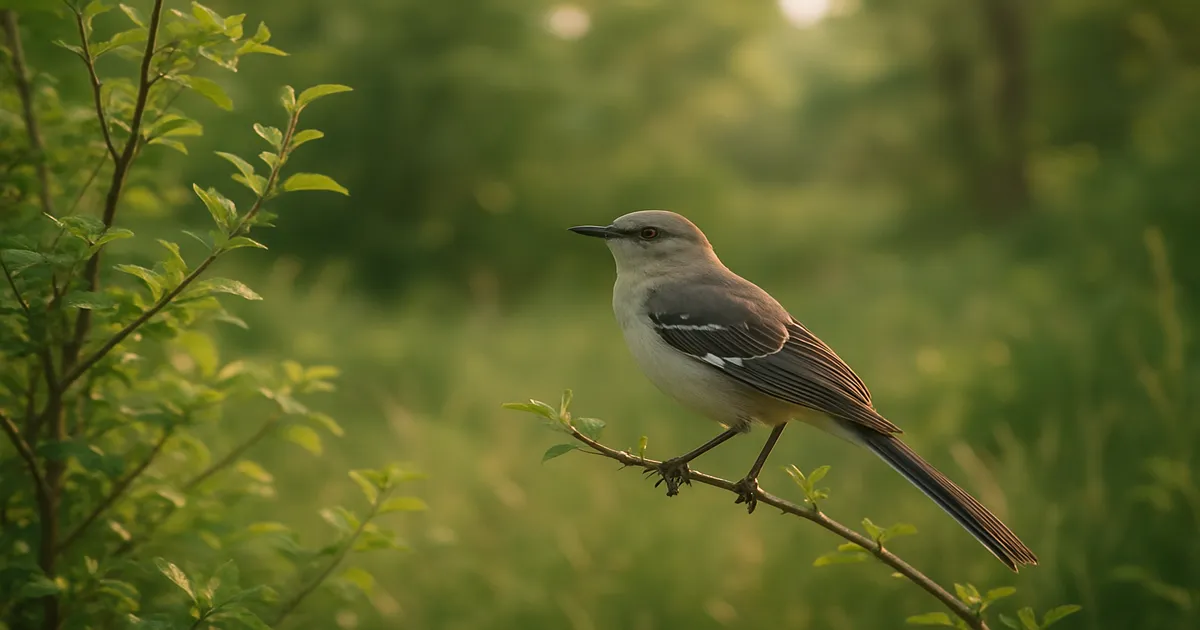
Quick Answer: The Northern Mockingbird (Mimus polyglottos) is a medium-sized gray songbird with bold white wing patches that flash in flight, a long dark tail with white outer feathers, and a bright yellow eye. It’s most reliably identified by its song — each phrase repeated 3–6 times before switching to the next. If you’re in North America and you’ve got a gray bird singing its head off at 2 a.m., you’ve found your bird.
If you’re trying to figure out how to identify a mockingbird, you’re almost certainly looking at a Northern Mockingbird — the only mockingbird species most North American birders will ever encounter. It’s one of those birds that rewards attention: once you know what to look and listen for, you’ll spot them everywhere.
How to Identify a Mockingbird at a Glance
The Five Field Marks You Need
You don’t need all five to make a confident ID, but knowing them all helps when conditions aren’t perfect:
- Medium gray body — gray above, pale whitish-gray below
- Long dark tail with white outer feathers — flashes white when spread or fanned
- Bold white wing patches — visible at rest, unmistakable in flight
- Bright yellow eye — striking at close range, useful when the bird is perched quietly
- Repetitive song — each phrase sung 3–6 times before switching to the next
Size and Silhouette
A Northern Mockingbird runs about 8.3–10.2 inches (21–26 cm) long — similar in length to an American Robin (Turdus migratorius), but noticeably slimmer and longer-tailed. Where a robin looks chunky and upright, a mockingbird looks stretched out, with a tail it often cocks upward like a wren. Sexes are visually identical in the field.
Physical Field Marks: What Does a Mockingbird Look Like?
Body Shape
The body is slender and elongated. The tail is long and frequently pumped or cocked upward while the bird forages or perches. The bill is medium-length with a slight downward curve at the tip — a family trait shared with thrashers and catbirds. Legs are long and pale gray, built for ground work.
Adult Plumage
The overall impression is gray and white. Upperparts are medium gray; underparts are pale whitish-gray. Look for a thin dark loral stripe through the eye that gives the face a faintly masked look — present, but nothing like the bold black mask of a shrike.
The wings are where things get interesting. Two white wing bars are visible at rest, plus a large white patch at the base of the primaries. In flight, those patches flash conspicuously with every wingbeat. I’ve found this to be the single best long-distance clue — no other common gray bird in North America does this. The tail is dark gray-black with prominent white outer feathers that flash whenever the bird spreads or fans it.
The Yellow Eye
At close range, the pale yellow iris stands out sharply against the gray face. It’s not always visible in poor light or at distance, but when you get a good look, it’s striking. A good pair of binoculars makes this field mark much easier to use. (Nikon Monarch M5 8x42) This detail matters most when separating adult mockingbirds from juveniles and from the Gray Catbird.
Juvenile Mockingbirds
Juveniles are the source of most mockingbird confusion in summer. The breast and flanks are heavily spotted and streaked with dark brown, giving them a thrush-like look that throws a lot of birders off. The iris is dark brown rather than yellow, and the overall tone is slightly browner than an adult. The white wing patches and white outer tail feathers are still present, just slightly less crisp. By October, most first-year birds have completed their preformative molt and are nearly indistinguishable from adults.
Mockingbird Song: Identification by Ear
The Repetition Pattern
Song is often the easiest way to identify this species — you’ll hear one long before you see it. The key is the repetition: each distinct phrase is sung 3–6 times before the bird switches to the next. It’s relentless and varied, but that looping structure is unmistakable once you’ve heard it.
A quick rule of thumb: thrashers repeat each phrase twice; catbirds don’t repeat at all; mockingbirds repeat 3–6 times. If a singing bird keeps cycling through short phrases like it can’t decide what to say next, it’s a mockingbird.
Song Repertoire and Mimicry
A single male may have 150–200 or more distinct song types, including convincing mimicry of other bird species, frogs, and occasionally mechanical sounds. The mimicry can fool even experienced birders — I’ve been tricked by a mockingbird doing a dead-on Eastern Wood-Pewee (Contopus virens) impression more than once. The trick is to listen for the repetition pattern: no matter how convincing the individual phrase, a mockingbird will keep cycling back and repeating it.
Calls
The alarm call is a sharp, emphatic “CHEK” or “CHAK” — loud and forceful for a bird this size. You’ll hear it when you walk too close to a nest or when a cat appears in the yard. There’s also a softer, nasal “mew” used as a contact call, which can occasionally be confused with the Gray Catbird’s signature call.
Nocturnal Singing
Nocturnal singing is almost exclusively the work of unmated males, particularly in spring and early summer. A mated male generally quiets down at night; an unmated one will sing for hours from a rooftop or antenna, seemingly indifferent to sleep schedules. Impressive if you’re not the one trying to sleep through it.
Using Apps to Confirm Your ID
The free Merlin Bird ID app has a Sound ID feature that’s excellent at picking up mockingbirds in real time. Cross-reference what you’re hearing with the repetition pattern, and you’ll have a confirmed ID within seconds.
Habitat and Range: Where to Find Mockingbirds
The Northern Mockingbird is a year-round resident across the entire southeastern U.S., the Mid-Atlantic states, Texas, Oklahoma, the California coast and Central Valley, and much of the Southwest. It’s largely non-migratory.
This is a bird of open to semi-open country — farmland edges, hedgerows, desert scrub, coastal chaparral, and above all, suburban neighborhoods. Fruiting shrubs are the single strongest predictor of mockingbird presence, especially in winter, when a bird may defend a single holly bush as its entire territory. Skip dense forest interior, open grassland without shrubs, and high-elevation coniferous zones — mockingbirds need structure and avoid habitats that don’t provide it.
Over the past century, the species has expanded significantly northward, now breeding regularly in southern Ontario, Quebec, and the Maritime provinces. Suburban plantings of fruiting shrubs and milder winters are both likely contributors. If you’re in the northern U.S. or southern Canada and you think you’re seeing a mockingbird, you’re probably right.
Mockingbird Behavior: What to Watch For
The Wing-Flash Display
While foraging on the ground, a mockingbird will slowly raise its wings in two or three deliberate stages, exposing the white patches, then lower them again. It’s unhurried and deliberate — nothing like the reflexive wing-flick of a waterthrush. The leading hypothesis is that the white flashes startle hidden insects into moving, making them easier to catch. Research results have been mixed, and the debate is still open. Whatever the function, it’s a reliable behavioral signature — no other common species does this in the same slow, staged way.
Ground Foraging Style
Watch a mockingbird on a lawn and you’ll see a distinctive pattern: short dashes, abrupt stops, upright posture while scanning, then another dash. It’s more energetic and stop-start than a robin’s methodical walk. That foraging style, combined with the long cocked tail, makes mockingbirds recognizable even at a distance.
Territorial Aggression
Mockingbirds are among the most aggressively territorial songbirds in North America, and they don’t discriminate by size. Crows, Red-tailed Hawks (Buteo jamaicensis), cats, dogs, and humans who stray too close to a nest are all fair targets for dive-bombing. I’ve had a mockingbird strike me on the back of the head twice in one morning while walking past a nest I didn’t even know was there. If a small gray bird is repeatedly harassing something much larger than itself, it’s almost certainly a mockingbird.
Mockingbird Look-Alikes: Avoiding Misidentifications
Gray Catbird
The Gray Catbird (Dumetella carolinensis) is the species most often confused with a Northern Mockingbird. Both are gray, medium-sized members of the family Mimidae. The differences are clear once you know them:
- Catbirds are darker gray overall, with a black cap and rusty-red undertail coverts
- No white wing patches — wings are plain dark gray
- Song flows continuously without repeating phrases
- Alarm call is a drawn-out, cat-like mew, more nasal than the mockingbird’s sharp “CHAK”
Shrikes
Both the Northern Shrike (Lanius excubitor) and Loggerhead Shrike (Lanius ludovicianus) share the gray-and-white color scheme, but have a bold black mask, a hooked bill, and a habit of perching motionless on exposed wires or posts while scanning for prey. Behavior alone separates them — shrikes are predators, not fruit-eating songbirds.
Townsend’s Solitaire
Townsend’s Solitaire (Myadestes townsendi) is a slim, gray thrush of western mountains that occasionally causes confusion. Key differences: buffy (not white) wing patches, a white eye ring, montane conifer habitat rather than suburbs, and a completely different song.
Juvenile Mockingbird vs. Spotted Thrushes
The spotted breast of a juvenile mockingbird can suggest a Swainson’s Thrush (Catharus ustulatus) or Hermit Thrush (Catharus guttatus). Check the wings and tail: white wing patches and white outer tail feathers are present even in juveniles, and no spotted thrush has them.
Quick Comparison Table
| Feature | N. Mockingbird | Gray Catbird | Loggerhead Shrike | Townsend’s Solitaire |
|---|---|---|---|---|
| Overall color | Medium gray | Dark gray | Gray & white | Pale gray |
| Cap | Plain gray | Black | Gray | Plain gray |
| Wing patches | Bold white | None | White | Buffy |
| Tail | White outer feathers | Plain dark | White-cornered | White outer feathers |
| Eye | Yellow | Red | Dark | White eye ring |
| Song pattern | Repeats 3–6x | No repetition | Harsh, varied | Melodious, no repetition |
| Bill | Slightly curved | Slightly curved | Hooked | Straight |
Note: Gray Catbird eye color is actually dark red to reddish-brown, not a bright red — visible only at close range.
How to Attract Mockingbirds to Your Yard
What They Eat
Spring and summer are all about insects — beetles, caterpillars, grasshoppers, wasps, and earthworms. Come fall, the shift to fruit and berries is dramatic. A mockingbird in winter may subsist almost entirely on holly berries, pyracantha, or pokeweed, defending a single fruiting shrub against all comers.
Feeder Foods That Work
Mockingbirds aren’t seed eaters, so a standard tube feeder won’t do much. What actually works:
- Mealworms — live or dried, in a shallow open dish; this is by far the most effective offering (Duncraft Mealworm Feeder Tray)
- Fruit — halved apples, soaked raisins, blueberries, or sliced grapes on a platform feeder
- Suet — occasionally visited in cold weather, especially softer suet cakes
Open platform or tray feeders are essential. Mockingbirds won’t use tube feeders — they need a flat surface with room to land and move around.
Native Plants
If I had to give one piece of advice for attracting mockingbirds, it would be to plant native fruiting shrubs. The best options:
- American holly (Ilex opaca)
- Possumhaw (Ilex decidua)
- Eastern red cedar (Juniperus virginiana)
- American beautyberry (Callicarpa americana)
- Native dogwoods (Cornus spp.)
- Serviceberry (Amelanchier spp.)
These plants provide fruit that persists through winter — exactly what mockingbirds need when insects are scarce.
Water Features
A birdbath with a dripper or mister is one of the most effective and underused ways to bring mockingbirds into your yard. Moving water catches their attention from a distance. A simple dripper attachment on a standard bath works well.
Conservation Status
The Northern Mockingbird is listed as Least Concern by the IUCN, with an estimated North American population of around 30–45 million birds. That said, the North American Breeding Bird Survey shows a slow declining trend of roughly 0.5–1% per year since the 1960s — not a crisis, but a direction worth watching.
The main threats are free-roaming cats (this species nests low and has fledglings that spend time on the ground), window strikes, loss of shrubby edge habitat to development, and pesticide use that reduces the insect base breeding birds depend on.
The most useful things you can do: keep cats indoors, apply window collision deterrents to large glass surfaces, (WindowAlert UV Decals) plant native fruiting shrubs, and reduce pesticide use. Log your sightings on eBird — it’s the primary data source researchers use to track population trends, and your records genuinely matter.
Frequently Asked Questions About Mockingbird Identification
What does a mockingbird look like?
A Northern Mockingbird is a medium-sized songbird, about 8.3–10.2 inches (21–26 cm) long, with a slender build and a notably long tail. It’s medium gray above and pale whitish-gray below, with bold white wing patches that flash in flight, white outer tail feathers, and a bright yellow eye visible at close range. The long tail is often cocked upward, giving the bird a distinctive silhouette.
How do I tell a mockingbird apart from a gray catbird?
The Gray Catbird is darker gray overall, has a black cap, and shows rusty-red undertail coverts when the tail is raised — features the mockingbird lacks entirely. Most importantly, a mockingbird has bold white wing patches that a catbird doesn’t have at all. The songs are also different: mockingbirds repeat each phrase 3–6 times, while catbirds string phrases together without repeating.
Why is a mockingbird singing at night?
Almost always an unmated male. Unmated males sing through the night, especially in spring and early summer, to attract a mate. Once paired, males typically stop the nocturnal performances. If the singing is driving you up the wall, take some comfort in knowing it usually stops once the bird finds a mate.
Are mockingbirds aggressive?
Yes, reliably so. Mockingbirds will dive-bomb cats, dogs, crows, hawks, and people who get too close to a nest. This behavior peaks during nesting season (roughly April through August across most of the range) but territorial defense of winter food sources can be just as intense. If a small gray bird keeps harassing you on your morning walk, check for a nearby nest.
Is a mockingbird the same as a catbird or thrasher?
No, but they’re close relatives. All three belong to the family Mimidae — the mimids — and all are capable mimics. The Northern Mockingbird, Gray Catbird, and Brown Thrasher (Toxostoma rufum) are the three most common eastern members of this family. The easiest way to tell them apart is by song structure: mockingbirds repeat phrases 3–6 times, thrashers repeat twice, and catbirds don’t repeat at all.