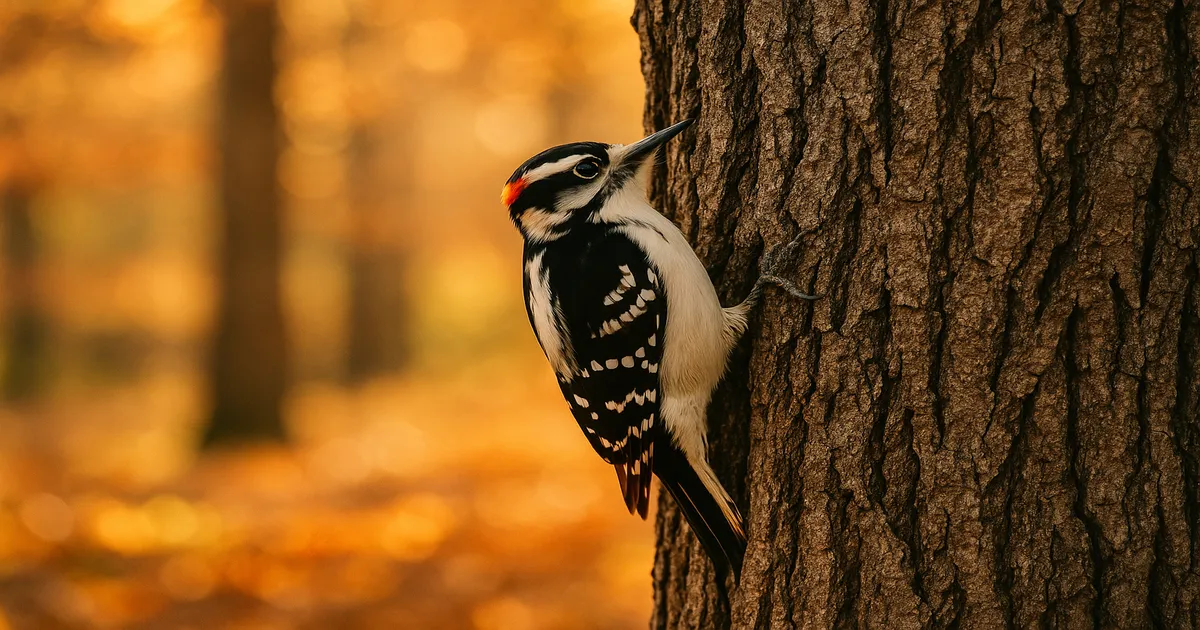
Quick Answer: The Hairy Woodpecker (Leuconotopicus villosus) is a medium-sized black-and-white woodpecker found across most of North America year-round. It’s best identified by its long, chisel-like bill, bold black-and-white head pattern, and clean white outer tail feathers. It’s one of the continent’s most widespread woodpeckers and a regular backyard feeder visitor — though it’s constantly mistaken for the smaller Downy Woodpecker.
If you’ve spotted a boldly patterned black-and-white woodpecker hammering away at a tree in your backyard and wondered what is a Hairy Woodpecker, you’re not alone. It’s one of the most recognizable birds in North American forests, yet it gets misidentified constantly — almost always for its smaller look-alike, the Downy Woodpecker (Dryobates pubescens). Once you know what to look for, you won’t mix them up again.
Hairy Woodpecker Identification: Size, Shape & Field Marks
Size and Overall Build
The Hairy Woodpecker measures about 7.1–10.2 inches (18–26 cm) long, with a wingspan of 13–16 inches (33–41 cm) and a weight of 1.4–3.4 oz (40–95 g). It’s a solid, stocky bird — that heavy-bodied, large-headed silhouette is worth noting even before you pick up your binoculars. (Nikon Monarch M5 8x42)
Key Plumage Field Marks
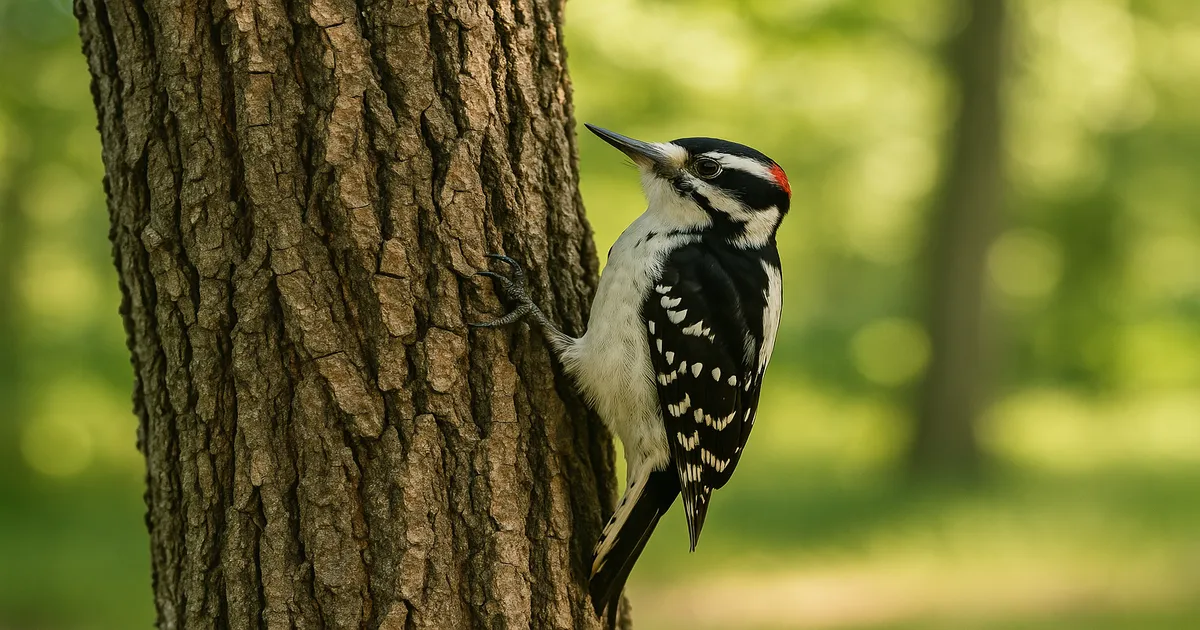
The plumage is crisp and high-contrast: black above, white below, with no yellow, orange, or brown tones anywhere on the body.
- Back: A broad, unbroken white stripe runs straight down the center — visible from a surprising distance
- Wings: Black with neat rows of white spots
- Head: Bold striped pattern — black crown, wide white eyebrow stripe, black eye mask, white cheek, and a black mustache stripe
- Underparts: Clean, unmarked white
- Outer tail feathers: Entirely white with no barring — this matters more than most beginners realize
- Bill: Long, chisel-like, and nearly as long as the head is deep — the single most reliable field mark on the whole bird
Male vs. Female
Males have a small red patch on the back of the crown (the nape); females have an entirely black crown. That’s the only consistent plumage difference. Both sexes share the same bold black-and-white body pattern, same bill length, and same behavior.
Juvenile Plumage
Young birds look similar to adults but aren’t quite as sharp. Juvenile males often show blotchy red or orange-red streaking across the entire crown rather than a neat nape patch. Juvenile females may show a pale yellowish or buff wash on the crown. By late summer or early fall of their first year, most juveniles have molted into adult-like plumage, so the window for seeing them in juvenile dress is short.
What Does a Hairy Woodpecker Sound Like?
The Sharp ‘Peek’ Call
The most common vocalization is a loud, sharp peek — a ringing, slightly metallic note that carries well through the woods. It’s noticeably louder and lower-pitched than the Downy Woodpecker’s call, which sounds flatter and softer. Hear both back-to-back once and you’ll never confuse them again.
Whinny and Rattle Calls
Both species give a descending whinny — a rapid kee-kee-kee-kee that drops in pitch. The Hairy’s version is lower and more emphatic. These calls are used year-round for territory defense and communication, so you’re not limited to hearing them in spring.
Drumming
Hairy Woodpeckers drum fast and loud, seeking out resonant dead wood, hollow branches, or even utility poles to produce sustained rolls that carry long distances. Drumming advertises territory and attracts mates. You’ll also hear soft churring notes between paired birds near an active nest — much quieter and easy to miss.
Hairy Woodpecker vs. Downy Woodpecker: Telling Them Apart
This is the identification challenge that brings most people to this article, and it trips up experienced birders too — especially without a direct size comparison.
Bill Length: The Most Reliable Clue
Look at the bill relative to the head. On a Hairy Woodpecker, the bill is nearly as long as the head is deep — it looks almost spike-like. On a Downy, the bill is roughly half the head depth, stubby and almost cute by comparison. This works even in photos and at moderate distances. Go straight to the bill; don’t let size fool you first.
Outer Tail Feathers: Barred vs. Unbarred
The Hairy’s white outer tail feathers are completely clean — no markings at all. The Downy’s white outer tail feathers carry small black bars or spots. You need a decent view to see this, but it’s a solid secondary mark when the bird cooperates.
Size, Build, and Call
At roughly 9.25 inches (23.5 cm), the Hairy is noticeably larger than the Downy’s 6.75 inches (17 cm) — but without both birds side by side, size alone will mislead you. The Hairy also looks stockier and heavier-headed, and its call is louder, sharper, and lower-pitched.
Quick Comparison Table
| Feature | Hairy Woodpecker | Downy Woodpecker |
|---|---|---|
| Length | ~9.25 in (23.5 cm) | ~6.75 in (17 cm) |
| Bill | Long — nearly equals head depth | Short — roughly half head depth |
| Outer tail feathers | Pure white, unbarred | White with black bars/spots |
| Build | Stocky, large-headed | Smaller, more delicate |
| Call note | Loud, sharp peek | Soft, flat pik |
| Whinny | Lower-pitched, emphatic | Higher-pitched, lighter |
Hairy Woodpecker Habitat and Range
Where They Live
The Hairy Woodpecker is found in every U.S. state except Hawaii, plus Alaska, most of Canada, Mexico, and parts of Central America as far south as Panama. The only gaps are treeless tundra, open grasslands, and heavily developed areas without mature trees.
Preferred Habitats
Mature forest is where this bird thrives — specifically, forest with large-diameter trees and standing dead wood (snags). It’s equally at home in deciduous oak-maple-beech forest, coniferous pine-spruce-fir stands, mixed forest, riparian woodlands, and aspen groves. The common thread is big trees and dead wood. Young, even-aged plantations don’t cut it.
Hairy Woodpeckers adapt well to suburbs and parks as long as mature trees are present. Wooded neighborhoods with old oaks or large maples can support a resident pair. They’re essentially absent from neighborhoods where every dead limb gets removed on sight.
Elevation and Year-Round Residency
You’ll find them from sea level to around 10,000 feet (3,050 m) in the Rockies and Sierra Nevada. Mountain populations may shift to lower elevations in harsh winters, but this is modest altitudinal movement, not true migration. The vast majority are permanent residents wherever they live.
Behavior, Diet & Foraging
What They Eat
Wood-boring beetle larvae are the bread and butter of this species — longhorn beetles, bark beetles, and metallic wood-boring beetles make up the bulk of the diet year-round. Ants are a significant secondary food source, along with termites, caterpillars, and spiders. In fall and winter, the diet shifts to include wild berries (dogwood, serviceberry, Virginia creeper), acorns, tree sap gleaned from Yellow-bellied Sapsucker (Sphyrapicus varius) wells, and cached seeds.
How They Forage
This is where the Hairy’s long bill earns its keep. The bird scales off large flakes of bark to expose larvae, drills deep into wood to extract them, and probes crevices with its long, barbed, sticky tongue. Most foraging happens on snags and large branches — dead or dying wood is prime real estate. They’ll work living trees too, especially stressed or diseased ones.
Social Behavior
Outside of breeding season, Hairy Woodpeckers are largely solitary and territorial. Both sexes defend individual territories year-round through drumming, calling, and direct chasing. They’ll occasionally tag along with mixed-species winter flocks of chickadees and nuthatches, but they’re never fully integrated — more like tolerated neighbors than flock members. At feeders, they reliably displace Downy Woodpeckers and other smaller species without hesitation.
Attracting Hairy Woodpeckers to Your Yard
Best Foods
Suet is king. Plain beef suet, rendered suet cakes, and nut or insect blends all work well. If squirrels are a problem, hot-pepper suet is genuinely effective at deterring them while leaving woodpeckers completely unfazed — birds can’t taste capsaicin. Shelled peanuts are a close second, and peanut butter packed into a log feeder is hard to beat. Black-oil sunflower seeds on a platform feeder round out the options. (Droll Yankees Onyx Seed Tray)
Feeder Styles That Work
Hairy Woodpeckers need something to brace against while feeding. Suet cages with a tail prop — an extended bottom section the bird can lean its tail against — work noticeably better than standard flat cages. Log feeders and platform feeders also suit them well. Tube feeders with small perches are mostly a dead end for this species.
Habitat Tips
If you can safely leave a dead tree or large dead branch standing on your property, do it. Snags are more valuable to Hairy Woodpeckers than any feeder you could put up — they provide foraging habitat and potential nest sites. Native trees like oaks, maples, and birches attract the insects that woodpeckers depend on far more than ornamental species do.
When to Expect Them
Early morning is peak feeder time. Cold-weather months bring the most consistent visits, as natural food becomes harder to find under snow and ice. During mild weather, visits may drop off even if the birds are still around. They also cache food — suet chunks and peanuts tucked into bark crevices — so don’t be surprised if a bird grabs something and immediately flies off to stash it.
Nesting and Breeding
Breeding Season
Breeding activity runs from April through July across most of the range, starting earlier in the South and later at high elevations. Courtship begins in late winter — February or March — with increased drumming from both sexes, mutual chasing, wing-spreading displays, and calling duets.
Nest Cavity Excavation
Both sexes excavate a brand-new cavity each year; they almost never reuse an old one. Excavation takes one to three weeks and produces a hole about 1.5 inches (3.8 cm) in diameter and 8–12 inches (20–30 cm) deep, typically in a dead or dying tree between 5 and 30 feet (1.5–9 m) off the ground. Preferred trees include aspen, birch, maple, and pine. The old cavities don’t go to waste — bluebirds, swallows, wrens, and flying squirrels move in quickly.
Eggs and Fledging
A typical clutch is 3–6 white, unmarked eggs — usually four. Both sexes incubate for about 11–12 days, with the male taking night duty. Nestlings stay in the cavity for roughly 28–30 days before fledging. The family raises a single brood per year, though they’ll attempt a replacement nest if the first fails.
Conservation Status and Threats
Current Status
The Hairy Woodpecker is listed as Least Concern on the IUCN Red List, with an estimated global breeding population of around 9 million individuals. That’s reassuring, but Breeding Bird Survey data shows modest, consistent declines in parts of the eastern United States — worth watching.
Key Threats
The biggest long-term threat is loss of mature forest and snag removal in managed forests. “Clean” forestry that removes all dead wood strips out both the nesting and foraging habitat this species depends on. Beyond that: forest fragmentation, suburban development, window strikes, outdoor cats, pesticide-driven insect declines, and climate-driven shifts in forest composition and insect emergence timing all play a role.
How You Can Help
- Leave dead trees standing on your property where they’re safe to do so
- Apply window collision deterrents — exterior tape, decals, or screens on large windows
- Keep cats indoors
- Report sightings to eBird — citizen science data genuinely drives conservation decisions
- Choose FSC-certified wood products, which come from forests managed with structural complexity — including snags — in mind
Frequently Asked Questions About Hairy Woodpeckers
What is a Hairy Woodpecker, and why is it called that?
The Hairy Woodpecker (Leuconotopicus villosus) is a medium-sized black-and-white woodpecker found across most of North America year-round. The name comes from the long, hair-like white feathers that run down the center of its back — a field mark that’s visible from a good distance.
What’s the difference between a Hairy Woodpecker and a Downy Woodpecker?
The most reliable difference is bill length: the Hairy’s bill is nearly as long as its head is deep, while the Downy’s looks stubby by comparison. The Hairy is also larger (about 9.25 inches vs. 6.75 inches), has completely unbarred white outer tail feathers (the Downy’s have black bars), and gives a louder, sharper peek call. Size alone can mislead you without a direct comparison — always check the bill first.
How do I attract Hairy Woodpeckers to my backyard?
Suet is your best bet — nut-blend or hot-pepper suet cakes in a cage feeder with a tail prop work especially well. Shelled peanuts, peanut butter log feeders, and black-oil sunflower seeds on a platform feeder are also effective. Leaving a dead tree or large snag standing in your yard will do more than any feeder to make your property genuinely attractive to this species.
Do Hairy Woodpeckers migrate?
No. The vast majority are permanent, year-round residents throughout their range. Some mountain populations shift to lower elevations in severe winters, but this is limited altitudinal movement rather than true migration.
How do you tell a male Hairy Woodpecker from a female?
Males have a small red patch on the back of the crown (nape); females have an entirely black crown. That’s the only consistent plumage difference — both sexes share the same bold black-and-white body pattern, bill length, and size.