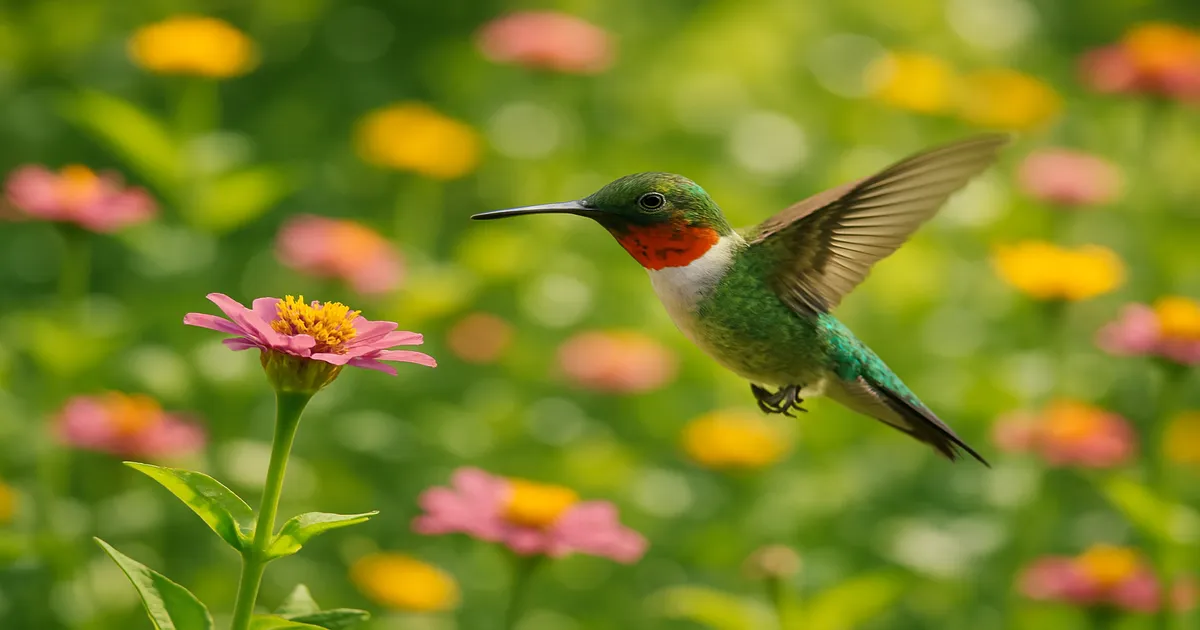
Quick Answer: Your location is the single biggest clue — if you’re east of the Mississippi, you’re almost certainly looking at a Ruby-throated Hummingbird (Archilochus colubris). In the West, check the throat color (gorget), then overall size and back color to narrow down nine or more possible species. The guide below walks you through the whole process, species by species.
If you’ve ever grabbed your phone and typed “can you help me identify this hummingbird,” you’re in good company. Hummingbirds move fast, the light is usually wrong, and the throat patch that should clinch the ID looks jet-black half the time. This guide will get you to a confident identification — or at least a short list of candidates — without needing a biology degree. A decent pair of 8×42 binoculars helps enormously, but even naked-eye observation works if you know what to look for.
Can You Help Me Identify This Hummingbird? Start Here
Start With Your Location
Geography does most of the heavy lifting. East of the Mississippi? Ruby-throated is the only regularly breeding hummingbird, accounting for the vast majority of sightings from southern Canada to the Gulf Coast. In the West, you’ve got more options — Arizona alone can host eight or more species in a single season.
Look at the Throat (Gorget) Color First
The gorget is the iridescent throat patch on adult males, and it’s your fastest field mark after location. The catch: iridescent feathers are structural, not pigmented. A ruby-red gorget can look completely black when the bird isn’t facing the light. Wait for the bird to turn — you’ll often see a flash of color that confirms everything.
Note the Overall Size, Back Color, and Tail Shape
Once you’ve got gorget color, check the back (green vs. rufous/orange is critical for separating Rufous from Allen’s) and tail shape (forked in male Ruby-throated, rounded in females). Size helps too, though it’s hard to judge without a reference object nearby.
Here’s a fast-reference table for the ten species you’re most likely to encounter:
| Species | Primary Range | Adult Male Gorget |
|---|---|---|
| Ruby-throated Hummingbird | East | Ruby-red |
| Anna’s Hummingbird | West/Pacific | Rose-red (full head) |
| Black-chinned Hummingbird | West | Black with violet lower band |
| Rufous Hummingbird | West/migrant | Blazing orange-red |
| Allen’s Hummingbird | CA coast | Orange-red (green back) |
| Broad-tailed Hummingbird | Mountain West | Rose-red |
| Calliope Hummingbird | Mountain West | Magenta rays on white |
| Broad-billed Hummingbird | SW borderlands | Blue-green body, red bill |
| Buff-bellied Hummingbird | South TX | Green gorget, red bill |
| Costa’s Hummingbird | Desert SW | Purple, flared sides |
The 10 Most Common North American Hummingbirds
Eastern Species: Why Ruby-throated Dominates
The East is refreshingly simple. The Ruby-throated Hummingbird is the only species that breeds regularly east of the Great Plains, so unless you’re in south Texas or dealing with a genuine vagrant, it’s your bird. Females and immatures are trickier — more on those below.
Western Species: A More Crowded Field
The West rewards patience. States like Arizona, Colorado, and California can have overlapping populations of Anna’s, Black-chinned, Broad-tailed, Rufous, Allen’s, Calliope, Costa’s, Broad-billed, and Buff-bellied — sometimes at the same feeder. Females and immatures of closely related species (especially the Selasphorus group) can be nearly impossible to separate without tail measurements in hand. If you can only get to “Selasphorus sp.” on a female, you’re in good company — experienced birders land there regularly.
Identifying the Ruby-throated Hummingbird
About 3.75 inches (9.5 cm) long and weighing roughly the same as a U.S. penny, the Ruby-throated Hummingbird (Archilochus colubris) is compact and torpedo-shaped with an almost impossibly thin bill.
Adult Male Field Marks
The gorget is iridescent ruby-red — but only when the light hits it right. In shadow or from the side, it reads as flat black. The back is metallic emerald green, the breast is white with grayish-green flanks, and the tail is distinctly forked and dark.
Adult Female Field Marks
Female Ruby-throateds are green above and white below, with a buffy-green wash on the flanks. Two marks worth memorizing:
- White tips on the outer three tail feathers, each with a dark subterminal band — visible when the tail is spread
- A white post-ocular spot (behind the eye)
Some females show a few scattered red gorget feathers. That’s normal variation, not a sign you’re looking at a male.
Juveniles and Calls
Fresh juveniles of both sexes resemble adult females when they leave the nest. Young males begin showing patchy red gorget feathers by late summer of their first year. The most common call is a rapid, high-pitched chee-dit or chattering tik-tik-tik, often heard before the bird is seen.
One tip worth passing along: in early spring, follow Yellow-bellied Sapsuckers (Sphyrapicus varius). Ruby-throateds track sapsucker activity and drink from the sap wells those woodpeckers drill — a reliable way to find early migrants before the flowers are up.
Can You Help Me Identify This Hummingbird? Western Species Guide
Anna’s Hummingbird: The Only Fully Red-Headed Species
The male Anna’s Hummingbird (Calypte anna) is unmistakable: both the crown and gorget are iridescent rose-red to magenta, making it the only North American hummingbird with a fully red head. At about 3.9 inches (10 cm), it’s slightly stockier than a Ruby-throated.
Female Anna’s have a gray-white throat with a central patch of rose-red spots — that central red spot separates them from most other western female hummingbirds. Anna’s also has the most elaborate song of any North American hummingbird: a scratchy, complex series of buzzes and chips that males deliver year-round. During courtship, males perform a dramatic J-shaped dive, finishing with a loud explosive pop produced by the tail feathers at the bottom of the arc. If you’ve heard a sharp crack near a hummingbird and wondered what happened, that’s it.
Black-chinned Hummingbird: The Western Ruby-throated Look-Alike
Structurally, the Black-chinned Hummingbird (Archilochus alexandri) is nearly identical to the Ruby-throated — they’re sister species. The male’s gorget is black with a violet-purple lower band that can also look black in poor light. Range separates them cleanly, but if you’re in a border zone, watch the tail: Black-chinned males pump it continuously while hovering, almost mechanically. Ruby-throateds don’t do this, and once you’ve seen it, you won’t forget it.
Rufous vs. Allen’s: The Trickiest Pair
Male Rufous Hummingbirds (Selasphorus rufus) are easy — blazing orange-rufous back, flanks, and tail, with a brilliant orange-red gorget. Note that some male Rufous show a small patch of green on the upper back, which can cause confusion; the key is that the back is predominantly rufous. Male Allen’s Hummingbirds (Selasphorus sasin) look nearly identical, but the back is solidly green. That’s the reliable mark for adult males.
Females and immatures? Essentially inseparable in the field without measuring tail feathers. Use range and date instead — Allen’s breeds along a narrow coastal strip of California and extreme southwestern Oregon, while Rufous breeds further north (from northern California through the Pacific Northwest into Alaska) and passes through the interior on its southbound migration in late summer. Coastal California in spring: lean Allen’s. Colorado in August: lean Rufous.
Broad-tailed, Calliope, Costa’s, Broad-billed, and Buff-bellied
- Broad-tailed Hummingbird (Selasphorus platycercus): Rose-red gorget on males; breeds in the Rocky Mountain West, typically above 5,000 feet (1,500 m). The male’s wings produce a loud, metallic trill in flight — one of the most useful audio field marks of any hummingbird. Hear it and you don’t even need to see the bird.
- Calliope Hummingbird (Selasphorus calliope): The smallest bird that breeds in North America at just 3.25 inches (8.3 cm) and 0.07–0.1 oz (2–3 g). The male’s gorget is a starburst of magenta rays on white — no other species has this pattern. When perched, the tail falls short of the wingtips, a useful size clue.
- Costa’s Hummingbird (Calypte costae): The purple crown and long gorget feathers that flare out to the sides like a handlebar mustache make the male unmistakable. Breeds in the Sonoran and Mojave Deserts, with nesting beginning as early as February.
- Broad-billed Hummingbird (Cynanthus latirostris): The bright red bill with a black tip is the fastest field mark. Males are blue-green overall. Found mainly in southeastern Arizona canyon country.
- Buff-bellied Hummingbird (Amazilia yucatanensis): Buffy/cinnamon belly, green gorget, and a red bill. One of the larger U.S. hummingbirds at 4–4.5 inches (10–11.5 cm). Almost entirely restricted to the lower Rio Grande Valley of Texas, with some post-breeding dispersal along the Gulf Coast into Louisiana and beyond.
Range, Behavior, and Getting a Better Look
Where and When to Find Each Species
Ruby-throateds breed across the entire eastern half of North America, wintering in southern Mexico and Central America. Look for them wherever tubular red or orange flowers grow — trumpet vine, cardinal flower, and jewelweed are reliable attractants. Anna’s is the Pacific Coast’s year-round resident, now expanding northward into Oregon and Washington in winter thanks largely to feeders and ornamental plantings. The Mountain West hosts Broad-tailed and Calliope during breeding season, with Black-chinned in lower-elevation riparian corridors. Rufous follows a clockwise migration loop: north along the Pacific Coast in spring, south through the Rocky Mountain interior in late summer — which is why it turns up at Colorado feeders in July and August.
Behavior That Helps With ID
Black-chinned’s continuous tail pumping while hovering is the standout behavioral field mark. Anna’s tends to perch conspicuously and sing; Ruby-throated is more secretive away from feeders. Rufous is legendarily aggressive — I’ve watched a single male hold a feeder against a dozen Anna’s for an entire afternoon. If a small, ferociously territorial orange hummingbird is running everything else off your feeder in late summer, that behavioral profile alone points strongly to Rufous.
Females of most species are trap-liners, following a regular circuit of flowers and moving on before nectar is depleted. Males are more likely to defend a rich patch aggressively. Hummingbirds also glean insects and spiders from foliage and webs — protein is essential, especially during nesting — and will hawk small flying insects in midair.
Getting a Better Look and Photo
Place your feeder at eye level, within 10–15 feet of a natural perch — a bare branch or a dedicated perch stick works well. Hummingbirds spend a surprising amount of time sitting still and guarding territory, and a perched bird is infinitely easier to study than a hovering one. Multiple feeders spread around the yard reduce single-male dominance and give you better looks at more individuals. A quality hummingbird field guide kept near the window speeds up identification considerably.
Early morning and late afternoon are peak activity windows. Hummingbirds need to top off energy reserves after the overnight fast and again before roosting. Midday activity drops off noticeably in hot weather.
For photos, use 1/1000s or faster to freeze wing motion, shoot in burst mode, and keep continuous autofocus on. With a phone, video beats stills — record 15–20 seconds and step through it frame by frame. You’ll catch the gorget color at multiple angles that a single still would miss entirely.
How to Post for Community ID Help
When you post to iNaturalist, eBird, or a Facebook birding group, include: location (state and county), date, habitat, size relative to something familiar, gorget color at multiple angles, tail shape and any white tips, back color, sounds heard, and behavior. The more of these you can provide, the faster someone can confirm your ID — or tell you you’ve got something genuinely unusual.
Frequently Asked Questions About Hummingbird Identification
Why does my hummingbird’s throat look black instead of red?
Iridescent gorget feathers reflect color only at specific angles relative to the light source. When a Ruby-throated or Anna’s male faces away from the sun, the throat appears flat black. Shift your position or wait for the bird to turn toward the light, and the color flashes immediately. This is the single most common source of misidentification among beginners.
How do I tell a female Ruby-throated from other female hummingbirds?
In the East, range alone solves most cases. The most reliable field marks are the white-tipped outer tail feathers with a dark subterminal band and the white post-ocular spot. In the West, separating female hummingbirds requires careful attention to gorget pattern, tail color, and flank wash — and some individuals, especially female Selasphorus, simply can’t be identified to species in the field.
What is the smallest hummingbird in North America?
The Calliope Hummingbird (Selasphorus calliope) at about 3.25 inches (8.3 cm) and 0.07–0.1 oz (2–3 g). It’s also the smallest bird of any kind that breeds in North America. When perched, its tail doesn’t extend past the wingtips. The male’s starburst magenta gorget is unique, making adult males straightforward to identify.
Can Rufous Hummingbirds really show up on the East Coast?
Yes, and it’s less rare than it used to be. A small but growing number of Rufous Hummingbirds now winter along the Gulf Coast from Texas to Florida, and genuine vagrants turn up along the Atlantic seaboard most years. If you’re in the Southeast and have an orange hummingbird at your feeder in December, report it to your local rare bird alert — it’s worth documenting, and banders in your area may want to catch and measure it.
What’s the best way to attract hummingbirds for easier identification?
A clean feeder with fresh nectar (four parts water to one part plain white sugar, no red dye needed) is the foundation. Plant native tubular flowers — salvia, trumpet honeysuckle, and bee balm are reliable across most of North America. Feeders with built-in perch rings give birds a place to rest, which makes identification far easier than trying to study a hovering bird.