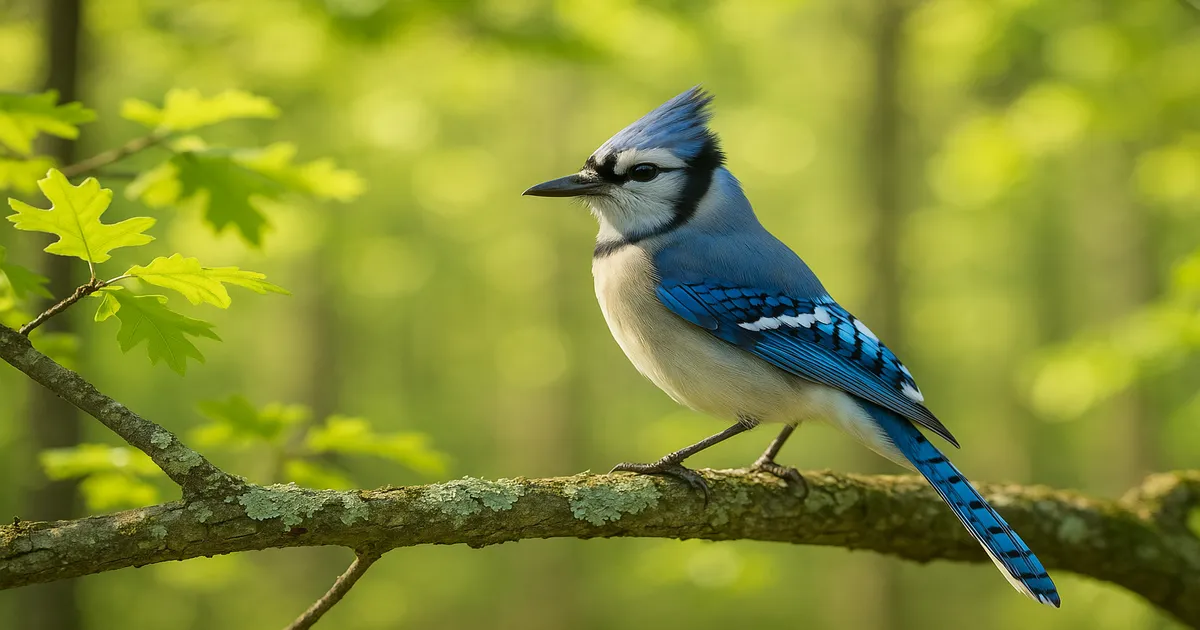
Quick Answer: A Blue Jay (Cyanocitta cristata) is identified by its vivid blue upperparts, white underparts, bold black collar, prominent pointed blue crest, and white spots on its wings and tail. It’s one of the most recognizable birds in eastern North America — once you know what to look for, you’ll never misidentify one again.
Blue Jays are loud, bold, and brilliantly colored, yet I’m still surprised how often people aren’t sure how to identify a Blue Jay with confidence — especially in flight, or when they catch a glimpse of a dull-looking juvenile in summer. This guide walks through every field mark, sound, and behavioral cue you need to nail the ID every time.
How to Identify a Blue Jay: Five Field Marks That Clinch the ID
You don’t need all five to make the call, but together they’re foolproof:
- Vivid blue upperparts — crown, back, wings, and tail are a rich, brilliant blue
- White underparts — clean white to pale gray-white on the face, throat, and belly
- Bold black bridle collar — a U-shaped black band wraps from the nape around the neck and across the upper chest
- Prominent pointed blue crest — actively raised and lowered; no other common backyard bird has this combination
- White spots on wings and tail corners — flash conspicuously in flight
Blue Jay Fast Facts
| Feature | Measurement |
|---|---|
| Length | 9.8–11.8 inches (25–30 cm) |
| Wingspan | 13.4–16.9 inches (34–43 cm) |
| Weight | 2.5–3.5 oz (70–100 g) |
| Range | Eastern North America |
| IUCN Status | Least Concern |
Blue Jay Plumage: A Detailed Look at Every Field Mark
Crown, Crest, and Upperparts
The crest is the first thing most people notice — a tall, pointed spike of blue feathers the bird controls with surprising expressiveness. Fully erect when the jay is alert or agitated, slicked flat when it’s calmly feeding or being submissive. The back and crown are a rich, saturated blue that looks almost electric in good light.
That blue isn’t pigment. It’s structural color produced by light scattering through modified feather barbs. Wet or backlit feathers can look much duller, which throws off beginners who expect a neon bird and get something closer to gray.
The Black Bridle Collar
This is the field mark I always point to first. The black bridle forms a complete U-shape — running from the nape, down both sides of the neck, and connecting across the upper breast like a necklace. It frames the white face cleanly, creating a high-contrast pattern visible from a surprising distance. No other blue bird in North America wears this collar.
Wings: Blue, Black Barring, and White Spots
The wings are blue with crisp black barring across the flight feathers and secondaries. The white spots — one row on the wing tips and another on the secondary coverts — are particularly useful for in-flight ID. When a Blue Jay banks or spreads its wings, those white patches catch the light and flash clearly against the blue.
Tail: Barring and White Corner Flashes
The tail is long and graduated, blue with fine black barring, and tipped with white on the outer feathers. Those white corners are especially noticeable when the bird fans its tail on landing — a quick, reliable confirmation mark even when the rest of the bird is partly hidden by foliage.
Underparts, Bill, and Legs
The underparts are plain white to pale gray-white — clean and unstreaked, which contrasts sharply with the bold upperparts. The bill is stout, straight, and black, built for cracking acorns rather than picking insects. Legs and feet are also black. The bill’s heaviness gives the bird a chunky-headed look that’s part of its overall shape and worth noting when you’re trying to ID a bird at distance.
Size, Shape, and Flight Silhouette
How Big Is a Blue Jay?
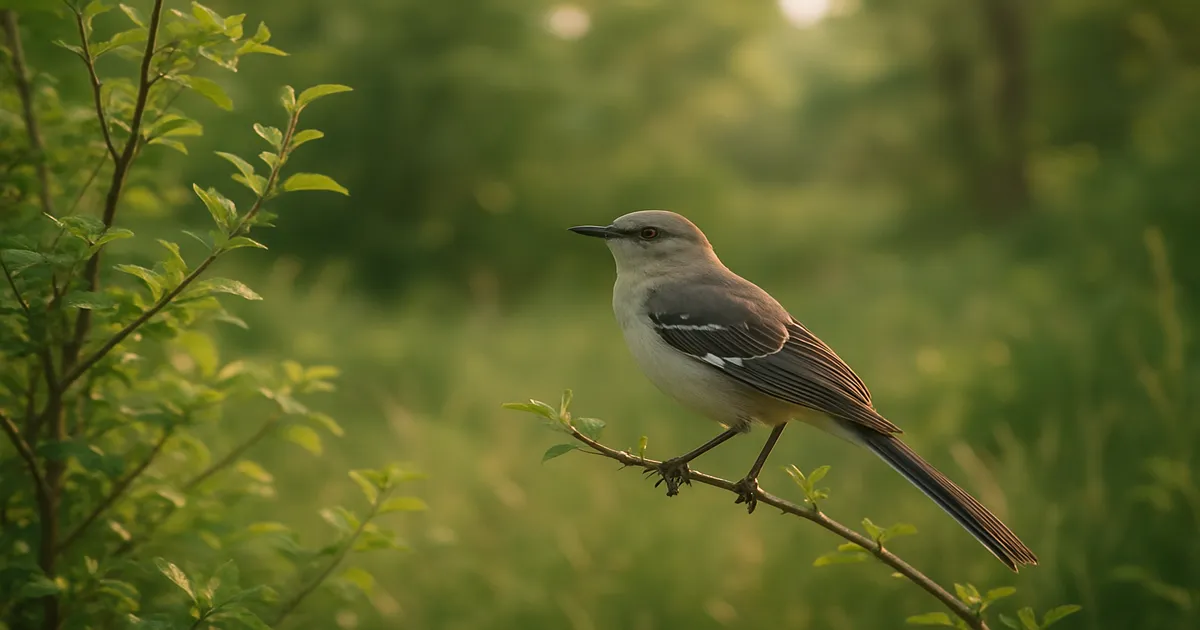
Blue Jays are noticeably larger than most feeder birds. The most useful comparison: they’re roughly the same size as an American Robin (Turdus migratorius), or slightly bigger. They dwarf a House Sparrow (Passer domesticus) — nearly twice the length — and run larger than a Northern Mockingbird (Mimus polyglottos), though the two can look similar at a quick glance.
The body is broad-chested and robust, with a large crested head and a long tail that gives the bird a top-heavy, front-loaded silhouette. A good pair of binoculars makes all the difference when you’re sorting out size and shape at the feeder. (Nikon Monarch M5 8x42)
Recognizing a Blue Jay in Flight
In flight, look for broad rounded wings, a long tail, and steady, slightly undulating wingbeats — not as deeply bounding as a woodpecker, but not the flat direct flight of a starling either. The crested head profile is distinctive even at distance or in poor light, especially from a side view. The white wing spots and tail corners flash with every wingbeat. Once you’ve seen a Blue Jay fly overhead, the silhouette sticks with you.
Male, Female, and Juvenile Blue Jays: Can You Tell Them Apart?
Are Male and Female Blue Jays Identical?
Essentially, yes. Blue Jays are sexually monomorphic — males and females share the same plumage, and there’s no reliable way to separate them in the field by looks alone. Males average slightly larger, but the overlap is too great to use size as a field mark. The most reliable behavioral cue is courtship feeding: if one bird is feeding another, the one receiving food is almost certainly the female.
What Does a Juvenile Blue Jay Look Like?
Juveniles fledge in late spring and early summer with a noticeably shorter crest, slightly duller brownish-blue tones on the back, and less crisp black markings. By early fall, they look very close to adults. If you’re watching a family group in June or July and one bird looks washed-out with a stubby crest, that’s your juvenile.
Molt and Seasonal Appearance
Blue Jays undergo one complete molt per year, running from July through September after the breeding season. Adults can look slightly ragged or dull during this period — don’t let that throw you off. There’s no separate breeding plumage, so a Blue Jay in December looks essentially the same as one in April.
How to Identify a Blue Jay by Sound
Calls, Bell Notes, and Hawk Mimicry
Sound is often how you find a Blue Jay before you see it. The signature call is a loud, harsh, descending JAAAY or JEEAH — repeated two to five times and audible from a long distance. Brash and unmistakable. But the repertoire goes well beyond that:
- Bell call: A liquid, musical tull-ull or toodle-oodle — surprisingly mellow, often exchanged between mated pairs
- Whisper song: A quiet, rambling mix of clicks and liquid notes at close range; rarely heard
- Pump-handle call: A rhythmic, creaking queedle-queedle often heard from migrating flocks
- Juvenile begging call: A persistent nasal wheeee or kweee — if you hear this in summer, look for a fledgling trailing a parent
Blue Jays are also superb mimics of Red-tailed Hawks (Buteo jamaicensis) and Red-shouldered Hawks (Buteo lineatus), and the imitations are accurate enough to scatter other birds from a feeder — which may be exactly the point. My rule of thumb: if you hear a hawk call from a suburban yard with no large trees overhead, look hard for a Blue Jay before you log the raptor.
When a jay spots a predator — cat, owl, Cooper’s Hawk — it switches to a rapid, harsh chek-chek-chek or rattling scold. I’ve learned to trust Blue Jay alarm calls. If one is going ballistic in a tree, there’s usually something worth looking at nearby.
Where to Find Blue Jays
Blue Jays are year-round residents across most of eastern North America, from southern Canada south to the Gulf Coast and west to the eastern Great Plains. They’ve been expanding westward for decades and now breed regularly in Wyoming, Colorado, Idaho, and parts of Oregon — likely following suburban oak plantings and feeders into new territory. They’re absent from the Pacific Coast (except as rare vagrants), the Great Basin, and the desert Southwest.
The Blue Jay’s distribution tracks oak trees (Quercus spp.) more closely than almost any other factor. Where oaks grow, Blue Jays are nearly always present. They also thrive in suburban neighborhoods with mature deciduous trees, city parks, forest edges, and riparian corridors, but avoid dense unbroken conifer forest and open grasslands.
Migration adds a wrinkle. Some individuals stay put year-round; others migrate, particularly younger birds — and the same individual may migrate one year and stay the next. Fall migration peaks from late September through early November and is genuinely visible: hawk-watch sites like Cape May Point (NJ), Hawk Mountain Sanctuary (PA), and Braddock Bay (NY) record thousands of Blue Jays moving through each autumn.
Blue Jay Behavior Worth Watching
Acorn Caching
A single Blue Jay can carry up to five acorns at once in its expandable gular pouch, and one bird may cache 3,000–5,000 acorns in a single autumn. Most are never retrieved. Blue Jays are widely credited with accelerating the post-glacial northward spread of oak forests across North America — a remarkable ecological legacy for a backyard bird.
Crest Position as a Mood Indicator
The crest is a real-time mood display you can read from a distance. Fully raised means alert, agitated, or dominant. Flat against the head means calm or submissive. A half-raised crest usually means curious but not alarmed. Once you start watching for it, it becomes one of the more satisfying things to observe at a feeder.
Intelligence and Social Bonds
Blue Jays are monogamous and pairs often stay together year-round, potentially for life. As corvids, they demonstrate strong problem-solving ability, excellent spatial memory for cache locations, and the capacity to recognize individual humans. Resident Blue Jays absolutely learn which people refill the feeders — I’ve had one follow me to the garage and back.
Attracting Blue Jays to Your Feeder
Whole peanuts in the shell are your best tool. They’re irresistible, and watching a jay stuff three into its throat pouch before flying off to cache them is genuinely entertaining. Other reliable options:
- Shelled peanuts — nearly as attractive as whole ones
- Black-oil sunflower seeds — a staple for almost every feeder bird
- Dried corn — whole cobs or cracked corn scattered on the ground
- Suet — especially useful in winter
Platform and tray feeders are the right call. Blue Jays want an open landing area where they can survey their surroundings and carry off multiple items. Tube feeders are usually too small — jays will cling awkwardly or skip them entirely. One practical tip: placing a dedicated peanut tray away from your main seed feeder reduces the time Blue Jays spend displacing smaller birds. Everyone gets fed with less drama.
Blue Jay Conservation
The global Blue Jay population is estimated at around 17 million individuals, and the species is listed as Least Concern by the IUCN. That said, Breeding Bird Survey data shows a moderate long-term decline of roughly 0.6–1.0% per year since the 1970s, particularly in the Northeast and Midwest. Primary threats include oak forest loss, window strikes, outdoor cats, and West Nile Virus — the 1999–2002 outbreak caused substantial corvid mortality, and some regional populations haven’t fully recovered.
The most effective things you can do are also the most straightforward. Plant native oaks if you have the space. Apply window collision deterrents to large glass surfaces — even simple decals make a real difference. (WindowAlert UV Liquid) Keep cats indoors. And submit your sightings to eBird; population monitoring depends on data from observers like you.
Frequently Asked Questions About Blue Jay Identification
What bird is most commonly mistaken for a Blue Jay?
The most frequent source of confusion is the Steller’s Jay (Cyanocitta stelleri), found in western North America. It also has a crest, but sports a dark blackish-brown head and no white markings anywhere. In the East, the Indigo Bunting (Passerina cyanea) occasionally causes confusion, but it’s much smaller, lacks a crest, and has no white on the wings or tail.
How can you tell a male Blue Jay from a female?
You can’t, reliably — not by plumage. Males and females look essentially identical in the field. The best behavioral cue is courtship feeding: during breeding season, the male feeds the female, so if one bird is accepting food from another, she’s almost certainly the female. Definitive sexing requires in-hand measurements.
Why do Blue Jays make a hawk sound?
Blue Jays mimic Red-tailed and Red-shouldered Hawks with remarkable accuracy — likely as an alarm signal, and possibly to scatter competing birds from a food source. The mimicry is precise enough to fool experienced birders. If you hear a hawk call from a suburban yard, check for a Blue Jay before logging the raptor.
What does a Blue Jay’s crest position mean?
A fully raised crest signals alert, agitated, or dominant. A flattened crest means calm or submissive — often seen when a jay is quietly feeding or deferring to a dominant bird. A half-raised crest typically indicates curiosity. It’s one of the clearest real-time behavioral signals of any backyard bird.
Do Blue Jays migrate?
Some do, some don’t — and the same individual may migrate one year and stay put the next. Younger birds are more likely to move. Fall migration peaks from late September through early November and is visible at hawk-watch sites across the Northeast, where thousands of jays can pass through in a single day.