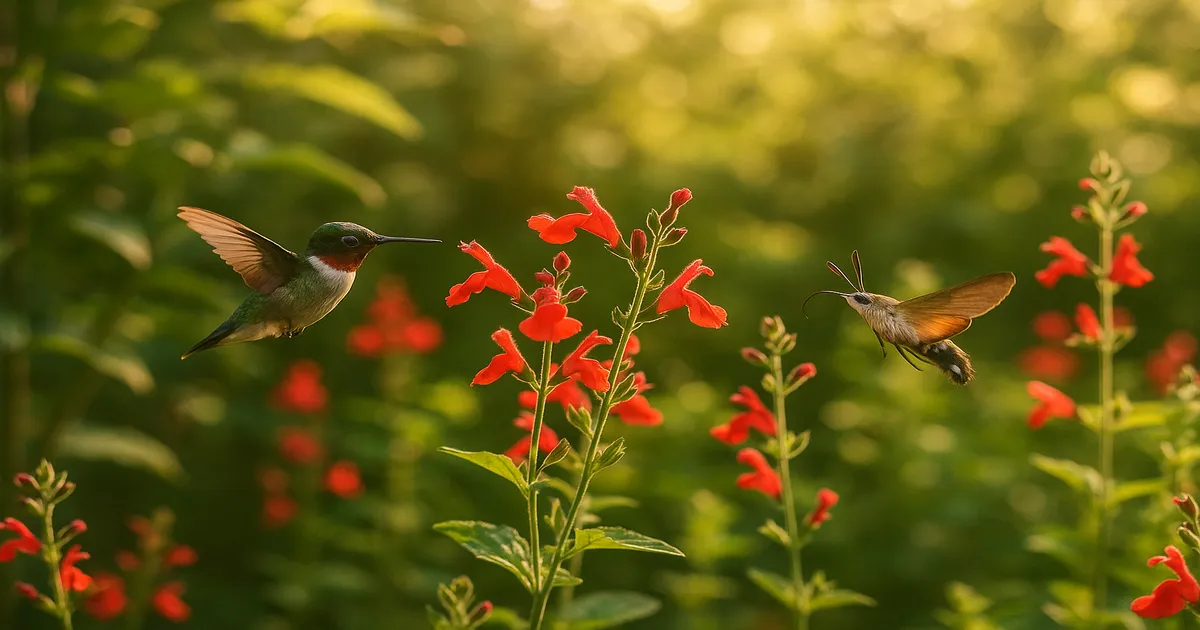
Quick Answer: Check for antennae first — if you see them, it’s a moth. In eastern North America, the Ruby-throated Hummingbird (Archilochus colubris) is your benchmark bird, while the Hummingbird Clearwing (Hemaris thysbe) is the moth most likely causing your backyard confusion. The true Hummingbird Hawk-Moth (Macroglossum stellatarum) is a European species you almost certainly won’t encounter in North America.
Few moments in the garden stop you cold quite like a hummingbird vs hummingbird hawk-moth situation — that tiny hovering creature working the phlox, wings a blur, and you genuinely cannot tell what you’re looking at. It happens to experienced birders too. The convergent evolution here is remarkable: two completely unrelated lineages arrived at nearly the same solution for extracting nectar in daylight. Once you know what to look for, though, the confusion dissolves in seconds.
Hummingbird vs Hummingbird Hawk-Moth: The Fastest Field Marks
You don’t need to study every feather or wing scale. Three things will settle it almost instantly:
- Antennae — Look at the head. Hummingbirds don’t have them. Moths do, and clearwing moths have clubbed or tapered antennae that are visible even in flight if you focus on the right spot.
- Sound — Hummingbirds chitter and squeak constantly. A rapid, high-pitched series of calls alongside the wing hum means bird. Moths produce only the hum.
- Size — Hawk-moths are noticeably smaller than even the smallest hummingbird. If it looks almost too small to be a bird, trust that instinct.
If the animal perches on a thin branch between flower visits, it’s definitely a hummingbird. Clearwing moths almost never do that.
A Note on North American Species: It’s Probably Not the Hummingbird Hawk-Moth
Most online articles bury this: the true Hummingbird Hawk-Moth (Macroglossum stellatarum) is a European and Asian species. It’s a rare vagrant in North America — a handful of records from eastern Canada and the northeastern U.S., nothing more. If you’re in a North American garden watching something hover at your bee balm, the insect is almost certainly a native clearwing moth: either the Hummingbird Clearwing (Hemaris thysbe) or the Snowberry Clearwing (Hemaris diffinis). The comparison table below covers all four side by side.
What to Look For: Key ID Criteria
Body Size and Shape
Ruby-throated Hummingbirds run about 3.75 inches (9.5 cm) long with a 4.25-inch (10.8 cm) wingspan. Clearwing moths top out around 2.25 inches (5.7 cm) in wingspan — noticeably smaller. Distance distorts everything, so size alone won’t always clinch it, but a hovering visitor that seems almost insect-sized probably is one.
Shape matters too. Hummingbirds have a torpedo body, a long protruding bill, and a distinct tail. Moths have a stocky, furry thorax, a tapered abdomen, and no bill — though the uncoiled proboscis mimics one convincingly at range.
Bill vs. Proboscis
A hummingbird’s bill is rigid, straight, and needle-like. It doesn’t flex or retract. A moth’s proboscis is a flexible, coiled tube that unrolls to reach nectar and coils back up when not in use. In a photo you can often see the curl at the tip. In real time the difference is subtle, but if you watch long enough, the proboscis movement gives it away.
Antennae and Eyes
This is the single fastest field mark, full stop. No hummingbird has antennae. Every moth does. Clearwing moths have prominent, clubbed antennae that angle forward — visible even in flight if you’re within ten feet and know to look. Compound insect eyes are also large and bulging compared to the small, round eyes of a hummingbird. In good light, eye shape alone can settle the ID. A pair of close-focus binoculars makes this trivially easy from a comfortable distance. (Vortex Optics Diamondback HD 8x42)
Tail Shape and Texture
A male Ruby-throated Hummingbird has a clean forked tail made of actual feathers. Females show a rounded tail with white tips on the outer feathers. Clearwing moths have a fan-shaped tuft of hairs at the abdomen tip — it spreads during hovering and looks nothing like a feathered tail up close, though from a distance the fan shape is surprisingly convincing.
Sound: Calls vs. Hum Only
I’ve identified hummingbirds by ear before I even saw them. That rapid, chittering call is unmistakable once you know it, and Ruby-throated Hummingbirds are vocal — they announce themselves. Hawk-moths produce only the wing hum. If your hovering visitor is completely silent except for the hum, lean toward moth.
Perching Behaviour
Underrated as a field mark. Hummingbirds perch constantly — on thin branches, feeder perches, wire, anywhere. They sit between feeding bouts, preen, and survey their territory. Clearwing moths essentially never perch while foraging; they move flower to flower in continuous hovering flight. Watch for 60 seconds. If it never lands, that’s a meaningful data point.
Hummingbird vs Hawk-Moth: At-a-Glance Comparison
| Feature | Ruby-throated Hummingbird | Hummingbird Hawk-Moth (M. stellatarum) | Hummingbird Clearwing (H. thysbe) | Snowberry Clearwing (H. diffinis) |
|---|---|---|---|---|
| Body length | 3.75 in (9.5 cm) | 1.6–1.8 in (4–4.5 cm) | ~1.5 in (3.8 cm) | ~1.5 in (3.8 cm) |
| Wingspan | 4.25 in (10.8 cm) | 1.6–1.8 in (4–4.5 cm) | 1.5–2.25 in (3.8–5.7 cm) | 1.5–2.25 in (3.8–5.7 cm) |
| Bill/Proboscis | Rigid needle bill | Coiled proboscis | Coiled proboscis | Coiled proboscis |
| Antennae | None | Prominent, tapered | Prominent, clubbed | Prominent, clubbed |
| Tail | Forked/rounded feathers | Black-and-white hair tuft | Hair tuft | Hair tuft |
| Wing appearance | Feathered; blur in flight | Orange-yellow hindwings; blur | Clear with reddish-brown borders | Clear with dark borders |
| Body texture | Feathered | Furry thorax, olive-brown | Olive-green/burgundy, furry | Yellow-and-black banded, furry |
| Sounds | Chittering calls + wing hum | Wing hum only | Wing hum only | Wing hum only |
| Perching habit | Perches frequently | Rarely perches | Rarely perches | Rarely perches |
| North American range | Eastern North America | Rare vagrant (NE U.S./Canada) | Eastern North America | Most of North America |
| Active season | Late March–October | Summer (if vagrant) | May–September | Late April–early fall |
| Best for | Eastern NA benchmark | European/UK travel | Eastern NA moth ID | Western/central NA moth ID |
Ruby-throated Hummingbird (Archilochus colubris)
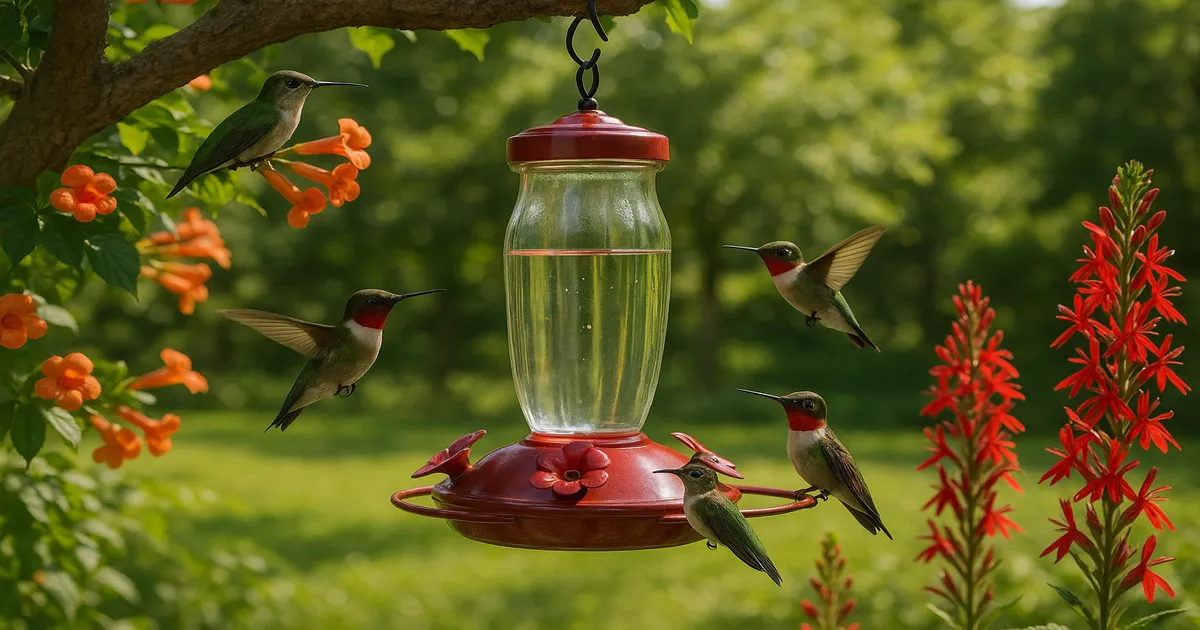
The Ruby-throated Hummingbird is the benchmark for this entire comparison — the only hummingbird that regularly breeds east of the Mississippi, and the bird most commonly confused with clearwing moths across eastern North America. Males are stunning in good light: iridescent emerald-green back, a gorget that blazes ruby-red when the angle is right, and a clean forked tail. Females are subtler — green above, white below, with a rounded tail showing white tips on the outer three feathers — but that long needle bill and hovering flight still set them apart from any insect.
Ruby-throateds arrive on their breeding grounds from late March in the South to mid-May in Canada, following the bloom of early-season flowers northward. They depart southward from August through October, with adult males leaving first. They winter in Mexico and Central America, occasionally lingering in the Gulf Coast states.
Key specs:
- Body: 3.75 in (9.5 cm); wingspan: 4.25 in (10.8 cm); weight: 0.1–0.2 oz (2.8–5.7 g)
- Wing beats: approximately 53 per second during normal flight (range 40–80 reported in display)
- Breeding range: Eastern North America from the Gulf Coast north to southern Canada
- Winters: Southern Mexico through Panama; small numbers in Florida and Gulf Coast states
Pros
- The easiest hummingbird to find east of the Great Plains — plant the right flowers and they’ll come
- Chittering calls carry 30+ feet; you’ll often hear one before you see it
- Perches frequently, allowing extended close observation
- Visits feeders reliably, making repeated study easy
Cons
- The ruby gorget appears flat black in shade or at the wrong angle, causing confusion even among experienced observers
- Females and juveniles lack the red throat entirely and can puzzle beginners expecting the signature color
Best for: Eastern North American observers who want the definitive reference point for this comparison. If your hovering visitor perches and chatters, it’s almost certainly this bird.
Hummingbird Hawk-Moth (Macroglossum stellatarum)
This is the original insect impersonator — a European and Asian species that independently evolved hovering flight, a long feeding appendage, and daytime nectar-foraging to exploit the same resource niche as hummingbirds. It’s genuinely extraordinary to watch: orange-yellow hindwings flashing in flight, a fan-shaped black-and-white tail tuft, and a furry olive-brown thorax. Wing beats clock at 70–80 per second, producing a hum nearly indistinguishable from a small bird’s.
Key specs:
- Body: 1.6–1.8 in (4–4.5 cm); wingspan: 1.6–1.8 in (4–4.5 cm)
- Wing beats: 70–80 per second
- No sexual dimorphism
- Primary range: Europe, Mediterranean basin, and Asia; resident in southern Europe, migratory further north
Pros
- A textbook example of convergent evolution — fascinating to study alongside hummingbirds
- Common and easy to observe in southern Europe and the UK, particularly on lavender and valerian; a highlight of any naturalist trip abroad
- No sexual dimorphism means ID is consistent regardless of which individual you’re watching
Cons
- Essentially irrelevant for North American readers — this is not the species behind your backyard mystery
- The diagnostic orange hindwings and tail tuft are only clearly visible at close range or in photographs
Best for: Birders and naturalists travelling in Europe or the UK. Once you’ve watched one work a buddleia bush, you’ll understand immediately why the confusion exists.
Hummingbird Clearwing Moth (Hemaris thysbe)
This is the species doing most of the heavy lifting when it comes to “is that a hummingbird?” confusion in eastern North America. The Hummingbird Clearwing has an olive-green and burgundy body, clear wings edged in reddish-brown, and it forages at the same flowers Ruby-throated Hummingbirds prefer — bee balm, phlox, verbena — in full daylight. I’ve watched them work the same flower patch as hummingbirds simultaneously, and even knowing what to look for, the double-take is real.
Adults are on the wing from May through September across most of their range, with two broods in the southern part of their range. Larvae feed on viburnum, hawthorn, and wild cherry.
Key specs:
- Wingspan: 1.5–2.25 in (3.8–5.7 cm)
- Body: olive-green and burgundy
- Wings: clear with reddish-brown borders
- Range: eastern North America, west to the Great Plains
- Active season: May–September
Pros
- Widespread and genuinely common in gardens across eastern North America
- Daytime activity means you’re watching in good light, not at dusk
- Fascinating to observe alongside actual hummingbirds for a real-time side-by-side comparison
Cons
- Clear wings and rapid movement make photography frustrating without fast shutter speeds
- Antennae require deliberate close observation to spot — easy to miss in the excitement of the moment
- Often dismissed as “just a moth” once identified, which undersells how remarkable these animals actually are
Best for: Eastern North American observers who want to solve the majority of their backyard hummingbird-or-moth mysteries. Learn this species and you’ve cracked the most common case.
Snowberry Clearwing Moth (Hemaris diffinis)
The Snowberry Clearwing adds a second layer of confusion that I find genuinely entertaining: its yellow-and-black banded abdomen looks convincingly like a bumblebee, so observers often misidentify it as a bee before they even get to the hummingbird question. The hovering flight is identical in style to H. thysbe, and it visits many of the same garden flowers. It’s also more widespread than its cousin, found across most of North America including the West, where the Hummingbird Clearwing is scarce.
Adults fly from late April through early fall, with two broods in warmer regions. Larvae feed primarily on snowberry (Symphoricarpos) and honeysuckle (Lonicera).
Key specs:
- Wingspan: ~1.5–2.25 in (3.8–5.7 cm)
- Body: yellow-and-black banded abdomen
- Wings: clear with dark borders
- Host plants: snowberry, honeysuckle, dogbane
- Range: most of North America
- Active season: late April through early fall
Pros
- Found across North America, making it relevant for western and central observers where H. thysbe is scarce
- The bumblebee mimicry makes it a fascinating dual-mimicry study subject
- Attracted to common garden flowers — easy to encounter without any special effort
Cons
- The bumblebee-like coloration means it’s frequently misidentified as a bee and never enters the hummingbird-or-moth conversation at all
- Less frequently covered in hummingbird identification resources, leaving many observers unaware it exists
Best for: Western and central North American observers, and anyone whose “hummingbird” confusion involves a yellow-and-black hovering visitor that seems to be acting like neither a bee nor a bird.
Other Hummingbird Species That Cause Confusion
Rufous Hummingbird (Selasphorus rufus)
Rufous males are hard to mistake — rusty-orange overall with a flame-red gorget, they look nothing like a moth. The confusion point is females and immatures, which are green above with rufous-washed flanks and closely resemble female Ruby-throated Hummingbirds. Rufous Hummingbirds breed in the Pacific Northwest and western Canada, and they’re increasingly turning up in the eastern U.S. during fall and winter as rare but regular vagrants. Don’t assume an out-of-season hummingbird in the East is a Ruby-throated.
Black-chinned Hummingbird (Archilochus alexandri)
The western counterpart to the Ruby-throated — nearly identical in shape and size. Males have a purple gorget band below the black chin, but it’s only visible in direct light and can look completely black otherwise. Females of the two species are essentially inseparable in the field. If you’re in the western U.S. and see what looks like a Ruby-throated, it’s almost certainly this species.
Anna’s Hummingbird (Calypte anna)
Anna’s is the year-round Pacific Coast hummingbird — larger than the Ruby-throated, with males sporting a rose-red crown and gorget that extends up over the entire head (not just the throat). It’s the only hummingbird reliably present in winter across much of the western U.S., so a hovering visitor in January in California is almost certainly this species, not a moth.
Broad-tailed Hummingbird (Selasphorus platycercus)
Mountain West observers have an audible field mark that no moth can replicate: male Broad-taileds produce a distinctive metallic wing trill from structurally modified outer primary feathers. You’ll hear it before you see the bird. If something is buzzing through your mountain meadow with a sound like a tiny circular saw, that’s a Broad-tailed male, full stop.
Our Verdict: Solving Your Hummingbird-or-Moth Mystery
Best Overall ID Strategy: Antennae First, Every Time
This works everywhere, every time. Before you worry about color, size, or behavior, look at the head. Antennae mean moth. No antennae mean bird. Everything else is secondary confirmation. A pair of close-focus binoculars — something that focuses down to six or eight feet — makes this call from across the garden. (Nikon Monarch M5 8x42)
Best for Eastern North America: Ruby-throated Hummingbird + Hemaris thysbe
These two species share habitat, flower preferences, and foraging times. Learning them together — the chittering, perching bird versus the silent, never-landing moth — solves the vast majority of eastern garden mysteries.
Best for European Observers: The True Hummingbird Hawk-Moth
If you’re in the UK or Europe and something is hovering at your lavender, Macroglossum stellatarum is a genuine possibility from late spring through fall. Watch for the orange hindwing flash and the black-and-white tail tuft — those are the marks that separate it from any bird at close range.
Best for Western North America: Snowberry Clearwing + Multiple Hummingbird Species
Western observers are playing a harder game. Multiple hummingbird species overlap in range, and the Snowberry Clearwing is the primary moth look-alike. Add the Broad-tailed’s wing trill and Anna’s year-round presence to your mental toolkit, and western ID puzzles become manageable.
Best for Photographers: Camera Settings for Both Subjects
The same settings work for hummingbirds and clearwing moths — they move at comparable speeds and hover with similar predictability. Use at least 1/2000 sec shutter speed (1/4000 sec is better), continuous autofocus with subject tracking, and burst mode. Position yourself with shaded foliage behind your subject for a clean, dark background. Fill flash helps freeze wing motion and brings out iridescent gorget colors on hummingbirds. A fast telephoto lens gives you the reach and autofocus speed these subjects demand. (Sony FE 200-600mm f/5.6-6.3 G OSS)
- Plant cardinal flower, trumpet vine, bee balm, salvia, and columbine
- Hang red feeders with a 4:1 water-to-white-sugar solution; change every 2–3 days in warm weather
- Add a mister or dripper — hummingbirds love fine spray
- Skip the pesticides; you need the insects they also eat
To attract clearwing moths:
- Plant phlox, verbena, lantana, bee balm, and honeysuckle
- Allow viburnum or snowberry to grow at garden edges for larval habitat
- Avoid broad-spectrum insecticides, which kill caterpillars on host plants
Frequently Asked Questions
How can I tell if I’m seeing a hummingbird or a moth?
Look for antennae first — if you see them, it’s a moth, no further investigation needed. Then listen: hummingbirds make rapid chittering calls in addition to the wing hum, while moths are silent except for the hum. Finally, watch whether the animal perches between flower visits. Hummingbirds do this constantly; clearwing moths almost never do.
Are hummingbird hawk-moths found in North America?
The true Hummingbird Hawk-Moth (Macroglossum stellatarum) is primarily a European and Asian species — an extremely rare vagrant in North America, with only scattered records from northeastern Canada and the U.S. The moths causing confusion in North American gardens are native clearwing species: the Hummingbird Clearwing (Hemaris thysbe) in the East and the Snowberry Clearwing (Hemaris diffinis) across a broader range.
Why do hawk-moths look and act like hummingbirds?
Convergent evolution. Two completely unrelated lineages independently arrived at the same solution for the same problem. Hovering in daylight to feed from tubular flowers is an efficient strategy, and both hummingbirds and hawk-moths evolved long feeding appendages, rapid wing beats, and hovering flight to exploit that niche. Neither copied the other; they just solved the same puzzle the same way.
Can hawk-moths use hummingbird feeders?
No. Hummingbird feeders have small ports designed for a rigid bill, and moths cannot insert their flexible, coiled proboscis into them. Clearwing moths feed exclusively at open flowers. If something is actually drinking from your feeder, it’s a hummingbird.
What time of year are clearwing moths active compared to hummingbirds?
Ruby-throated Hummingbirds arrive in the eastern U.S. from late March through May, well before clearwing moths are active. Something hovering at flowers in early spring is almost certainly a hummingbird. Clearwing moths emerge later — typically May or June — and peak through summer into early fall. Both are largely gone by October, though hummingbirds depart first on their southward migration.