Quick Answer: In most North American woodpeckers, males show red on the head — a nape patch, full cap, or mustache stripe — while females show little or none. The Downy Woodpecker (Dryobates pubescens) is the easiest species to learn this on: males have a bold red nape patch, females have a clean all-black crown. The main exceptions are the Red-headed Woodpecker (sexes look identical) and the Yellow-bellied Sapsucker (throat color, not cap, is the key).
Figuring out male woodpecker vs female woodpecker is one of the most satisfying skills you can build as a birder. Most of the time it’s genuinely straightforward — once you know what to look for. A few species will humble you, though, and juvenile birds can throw a wrench into even the most confident ID. This guide covers eight common North American species, tells you exactly which field marks to check, and flags every trap along the way.
Male Woodpecker vs Female Woodpecker: The One Rule That Covers Most Species
Look for red on the head. In the vast majority of North American woodpeckers, males carry red somewhere on the head — a nape patch, a full cap, a forehead spot, or a mustache stripe — and females either lack it entirely or show a reduced version. Scan the crown, nape, and face before anything else.
That single mental model gets you the right answer most of the time. Lock it in first, then learn the exceptions.
Two species break the rule in ways that matter:
- Red-headed Woodpecker (Melanerpes erythrocephalus): Both sexes have the same full crimson head. Plumage is useless for sexing this bird.
- Yellow-bellied Sapsucker (Sphyrapicus varius): Both sexes share a red forehead patch, so the cap won’t help you. Check the throat instead — red in males, white in females.
Key Field Marks for Sexing Woodpeckers
Red Nape or Crown Patches
This is the big one. In Downy, Hairy, and Red-bellied Woodpeckers, the presence, absence, or extent of red on the crown or nape is the diagnostic feature. On a Downy, the male’s red nape patch is a clean, bold spot — you can’t miss it. On a Red-bellied, the difference is about how far the red extends: all the way to the bill base on males, restricted to the nape only on females.
Mustache (Malar) Stripes
For Northern Flicker (Colaptes auratus) and Pileated Woodpecker (Dryocopus pileatus), the malar stripe is the sex marker to check. Both Pileated sexes have a dramatic red crest, so the crest alone tells you nothing about sex. The red malar stripe on male Pileateds versus the black malar on females is where the answer lives.
Throat Color
Yellow-bellied Sapsucker is the only common species where throat color is the primary sex marker. Red throat = male. White throat = female. Both sexes have a red forehead, so don’t let that mislead you.
Juvenile Plumage Pitfalls
Juvenile woodpeckers are the most common source of sexing errors. Young Downy Woodpeckers of both sexes show a red forehead cap — not the nape patch of adult males — which fools beginners into thinking every juvenile is male. Juvenile Red-headed Woodpeckers have a brown head with no red at all, looking nothing like either adult sex. When in doubt about age, confirm the bird is an adult before you attempt to sex it.
Species Comparison: Male vs Female Woodpecker at a Glance
| Species | Male Key Mark | Female Key Mark | Difficulty | Sexes Identical? | Best Field Clue |
|---|---|---|---|---|---|
| Downy Woodpecker | Red nape patch | All-black crown | Easy | No | Nape patch present/absent |
| Hairy Woodpecker | Red nape patch | No red on head | Easy | No | Nape patch present/absent |
| Red-bellied Woodpecker | Full red cap (bill to nape) | Red on nape only; gray crown | Easy | No | Extent of red on crown |
| Pileated Woodpecker | Red malar stripe; red forehead | Black malar stripe; brownish-black forehead | Moderate | No | Malar stripe color |
| Northern Flicker | Black or red mustache stripe | No mustache stripe | Easy | No | Mustache present/absent |
| Yellow-bellied Sapsucker | Red throat | White throat | Moderate | No | Throat color |
| Red-headed Woodpecker | Full red head | Full red head | Unsexable | Yes | Cannot sex by plumage |
| Acorn Woodpecker | Red cap touches white forehead | Black band separates red cap from white forehead | Hard | Near-identical | Black band on female’s forehead |
Downy Woodpecker: The Best Starting Point
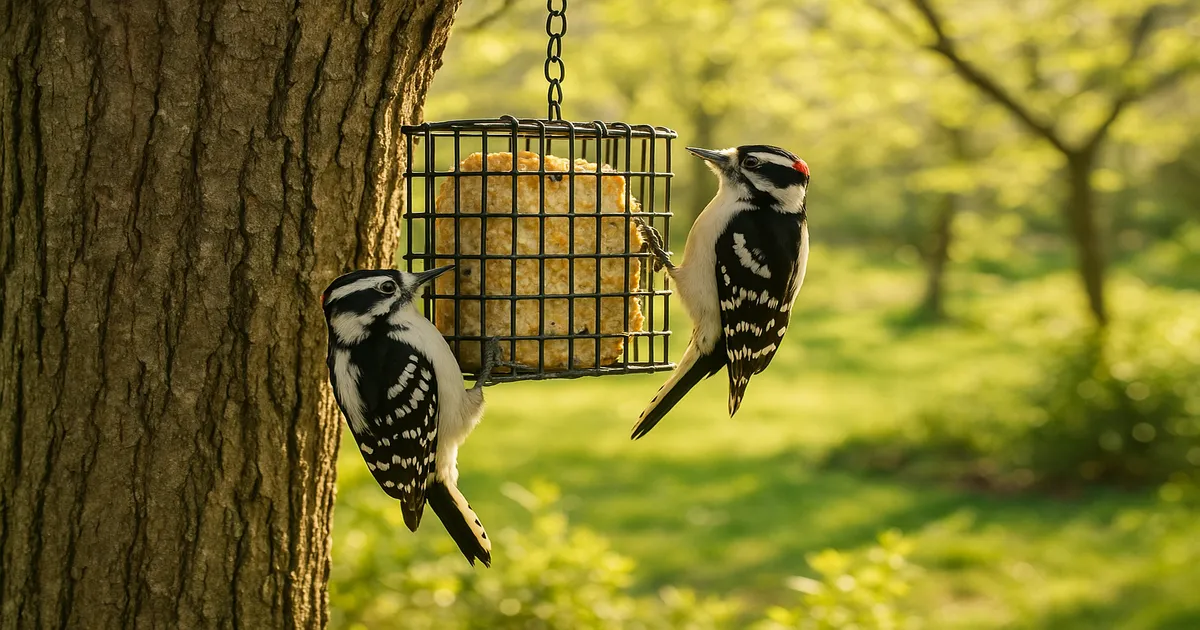
The Downy is about 6.75 inches (17 cm) long with a short, stubby bill — noticeably shorter than the depth of its head, which is how you separate it from the Hairy Woodpecker. Its ladder-back pattern and clean white underparts make it one of the most recognizable birds at any feeder. For learning to sex woodpeckers, nothing beats it.
- Male: Bold red patch on the rear crown (nape); rest of crown is black
- Female: Crown entirely black; no red anywhere on the head
- Juvenile trap: Both sexes show a red forehead cap in first plumage — this disappears or shifts after the first molt
A suet feeder in your backyard will give you multiple daily chances to practice this ID. A good pair of close-focusing binoculars helps enormously at feeder distances. (Nikon Monarch M5 8x42)
Pros
- Red nape patch on males is large, clean, and unmistakable
- Extremely common at feeders across virtually all of North America
- Female’s all-black crown is equally unambiguous — no guesswork
- Easy to observe at close range, giving you time to study the field marks
Cons
- Juvenile birds of both sexes show a red forehead, routinely fooling beginners
- Easy to confuse with Hairy Woodpecker — confirm species before sexing
- White outer tail feathers have small black spots (unlike Hairy’s clean white), but this requires a close look
Best for: Beginners learning woodpecker sexing for the first time.
Hairy Woodpecker: Same Rule, Bigger Bird
The Hairy Woodpecker (Dryobates villosus) is about 9.25 inches (23.5 cm) long — meaningfully bigger than a Downy — and its bill is roughly as long as its head is deep. That bill length is the most reliable way to confirm you’re looking at a Hairy. Once you’ve got the species right, sexing follows the exact same logic as the Downy: red nape patch on males, no red on females.
- Male: Red nape patch (sometimes split into two lateral spots in western populations); no spots on white outer tail feathers
- Female: No red anywhere on the head; otherwise identical to male
- Juvenile: Young males show variable red on the crown; females may show faint orange tinting
A quality field guide is the fastest way to nail the Downy/Hairy distinction before you attempt to sex either bird.
Pros
- Same reliable red-nape rule as Downy — learn one, you’ve learned both
- Loud, sharp peek call carries well through forest, helping you locate birds
- Clean white back stripe is distinctive at distance
Cons
- Must confirm species first — misidentifying a Hairy as a Downy invalidates your sex determination
- Pacific Northwest and southeastern birds are darker, making plumage details harder to read
- Less common at feeders than Downy; you’ll often be working with more distant views
Best for: Birders who’ve mastered Downy sexing and want to apply the same rule to a forest-interior species.
Red-bellied Woodpecker: Crown Extent Is Everything
The Red-bellied Woodpecker (Melanerpes carolinus) is about 9.4 inches (24 cm) long with a bold barred ladder-back and a rolling churr call you’ll hear long before you see the bird. Despite the name, the reddish belly wash is genuinely hard to see in the field — don’t rely on it. The crown is where the sex ID lives.
- Male: Red runs continuously from the base of the bill all the way to the nape
- Female: Red restricted to the nape only; crown is gray to buff
- Juvenile: No red on the head at all; red develops gradually through the first year
Pros
- Crown extent difference is dramatic — full cap versus nape-only is easy to see in good light
- Common at eastern suburban feeders; range has expanded northward into southern Ontario and Quebec
- Both sexes are vocal and conspicuous, giving you repeated observation opportunities
Cons
- Juveniles show zero red, so they can’t be sexed by plumage
- The “red belly” name sends beginners looking at the wrong body part
- Requires a clear view of the crown from above or at eye level to judge the full extent
Best for: Eastern backyard birders who want a reliable, common species to practice the crown-extent rule.
Pileated Woodpecker: Check the Face, Not the Crest
North America’s largest woodpecker at about 16.5 inches (42 cm) long — crow-sized, with a flaming red triangular crest and a call that sounds like something out of a tropical jungle. Both sexes have that red crest, so new birders often assume the crest tells them the sex. It doesn’t. You need a look at the face.
- Male: Red malar (mustache) stripe; red forehead; massive ivory bill
- Female: Black malar stripe; brownish-black forehead; otherwise identical
- Juvenile: Similar to adults but crest is duller; young males show a reduced malar stripe
A spotting scope is worth having if you’re watching Pileateds work the upper trunks of large trees. (Vortex Diamondback HD 20-60x80)
Pros
- As a species, it’s unmistakable — nothing else looks like a Pileated
- Malar stripe difference is bold and clear when you get a good look at the face
- Large enough that even moderate-quality binoculars give you sufficient detail
Cons
- Lives in mature forest, often working high on large trunks — a clear face view takes patience
- Dense canopy makes lighting difficult; the red malar can look dark in poor light
- A bird working the far side of a trunk tells you nothing
Best for: Birders in mature eastern or Pacific Northwest forests who want the most dramatic sexing challenge in the family.
Northern Flicker: The Most Satisfying Rule in Woodpecker Sexing
The Northern Flicker is about 12.5 inches (32 cm) long and spends more time on the ground than any other common woodpecker, probing lawns and fields for ants. The sex rule here is, in my opinion, the single most satisfying field mark in woodpecker ID: if there’s a mustache stripe, it’s a male. If there isn’t, it’s a female.
- Yellow-shafted (eastern) male: Black mustache stripe; red nape crescent; yellow wing-shaft flash in flight
- Yellow-shafted female: No mustache; no nape crescent
- Red-shafted (western) male: Red mustache stripe; no nape crescent; salmon-red wing-shaft flash
- Red-shafted female: No mustache
Pros
- Mustache rule is 100% reliable in adult birds — no ambiguity
- Flickers are large, approachable, and often seen on open ground at close range
- The mustache is visible at a reasonable distance with binoculars
Cons
- Hybrid Yellow-shafted × Red-shafted birds (common in the Great Plains) can show intermediate or partial malar markings
- Very young males develop the mustache during their first fall — early juveniles may lack it
- Subspecies differences (black vs. red mustache) require you to know which form you’re looking at
Best for: Anyone who wants the most cut-and-dried sex ID in North American birding.
Yellow-bellied Sapsucker: The Exception That Tests You
The Yellow-bellied Sapsucker (Sphyrapicus varius) is about 8.5 inches (21.5 cm) long and one of the few truly migratory woodpeckers in North America, wintering across the southeastern U.S. and into Central America. It drills neat rows of small holes — sap wells — in living trees, then returns to feed on the sap and the insects the wells attract. Its drumming rhythm is irregular and syncopated, unlike the steady rolls of most woodpeckers, which makes it identifiable by ear once you know it.
Here’s where the standard rule breaks down: both sexes have a red forehead patch. Apply the usual logic and declare every bird with red on the head a male, and you’ll be wrong half the time.
- Male: Red throat; red forehead; black-and-white barred back
- Female: White throat; red forehead (same as male)
- Juvenile: Brown overall; no red anywhere; barred pattern develops through first winter
Pros
- Throat color contrast is stark and reliable in adults — red versus white is unambiguous
- Once you know the rule, it’s a quick check
- Sap wells are a great way to find the bird; stake out a sap-well tree and wait
Cons
- Juveniles show no red at all and are unsexable by plumage
- The shared red forehead is a reliable trap for birders who’ve just learned the standard rule
- Worn winter birds can be dull, making throat color slightly harder to judge in poor light
Best for: Intermediate birders who want to test their knowledge of exceptions.
Red-headed and Acorn Woodpeckers: When the Sexes Look the Same
Red-headed Woodpecker
The Red-headed Woodpecker is about 9.25 inches (23.5 cm) long with one of the most striking plumage patterns in North American birding — full crimson head, snow-white body, jet-black back. Both sexes look exactly like this. There is no reliable plumage field mark that separates male from female. This isn’t a gap in our knowledge; it’s just how the species works.
Juvenile Red-headed Woodpeckers have a brown head and streaked body, developing the adult pattern through their first winter — so age, not sex, is the main identification challenge here.
Acorn Woodpecker
The Acorn Woodpecker (Melanerpes formicivorus) is about 9 inches (23 cm) long and lives in cooperative breeding groups in western oak woodlands, maintaining communal “granary trees” stuffed with thousands of cached acorns. Sexing it visually is genuinely difficult. The only plumage difference: on females, a narrow black band separates the red cap from the white forehead. On males, the red cap touches the white forehead directly. In practice, this requires a clear, close, well-lit look.
Pros
- Knowing these species are monomorphic (or near-monomorphic) saves you from wasted effort
- Behavioral cues — who incubates, who excavates the nest cavity — can hint at sex with extended observation
- Cooperative breeding behavior in Acorn Woodpeckers makes them fascinating to watch regardless
Cons
- No visual shortcut exists for Red-headed; you simply cannot sex it in the field by plumage
- The Acorn Woodpecker’s forehead-band difference is subtle enough that poor lighting or distance makes it unreliable
- Behavioral sexing requires long, repeated observations at an active nest — not practical for most birders
Best for: Advanced birders who want to understand the full spectrum of woodpecker sexual dimorphism, including where it disappears entirely.
Our Verdict
Best for Beginners: Downy Woodpecker
Start here, every time. The Downy’s red nape patch on males and clean black crown on females is the clearest expression of the rule you’ll find in the woodpecker family. Set up a suet feeder in your backyard and you’ll have multiple daily chances to practice. Once you’ve got Downy locked in, the same logic transfers directly to Hairy and Red-bellied.
Most Satisfying Field Mark: Northern Flicker
The mustache rule is binary, reliable, and works at distance. I’ve watched new birders nail it on their first attempt and feel immediately confident. That’s rare in birding.
Most Surprising Exception: Yellow-bellied Sapsucker
The sapsucker is the species I use to test whether someone has really internalized woodpecker sexing — or just memorized a rule without understanding the exceptions. The shared red forehead is the trap; the throat color is the answer.
Hardest to Sex by Sight: Red-headed Woodpecker
Humbling, but instructive. Knowing that some species simply can’t be sexed by plumage is part of being a complete birder. Don’t waste time staring at a Red-headed trying to find a difference that isn’t there.
Best Backyard Learning Opportunity (East of the Plains): Red-bellied Woodpecker
For eastern birders, the Red-bellied at a suet or peanut feeder is the perfect classroom. It’s common, bold, and the crown-extent difference is visible even through a window. If you’re east of the Great Plains, this is probably your most reliable daily practice species after the Downy.
Frequently Asked Questions
How can you tell a male woodpecker from a female woodpecker?
In most North American woodpeckers, check for red on the head. Males typically show a red nape patch, full cap, or mustache stripe; females show less red or none. The Downy’s red nape patch and the Northern Flicker’s mustache rule are the clearest examples. The main exceptions are the Red-headed Woodpecker (both sexes identical) and the Yellow-bellied Sapsucker (throat color, not cap, is the key).
Do female woodpeckers have red on their heads?
Some do — but typically less than males. Female Red-bellied Woodpeckers have red on the nape only (males have a full red cap). Female Pileated Woodpeckers have a red crest but lack the male’s red mustache stripe. Female Yellow-bellied Sapsuckers share the male’s red forehead patch. “Females never have red” is an oversimplification — the question is always how much red, and where.
Which woodpecker species look the same in both sexes?
The Red-headed Woodpecker is the primary example — both sexes have the identical full crimson head and cannot be separated by plumage. The Acorn Woodpecker is nearly identical between sexes, with only a subtle black band on the female’s forehead. For practical field purposes, treat both species as visually unsexable unless you have an exceptional, close, well-lit view of an Acorn Woodpecker’s forehead.
Can juvenile woodpeckers be mistaken for the wrong sex?
Yes — this is one of the most common errors in woodpecker ID. Juvenile Downy Woodpeckers of both sexes show a red forehead cap, which beginners often interpret as the male’s red nape patch. Juvenile Red-headed Woodpeckers have a brown head with no red at all. When you’re unsure of a bird’s age, confirm it’s an adult before attempting to sex it.
Do male and female woodpeckers drum differently?
Not in any reliable way. Both sexes drum in most woodpecker species — drumming functions as territorial advertisement and mate attraction, not as a sex-specific behavior. Drumming rate and pattern are species-specific (Yellow-bellied Sapsucker has a distinctive irregular rhythm; Pileated produces a deep, resonant roll) but don’t vary consistently between sexes within a species. Drumming tells you the species, not the sex.