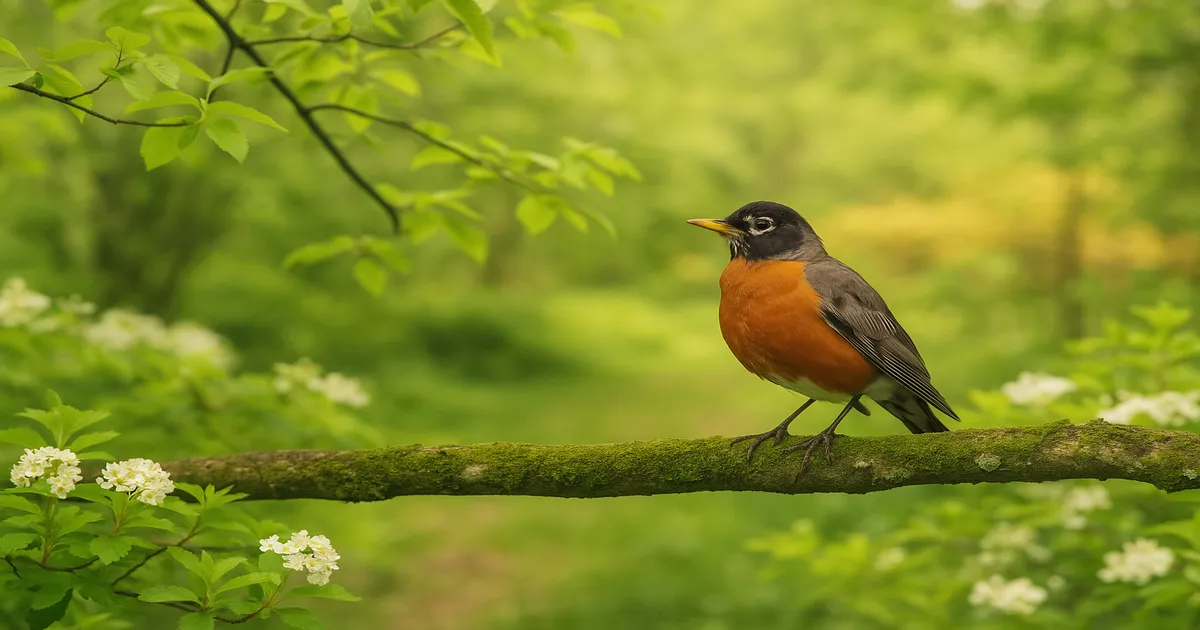
Quick Answer: The American Robin (Turdus migratorius) is one of the easiest birds in North America to identify — a brick-red breast, slate-gray back, and dark head are all you need in most situations. For separating it from look-alikes, check the breast first: a solid orange-red breast with no band means robin; anything else sends you elsewhere.
If you’ve landed here searching “robin vs robin Teen Titans,” I’ll be straight with you — that’s a DC Comics question, and I’m a birding writer. What I can tell you is that the American Robin is one of the most satisfying birds to master, and once you nail it, you’ve built the foundation for identifying every other thrush on the continent. This guide covers the classic field marks and the trickiest look-alikes, structured the way I’d walk a new birder through it in the field.
Robin vs Robin Teen Titans? Wrong Robin — But Here’s the Right One
Top Field Marks in 30 Seconds
You don’t need a field guide open to identify an American Robin. Four things tell the story immediately:
- Brick-red to deep orange breast — solid, no spots, no band
- Slate-gray back — uniform, no wingbars, no rufous tones
- Dark head — near-black in males, dark gray in females, with a broken white eye-ring
- Yellow-orange bill — with a dark tip; visible even at modest distance
That’s it. In most encounters — a bird on a lawn, hopping through a park, sitting on a fence post — those four marks close the case in seconds. I’ve been birding for over two decades and I still get a small satisfaction every time one of these birds just declares itself.
Male vs Female: Key Differences
| Feature | Male | Female |
|---|---|---|
| Head color | Near-black | Dark gray, noticeably paler |
| Breast color | Deep brick-red | Paler, more washed-out orange |
| Eye-ring | Bold white | Similar, slightly less crisp |
| Overall impression | High contrast | Softer, more blended tones |
The difference is real but subtle at distance. Don’t stress over it until you’re comfortable with the species overall.
What to Look For: Full Field Identification
Size and Shape
The American Robin runs about 9–11 inches (23–28 cm) long with a wingspan of roughly 12–16 inches (31–41 cm). It’s noticeably larger than a House Sparrow and substantially bigger than any towhee — size alone rules out a surprising number of confusion species. The body is round and upright, the tail moderately long, and the bird carries itself with purposeful confidence on the ground.
One behavioral mark that’s genuinely useful: robins pump their tails up and down while standing still. It’s subtle, but once you know to look for it, it jumps out.
Plumage Details: Head, Breast, Back, and Tail
The white eye-ring is broken at the top and bottom, giving the bird a slightly wide-eyed expression up close. The throat is white with dark streaking — easy to see in good light. In flight, look for white corners on the outer tail feathers; they flash briefly but distinctly and are diagnostic once you’ve seen them a few times.
The back and wings are clean slate-gray with no wingbars. Any rufous, brown, or spotted patterning on the back immediately points away from American Robin.
Juvenile Plumage: Why Young Robins Look Different
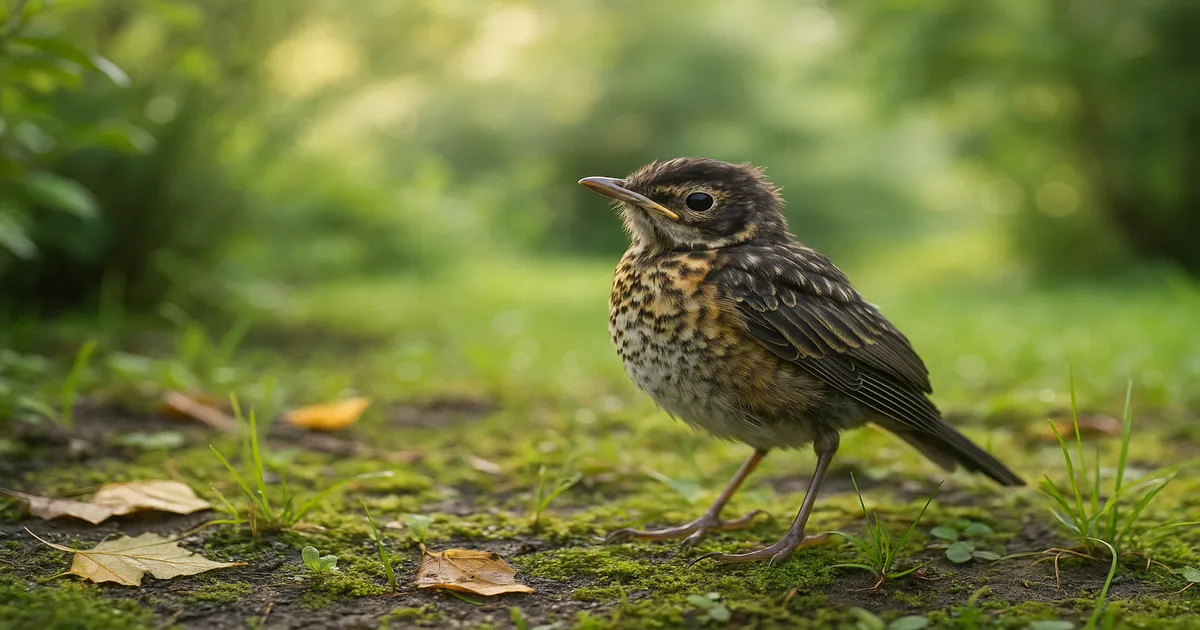
This trips up a lot of new birders, and honestly, I don’t blame them. Juvenile robins sport a heavily spotted breast — classic thrush-spotting pattern — along with spotted backs and buff fringes on the wing coverts. They look genuinely unlike their parents for the first several weeks of life.
By late summer, an orange wash starts developing on the breast, and the adult-like shape is already there. If you see a spotted thrush that’s robin-sized, check the bill base for yellow-orange coloring and look for that emerging breast wash. It becomes pretty reliable with a bit of practice.
Calls and Song
The song is one of the most familiar sounds in North American spring — a rich, caroling series of two- and three-note phrases often described as cheerily, cheer-up, cheerio, delivered at an unhurried, almost conversational pace. Robins start singing well before dawn and are often the first voice in the morning chorus.
The alarm call is a sharp, penetrating tuk-tuk-tuk — it means a cat or hawk is nearby. In flight, especially during nocturnal migration, listen for a thin, high seep or seet. There’s also a descending laughing whinny when the bird is agitated. Between the song and the alarm call, you can identify robins by ear as reliably as by sight.
Robin vs Robin Teen Titans — and Every Other Look-Alike: Comparison Table
| Species | Breast Pattern | Back Color | Head Pattern | Range/Habitat | Key Difference from Robin |
|---|---|---|---|---|---|
| American Robin | Solid orange-red | Slate-gray | Dark with white eye-ring | Continent-wide; lawns to forests | — |
| Varied Thrush | Orange with black breast band | Slate-gray | Orange supercilium, black mask | Pacific Northwest; fruiting trees | Bold black breast band |
| Rufous-backed Robin | Solid orange-red | Rufous/brown | Dark, similar | Mexico; rare AZ/NM vagrant | Rufous (not gray) back |
| Spotted Towhee | Orange flanks only | Black with white spots | Black hood | West; dense shrubs/leaf litter | Much smaller; spotted wings |
| Eastern Towhee | Orange flanks, white belly | Black | Black hood, red eye | East; dense undergrowth | White belly; black hood |
| Juvenile Robin | Spotted orange-buff | Spotted gray-brown | Developing adult pattern | Same as adult | Spotted breast; adult size and shape |
The fastest single rule: check whether the orange is a full breast or just flanks. Towhees show orange on the sides only, with a white belly below and a black hood above. A full orange-red breast from throat to belly means American Robin — or, in the Pacific Northwest, possibly a Varied Thrush, in which case look immediately for the breast band.
Varied Thrush: The Most Frequently Confused Species
The Varied Thrush (Ixoreus naevius) is the one species that genuinely gives experienced birders a moment’s pause. In the Pacific Northwest during winter, both species flock to the same fruiting trees — madrones, hollies, crabapples — and at a glance, that orange breast registers as “robin” before your brain catches up. A good pair of binoculars makes the separation instant. (Vortex Diamondback HD 8x42)
- Length: About 9.5 inches (24 cm) — nearly identical to a robin
- Breast: Orange with a bold black breast band across the chest
- Head: Striking orange supercilium (eyebrow stripe), black mask
- Back: Slate-gray, similar to robin
- Range: Pacific coast specialist; breeds in dense coniferous forest from southern Alaska to northwestern California, winters in lowland fruiting areas and occasionally wanders east
Pros of Varied Thrush as a Comparison Subject
- The breast band is so bold that once you’ve seen it, you’ll never mistake it again
- The orange supercilium creates a completely different facial expression from the robin’s white eye-ring
- It’s a genuinely beautiful bird — learning this comparison is its own reward
Cons of Varied Thrush as a Comparison Subject
- Range overlap with most American observers is limited; if you’re in the eastern two-thirds of the country, you’ll probably never encounter one
- In poor light or at distance, the breast band can be hard to see, and the initial orange impression is real
Verdict
If you see an orange breast and you’re in the Pacific Northwest in winter — stop and look for the band before calling it a robin. A black band across the breast means Varied Thrush, full stop.
Rufous-backed Robin: The Rare Southwestern Vagrant
The Rufous-backed Robin (Turdus rufopalliatus) is a Mexican species that wanders into Arizona and occasionally New Mexico in small numbers each fall and winter, typically October through February. When one shows up at a Tucson feeder, it causes genuine excitement — and genuine confusion, because the breast color is similar enough to an American Robin to fool observers who aren’t looking at the back. A spotting scope helps when the bird is feeding high in a fruiting tree. (Vortex Diamondback HD 16-48x65)
- Length: Slightly smaller than American Robin, around 9 inches (23 cm)
- Breast: Warm orange-red, similar to robin
- Back: Distinctly rufous to brown — not gray
- Head: Dark, similar facial pattern to robin; note the Rufous-backed Robin also lacks the bold white eye-ring of the American Robin
- Range: Mexico; rare vagrant to AZ/NM, primarily October–February
Pros of Rufous-backed Robin as a Comparison Subject
- The back color difference is immediately obvious in decent light — rufous vs. slate-gray is not a subtle distinction
- Knowing this species primes you to check the back on every robin-type bird you see in the Southwest
Cons of Rufous-backed Robin as a Comparison Subject
- This is genuinely rare. Most birders in North America will never encounter one. If you’re not in southern Arizona in winter, it’s essentially a non-issue.
Verdict
Check the back. A brown or rufous back rules out American Robin immediately. In Arizona in winter, that single mark is worth knowing cold.
Spotted Towhee: The Backyard Confusion Bird
The Spotted Towhee (Pipilo maculatus) is probably the most common source of “is this a robin?” questions from beginners, and I understand why. You catch a glimpse of orange in a shrubby border, your brain says “robin,” and then the bird scratches in the leaf litter and everything is wrong. Spotted Towhees visit platform feeders regularly, so if you want a closer look, a well-placed feeder near shrubby cover will bring them in.
- Length: About 8.3 inches (21 cm) — noticeably smaller than a robin
- Breast/flanks: Orange on the sides only; white belly
- Wings: Black with bold white spots
- Head: Black hood extending down to upper breast
- Behavior: Scratches vigorously in leaf litter with a double-footed hop; rarely ventures onto open lawn
Pros of Spotted Towhee as a Comparison Subject
- Once you appreciate the size difference, confusion ends permanently — the towhee is a smaller, chunkier bird with a completely different silhouette
- The white-spotted black wings are unmistakable once you’re looking for them
Cons of Spotted Towhee as a Comparison Subject
- The behavioral difference is so pronounced — scratching in dense litter vs. running on open lawn — that most observers self-correct within seconds
- The orange is on the flanks only, not a full breast; the distinction is clear in any decent view
Verdict
If the bird is scratching in leaf litter, is noticeably smaller than you’d expect, and shows white spots on black wings — that’s a Spotted Towhee. A robin doesn’t scratch, doesn’t have spotted wings, and won’t be caught dead in dense shrubs when there’s a lawn nearby.
Eastern Towhee: The Eastern Counterpart
The Eastern Towhee (Pipilo erythrophthalmus) presents the same basic confusion scenario as the Spotted Towhee, just in eastern North America. The orange flanks catch your eye, your brain briefly says “robin,” and then you notice the white belly and black hood. (Zeiss Terra ED 8x42)
- Length: About 8.4 inches (21 cm)
- Breast/flanks: Orange on the sides; clean white belly
- Head: Black hood (male) or brown hood (female); striking red eye in most populations, though white-eyed birds occur in Florida
- Back: Black (male) or brown (female)
- Habitat: Dense undergrowth, thickets, brushy edges — not open lawns
Pros of Eastern Towhee as a Comparison Subject
- The white belly and black hood are immediately obvious the moment you get a clear look; there’s nothing subtle about this distinction
- The red eye is a memorable mark once you’ve seen it
Cons of Eastern Towhee as a Comparison Subject
- Habitat overlap with robins is minimal — towhees stay in dense cover, robins work open ground. The situations where you’d confuse them are brief and specific.
Verdict
White belly plus black hood equals Eastern Towhee. Full orange-red breast with no hood equals American Robin. These two birds aren’t really that similar once you slow down for two seconds.
Juvenile American Robin: Confusing Your Own Target Species
Here’s the irony: the bird most likely to confuse you when you’re learning American Robin identification is an American Robin. Juvenile robins, fresh out of the nest in June and July, sport a heavily spotted breast and spotted back that can briefly suggest a Hermit Thrush (Catharus guttatus) or Swainson’s Thrush (Catharus ustulatus) to an observer who doesn’t expect it. A good field guide with plates showing juvenile plumage is worth having on hand through midsummer. (Sibley’s Birds of North America)
- Breast: Heavily spotted buff-orange — classic thrush spotting pattern
- Back: Spotted with buff fringes on wing coverts
- Bill: Yellow-orange at the base, even in young birds
- Size: Already essentially adult-sized by the time they leave the nest
- Timeline: Spotting fades through first summer; orange wash visible by late summer
Pros of Knowing Juvenile Plumage
- Prevents unnecessary “unknown thrush” reports
- Understanding juvenile plumage deepens your grasp of thrush identification generally — the spotted pattern is ancestral to the whole family
Cons of Juvenile Plumage for New Birders
- The classic thrush spotting genuinely does resemble Hermit or Swainson’s Thrush at a quick glance, especially in dappled light
- The orange wash on the breast develops gradually, so very young birds show less of it
Verdict
Look for adult-like size and shape, the developing orange wash on the breast, and the yellow-orange bill base. Juvenile robin ID becomes straightforward with practice — and it’s one of those things where you suddenly wonder how you ever found it confusing.
Our Verdict: Confident Robin Identification by Situation
Best Overall Field Mark: The Brick-Red Breast
Nothing else on a North American bird looks quite like a robin’s full, solid orange-red breast. Check it first; in most situations it’s the last thing you need.
Best Mark for Flight ID: White Tail Corners
Watch for the white flashes at the corners of the tail as the bird banks or lands. They’re brief but consistent, and they work at distances where breast color is hard to judge.
Best Mark for Distant Flock ID: Size and Run-Stop-Tilt Behavior
A flock of robins working a lawn from 100 yards is identifiable purely by behavior. That distinctive run-stop-tilt-lunge foraging gait is essentially unique among common North American birds. Size confirms it.
Best Mark for Separating from Towhees: Full Breast Color and Size
Towhees show orange on the flanks only, with a white belly below and a black hood above. Robin’s orange-red covers the entire breast. Add the size difference and you’re done.
Best Mark for Separating from Varied Thrush: Absence of Breast Band
The single fastest check in Pacific Northwest birding. No band across the breast means American Robin. A bold black band means Varied Thrush. Takes one second.
Best Tool for Confirming in the Field: Merlin Bird ID
If you’re still uncertain, Merlin Bird ID (Cornell Lab of Ornithology) handles American Robin identification confidently and walks you through the field marks step by step. eBird lets you check what’s been reported recently in your exact location — if no Varied Thrush has been recorded in your county in years, that orange bird on your lawn is almost certainly a robin. Both apps are free and genuinely excellent.
Frequently Asked Questions
How do I tell a male American Robin from a female?
Male American Robins have a near-black head and a deep brick-red breast, giving them a high-contrast look. Females show a noticeably paler dark gray head and a more washed-out orange breast. The difference is real — in good light and at close range, it’s straightforward — but in poor light or at distance, it can be genuinely hard to call, and that’s fine.
What bird looks like a robin but has a spotted breast?
A spotted breast on an otherwise robin-sized bird is most likely a juvenile American Robin. Young robins have classic thrush spotting that fades by late summer. If the bird is significantly smaller and you’re in the right habitat, it could be a Hermit Thrush or Swainson’s Thrush — both are smaller, browner, and lack any orange on the breast.
Is a Varied Thrush the same as an American Robin?
No. The Varied Thrush is a separate species found primarily along the Pacific Coast. Both have orange breasts and slate-gray backs, but the Varied Thrush has a bold black band across its chest and a striking orange eyebrow stripe. Those two marks settle it immediately.
Why does my robin have spots — is it a different species?
Almost certainly not. Juvenile American Robins have heavily spotted breasts and backs for the first several weeks after fledging. Look for the adult-like size, the yellow-orange bill base, and any emerging orange wash on the breast. By late summer, most of the spotting has faded.
What is the fastest way to identify an American Robin in the field?
Look at the breast. A full, solid orange-red breast with no spots and no dark band, combined with a slate-gray back and dark head, means American Robin. In most situations you’ll have a confident ID within three seconds. The run-stop-tilt foraging behavior on lawns is strong secondary confirmation if you need it.