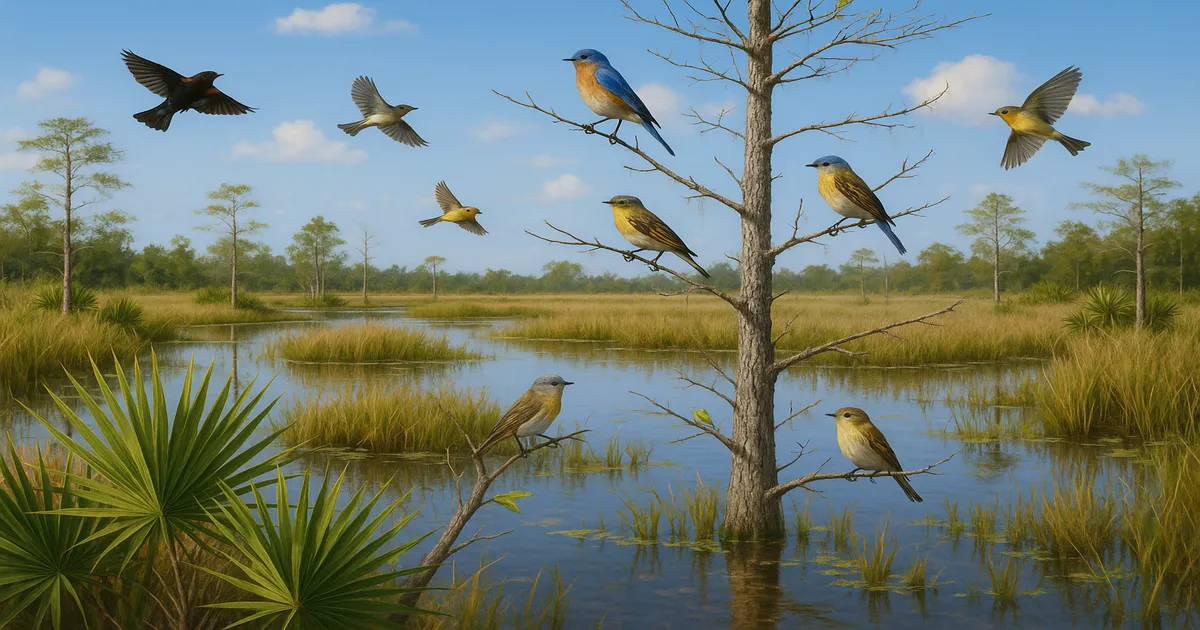
Quick Answer: To attract birds in Florida, focus on four things: native plants for food and shelter, fresh water (especially moving water), the right feeders stocked with black-oil sunflower seed and millet, and a chemical-free yard. Florida’s subtropical climate and position along the Atlantic Flyway mean you can attract both year-round residents and seasonal visitors with a relatively simple setup.
Florida is one of the best places in North America to attract birds to your backyard. If you’re working out how to attract birds in Florida specifically, the state’s biodiversity does a lot of the heavy lifting — but you still need to understand which birds you can realistically pull in, when they’ll show up, and how the state’s distinct regional habitats change the equation. Whether you’re in Miami, Orlando, or Pensacola, the strategies below will get more birds — and better birds — into your yard.
How to Attract Birds in Florida: The Essentials
The four pillars are straightforward:
- Food — feeders with the right seed, plus native fruiting and flowering plants
- Fresh water — a birdbath or dripper, cleaned regularly
- Shelter and cover — shrubs, trees, and brush piles for perching and hiding
- Nesting sites — nest boxes and dense native plantings
Florida’s dry season runs roughly November through May. Natural water sources dry up, and birds become heavily dependent on backyard water features. That single factor can transform a quiet yard into a busy one almost overnight.
Florida also sits at the southern tip of the eastern migratory flyway, funneling birds heading to and from the Caribbean and South America. The peninsula concentrates migrants in ways few other states can match. Add the subtropical south, temperate north, and hundreds of miles of coastline, and you’re dealing with an unusual mix of resident, wintering, and breeding species — often in the same yard, often at the same time.
Florida’s Most Common Backyard Birds
Year-Round Residents: Cardinals, Wrens, and Woodpeckers
These are your reliable regulars, present every month of the year:
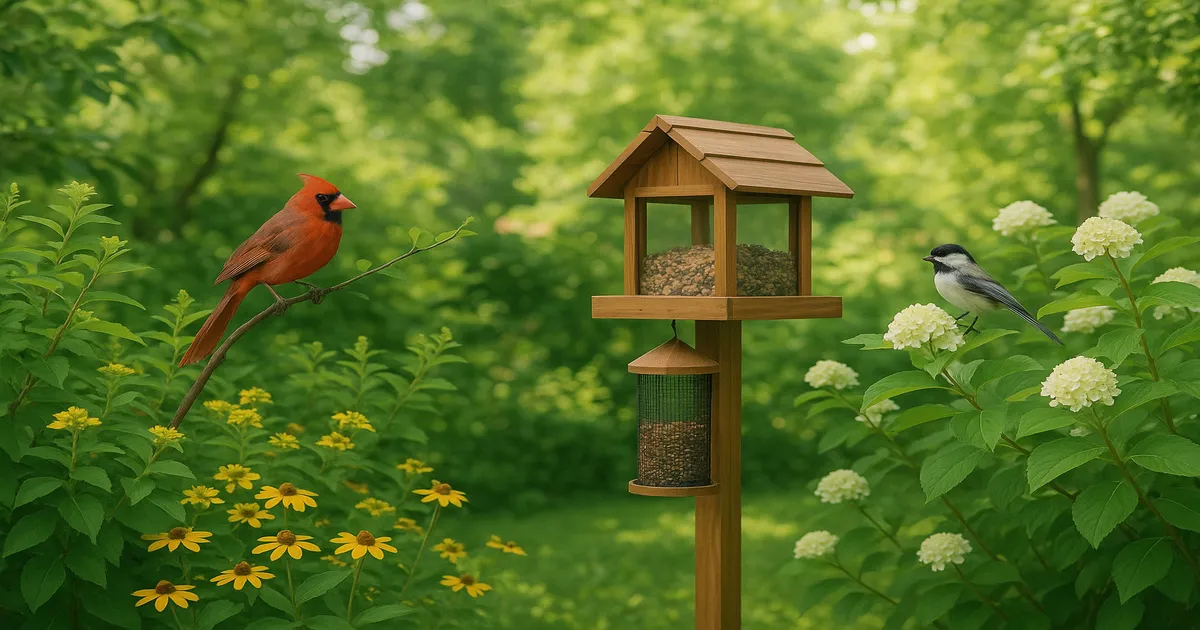
- Northern Cardinal (Cardinalis cardinalis) — The male’s all-red plumage and heavy orange-red bill are unmistakable. Females are warm buffy-brown with reddish tinges on the wings, crest, and tail. Both sexes sing — genuinely unusual among North American songbirds. Listen for the loud, whistled “cheer-cheer-cheer.”
- Carolina Wren (Thryothorus ludovicianus) — About 5.5 inches (14 cm), rusty-brown above, warm buff below, with a bold white supercilium and a cocked tail. Absurdly loud for its size — that “teakettle-teakettle-teakettle” carries across the whole yard.
- Red-bellied Woodpecker (Melanerpes carolinus) — The bold black-and-white ladder-back barring is the key field mark. Males have red from bill to nape; females only on the nape. The faint reddish belly the name promises is usually invisible in the field.
- Northern Mockingbird (Mimus polyglottos) — Florida’s state bird. Gray above, whitish below, with white wing patches that flash in flight. Can incorporate 200+ song types and will sing through the night during breeding season.
- Blue Jay (Cyanocitta cristata) — Bold blue, white, and black with a prominent crest. Loud, opinionated, and an impressive mimic of Red-shouldered Hawk calls.
- Mourning Dove (Zenaida macroura) — Slender, soft grayish-brown, with a long pointed tail. The mournful cooing call is regularly mistaken for an owl.
If you have a larger yard or nearby open space, watch for Sandhill Cranes (Antigone canadensis). The Florida subspecies (A. c. pratensis) is non-migratory, and those bugling calls are one of the most distinctive sounds in the state.
Winter Visitors: Robins, Warblers, and Buntings
Florida winters bring a serious influx from the north. American Robins (Turdus migratorius) arrive in large, nomadic flocks from November onward, descending on yards with fruiting trees. Palm Warblers (Setophaga palmarum) are practically everywhere in Florida from October through April — small brownish birds with a rusty cap and a constantly pumping tail. Yellow-rumped Warblers (Setophaga coronata) are equally abundant. Cedar Waxwings (Bombycilla cedrorum) show up in flocks whenever fruit is ripe, then vanish just as quickly.
Hummingbirds and Painted Buntings
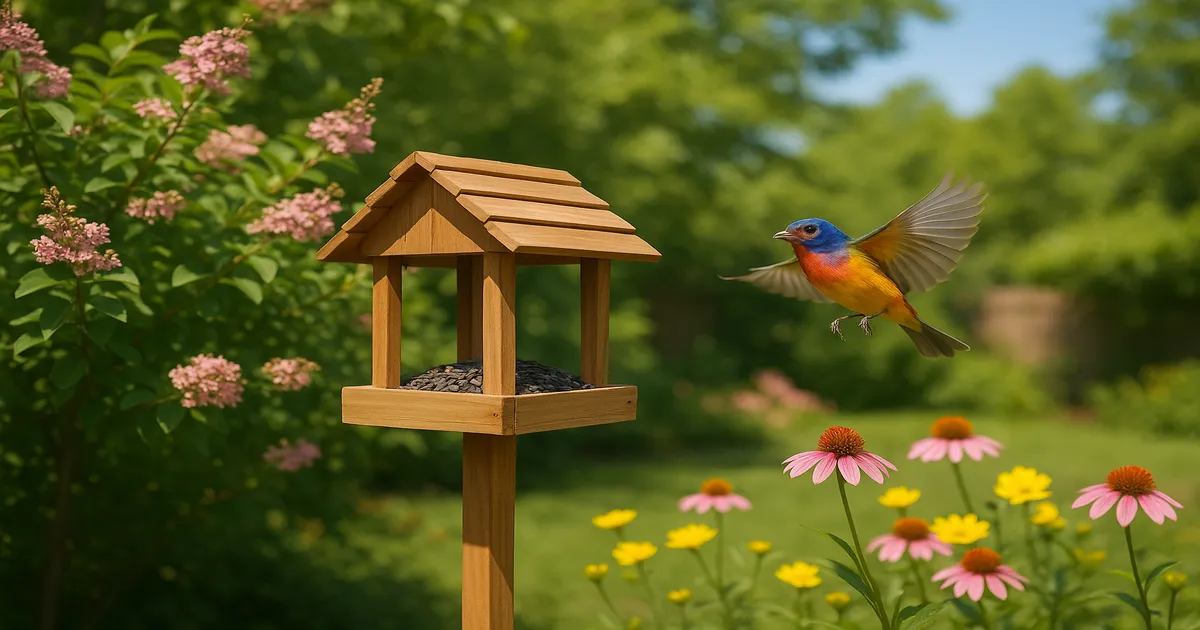
Ruby-throated Hummingbirds (Archilochus colubris) breed in north Florida and pass through the peninsula during spring (April–May) and fall (August–October) migration. The male’s ruby-red gorget can look black in poor light — a common source of confusion. Painted Buntings (Passerina ciris) are the prize of Florida winter birding across the south and central parts of the state. The male is the most colorful bird in North America: blue head, red underparts, lime-green back. They winter in Florida from roughly October through April, with peak feeder activity in December through February.
Wading Birds and Raptors
A pond, canal, or large water feature puts you in range of some spectacular birds. Great Blue Herons (Ardea herodias) — nearly 4 feet tall, blue-gray with a yellow-orange bill and a black-and-white striped head — will patrol any yard with fish or frogs. Ospreys (Pandion haliaetus) are common near open water statewide. In south and central Florida, Roseate Spoonbills (Platalea ajaja) are unmistakable: pink plumage, spatula-shaped bill, and a side-to-side sweeping feeding motion through shallow water.
How to Attract Birds in Florida by Region
South Florida: Subtropical Gardens
South Florida gardeners can attract species found nowhere else in the continental U.S. — White-crowned Pigeons, Mangrove Cuckoos, and occasional Caribbean vagrants. Native tropical plantings are essential. The Everglades influence means wading birds are practically neighbors.
Central Florida: Scrub, Lakes, and Suburban Yards
Central Florida’s Lake Wales Ridge contains some of the most critically important scrub habitat in the state. If your yard borders scrub, you may get visits from Florida Scrub-Jays (Aphelocoma coerulescens) — a federally threatened species found only in Florida. They’re about 11 inches (28 cm), blue and gray with a white forehead and no crest, and remarkably bold around humans. Avoid planting tall trees near scrub edges; scrub-jays need open, low-growing habitat to survive and tall woody encroachment is one of the primary threats to their remaining populations.
North Florida and the Panhandle: Temperate Woodlands
North Florida overlaps with the broader southeastern U.S. bird community. Dark-eyed Juncos (Junco hyemalis) appear in winter here but rarely further south. Longleaf pine flatwoods support woodpeckers and Brown-headed Nuthatches (Sitta pusilla). The Panhandle also hosts a breeding population of Painted Buntings — one of only two breeding populations in the eastern U.S.
The Best Bird Feeders for Florida Backyards
For sheer volume of birds, a tube or hopper feeder stocked with black-oil sunflower seed is the gold standard. Cardinals, Blue Jays, and Carolina Wrens all use it regularly. Skip the cheap mixed seed bags — the milo filler mostly ends up on the ground. (Perky-Pet Squirrel-Be-Gone Max)
A basic wire suet cage pulls in Red-bellied Woodpeckers reliably. In Florida’s heat, use no-melt suet formulations — standard suet goes rancid fast in summer. Carolina Wrens will work suet feeders too, clinging sideways in a way that looks physically improbable.
For hummingbirds, mix your own nectar: 1 part white sugar to 4 parts water, boiled briefly to dissolve. Never use red dye — it’s unnecessary and potentially harmful. Clean the feeder every two to three days in summer; Florida’s heat turns nectar into a bacterial soup faster than you’d expect. (Aspects HummZinger Excel 16 oz)
Mourning Doves, Northern Mockingbirds, and Painted Buntings all prefer feeding at or near ground level. A low platform feeder stocked with white proso millet is the single best way to attract Painted Buntings. Watch for fire ants invading ground feeders — a pole-mounted feeder with a baffle is much safer than anything placed directly on soil.
Place feeders within 3 feet of a window (to reduce strike speed if a bird hits the glass) or more than 30 feet away. Clean seed feeders every one to two weeks with a 10% bleach solution, rinse thoroughly, and let dry before refilling. Florida’s humidity accelerates mold fast.
Native Plants That Attract Birds in Florida
Native plants are the most effective long-term strategy for attracting Florida birds. A yard full of natives produces insects, fruit, seeds, and nesting material that no feeder can replicate.
Berry-producing shrubs and trees are your foundation:
- Beautyberry (Callicarpa americana) — vivid purple berry clusters that American Robins, Cedar Waxwings, and Gray Catbirds strip clean in winter
- Wax Myrtle (Morella cerifera) — waxy gray berries are a Yellow-rumped Warbler staple; also provides dense cover
- Saw Palmetto (Serenoa repens) — berries feed a wide range of birds; dense fronds provide shelter and nesting sites
- Sand Live Oak (Quercus geminata) — acorns attract Blue Jays, woodpeckers, and Wild Turkeys; the canopy supports enormous insect diversity
For hummingbirds and warblers, Firebush (Hamelia patens) is probably the single best hummingbird plant for Florida — it blooms almost year-round in south Florida and the tubular red-orange flowers draw Ruby-throated Hummingbirds reliably. Coral Honeysuckle (Lonicera sempervirens) is equally effective and handles shadier spots well.
Native bunch grasses like Muhly Grass (Muhlenbergia capillaris) produce seed heads that sparrows and doves work over methodically. Ground cover plantings also create the leaf litter layer where Eastern Towhees and thrushes scratch for insects.
Think in layers: tall canopy oaks or pines, a mid-story of Beautyberry and Firebush, and low ground cover or native grasses. This structure supports foraging at every level and gives birds a reason to stay rather than just pass through.
Water Features: The Fastest Way to Attract More Birds
Moving water is the most powerful bird attractant in a Florida yard. Warblers, thrushes, and even hummingbirds will ignore feeders entirely and spend 20 minutes at a dripper. A simple solar dripper attached to your existing bath costs almost nothing and makes a dramatic difference.
For the bath itself, use a shallow, textured basin — no deeper than 2 to 3 inches (5–7 cm) at the center. Smooth glazed baths look nice but birds slip on them. Place it near shrubs so birds can retreat quickly, but not so close that a cat can use the cover as an ambush point.
Misters are especially effective for hummingbirds, who prefer flying through a fine spray rather than bathing conventionally. If you have space for a small pond — even a half-barrel water garden — you’re opening the door to Great Blue Herons, Little Blue Herons, and Sandhill Cranes.
Change birdbath water every one to two days during summer and scrub the basin weekly. A solar-powered fountain pump keeps water moving, prevents mosquito breeding, and discourages algae.
Seasonal Birding Calendar: What to Expect Month by Month
Winter (November–March) is Florida’s best season for backyard birding. American Robins arrive in large flocks tracking fruiting trees. Palm and Yellow-rumped Warblers are everywhere. Painted Buntings are actively using feeders in south and central Florida — stock millet and be patient. Purple Martins (Progne subis) begin arriving in south Florida as early as January, the earliest arrival of any North American swallow.
Spring (March–May) brings Ruby-throated Hummingbirds pushing through the peninsula in April and May. Keep that nectar feeder clean and full. Neotropical migrants concentrate at coastal spots like Fort De Soto County Park and the Dry Tortugas in April — worth a day trip if you want to see warblers in numbers that will recalibrate your expectations. Back home, Cardinals, Wrens, and Woodpeckers begin nesting; reduce disturbance near nest boxes.
Summer (June–August) is quieter at feeders but active in the yard. Resident breeders are raising young. Swallow-tailed Kites (Elanoides forficatus) — elegant black-and-white raptors with deeply forked tails — are present through July and worth watching for overhead. Ruby-throated Hummingbirds breed in north Florida during this period. Keep water features running; the heat makes them essential.
Fall (August–October) brings Painted Buntings back to Florida feeders starting in late September — one of the highlights of the birding year. Hummingbird migration peaks in September and October; a well-maintained nectar feeder can see multiple individuals daily. Warblers and other migrants filter through, often stopping at water features before continuing south.
Conservation: Protecting Florida’s Birds in Your Backyard
Cats are the leading human-caused source of bird mortality in the U.S. — an estimated 1.3–4 billion birds killed annually. In Florida, where many ground-nesting and low-shrub-nesting species are concentrated, the impact is severe. Keep pet cats indoors.
Window strikes are the second major threat. Apply Acopian BirdSavers (hanging paracord strips) or window collision tape in a grid pattern — spacing no more than 2 inches (5 cm) horizontally and 4 inches (10 cm) vertically. External screens work well too. (WindowAlert UV Liquid)
Pesticides don’t just kill pest insects — they eliminate the caterpillars, beetles, and spiders that birds, especially nestlings, depend on for protein. A single clutch of Carolina Wren chicks requires thousands of insects during the first two weeks of life. Herbicides remove native plant diversity. A chemical-free yard isn’t just better for birds; it’s the foundation everything else in this article is built on.
If you live near scrub habitat, avoid planting tall trees that fragment the open structure Florida Scrub-Jays depend on. Support local land conservation organizations working to protect and manage remaining scrub parcels — it’s some of the most endangered habitat in the state.
Frequently Asked Questions
What is the easiest way to attract birds in Florida? Start with a clean birdbath and a hopper feeder filled with black-oil sunflower seed. Moving water — even a cheap solar dripper — will pull in more species faster than any feeder. Add a platform feeder with white millet if you want Painted Buntings.
What birds come to feeders in Florida year-round? Northern Cardinals, Carolina Wrens, Red-bellied Woodpeckers, Blue Jays, and Mourning Doves are reliable year-round feeder visitors across most of the state. Northern Mockingbirds visit occasionally but prefer foraging on the ground or in fruiting shrubs.
When do Painted Buntings arrive in Florida? Painted Buntings typically arrive in south and central Florida in late September to October and stay through April. Peak feeder activity is December through February. White proso millet on a low platform feeder is the best way to attract them.
Do hummingbirds stay in Florida year-round? Ruby-throated Hummingbirds breed in north Florida in summer and migrate through the peninsula in spring and fall. A small number of other species — including Rufous and Black-chinned Hummingbirds — occasionally winter in Florida, so it’s worth leaving a feeder up year-round.
Is it worth feeding birds in Florida during summer? Yes, though feeder activity slows down. Resident breeders are foraging widely to feed young, but they still visit. More importantly, water features become critical in summer heat. Keep your birdbath clean and your nectar feeder fresh — you’ll still see plenty of activity.