Quick Answer: To attract birds in crimson desert landscapes, install a shallow moving-water feature with a dripper or wiggler — that alone will bring more birds than almost anything else. Back it up with platform feeders stocked with black-oil sunflower and safflower seeds, native plantings of mesquite and prickly pear, and keep cats indoors. Do those four things and you’ll have a real shot at Pyrrhuloxia, Vermilion Flycatcher, and a dozen other stunning desert species visiting regularly.
The red-rock deserts of the American Southwest — those iron-oxide sandstone landscapes that glow copper and crimson at sunrise — hold some of the most visually striking birds on the continent. Knowing how to attract birds in crimson desert environments means understanding what these species actually need: not just seed, but structure, water, and native vegetation that mirrors the wild desert around them. This guide covers all of it.
Meet the Crimson Desert Birds: Species Overview
Pyrrhuloxia (Desert Cardinal)
The Pyrrhuloxia (Cardinalis sinuatus) runs about 8.75 inches (22 cm) long and looks, at first glance, like a cardinal that’s been left in the sun too long. The male is gray overall with rose-red washes on the crest, wings, tail, and breast center — not drenched in red like a Northern Cardinal, but painted with it in precise strokes. The single best field mark is the bill: short, stubby, and curved like a parrot’s, yellow to yellowish-gray. If the bill looks weird, it’s a Pyrrhuloxia.
Females are buffy-gray with pale rose tints on the crest and wings. Both sexes carry a slightly slimmer profile than a Northern Cardinal — longer tail, narrower body.
Vermilion Flycatcher
The male Vermilion Flycatcher (Pyrocephalus rubinus) is one of those birds that stops new birders cold. Crown and entire underparts are brilliant scarlet; back, wings, and mask are sooty black. Two-tone, zero subtlety. Females are gray-brown above with fine dark streaking below and a peachy-salmon wash on the lower belly — pretty in their own right, though nothing like the male. Watch for it sallying from low perches near open ground and water. It’s present year-round at lower Sonoran Desert elevations but withdraws from the northern and higher portions of its range in winter.
House Finch
The House Finch (Haemorhous mexicanus) is the common red bird of desert towns and suburbs. Males show raspberry-red on the head, breast, and rump against a streaked brown body — intensity varies quite a bit depending on diet during molt. Smaller than a Pyrrhuloxia, no crest, plain conical bill. You’ll almost certainly have these at any feeder you set up.
Cassin’s Finch
The Cassin’s Finch (Haemorhous cassinii) is the higher-elevation cousin. Males sport a rosy-red cap and pinkish breast that’s cleaner and brighter than the House Finch’s raspberry tones. Above about 5,000 feet (1,524 m) in Arizona or New Mexico, this is the red finch you’re more likely to encounter. The sharply defined rosy cap is the quickest ID shortcut; House Finch shows a more blended, washed-out red by comparison.
Other Desert Species Worth Attracting
These aren’t crimson birds, but they’re the ones that make a desert yard feel alive:
- Cactus Wren (Campylorhynchus brunneicapillus) — large, boldly spotted, and loud; Arizona’s state bird
- Curve-billed Thrasher (Toxostoma curvirostre) — orange-eyed, curved-billed, often the most dominant bird at a desert feeder
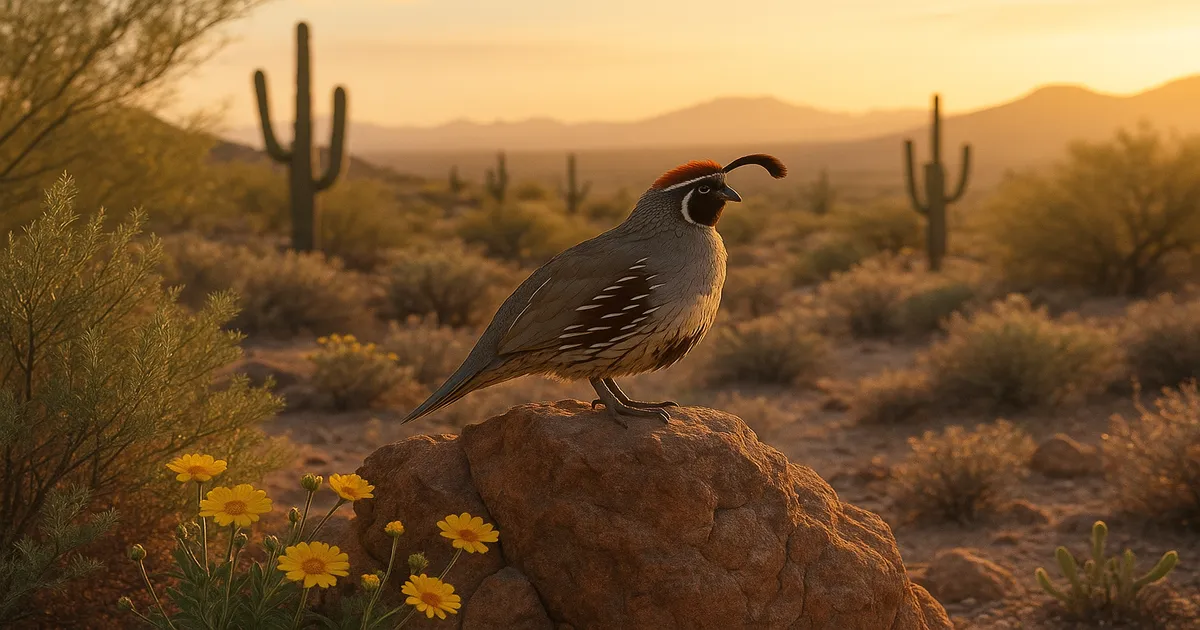
- Gambel’s Quail (Callipepla gambelii) — scaled-patterned with a topknot plume; travels in charming coveys
- Gila Woodpecker (Melanerpes uropygialis) — saguaro specialist with a zebra-striped back
- Gilded Flicker (Colaptes chrysoides) — golden-shafted Sonoran specialty; excavates saguaro nest cavities
- Greater Roadrunner (Geococcyx californianus) — the streaky ground cuckoo that will occasionally jog through your yard and make your whole morning
Understanding Crimson Desert Habitat
The Four Desert Biomes of the American Southwest
The “crimson desert” spans four distinct biomes, each with its own bird community.
- Sonoran Desert (southern Arizona, northwest Mexico): The most biologically diverse North American desert; defined by saguaro, palo verde, and cholla; home to Gila Woodpecker, Gilded Flicker, Gambel’s Quail, Pyrrhuloxia, and Vermilion Flycatcher
- Chihuahuan Desert (southern New Mexico, west Texas, northern Mexico): Dominated by mesquite scrub, lechuguilla, and desert grassland; the core range of Pyrrhuloxia; excellent for Curve-billed Thrasher
- Mojave Desert (southern Nevada, southeastern California): Defined by Joshua tree woodland; slightly cooler and drier; supports Gambel’s Quail and House Finch
- Great Basin Desert (Nevada, Utah, western Colorado): Cold-winter sagebrush desert with pinyon-juniper at its edges; Cassin’s Finch territory
Vegetation and Elevation
Desert washes — dry arroyos lined with mesquite, desert willow, and hackberry — are the biodiversity hotspots of any desert landscape. They concentrate water, insects, and fruit, which means they concentrate birds. If your property borders a wash, that’s where you’ll see the most action.
Dense thorny thickets of cholla, catclaw acacia, and prickly pear are equally valuable. Pyrrhuloxia, Curve-billed Thrasher, and Gambel’s Quail depend on this kind of cover for nesting and roosting.
Elevation matters, too. Pyrrhuloxia and Vermilion Flycatcher are most reliable below about 4,000 feet (1,219 m). Cassin’s Finch appears at higher desert edges, typically above 5,000 feet (1,524 m). Knowing your elevation sets realistic expectations for which species will respond to your efforts.
Native Plants: The Foundation of a Desert Bird Garden
No feeder setup beats a yard full of the right native plants. These are the workhorses:
- Mesquite (Prosopis spp.) — seeds, insects, and nesting cover; Pyrrhuloxia’s favorite tree
- Palo verde (Parkinsonia spp.) — excellent nesting cover; attracts insects that feed flycatchers and warblers
- Desert hackberry (Celtis pallida) — small orange berries that thrashers and mockingbirds devour
- Wolfberry (Lycium spp.) — dense thorny shrub with red berries; beloved by Curve-billed Thrasher and Pyrrhuloxia
- Prickly pear (Opuntia spp.) — fruit taken readily by Gambel’s Quail, thrashers, and Pyrrhuloxia
- Saguaro (Carnegiea gigantea) — provides nest cavities for Gila Woodpecker and Gilded Flicker; once those woodpeckers move on, Elf Owls and other cavity nesters move in
- Cholla (Cylindropuntia spp.) — the desert’s best nesting fortress: dense, spiny, nearly impenetrable to predators
- Catclaw acacia (Senegalia greggii) — seed production and thorny cover
The Arizona Native Plant Society (aznps.com) maintains excellent regional planting guides. Check their resources before buying anything at a nursery — regional ecotypes matter more than most people realize.
What to avoid: Buffelgrass (Cenchrus ciliaris) is the single biggest landscaping threat to desert bird habitat. It carries fire into native shrublands that evolved without regular fire, killing the mesquite and palo verde that birds depend on. Remove it wherever you find it. Non-native turf grass is similarly harmful — it replaces diverse native scrub with a biological dead zone.
How to Attract Birds in Crimson Desert: Feeders and Food
Best Feeder Types
Platform feeders and hopper feeders with wide trays are the right call for most desert species. Pyrrhuloxia, Gambel’s Quail, and Curve-billed Thrasher all prefer ground or low-level feeding — a raised tube feeder with tiny perches won’t cut it for them. A wide, low platform feeder like the Woodlink Going Green Platform Feeder works well here.
Tube feeders suit House Finch and Cassin’s Finch, which are comfortable clinging to small perches. The Droll Yankees Onyx Clever Clean Finch Magnet is a solid, easy-to-clean option. For Gila Woodpecker and Gilded Flicker, add a suet cage near a saguaro or large tree.
Top Seed and Food Choices
- Black-oil sunflower seeds — the universal desert feeder seed; attracts Pyrrhuloxia, House Finch, Cassin’s Finch, and more
- Safflower seeds — Pyrrhuloxia takes these readily; squirrels typically ignore them
- Cracked corn — scatter it on the ground or a low tray for Gambel’s Quail and Curve-billed Thrasher
- Suet — Gila Woodpecker and Gilded Flicker will visit suet cakes, especially in cooler months
Placement and Seasonal Timing
Place feeders within 3 feet (0.9 m) of a window or more than 30 feet (9 m) away — the middle distance is where window strikes happen most. Dense shrub cover within 10 feet (3 m) gives birds an escape route from hawks. Partial shade matters in the desert; direct sun in July will turn seeds rancid fast.
Summer feeding is most productive in the first two hours after sunrise and the two hours before sunset. Midday, birds are in the shade and feeders go quiet. Adjust your refill schedule accordingly — loading feeders at noon in August is mostly feeding the heat. Winter activity spreads more evenly through the day, and you may see larger flocks as birds congregate around reliable food sources.
Water Features: The Single Most Powerful Tool for How to Attract Birds in Crimson Desert
If you only do one thing, put in a water feature with movement. A still birdbath is fine, but a dripper, wiggler, or recirculating fountain that produces sound and surface motion will pull birds from a surprising distance. In an environment where water is genuinely scarce, birds are tuned to the sound of it — they’ll find a dripper before they find your feeders.
Keep the basin shallow: 1 to 2 inches (2.5 to 5 cm) deep is ideal. A textured bottom — rough stone or a piece of bark — gives birds confident footing. Ground-level features or low pedestal designs work best for Gambel’s Quail and Pyrrhuloxia, which are reluctant to use tall, exposed birdbaths. A heated dripper model like the Allied Precision Industries Heated Bird Bath keeps water accessible through cold snaps and adds the surface movement that draws birds in.
A solar-powered recirculating fountain is a low-maintenance alternative that also keeps water fresher between changes. The AISITIN Solar Bird Bath Fountain Pump is inexpensive and reliable in the Southwest’s abundant sun.
Change the water daily in summer — not weekly, daily. Standing water in desert heat breeds mosquitoes fast and grows algae that birds find unappealing. Scrub the basin with a stiff brush every few days. This is where most desert water setups fail: people install a great feature and then let it go stagnant.
Pyrrhuloxia, Gambel’s Quail, Vermilion Flycatcher, and Greater Roadrunner are all reliably drawn to water in desert yards. Place a natural-looking perch — a branch or flat rock — near the water’s edge. It gives birds a staging spot before they drink and gives you a clean photo opportunity.
Behavior and Seasonality
Year-Round Residents vs. Seasonal Visitors
Several of the best desert yard birds are permanent residents — present 365 days a year if the habitat is right. These include Pyrrhuloxia, Cactus Wren, Curve-billed Thrasher, Gambel’s Quail, and Gila Woodpecker. Vermilion Flycatcher is year-round at lower Sonoran Desert elevations but withdraws from the northern and higher portions of its range in winter, typically departing by October and returning by late February or March.
Breeding Season: February Through July
February is when things get loud. Male Pyrrhuloxia start singing from exposed cactus tops at first light, and Vermilion Flycatchers begin their fluttery display flights over open ground. Nesting runs roughly March through July for most desert species, with some — like Gambel’s Quail — capable of raising two broods if conditions are good. This window is when males are most vocal, most visible, and easiest to locate. If you want to photograph crimson desert birds, work the dawn shift from February through May.
Reading Feeder Behavior
Pyrrhuloxia and Gambel’s Quail scratch and forage beneath shrubs and feeders; ground disturbance under your platform feeder usually means something good is visiting. Vermilion Flycatcher won’t use feeders at all — it sallies from low perches to catch insects over open ground, especially near water. Alarm calls (sharp chips from Pyrrhuloxia, loud clattering from Cactus Wren) usually mean a hawk is nearby. When the yard goes suddenly quiet, scan for a Cooper’s Hawk (Accipiter cooperii) or Sharp-shinned Hawk (Accipiter striatus).
A good pair of binoculars makes all of this much more rewarding — the Nikon Monarch M5 8x42 is an excellent mid-range option that handles bright desert light well.
Conservation: Protecting Crimson Desert Bird Habitat
Most crimson desert species are listed as IUCN Least Concern, but that doesn’t mean the pressure isn’t real. Breeding Bird Survey data shows modest but consistent population declines for Pyrrhuloxia in parts of Texas where mesquite clearing for rangeland management removes critical habitat. Invasive buffelgrass is reshaping fire regimes and destroying native shrub communities across the Sonoran Desert. Domestic and feral cats are a serious threat to ground-foraging species like Pyrrhuloxia and Gambel’s Quail — these birds spend most of their time at or near ground level, which makes them easy targets.
Window strikes and pesticide use — which depletes the insect prey that supports nesting birds — round out the primary threats.
What you can do:
- Plant native shrubs and remove buffelgrass
- Keep cats indoors — non-negotiable if you care about ground birds
- Apply window decals or external screens to break up glass reflections; WindowAlert Ultraviolet Liquid is easy to apply and effective
- Stop using broad-spectrum insecticides; the insects they kill are what baby birds eat
The Arizona Native Plant Society (aznps.com) is the best regional resource for native planting guidance. The National Wildlife Federation’s Garden for Wildlife program certifies wildlife-friendly yards and provides planning tools. All native birds — including non-migratory species like Pyrrhuloxia — are protected under the Migratory Bird Treaty Act. For tracking and contributing data, eBird and the Christmas Bird Count are both excellent citizen science tools that help researchers monitor desert bird population trends.
Top Birding Spots for Crimson Desert Birds
Arizona
- Saguaro National Park (West Unit) — Tucson; reliable Pyrrhuloxia, Curve-billed Thrasher, Gambel’s Quail, Gila Woodpecker
- Buenos Aires National Wildlife Refuge — southern Arizona; excellent for Pyrrhuloxia and Vermilion Flycatcher along riparian corridors
- Madera Canyon — Santa Cruz County; outstanding all-around desert birding with good Vermilion Flycatcher numbers along the creek
- Patagonia-Sonoita Creek Preserve — one of the best riparian birding sites in the country; Vermilion Flycatcher is nearly guaranteed
Texas
- Big Bend National Park — Trans-Pecos Texas; Pyrrhuloxia, Vermilion Flycatcher, and Curve-billed Thrasher all present
- Bentsen-Rio Grande Valley State Park — south Texas; excellent for Pyrrhuloxia in brush country habitat
- Kickapoo Cavern State Park — Edwards Plateau; reliable Pyrrhuloxia in dense thorny scrub
New Mexico and Nevada
- Bosque del Apache NWR surroundings — the desert scrub edges around this famous refuge hold Pyrrhuloxia and Curve-billed Thrasher year-round; Vermilion Flycatcher is present along the Rio Grande corridor spring through fall
- Henderson Bird Viewing Preserve, Nevada — reliable desert water birding in the Mojave; good for Gambel’s Quail and migrant species
Frequently Asked Questions
What is the easiest way to attract Pyrrhuloxia to my yard? Water first, then food. A dripper or wiggler on a shallow birdbath will pull Pyrrhuloxia in faster than any feeder. Once they’re coming for water, add a platform feeder with black-oil sunflower or safflower seeds at ground level or low height.
Will Vermilion Flycatchers come to feeders? No — Vermilion Flycatchers are insectivores and won’t visit seed or suet feeders. Your best strategy is to provide open ground near water, which gives them hunting perches and a reliable water source. Stop using insecticides in your yard and you’ll naturally increase the insect prey that draws them in.
How do I keep my birdbath from going stagnant in desert heat? Change the water daily and scrub the basin with a stiff brush every two to three days. A solar-powered recirculating pump keeps water moving and significantly slows algae growth. In peak summer, even a pump won’t substitute for daily water changes.
Which desert birds are active in summer midday heat? Almost none. Most desert birds go quiet between roughly 10 a.m. and 4 p.m. in summer. Gambel’s Quail may move to shaded areas near water, and Greater Roadrunner is sometimes active midday, but feeder activity drops sharply. Plan your watching for the first two hours after sunrise.
Do I need a field guide specific to the Southwest? A regional guide makes a real difference. Birds of Arizona by Richard Cachor Taylor or the National Geographic Field Guide to the Birds of North America both cover desert species well. For digital use, the Merlin Bird ID app from Cornell Lab is free and excellent for on-the-spot identification.