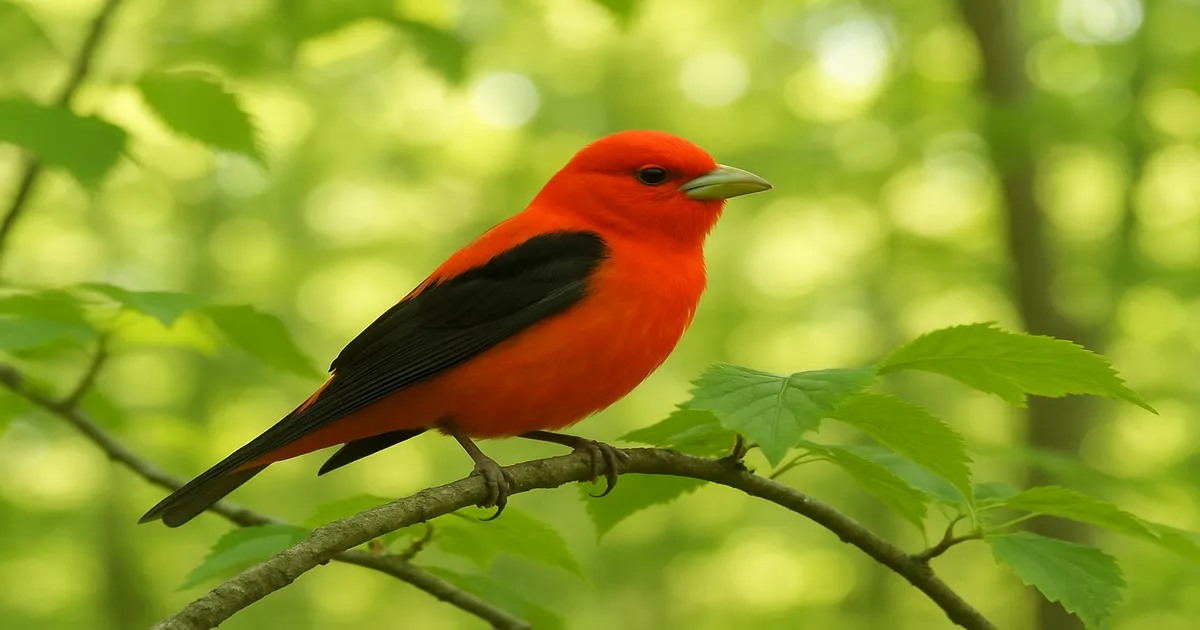
Quick Answer: Tanagers are medium-sized songbirds, roughly 6.7–8 inches long, best known for the stunning reds, oranges, and yellows of breeding males. North America has four species — Scarlet, Western, Summer, and Hepatic — each with distinct color patterns, while females of all four are cryptic olive-yellow and easily overlooked. If you’re trying to figure out what a tanager bird looks like, start with the male’s vivid plumage, then use bill shape and wing bars to seal the ID.
Quick Reference: North America’s Four Tanager Species
| Species | Male Color | Female Color | Wing Bars | Bill |
|---|---|---|---|---|
| Scarlet Tanager | Red body, black wings & tail | Olive-yellow, dark wings | None | Thick, pale |
| Western Tanager | Yellow body, orange-red head | Dull yellow-green | Two (yellow + white) | Long, pointed |
| Summer Tanager | All rose-red | Mustard-yellow | None | Large, curved, pale |
| Hepatic Tanager | Brick-red, gray cheeks | Olive-gray | None | Heavy, dark-tipped |
One taxonomic note worth knowing: these four were historically grouped in the family Thraupidae alongside 400+ tropical tanager species. Genetic work has since moved them into Cardinalidae — the same family as cardinals and grosbeaks — though everyone still calls them tanagers.
What Does a Tanager Bird Look Like? The Four North American Species
Scarlet Tanager: Flame-Red Body, Jet-Black Wings
The Scarlet Tanager (Piranga olivacea) is about 6.7 inches (17 cm) long with an 11.4-inch (29 cm) wingspan. It’s compact and round-headed, with a thick pale bill suited to both insects and fruit. The breeding male is one of the most visually arresting birds in North America — flame red against jet black, wings and tail, like something that escaped from a rainforest. Nothing else in the East looks quite like it.
Western Tanager: Yellow Body With an Orange-Red Head
The Western Tanager (Piranga ludoviciana) runs slightly larger at 7.5 inches (19 cm). Its bill is longer and more pointed than the other three — a subtle but reliable field mark once you’ve seen a few. The male’s orange-red head comes from rhodoxanthin, a rare pigment the bird can’t produce itself and must obtain from its diet, likely from certain insects and berries. No other North American tanager combines a yellow body with a distinctly colored head.
Summer Tanager: The Only All-Red Bird in North America
The Summer Tanager (Piranga rubra) is the largest of the four at 7.5 inches (19 cm) with a 12-inch (30 cm) wingspan. Its bill is the biggest and most curved of the group — built for a very specific purpose covered in the behavior section below. The male is entirely rose-red with no black anywhere, which makes it unique among North American birds. If you see a solid red bird with no crest and no black, you’ve got a Summer Tanager.
Hepatic Tanager: Brick-Red With Distinctive Gray Cheeks
The Hepatic Tanager (Piranga flava) is the most robust of the four at 8 inches (20 cm) and the one most likely to be overlooked by eastern birders who never venture into the Southwest mountains. Males are brick-red rather than the brighter rose-red of Summer Tanager, with gray flanks and cheeks that set them apart immediately. That dark-tipped gray bill is your fastest field mark in the field.
Plumage Guide: Males, Females, and Juveniles
Breeding Males: Peak Colors Explained
Scarlet and Summer Tanager males both get their red from carotenoid pigments acquired through diet — which means diet quality can affect how vivid a bird looks. Western Tanager’s orange-red head is chemically different, derived from rhodoxanthin, a pigment found in certain insects and fruits that very few North American birds use. Hepatic males are the dullest of the four, their brick-red muted by gray on the flanks and face.
Non-Breeding and Fall Plumage: Where IDs Get Hard
Fall is where tanager identification earns its reputation for difficulty. Male Scarlet Tanagers molt into eclipse plumage — a yellow-green body that could pass for a large warbler or vireo if you’re not paying attention. The black wings are retained year-round, though, so that contrast is always your anchor. Western Tanager males simply fade: the orange-red head goes yellowish, but the wing bars and yellow body persist. A yellow-green bird with black wings in September? Almost certainly a Scarlet.
Female Tanagers: Subtle but Identifiable
All four females are variations of olive-yellow to olive-gray, and they’re genuinely hard. The single most useful mark: female Western Tanager has two wing bars; the other three don’t. Female Hepatic is the grayest of the bunch, with a noticeably dark bill. Female Summer tends toward a warmer mustard-yellow, and some individuals show patchy orange blotching. Female Scarlet is cooler and greener, with darker wings that echo the male’s pattern.
A good field guide helps enormously here. The Sibley Guide to Birds has the best comparative plates for female tanagers of any guide currently in print.
Juvenile Tanagers: Patchy and Confusing
Young male Summer Tanagers are notorious for mosaic plumage — blotchy patches of red and greenish-yellow that look like the bird can’t decide what it wants to be. Young Hepatics show faint breast streaking, unusual for this group. Most juveniles resemble females until their first fall, when young males begin acquiring adult-type feathers.
Key Field Marks: How to Tell Tanagers Apart
Wing Bars: The Fastest Split in the Group
Western Tanager — both male and female — has two prominent wing bars. The other three species lack them entirely. If you see a tanager with wing bars, you’ve already narrowed it to one species.
Bill Shape and Color
Bills are underrated in tanager ID:
- Hepatic: Heavy, dark-tipped gray bill — unique in the group
- Summer: Largest and most curved, pale yellowish-horn — built for catching bees
- Western: Longest and most pointed — almost finch-like
- Scarlet: Thick and pale, the most generalist shape of the four
Calls: Your Best Tool in Dense Forest
In leafy summer canopy, you’ll often hear a tanager long before you see one. These calls are worth memorizing:
- Scarlet Tanager: A two-note chip-burr — raspy and distinctive
- Western Tanager: A three-syllable pit-er-ick — the extra note is the tell
- Summer Tanager: A rattling pik-i-tuk or chicky-tucky-tuck — unmistakable once you know it
- Hepatic Tanager: A soft single chup — quieter and more understated than the others
Learn the Scarlet’s chip-burr before your first spring migration walk in the East. You’ll find birds you’d otherwise walk right past.
Where to Find Tanagers: Habitat and Range
Scarlet Tanager: Eastern Deciduous Forest Interior
Scarlet Tanagers breed across eastern North America from the Great Plains to the Atlantic, preferring mature, unbroken oak-dominated forest over edges or scrubby second growth. They’re interior forest birds — a small fragmented woodlot won’t cut it. Breeding elevation runs from sea level up to about 3,500 feet (1,067 m) in the Appalachians. Come fall, they cross the Gulf of Mexico to wintering grounds in northwestern South America.
Western Tanager: Mountain Conifer Forests of the West
Western Tanagers breed in coniferous and mixed mountain forests from Alaska south through the Rockies and Cascades, typically at 3,000–10,000 feet (914–3,048 m). They’re one of the most widespread western migrants and regularly turn up east of their normal range during fall — which surprises a lot of birders. Most winter in Mexico and Central America, though small numbers linger in southern California and Arizona.
Summer Tanager: Open Woodlands and Riparian Corridors
Summer Tanagers occupy two distinct habitats depending on region. In the Southeast, look for them in open oak-pine woodlands. In the Southwest, they favor cottonwood-willow riparian corridors along rivers and streams. They’re a lowland species, rarely above 6,000 feet (1,829 m), and they winter from Mexico through northern South America.
Hepatic Tanager: High-Elevation Pine-Oak Mountains
Hepatic Tanagers are the most narrowly distributed of the four in the U.S., strongly tied to ponderosa pine and mixed conifer zones in Arizona, New Mexico, western Texas, and small parts of Colorado and Utah. Their sweet spot is 5,000–9,000 feet (1,524–2,743 m). If Scarlet Tanager is the eastern birder’s prize, Hepatic is the Southwest mountain equivalent. Summer and Hepatic can overlap in elevation in the Southwest, so pay attention to bill color and the exact shade of red.
Tanager Behavior: What to Watch For in the Field
Foraging in the Canopy
All four species work the mid-to-upper canopy, gleaning insects from leaves and moving deliberately through the foliage. Western and Scarlet Tanagers also sally out flycatcher-style to snatch flying insects. Hover-gleaning — briefly hovering at a leaf cluster — rounds out their toolkit. A binocular with close-focus capability makes a real difference when birds are working branches overhead. (Vortex Optics Viper HD 8x42)
The Summer Tanager’s Bee and Wasp Specialization
This is one of the most remarkable feeding behaviors in North American birds. Summer Tanagers catch bees and wasps in flight, then rub them vigorously against a branch to remove the stinger before swallowing. They’ll also raid active nests to eat larvae. That oversized curved bill isn’t an accident — it’s the tool that makes this whole strategy work.
Migration Timing
Scarlet Tanagers are nocturnal broad-front migrants, with many crossing the Gulf of Mexico in a single overnight flight. Spring arrivals hit the Gulf Coast in late April, pushing north through May. Western Tanagers move along the Pacific Coast and through the Great Basin on a similar schedule. Fall departures for all four species run August through October, with most birds gone from North America by November.
Nesting
Females build shallow, loosely woven cup nests on horizontal branches, typically 10–30 feet (3–9 m) up and often surprisingly far from the trunk. The nests are so flimsy you can sometimes see the eggs through the bottom. Clutch size is 3–5 pale blue-green spotted eggs; the female incubates for about 13–14 days while the male feeds her and sings from exposed canopy perches. Dawn is your best window for spotting males — they sing persistently from high, visible perches at first light.
Attracting Tanagers: Feeders, Food, and Garden Tips
Skip the seed feeders entirely — tanagers almost never visit them. What actually works:
- Halved oranges, bananas, and grapes on a platform feeder (same setup as for orioles)
- Grape jelly — surprisingly effective during spring migration
- Live or dried mealworms — particularly good for Summer Tanager
- Mulberries, elderberries, and serviceberries planted in your yard will draw them more reliably than any feeder
Open platform or tray feeders at mid-height near tree cover are your best bet. Enclosed tube feeders won’t work — tanagers need space to land and aren’t built for clinging. Position feeders where birds can retreat quickly to cover; they’re wary in the open.
A birdbath with a dripper or mister often beats food entirely. Moving water draws tanagers strongly, especially during migration stopovers when birds are tired and need to bathe and drink. Spring migration — April through May — is your best shot at feeder and bath visits. Treat any tanager at your setup as a bonus, not a regular occurrence.
Conservation Status and How to Help
All four species are currently listed as Least Concern by the IUCN, but the Scarlet Tanager’s situation deserves attention. Population estimates sit around 2.2 million birds with a downward trend, driven by forest fragmentation in the East and deforestation on South American wintering grounds. Western Tanager is more stable at roughly 7 million birds. Threats cutting across all four species include climate-driven mismatches between migration timing and insect availability, and collisions with windows and buildings during nocturnal migration.
Real things you can do:
- Support forest conservation organizations working in both North and South America
- Plant native fruiting shrubs — elderberry (Sambucus spp.), serviceberry (Amelanchier spp.), and mulberry (Morus spp.) are all solid choices
- Reduce window collisions with decals or tape on large glass surfaces (WindowAlert UV Liquid)
- Log your sightings on eBird — citizen science data directly informs conservation planning
- Use playback sparingly and never near active nesting territories; repeated playback causes genuine stress to territorial birds
Frequently Asked Questions: What Does a Tanager Bird Look Like?
What does a female tanager bird look like?
Female tanagers are olive-yellow to olive-gray overall, with no red or orange coloration. They’re easy to overlook in foliage. The most useful mark for separating them: female Western Tanager has two wing bars, while female Scarlet, Summer, and Hepatic do not. Female Hepatic is the grayest; female Summer tends toward a warmer mustard-yellow.
How do I tell a Scarlet Tanager apart from a Summer Tanager?
Look for black. Male Scarlet Tanagers have jet-black wings and tail contrasting with a red body. Male Summer Tanagers are entirely rose-red — no black anywhere — making them the only all-red bird in North America. In females, Summer runs warmer and more mustard-yellow, Scarlet cooler and more olive-green, and Summer’s bill is noticeably larger and more curved.
What bird is entirely red with no black markings?
The Summer Tanager. Males are rose-red from bill to tail with no black on the wings or body. This separates them immediately from the Scarlet Tanager (always shows black wings and tail) and from the Northern Cardinal (prominent crest, thick orange-red bill, black face mask).
Do tanager birds visit backyard feeders?
Not regularly, but they do show up — especially during spring migration in April and May. A platform feeder with halved oranges, grape jelly, or mealworms placed near tree cover gives you the best shot. A birdbath with a dripper often works better than food.
What does a tanager bird look like in fall?
Male Scarlet Tanagers molt into eclipse plumage — a yellow-green body that looks nothing like their breeding colors, though the black wings are always retained. Western Tanager males fade from orange-red to yellowish on the head, but the wing bars persist. Most tanagers are on wintering grounds in Mexico, Central America, or South America by November, so fall sightings in North America typically involve birds in transitional or muted plumage.