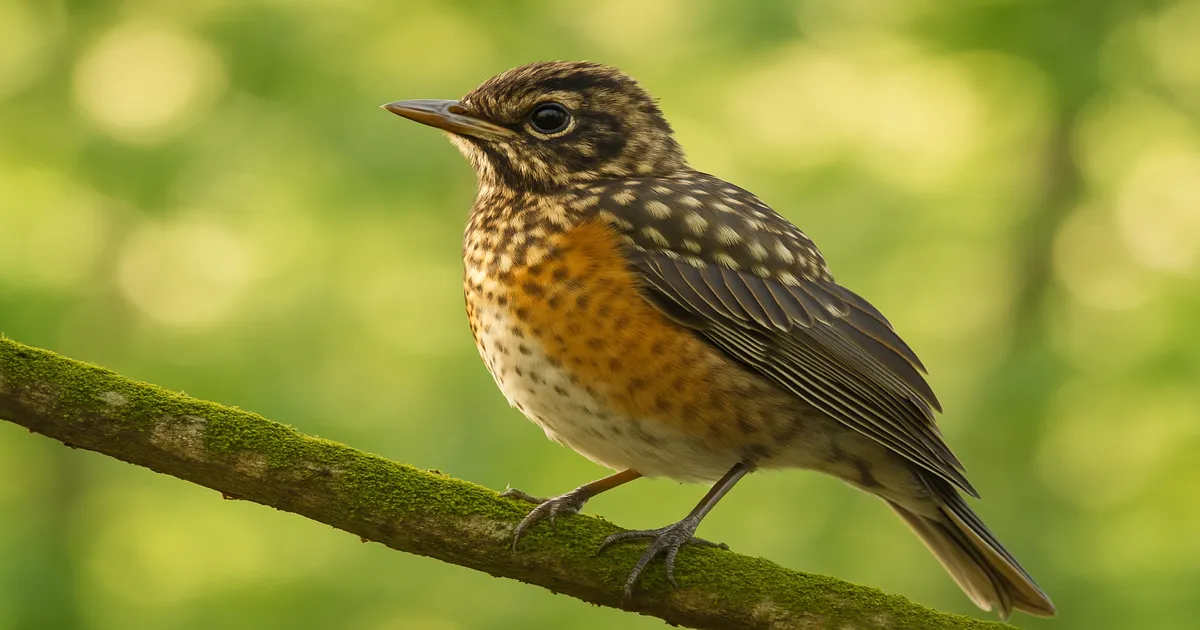
Quick Answer: If you’re asking why does this robin look like that, the most likely explanation is completely normal — you’re probably seeing a juvenile, a female, or a bird in mid-molt. Abnormal plumage like leucism is possible but rare. Use the sections below to match what you’re seeing to one of six common causes.
The American Robin (Turdus migratorius) is one of the most familiar birds in North America, yet it generates genuine confusion on a regular basis. People who’ve watched robins their whole lives suddenly spot one that looks spotted, pale, patchy, or almost white — and they want answers. This guide covers every reason a robin might look “wrong,” plus a few look-alike species that aren’t robins at all.
Why Does This Robin Look Different? The Six Most Common Reasons
- Juvenile plumage — spotted orange-buff breast, brown back, no black head
- Female coloration — pale orange breast, dark gray (not black) head
- Molt and feather wear — faded, patchy, or asymmetrical in late summer
- Abnormal pigmentation — leucism, albinism, or rare variants
- A look-alike species — Varied Thrush, towhee, or a spotted thrush
- Unusual behavior — fermented berries, window attacks, winter flocks
How to Use This Guide
First, confirm you’re actually looking at a robin. American Robins are about 9–11 inches (23–28 cm) long, with an upright posture, a stout yellow-orange bill, and that familiar run-stop-tilt behavior on lawns. If your bird matches that basic profile but looks off, jump to the section that fits your situation. If the bill is different or the bird is scratching in leaves, skip to Reason #5.
What a Standard Adult Male Robin Looks Like
The textbook adult male is what most people picture — but here’s the thing: most robins you actually encounter won’t look exactly like him. That’s the whole reason you’re here.
His field marks:
- Breast: Deep brick-red to burnt-orange, from throat to lower belly
- Head: Jet-black with broken white eye-rings (partial crescents above and below the eye)
- Back and wings: Slate-gray to dark brownish-gray
- Throat: Black with white streaking
- Undertail coverts: White
- Tail: White corners that flash in flight
Robins stand upright and run in short bursts, pausing to tilt and scan. That posture — confident, alert, ground-level — is as diagnostic as any field mark. Wingspan runs 12–16 inches (31–41 cm), and the bird weighs roughly 2.7–3.0 oz (77–85 g). The yellow-orange bill is stout and straight, built for pulling earthworms. The white eye-rings are broken, not complete circles — a subtle but useful detail when ruling out other thrushes.
Reason #1: It’s a Juvenile Robin (The Most Common Cause)
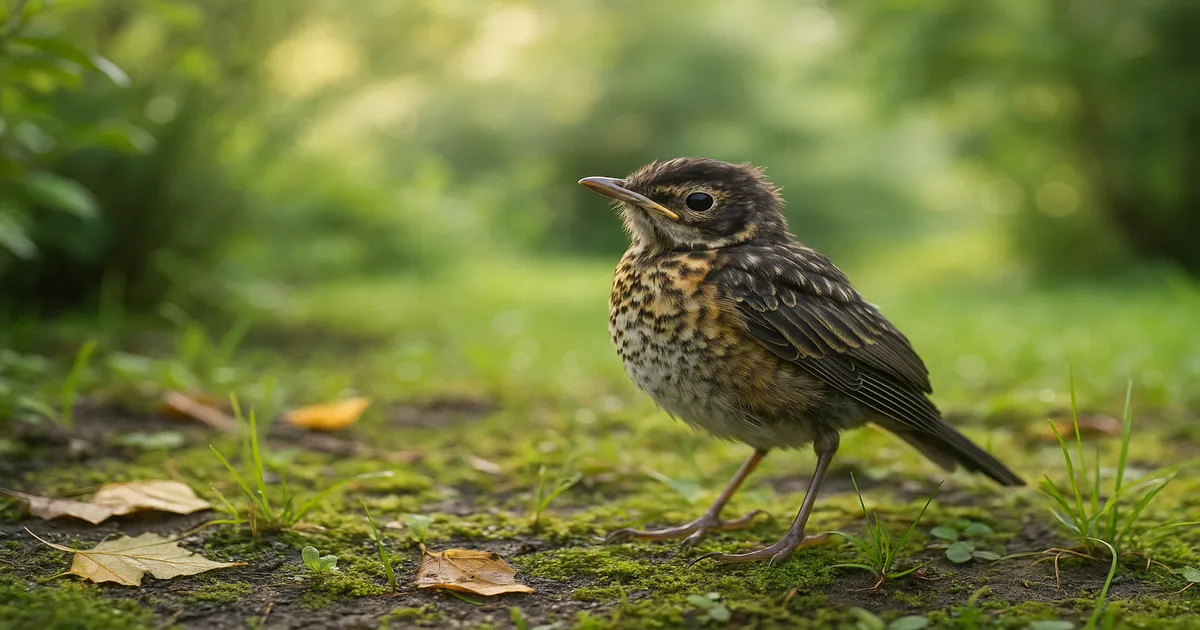
Juvenile robins look so different from adults that people routinely think they’re seeing an entirely different species. The spotted breast is the giveaway — pale orange-buff heavily marked with dark brown or black spots across the entire chest. The back is brown with pale buff streaking, the head is brown rather than black, and the bill is duller than an adult’s.
This spotted pattern isn’t a defect. It’s an ancestral thrush trait shared by all young thrushes, a holdover from deep in the family tree.
Juvenile robins start appearing in late May and continue through summer. If you’re seeing a spotted robin in June or July, this is almost certainly your explanation. The spotted phase lasts roughly 4–6 weeks. By late summer most young birds have completed a partial molt and look roughly like adult females, though some retain a few juvenile feathers into fall. August is peak confusion season for this reason.
Juvenile Robin vs. Other Spotted Thrushes
Juvenile robins get confused with Hermit Thrushes, Wood Thrushes, and Swainson’s Thrushes. Here’s how to sort them out:
- Hermit Thrush (Catharus guttatus): Much smaller (about 6.75 inches/17 cm); spots on a white or buff breast, not orange; pumps its tail slowly — a dead giveaway
- Wood Thrush (Hylocichla mustelina): Heavy round spots on a clean white breast; rufous-brown head; a forest interior bird, not a lawn bird
- Swainson’s Thrush (Catharus ustulatus): Smaller, with a buffy eye-ring; spotted on buff, not orange
The single best clue for juvenile robin ID? Look for adult robins nearby. Juveniles almost always are.
Reason #2: It’s a Female Robin (Paler Than You Expect)
Female robins are genuinely, noticeably paler than males — and I’ve seen experienced birders do a double-take. The key differences:
- Breast: Washed-out orange, significantly less saturated than the male’s deep red
- Head: Dark gray, not black — the most reliable distinction
- Back: Slightly paler gray-brown
- Bill: Same yellow-orange, possibly a touch duller
It comes down to sexual selection. Males benefit from vivid plumage for territory defense and attracting mates. Females, who handle most of the incubation, benefit from being less conspicuous on the nest. A pale, dull-headed robin foraging normally and flying well is almost certainly a healthy female. Sickness shows up in behavior first — fluffed feathers, lethargy, lack of coordination — not just in color. If the bird looks pale but acts fine, trust that.
Reason #3: Molt and Feather Wear
The same individual robin can look dramatically different in April versus August. Spring birds are fresh and vivid; late-summer birds can look washed out, patchy, and honestly a little rough. This is completely normal — just feather wear accumulating over months of use.
Robins go through two main molts:
- Pre-basic molt (late summer/fall): A complete molt — every feather replaced. Birds look their worst just before this finishes.
- Pre-alternate molt (late winter/early spring): A partial molt that freshens colors before breeding. Males come out of this looking their sharpest.
Mid-molt birds can look genuinely bizarre — mismatched head coloration, missing tail feathers, one wing looking darker than the other. If you’re seeing a robin that looks like it can’t decide what plumage it wants, it’s mid-molt. Give it a few weeks.
Why Does This Robin Look White? Leucism, Albinism, and Rare Variants
Leucism is a condition where pigment cells fail to develop properly, producing white patches, a generally pale washed-out bird, or in extreme cases an entirely white robin — with normal dark eyes. It’s rare, but robins with white wing patches or pale splotches on the breast do turn up.
True albinism is rarer still. A genuine albino robin will be fully white with pink or red eyes (from blood vessels showing through unpigmented irises). If the eyes are dark, it’s leucism, not albinism.
Melanistic robins — abnormally dark birds — are extremely rare but documented. Even rarer is gynandromorphism, where a bird shows male plumage on one side and female plumage on the other. If you think you’re seeing one, photograph it carefully and report it on eBird.
Leucistic and albino birds are more visible to predators, and true albinos often have vision problems. These records are genuinely valuable to researchers, so document what you see.
Reason #5: It Might Not Be a Robin — Common Look-Alike Species
Varied Thrush (Ixoreus naevius) is the most visually striking look-alike. It has an orange breast and dark back — but add a bold black band across the chest, an orange eyebrow stripe, and orange wing bars, and you’ve got something quite different. It’s a Pacific Coast and western mountain species that only rarely wanders east. Black chest band plus orange eyebrow equals Varied Thrush, full stop.
Spotted and Eastern Towhees (Pipilo maculatus and Pipilo erythrophthalmus) both have rufous sides and a dark hood, which can fool a quick glance. They’re smaller, have white bellies, and scratch backward in leaf litter rather than running on lawns. Their red eye is also distinctive.
Hermit Thrush and Wood Thrush are worth flagging again for anyone encountering migrants. The Hermit Thrush’s slow, deliberate tail-pumping is one of the most reliable behavioral field marks in North American birding — no other thrush does it quite the same way.
European Robin (Erithacus rubecula) shares a name and an orange breast, but that’s about it. It’s tiny — about 5.5 inches (14 cm) — and the orange is confined to the face and breast. It’s not found in North America except as an extreme vagrant, and it’s actually more closely related to Old World flycatchers than to American thrushes.
A good field guide helps enormously when sorting these out. The Sibley Guide to Birds covers all of them with side-by-side plates that make the differences obvious.
Robin Behavior That Looks Strange (But Isn’t)
Head tilting while foraging looks like the robin is listening for worms, but it’s actually visual. One eye is angled toward the soil surface — robins have monocular vision, so tilting gives them a better look at what’s happening underfoot.
Acting drunk on fermented berries is real and documented. Robins eating overripe, fermenting fruit can become visibly intoxicated — wobbly, disoriented, sometimes unable to fly properly. It passes. If you see a robin staggering near a berry-laden tree in winter, that’s almost certainly why.
Attacking windows happens when a territorial male sees his own reflection and treats it as a rival. He genuinely cannot figure out that the other “robin” isn’t real. Applying external deterrents to the glass — tape, paper, or anti-collision decals — usually breaks the cycle within a few days.
Massive winter flocks surprise people who assume robins have migrated. Many robins don’t migrate south at all — they shift from lawns to wooded areas following berry crops, making them less visible. Winter roosts can hold tens of thousands of birds. If you suddenly see a huge flock in January, they were probably around all along.
Attracting Robins and Watching Them Well
Robins don’t use tube feeders and won’t eat seeds. If you want to attract them, a pesticide-free lawn is the single most effective thing you can do. Beyond that: a birdbath with moving water works well, since robins are strongly drawn to drippers and misters; a platform feeder stocked with mealworms, halved apples, soaked raisins, or blueberries; and berry-producing native plants like holly, dogwood, crabapple, and hawthorn.
Once you’ve got robins in the yard, a decent pair of binoculars makes watching them — and sorting out juveniles from females from molting birds — much more satisfying. (Nikon Monarch M5 8x42)
Conservation Notes
The American Robin is listed as Least Concern by the IUCN, with a population estimated around 300 million individuals. That said, long-term monitoring shows a gradual declining trend, and the threats are real: outdoor cats (estimated 1.3–4 billion bird kills annually in the U.S.), window strikes (600 million to 1 billion collisions per year), and pesticides. Robins were among the first documented casualties of DDT — Rachel Carson wrote about them in Silent Spring — and today neonicotinoids and rodenticides are the primary concerns.
Robins are also a primary reservoir host for West Nile Virus. Infected mosquitoes bite robins, amplify the virus, and then bite other animals including humans. Robin populations have suffered real mortality during outbreak years.
If you see a leucistic, albino, or otherwise unusual robin, report it on eBird with photos. Participating in the Christmas Bird Count is another concrete way to contribute. Robins are protected under the Migratory Bird Treaty Act — it’s illegal to harm, capture, or possess them.
Frequently Asked Questions
Why does my robin have a spotted breast instead of an orange one?
A spotted breast almost always means you’re looking at a juvenile. Young robins keep their spotted plumage for about 4–6 weeks after leaving the nest, appearing from late May through summer. The spots are an ancestral thrush trait — all young thrushes are spotted. Look for adult robins nearby to confirm.
Why is this robin so pale — is it sick?
Probably not. A pale robin with a dark gray (not black) head is almost certainly a healthy female. Females are noticeably less vivid than males — it’s normal sexual dimorphism, not illness. A sick bird will show behavioral signs like lethargy, fluffed feathers, or difficulty flying, not just pale coloration.
Why does this robin look white or have white patches?
White patches or a washed-out appearance point to leucism — a condition where pigment cells don’t develop properly. A fully white bird with pink eyes would be a true albino, which is rarer still. Both conditions are worth documenting; photograph the bird and report it on eBird.
Why is a robin attacking my window over and over?
He’s seeing his own reflection and treating it as a territorial rival. Male robins are aggressively territorial during breeding season and can’t recognize themselves in glass. Covering the outside of the window with tape or paper usually resolves it within a few days once the “rival” disappears.
Is a baby robin on the ground injured?
Almost certainly not. Fledglings are supposed to be on the ground — they leave the nest before they can fly well, and their parents are still feeding them nearby. Only move the bird if it’s in immediate physical danger (a cat, a road), and place it in nearby cover rather than bringing it inside.