Quick Answer: House Finches (Haemorhous mexicanus) are tuned into a surprisingly rich acoustic world — they’re listening for mate-quality signals in rival males’ songs, tracking flock movements through constant contact calls, and eavesdropping on other species’ alarm calls. Urban birds have even shifted their singing pitch upward to cut through traffic noise. If you’ve ever wondered what are these house finches hearing at your feeder, the answer is: a lot more than you’d expect.
If you’ve spent any time watching a feeder flock, you’ve probably asked yourself: what are these house finches hearing? They twitch at sounds you can’t detect, scatter before you spot a hawk, and carry on a nonstop conversation in chips and warbles. That’s not random fidgeting — it’s a sophisticated acoustic social life playing out in real time. Understanding it makes watching them dramatically more interesting.
What Are These House Finches Hearing, Exactly?
House Finches are processing several distinct channels of sound at once. Males monitor rival songs for territorial cues. Females evaluate those same songs as health and quality indicators. The whole flock tracks each other’s “wheet” contact calls to stay coordinated. And everyone listens for alarm calls from other species — particularly Black-capped Chickadees (Poecile atricapilla) — that signal an incoming predator.
Once you know what they’re responding to, feeder behavior starts making sense. That sudden freeze before a scatter? Someone heard something. The male singing from the utility wire? He’s broadcasting fitness data to every finch in earshot.
House Finch Identification: Knowing Who’s at Your Feeder
Before you can read their behavior, you need to know who you’re watching.
Male House Finch
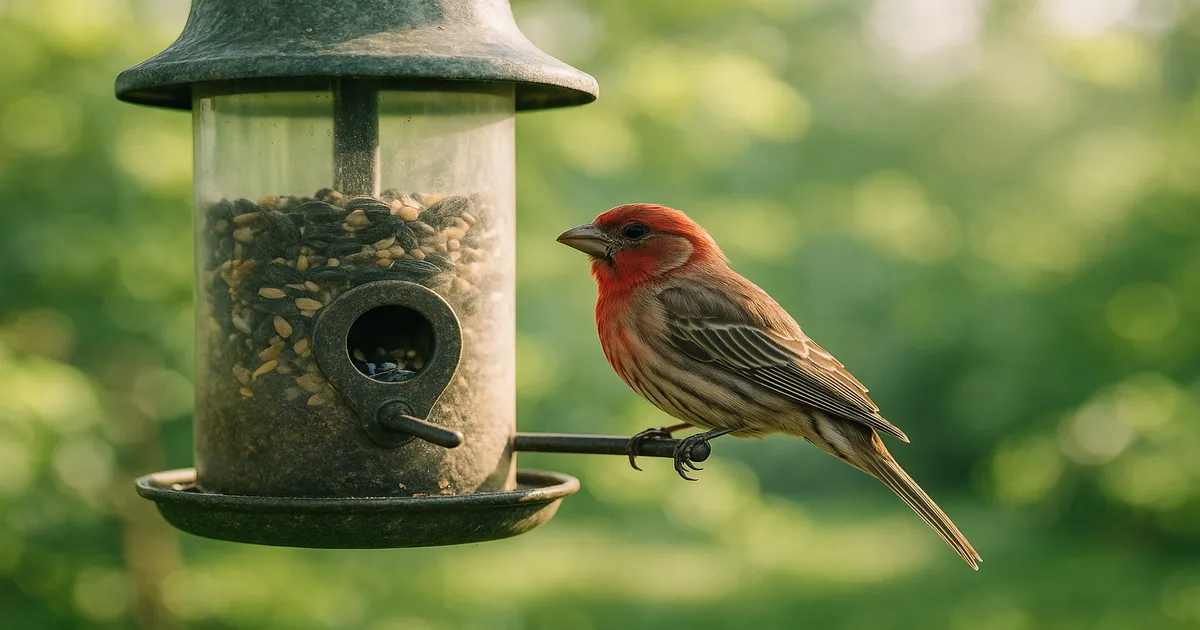
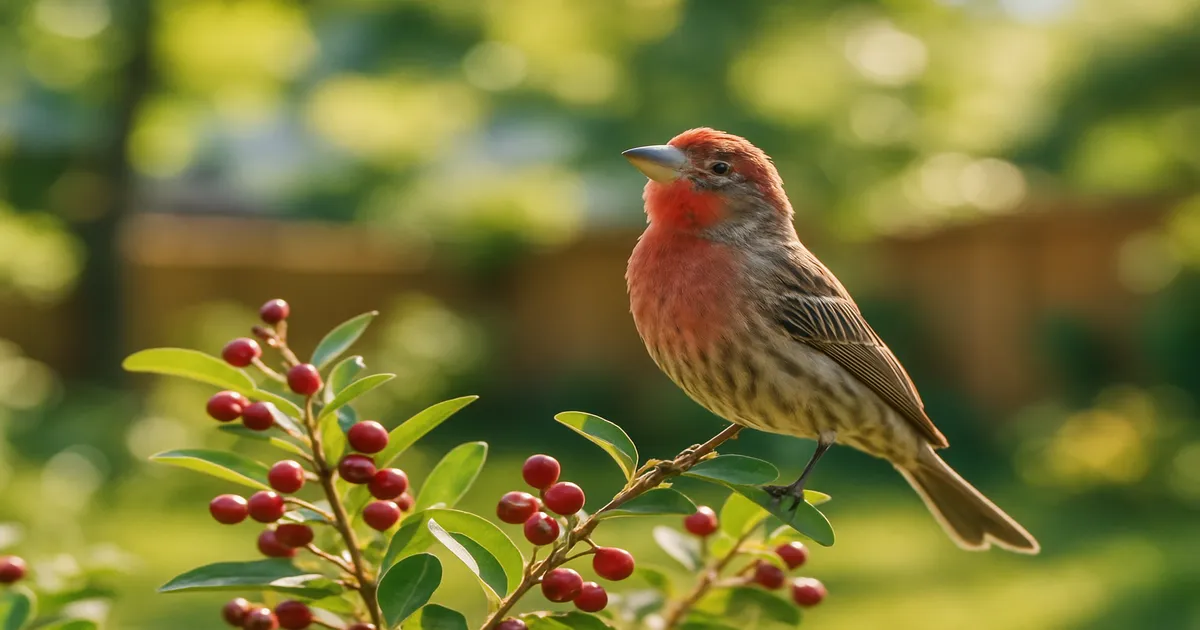
The male is about 5.0–5.5 inches (12.5–14 cm) long with a compact body, short notched tail, and a conical bill that curves noticeably along the upper ridge — that “Roman-nosed” profile is one of the best field marks. His forehead, eyebrow, throat, breast, and rump are washed in red, though the shade ranges from deep crimson to pale orange depending on the carotenoid content of his diet during molt. Back and flanks are brown and heavily streaked. No wing bars.
Female House Finch
She’s brown, streaky, and easy to dismiss as a sparrow. The key is her face: plain. No bold supercilium, no strong facial pattern — just an evenly streaked, unremarkable face that experienced birders call “blank.” That blank face, combined with the curved bill and heavily streaked underparts, separates her from most look-alikes.
Juveniles and First-Year Males
Juveniles look like adult females. Young males start picking up patchy reddish tones during their first fall partial molt, but the color is often washed-out and blotchy. Full adult male plumage typically comes in by the second fall — so don’t be surprised by odd-looking birds at your winter feeder.
Key Field Marks at a Glance
| Feature | Male | Female |
|---|---|---|
| Size | 5.0–5.5 in (12.5–14 cm) | Same |
| Bill | Curved, conical, “Roman-nosed” | Same |
| Head/breast color | Red (variable intensity) | Plain brown |
| Facial pattern | Red supercilium, brown cheek | Plain, unstreaked (“blank”) |
| Flanks | Brown streaked | Brown streaked |
| Wing bars | None | None |
A good pair of binoculars makes all the difference when you’re sorting out these field marks at feeder distance. (Nikon Monarch M5 8x42)
The Acoustic World of the House Finch
This is where things get genuinely fascinating.
Song Structure and Dialects
The male’s song is a bubbly, cheerful warble lasting about 3 seconds — variable, slightly disorganized, and ending with a distinctive slurred note that rises or falls. That final slur is diagnostic; once you learn it, you’ll pick House Finches out of a busy morning chorus immediately. Males sing persistently from exposed perches — utility wires, rooftops, treetops — especially from late winter through summer.
Songs are learned, not innate. Males copy elements from their fathers and from neighboring males, which produces regional dialects. Birds in my neighborhood have a slightly different “accent” than birds I hear when traveling — subtle but real once your ear is trained.
Contact Calls: The Flock’s Constant Conversation
The “wheet” — a sharp, rising contact call — is the acoustic glue holding a flock together. You’ll hear it constantly during foraging and almost every time a bird takes flight. A flock of 50 House Finches is a near-continuous stream of “wheet” calls, each bird essentially saying I’m here, where are you? When the calls suddenly stop, pay attention.
How Females Use Song to Choose a Mate
Female House Finches aren’t passive observers of male singing. Research has established that females use song complexity and delivery as a proxy for male health and genetic quality. A male who sings longer, more varied songs is advertising his fitness. Males who are sick or nutritionally stressed sing less and with reduced complexity — information females can apparently detect.
Males Eavesdropping on Rivals
A male singing from a nearby perch isn’t just performing for females — he’s also broadcasting to every other male in range. Rival males track each other’s singing activity and adjust their own behavior accordingly. It’s a constant, low-level acoustic negotiation, and it never really stops during breeding season.
Detecting Sick Neighbors Through Song
One of the more remarkable findings in House Finch research is that birds can distinguish healthy singers from sick ones based on subtle acoustic cues. Birds infected with Mycoplasma gallisepticum — the bacterium behind House Finch eye disease — sing less frequently and with less complexity. Other finches pick up on this. Whether they actively avoid sick singers or simply respond to the reduced signal isn’t fully resolved, but the detection itself is well-documented.
What Are These House Finches Hearing From Other Species?
House Finches don’t only listen to other House Finches. They respond to alarm calls from other species — particularly the chickadee’s high-pitched “seet” aerial predator alarm. This cross-species eavesdropping is a smart strategy: a chickadee that spots a Sharp-shinned Hawk is broadcasting useful information to every bird in the neighborhood, and House Finches have learned to tune in.
How Urban Noise Changes House Finch Song
Urban House Finches sing at higher minimum frequencies than their rural counterparts — a well-documented response to low-frequency traffic and mechanical noise that would otherwise mask their songs. Researchers at the Cornell Lab and elsewhere have documented this shift across multiple urban populations. It’s a striking example of rapid behavioral adaptation: birds adjusting their communication in real time to a human-altered acoustic environment.
Habitat, Range, and the Great Eastern Expansion
The House Finch is native to western North America — desert scrub, chaparral, open woodlands, and arid foothills from southern Canada through Mexico. Western birds are comfortable from sea level up to around 6,000 feet (1,830 m) and occasionally higher.
In 1940, a small number of House Finches were being sold illegally in New York City as “Hollywood Finches.” When dealers faced prosecution under the Migratory Bird Treaty Act, they released the birds on Long Island. That tiny founding population — probably just a handful of pairs — eventually colonized all of eastern North America. By the 1990s, the expanding eastern birds had met the native western population across the Great Plains. It’s one of the most dramatic range expansions ever documented for a North American bird, and it all started with a few caged birds set free to avoid a fine.
House Finches thrive in human-modified landscapes: suburbs, urban parks, orchards, farmsteads, and gardens. They avoid dense forest interior and gravitate toward any combination of open ground, shrubby cover, and bird feeders. They’ll nest in hanging baskets, wreaths, building ledges, ornamental shrubs, and cactus in the West. Most are year-round residents, though western mountain populations shift to lower elevations in winter.
Behavior at the Feeder
Outside the breeding season, House Finches are intensely social. Flocks of 50–200+ birds aren’t unusual at productive feeding sites. Brighter red males are dominant — they displace duller males and females at feeders and preferred foraging spots. Carotenoid-rich plumage signals competitive status as much as mate quality.
Males defend a small territory around the nest site, chasing rivals aggressively. But at feeders even a short distance from the nest? They’re surprisingly tolerant. I’ve watched six males feeding within a foot of each other on a platform feeder with minimal conflict. The territorial rules apply to the nest, not the food source.
Activity peaks in the first two hours after sunrise and again in the late afternoon, roughly 3–6 PM. Midday activity drops off, especially in summer heat. If you want to watch flock behavior at its most dynamic, be outside with your coffee at first light.
Diet and Feeder Setup
House Finches are primarily granivorous. Their wild diet includes dandelion, thistle, mustard, knotweed, mulberry, and — in the West — cactus fruit. During breeding season they add some insects, but even nestlings are fed largely on a regurgitated seed slurry, which is unusual among songbirds. Most species switch almost entirely to insects for chick-rearing; House Finches don’t.
Black-oil sunflower seed is my top recommendation — thin shells, high fat content, and House Finches love it. After that: nyjer (thistle) seed in a tube or sock feeder, safflower seeds if you want to discourage starlings and squirrels, white proso millet on a platform, and hulled sunflower chips for a no-mess option.
Tube feeders with multiple ports are my go-to for this species. They cling well and handle a crowd, which matters when your flock shows up twenty birds at a time. Platform feeders work great too and give you a clear view of dominance behavior. Sock feeders are ideal for nyjer.
One thing worth knowing: when a single House Finch lands at your feeder, watch for more. The first arrival signals to the rest of the flock that it’s safe. Within minutes you can go from one bird to twenty.
House Finch vs. Look-Alikes
House Finch vs. Purple Finch
This is the ID challenge that trips up birders at every level. Roger Tory Peterson described the male Purple Finch (Haemorhous purpureus) as “a sparrow dipped in raspberry juice” — that’s the key. The color is more saturated, more uniformly distributed across the head, and distinctly raspberry rather than red. Male House Finches have brown streaking on the flanks; male Purple Finches are much cleaner underneath. The Purple Finch also has a larger, more triangular bill.
Female Purple Finches are strongly patterned with a bold white supercilium and a distinct dark malar stripe — the opposite of the blank-faced female House Finch. If the female has a strong facial pattern, it’s a Purple Finch.
House Finch vs. Cassin’s Finch
Cassin’s Finch (Haemorhous cassinii) overlaps with House Finch in western mountain regions. The male Cassin’s has a bright rose-red cap that contrasts sharply with the brown nape — more cap-like than the diffuse red of the House Finch. Cassin’s also has a longer, more pointed bill and is more likely to turn up in high-elevation conifer forests than at a suburban feeder.
Female House Finch vs. Pine Siskin and Common Redpoll
Pine Siskins (Spinus pinus) are heavily streaked like female House Finches but noticeably smaller, with a thin pointed bill and yellow markings on the wings and tail. Common Redpolls (Acanthis flammea) have a bright red cap, a yellowish bill (House Finches have a dark bill), and are primarily a northern species that irrupts south in winter.
Quick Comparison Table
| Species | Bill | Male color | Female face | Key field mark |
|---|---|---|---|---|
| House Finch | Curved, conical | Red (variable) | Plain, blank | Roman-nosed bill, streaky flanks |
| Purple Finch | Larger, triangular | Raspberry, washed | Bold supercilium + malar | Raspberry saturation, clean flanks |
| Cassin’s Finch | Long, pointed | Rose-red cap | Crisp streaking | Contrasting red cap |
| Pine Siskin | Thin, pointed | Streaked, yellow wash | Streaked | Yellow wing/tail markings |
| Common Redpoll | Yellowish, small | Red cap, rosy breast | Red cap | Yellow bill, red poll |
A regional field guide is invaluable for sorting these out in the field. (Sibley’s Birds of North America)
Conservation, Disease, and Feeder Hygiene
With an estimated 267 million individuals, the House Finch is listed as Least Concern by the IUCN. But “abundant” doesn’t mean “invulnerable.”
Starting in the winter of 1993–94, Mycoplasma gallisepticum — a bacterium previously associated with poultry — began spreading through eastern House Finch populations. The eastern birds had low genetic diversity because they all descended from that tiny 1940 founding population, which made them especially vulnerable. Infected birds develop swollen, crusty eyes, become lethargic, and are easy to spot at feeders — which is also where the disease spreads most efficiently. Millions of birds died. The eastern population partially recovered but never returned to pre-disease numbers, and the pathogen has since moved into western populations as well.
If you see a House Finch at your feeder with swollen or crusty eyes, take your feeders down, clean them thoroughly with a 10% bleach solution (one part bleach to nine parts water), rinse well, let them dry completely, and wait at least two weeks before putting them back up. Rake up seed hulls and droppings beneath feeders regularly — wet debris on the ground is a disease vector too.
House Finches are also among the top species killed by window collisions. If you have feeders near glass, window collision deterrents are worth using. (WindowAlert UV Liquid Gel) Outdoor cats are the single largest human-caused source of bird mortality on the continent, and ground-foraging House Finches are particularly exposed.
The Cornell Lab of Ornithology’s Project FeederWatch and House Finch Disease Survey have produced some of the most valuable datasets in North American ornithology, and both rely entirely on backyard observers. If you’re already watching House Finches at your feeder, you’re halfway there. eBird is another excellent platform for logging observations year-round.
Frequently Asked Questions About House Finches
What does a house finch sound like?
The male sings a bubbly, rambling warble lasting about 3 seconds, often ending with a distinctive slurred note that rises or falls. Once you learn that final slur, you’ll pick it out of any morning chorus. The contact call is a sharp, rising “wheet” you’ll hear constantly from foraging flocks.
Why do house finches suddenly scatter from the feeder?
Usually because someone in the flock heard something alarming — a hawk overhead, a cat moving through the yard, or an alarm call from a nearby chickadee or other species. House Finches are wired to respond to these signals within fractions of a second. If your feeder empties instantly and the birds don’t come back for several minutes, assume a predator is nearby.
Why do some male house finches look orange instead of red?
Plumage color depends entirely on the carotenoid pigments in a male’s diet during his late-summer molt. Birds with access to carotenoid-rich foods — certain berries, fruits, and flowers — develop deep red plumage. Birds on a poorer diet come out orange or even yellowish. Color is a reliable signal of nutritional condition, which is exactly why females pay attention to it.
How do I tell a house finch from a purple finch?
Look at the flanks and the face. Male House Finches have heavy brown streaking on the flanks; male Purple Finches are much cleaner. The color on a Purple Finch is a richer, more saturated raspberry-red that washes across the whole head. Female Purple Finches have a bold white supercilium and a dark malar stripe — a strong facial pattern. Female House Finches have a plain, “blank” face with no strong markings.
Should I take down my feeders if I see a sick house finch?
Yes. A bird with swollen, crusty, or weeping eyes almost certainly has mycoplasmal conjunctivitis, and your feeder is the most efficient place for it to spread. Take feeders down immediately, clean them with a 10% bleach solution, rinse thoroughly, and let them dry completely before putting them back. Wait at least two weeks. It feels drastic, but it’s the right call.