Quick Answer: Searching for “how to get bird game 3”? Bird Game 3 is the Ruffed Grouse (Bonasa umbellus) — the third and toughest of North America’s three iconic upland game birds, after the Wild Turkey and Ring-necked Pheasant. This guide covers everything you need to find, identify, and appreciate this remarkable forest bird, from its thundering wing-drum to its snow-burrowing winter survival tricks.
How to Get Bird Game 3: Meet the Ruffed Grouse
The Three Great North American Game Birds
Rank North America’s most celebrated upland game birds and three names come up every time. The Wild Turkey (Meleagris gallopavo) is Bird Game 1 — massive, wary, and woven into American hunting culture. The Ring-necked Pheasant (Phasianus colchicus) is Bird Game 2 — a flashy introduced species that became a staple of open-country hunting across the Midwest. Then there’s Bird Game 3.
Why the Ruffed Grouse Earns the Third Spot
The Ruffed Grouse (Bonasa umbellus) earns that spot — and honestly the top spot in difficulty — for one simple reason: it lives in the densest, nastiest cover in the eastern woods, flushes like a feathered explosion, and vanishes into the trees before most people realize it was there. Hunters and birders alike regard it as the ultimate upland challenge. Here’s how to find it, identify it, and understand what makes it tick.
Ruffed Grouse Identification: Key Field Marks
Size, Shape, and Overall Appearance
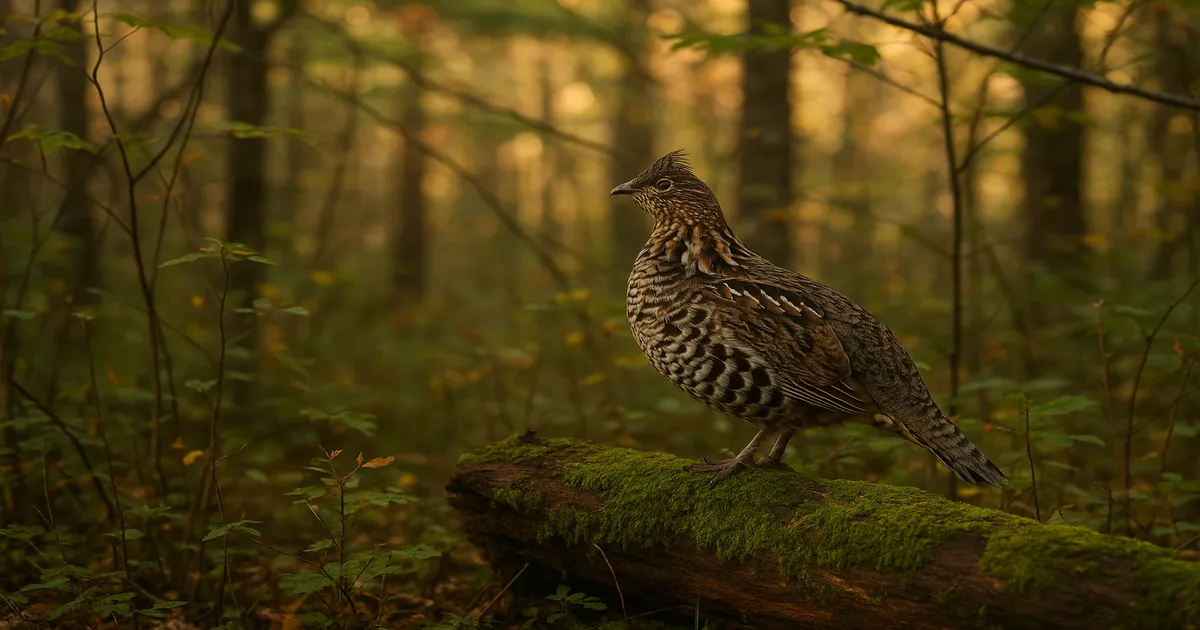
The Ruffed Grouse is a medium-sized, chicken-like bird — about 15–19 inches (38–48 cm) long, with a wingspan of 20–25 inches (50–64 cm) and a weight of 16–26 ounces (450–750 g). It’s stocky and round-bodied, with short legs, a small pointed crest, and a broad fan tail. The plumage is a near-perfect mosaic of brown, gray, black, buff, and white — dead leaves brought to life.
Brown Morph vs. Gray Morph
Two color morphs exist. The gray morph is more common in northern and western populations; the brown (rufous) morph predominates in the Appalachians and the southern part of the range. Both share the same key field marks — only the background tone shifts. I’ve flushed birds of both morphs from the same woodlot in northern Vermont, so don’t assume the two are neatly separated by geography.
The Namesake Ruff and Fan-Shaped Tail
Two features clinch the ID:
- The ruff — large, iridescent black or dark brown feathers on the sides of the neck. At rest they lie flat. When a male fans them during display, they form a dramatic collar unlike anything else in North American birds.
- The fan tail with a dark subterminal band — that bold dark bar near the tip of the broad, rounded tail is the single most reliable field mark, visible in flight and on the ground alike.
Telling Males, Females, and Juveniles Apart
| Feature | Male | Female | Juvenile |
|---|---|---|---|
| Ruff | Large, bold | Smaller, less prominent | Absent or rudimentary |
| Tail band | Complete, unbroken | Often broken in central feathers | Incomplete, muted |
| Size | Slightly larger | Slightly smaller | Noticeably smaller |
| Eye comb | Orange-red in spring | Absent or minimal | Absent |
| Plumage | Slightly richer | Slightly duller | Streaked, less patterned |
Start with the tail band when you’re trying to sex a bird. A complete, bold band almost always means male; a broken or faded band in the central feathers points to female. Juveniles in summer are streaky and noticeably small — by October they’re essentially adult-plumaged.
In winter, check the feet. Ruffed Grouse grow comb-like pectinations — fleshy projections on the toes that act as snowshoes. It’s one of the most elegant cold-weather adaptations in North American birds.
A good pair of binoculars makes all the difference when you’re trying to pick out tail-band details on a bird 30 yards into the brush. (Vortex Optics Diamondback HD 8x42) For grouse specifically, I lean toward 8x42 — enough magnification to read field marks, wide enough to track a flushing bird.
Sounds and Calls: Identifying Bird Game 3 by Ear
The Iconic Drumming Display
Here’s something that surprises a lot of people: the drumming is not a vocalization. The male stands on a log, braces his tail against it, and beats his wings rapidly against the air — producing a low-frequency sound that starts as slow, distinct thumps and accelerates into a rolling “brrrrrrrr”. The whole sequence lasts about 8–10 seconds and carries up to 400 meters through dense forest, which is remarkable for a bird that weighs less than two pounds.
Alarm Calls and the Flush
The alarm call is a sharp “quit-quit-quit” — easy to miss. What you won’t miss is the flush. When a Ruffed Grouse explodes from cover at your feet, the burst of wingbeats produces a loud, startling whirr that has caused even experienced birders to drop their binoculars. Hens with chicks give soft, low clucking notes to keep the brood together — a much quieter sound than anything else this bird produces.
When and Where to Listen for Drumming
Peak drumming runs April through May, though males drum at lower rates year-round. Get into good grouse habitat before first light and listen. The sound is directional — move slowly and listen from multiple positions to triangulate a drumming male. Calm, cool mornings with no wind carry the sound best.
Habitat and Range: Where to Find Bird Game 3
Geographic Range
The Ruffed Grouse is a year-round resident across one of the broadest ranges of any North American upland bird — from Alaska and the Yukon east across the boreal belt to Newfoundland, and south through the Appalachians into northern Georgia and Alabama. It also occurs in the Great Lakes states, parts of the Upper Midwest, and isolated mountain populations in the Rockies and Pacific Northwest. It doesn’t migrate. Where you find it in May, you’ll find it in January.
Ideal Forest Habitat
Young mixed deciduous-coniferous forest is the sweet spot. Ruffed Grouse thrive in early successional habitat — areas recovering from logging, fire, or blowdown — where dense shrubby understory grows alongside scattered trees. In the northern range, aspen stands are nearly synonymous with good grouse habitat. Aspen buds are a critical winter food, and aspen regenerates prolifically after cutting, creating exactly the young forest this species needs. Alder thickets, birch stands, and brushy forest edges round out the picture.
Drumming Logs: The Feature That Matters Most
If you’re actively looking for Ruffed Grouse, find the logs. Males select large, moss-covered fallen logs — often slightly elevated above the forest floor — as their drumming stages. These logs may be used for years, sometimes by successive males. In my experience, locating a drumming log in good habitat is the most reliable way to guarantee repeat encounters with this species.
Best States and Provinces
- Great Lakes region: Minnesota, Wisconsin, and Michigan hold some of the densest populations on the continent
- Northern New England: Maine, Vermont, and New Hampshire, especially in logged-over second-growth
- Adirondacks (New York): Consistently productive
- Ontario and Quebec: Enormous boreal habitat with strong populations
- Appalachians: Good numbers from Pennsylvania south into West Virginia
Behavior and Seasonal Patterns
Breeding Season
Drumming ramps up in March and peaks in April and May. Females visit, mate, and then handle everything alone — no pair bond is maintained. The nest is a leaf-lined scrape at the base of a tree or stump, usually with overhead concealment. Clutch size runs 9–14 eggs, pale buff and occasionally lightly spotted. Incubation takes 23–24 days. Chicks are precocial — they leave the nest within hours and can make short flights within 10–12 days. Broods stay together through summer and disperse in September and October.
Winter Survival
Cold winters don’t slow Ruffed Grouse down. When snow is deep enough, birds burrow in and create insulated cavities that stay significantly warmer than ambient air temperature. This snow-roosting behavior is genuinely critical for survival, which is why reduced snow cover from climate change is a real and growing concern. Diet shifts almost entirely to aspen and birch buds, catkins, and other woody browse — a single bird may consume hundreds of buds in a day.
Daily Activity and Movement
Ruffed Grouse are crepuscular, most active at dawn and dusk. Midday birds are typically tucked into dense cover or resting in snow burrows. They don’t move far — home range runs roughly 6–10 acres (2.4–4 ha) in good habitat, and most individuals spend their entire lives in a small area.
The 10-Year Population Cycle
One of the most fascinating things about this species is its natural 10-year population cycle, linked in the north to snowshoe hare dynamics and the predator communities that track them. When hare populations crash, predators like Northern Goshawk (Accipiter gentilis) and Great Horned Owl (Bubo virginianus) shift pressure onto grouse. These cycles make population trend analysis tricky — a single bad year may be natural fluctuation or the start of a real decline.
Diet and Feeding
Spring and summer bring the most varied diet: leaves, clover, fiddlehead ferns, serviceberry (Amelanchier spp.), wild strawberry, blueberry, and raspberry. Insects and invertebrates are especially critical for chicks in their first weeks — the protein from arthropods drives the explosive early growth that gets young birds airborne in under two weeks.
Fall shifts the diet toward wild fruits — grapes, apples, rose hips, dogwood berries, viburnum — plus acorns and beechnuts where available. This is the season when birds are most likely to be seen in the open, moving between food sources at forest edges and old orchards.
Winter diet in the northern range is almost entirely aspen and birch buds and catkins, supplemented by hemlock needles and dried berries still clinging to stems. The ability to digest these tannin-rich, nutritionally marginal foods is a genuine physiological adaptation most birds simply can’t manage.
Attracting Ruffed Grouse Through Habitat Planting
Forget the feeder — Ruffed Grouse almost never visit conventional feeders, and even ground-scattered seed is hit-or-miss. If you want grouse on your property, the answer is habitat:
- Plant native viburnum, serviceberry, and dogwood for fall and winter food
- Maintain brushy young-forest edges and let disturbed areas regenerate naturally
- Protect existing aspen and birch stands from over-browsing by deer
- Leave large fallen logs in place as potential drumming sites
Look-Alikes: Ruffed Grouse vs. Similar Species
Ruffed Grouse vs. Spruce Grouse
The Spruce Grouse (Canachites canadensis) overlaps in range across the boreal forest. The male has a bold black breast and a red eye comb — nothing like the barred brown pattern of a Ruffed Grouse. More practically, Spruce Grouse are famously tame (the “fool hen” nickname is well earned), while Ruffed Grouse are wary and explosive on the flush. If a grouse sits and watches you walk toward it, you’re almost certainly looking at a Spruce Grouse.
Ruffed Grouse vs. Sharp-tailed Grouse
The Sharp-tailed Grouse (Tympanuchus phasianellus) is an open-country bird of prairies and forest-grassland edges. The pointed tail versus the broad fan is the instant clincher. Sharp-tailed Grouse are also heavily spotted rather than barred and lack any ruff. If you’re in dense forest, you’re not looking at one.
Ruffed Grouse vs. Sooty and Dusky Grouse
The Sooty Grouse (Dendragapus fuliginosus) and Dusky Grouse (Dendragapus obscurus) are western species — both noticeably larger than Ruffed Grouse, with males that are dark bluish-gray and sport yellow-orange eye combs and inflatable neck sacs. Neither has the cryptic barred pattern, the ruff, or the banded fan tail. Range alone eliminates most confusion east of the Rockies.
Ruffed Grouse vs. Wild Turkey
If you’re genuinely debating whether you’re looking at a Ruffed Grouse or a Wild Turkey, look at the size. Turkey hens weigh 8–11 pounds (3.6–5 kg); toms can reach 25 pounds (11 kg). A Ruffed Grouse tops out around 1.6 pounds (750 g). They’re not close.
A quality field guide with detailed grouse plates is worth having before you head out — the plumage variation between morphs and age classes trips up a lot of people. (Sibley’s Birds of North America)
Conservation Status and How to Help
Current Population Trends
The Ruffed Grouse is listed as Least Concern by the IUCN — its overall range and global population remain large. But Breeding Bird Survey data tell a more sobering story in the East: a statistically significant decline of roughly 1–2% per year since the 1960s across much of the eastern range. State harvest data show the same trend. The 10-year cycle still operates, but the peaks are getting lower.
Primary Threats
Three threats stand out. Forest maturation is the biggest — as forests age past the early successional stage, grouse habitat quality drops sharply. The suppression of fire and the reduction of timber harvesting have eliminated vast areas of young forest across the East. West Nile Virus has been identified as a significant mortality factor, particularly in the southern and eastern range, and may be contributing to regional declines beyond what habitat loss alone explains. Climate change threatens the snow-roosting behavior that’s critical for winter survival, while warmer winters also disrupt the timing of bud availability and insect emergence.
How to Help
- Support young-forest management on public and private lands — clear-cuts look stark, but they’re exactly what grouse need
- Plant native berry-producing shrubs on forest edges
- Participate in your state’s spring drumming count — contact your state wildlife agency to get involved
- Report grouse observations to eBird to contribute to long-term range and population data
- Support the Ruffed Grouse Society’s habitat work at ruffedgrousesociety.org
If you’re heading out to run drumming count routes, a good recording device lets you capture and review sounds you might have missed in the field. (Zoom H1n Handy Recorder) And if you’re new to grouse habitat, a topographic map or dedicated GPS unit helps you navigate the kind of dense second-growth where these birds live. (Garmin eTrex 32x)
Frequently Asked Questions
What is “Bird Game 3” and how do I get it?
“Bird Game 3” refers to the Ruffed Grouse — the third of North America’s three iconic upland game birds, after the Wild Turkey (Bird Game 1) and Ring-necked Pheasant (Bird Game 2). To find one, head into young mixed forest with aspen stands in the Great Lakes states or northern New England, arrive before dawn in April or May, and listen for the low rolling drumming of a displaying male.
What does a Ruffed Grouse look like?
It’s a medium-sized, chicken-like bird about 15–19 inches long with cryptic brown, gray, and black plumage. The two most reliable field marks are the broad fan tail with a bold dark band near the tip, and the large iridescent neck ruff that males fan out during display. A small pointed crest and heavy breast barring help confirm the ID at close range.
What is the drumming sound a Ruffed Grouse makes?
The drumming is produced by a male beating his wings rapidly against the air while standing on a log — not a vocalization. It starts as slow, distinct thumps and accelerates into a low, rolling “brrrrrr” lasting about 8–10 seconds. Males drum primarily in April and May to attract females and warn off rivals, but produce the sound at lower rates year-round.
How is the Ruffed Grouse different from a Spruce Grouse?
The male Spruce Grouse has a bold black breast and red eye comb — nothing like the barred brown pattern of a Ruffed Grouse. The behavioral difference is just as telling: Spruce Grouse are famously tame, while Ruffed Grouse flush explosively at the slightest disturbance. If a grouse sits and watches you approach, it’s almost certainly a Spruce Grouse.
Where are the best places to find Ruffed Grouse in North America?
The Great Lakes states — Minnesota, Wisconsin, and Michigan — hold some of the densest populations on the continent. Northern New England, the Adirondacks, and the boreal forests of Ontario and Quebec are also consistently productive. Look for young mixed forest with aspen stands, brushy edges, and large fallen logs.