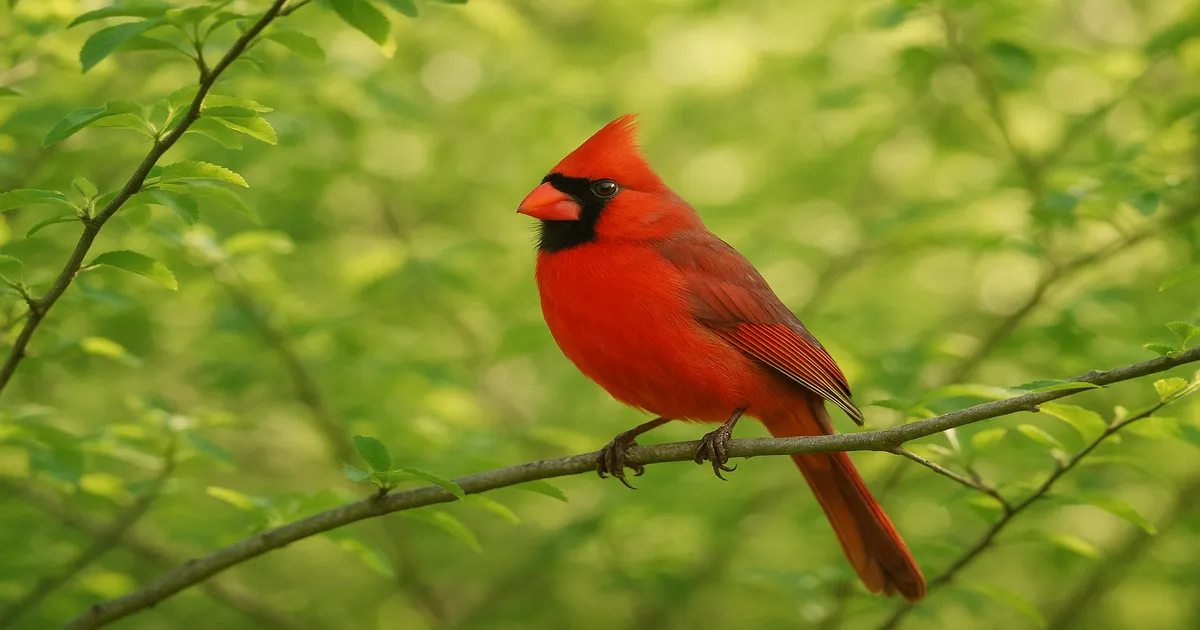
Quick Answer: The Northern Cardinal (Cardinalis cardinalis) is identified by five field marks shared by both sexes: a prominent pointed crest, a thick orange-red conical bill, a black facial mask, a chunky body with a long tail, and — in males — brilliant all-red plumage. Females are warm brown with red-washed crest, wings, and tail. No other common backyard bird combines all five of these marks.
The Northern Cardinal (Cardinalis cardinalis) is one of the most searched birds in North America, and yet people still misidentify it — or miss the subtler beauty of females and juveniles entirely. Learning how to identify a cardinal properly means going beyond “it’s the red bird” and understanding what to look for at every age, in every season, and from any angle.
How to Identify a Cardinal: Five Field Marks That Clinch It
You can confirm a cardinal in seconds once these five marks are locked in:
- Prominent pointed crest — raised or flattened depending on mood, but always present in both sexes year-round
- Thick, orange-red conical bill — triangular, almost parrot-like; one of the most distinctive bills in backyard birding
- Black facial mask — surrounds the face from lores through the chin; bold in males, softer in females
- Chunky body with a long, broad tail — big-headed and full-chested, often with the tail slightly cocked
- All-red plumage (males) or warm brown with red accents (females) — no streaking, no wingbars
Male vs. Female vs. Juvenile: The Shortest Summary
The adult male is brilliant crimson red from head to tail with a bold black mask — unmistakable. The adult female is warm buffy-brown with rose-red on the crest, wings, and tail, plus the same bright orange-red bill as the male. Juveniles of both sexes look like dull adult females but with a dark gray-to-black bill — that dark bill is the single most reliable juvenile field mark.
Size, Shape, and Silhouette
How Big Is a Cardinal?
Cardinals run about 8.25–9 inches (21–23 cm) long with a wingspan of roughly 10–12 inches (25–31 cm) and weigh around 1.5–1.7 oz (42–48 g). They’re noticeably larger than a House Sparrow but a bit smaller and stockier than an American Robin. That chunky, full-chested build is obvious the moment one lands at a feeder.
A good pair of binoculars makes a real difference when you’re trying to nail down bill color or mask detail at feeder distance. (Nikon Monarch M5 8x42)
The Crest
The pointed crest is the cardinal’s signature silhouette feature, visible on both sexes in every season. It rises when the bird is alert or agitated and flattens when relaxed or feeding. Even at a distance or in poor light, that spiked crown profile rules out most confusion species immediately.
Bill Shape
The bill is short, very thick, and triangular — built for cracking hard seeds. In profile it looks almost parrot-like, which is unusual for a songbird and makes it stand out even as a silhouette. The color — bright orange-red in adults — is a reliable ID point even when the rest of the bird is buried in foliage.
Tail and Flight
Cardinals have a long, broad tail that accounts for a significant chunk of their total length, often held slightly cocked at rest. In flight, look for an undulating, bounding pattern — bursts of wingbeats followed by brief glides — combined with that big-headed, long-tailed outline. They tend to fly low and hug shrub edges rather than crossing open ground.
Plumage Guide: Male, Female, and Juvenile Cardinals
Adult Male
The adult male is brilliant crimson red across the entire body, wings, and tail, with slightly darker primaries. The bold black mask covers the lores, chin, and upper throat in a sharply defined patch. No streaking, no wingbars, nothing to break up the red — which is exactly why he’s so striking against winter snow.
Adult Female
Female cardinals are genuinely underappreciated. Her base color is warm buffy-brown to grayish-tan, but look closer and you’ll see rose-red tinges on the crest, wings, and tail. The facial mask is present but soft and diffuse. That bright orange-red bill — identical to the male’s — is often the first thing that catches the eye when she’s half-hidden in a shrub.
Juvenile Cardinals
Fledglings and first-year birds of both sexes look like slightly dull adult females, but the key difference is bill color: dark gray to blackish at fledging, gradually warming to orange-red through the first fall and winter. Don’t rely on plumage tone alone — two birds that look nearly identical can be separated immediately by bill color.
Young males start showing patchy red on the breast and head during their first fall molt, creating a mottled red-and-brown look that can be confusing. By their first spring they’re mostly red, but full adult male plumage typically isn’t complete until the second fall.
Molting and Seasonal Changes
Cardinals go through one complete molt per year — the prebasic molt — in late summer and early fall, roughly July through October. During this period, males can look patchy, duller, and occasionally bald-headed. That scraggly red bird at your feeder in August is a normal molting male, not a sick one.
Fresh feathers have brownish or grayish tips that wear away gradually over winter. By late winter and early spring, males look their absolute brightest — timed, not coincidentally, to the start of breeding season.
Cardinal Songs and Calls
The Song
Sound is one of the best tools for finding cardinals before you see them. The song is a loud, clear series of whistled phrases — rich, pure-toned, and carrying easily across a yard or woodland edge. Common mnemonic phrases include “cheer-cheer-cheer,” “birdy-birdy-birdy,” and “pretty-pretty-pretty.” Individual males know 8–12 distinct song types and may string them together or switch between them in a single singing bout.
Chip Notes and Alarm Calls
The cardinal’s chip call — a sharp, metallic tink — is one of the loudest chip notes of any backyard bird. It’s often the first sound that alerts you to a cardinal lurking in dense shrubs. There’s also a softer chit used between mates, a rapid accelerating series of chips when a predator is nearby, and a thin, high-pitched seee as a flight call.
Do Female Cardinals Sing?
Yes — and it surprises a lot of birders. Female cardinals sing regularly, which is relatively unusual among North American songbirds. Female song tends to be slightly softer and more complex than the male’s, and females may sing from the nest or while foraging. If you hear cardinal song and can’t spot a male, look for the female.
Range and Habitat
Where Cardinals Live
The Northern Cardinal is a non-migratory year-round resident throughout its range. The core range covers eastern and central North America from southern Canada — southern Ontario, Quebec, and marginally into Nova Scotia — south through the eastern U.S., the Great Plains, the desert Southwest, and into Mexico and northern Central America. Introduced populations exist in Hawaii and Bermuda.
Preferred Habitats
Cardinals are edge birds. They thrive wherever shrubby thickets meet open areas: woodland edges, overgrown fence lines, riparian corridors, suburban gardens, and parks with a mix of trees and dense understory. They avoid the interior of unbroken forest and open grassland without shrubby cover. If there’s a tangle of dense shrubs nearby, there’s probably a cardinal.
Is the Range Expanding?
Yes, and it has been for over a century. Widespread bird feeding, reforestation of agricultural land in the Northeast, and milder winters have all allowed cardinals to establish themselves well north of their historical range. Areas that had no resident cardinals a few decades ago now have thriving year-round populations.
Cardinal Look-Alikes: Avoiding Misidentification
Pyrrhuloxia
The Pyrrhuloxia (Cardinalis sinuatus) is the most structurally similar species — same crest shape, same general build. But it has a gray body with rose-red accents rather than solid red, and a distinctly curved, yellowish-gray bill that looks more parrot-like than a cardinal’s already parrot-like bill. Range is the easy separator: Pyrrhuloxia is limited to the desert Southwest (Arizona, New Mexico, Texas) and northern Mexico.
House Finch and Purple Finch
Male House Finches and Purple Finches are red, but neither has a crest, neither has a black mask, and both show streaked underparts. Their bills are also much smaller and less triangular. A red bird at your feeder without a crest is almost certainly a finch.
Female Cardinal vs. Other Brown Birds
The most common mistake is calling a female cardinal a sparrow or a female finch. Here’s what to check:
- Female House Finch: Heavily streaked, no crest, small bill — not orange
- Female Rose-breasted Grosbeak: Bold head stripes, no crest, very different bill shape
- Sparrows: Much smaller, no crest, no orange bill, usually streaked
The combination of crest + orange-red bill + soft facial mask rules out every common confusion species. All three on a brown bird means female cardinal, full stop.
A good regional field guide is worth having open on the counter during feeder sessions — the side-by-side plates make these comparisons much faster.
Attracting Cardinals to Your Yard
Best Foods
Safflower seeds are the single best cardinal feeder food — cardinals love them, and squirrels and European Starlings largely ignore them, which is a genuine bonus. Black-oil sunflower seeds are universally accepted and highly nutritious. White millet is particularly attractive to females and juveniles, and shelled peanuts or cracked corn round out a good winter spread.
Feeder Styles
Platform or tray feeders are the best choice — cardinals want a flat, stable surface where they can sit upright and manipulate seeds. Hopper feeders work well if the ledge is wide enough. Tube feeders with small perches are a poor fit; cardinals aren’t clinging feeders and won’t use them reliably.
Landscaping for Cardinals
Feeders help, but habitat is what keeps cardinals in your yard. Plant dense shrubs — native species like dogwood, holly, elderberry, mulberry, and wild grape provide both food and cover. Cardinals need dense shrubby growth for nesting and roosting, so a yard with good structure will hold birds even when feeders are empty.
One more thing worth adding: if cardinals are hitting your windows, apply external window clings or tape to break up the reflection. (WindowAlert UV Liquid Decal) It stops both the territorial window-attacking behavior and accidental collisions.
Frequently Asked Questions About Cardinal Identification
What does a female cardinal look like?
The adult female is warm buffy-brown overall with rose-red tinges on her crest, wings, and tail. She has a soft, diffuse dark mask and a bright orange-red bill — the same bill color as the male. That orange bill is usually the easiest way to pick her out when she’s partially hidden in vegetation.
How can you tell a juvenile cardinal from an adult?
Bill color is the most reliable difference. Juveniles have a dark gray-to-black bill at fledging; adults of both sexes have an orange-red bill. Juveniles also tend to look slightly duller and more uniform brown than adult females, with less red on the crest and wings. Young males start showing patchy red plumage in their first fall but won’t reach full adult coloration until their second year.
What bird looks like a cardinal but isn’t red?
The Pyrrhuloxia is the closest look-alike — same crest and body shape as a Northern Cardinal, but gray with rose-red accents and a curved, yellowish-gray bill. It’s found only in the desert Southwest. Female cardinals are sometimes confused with female House Finches or sparrows, but the cardinal’s crest and orange bill make it distinctive once you know what to look for.
Why is a cardinal attacking my window?
It’s responding to its own reflection, which it interprets as a rival that won’t back down. This is most common in spring and early summer when territorial behavior peaks. Cover the outside of the window with paper, film, or external decals to eliminate the reflection — the behavior usually stops within a few days once the “rival” disappears.
Do female cardinals sing?
Yes, and it’s one of the more interesting things about the species. Female Northern Cardinals sing regularly, which is unusual among North American songbirds. Female song tends to be slightly softer and more complex than the male’s. If you hear cardinal song but can only spot a brown bird, you’re probably hearing a female — not a male hiding somewhere out of sight.