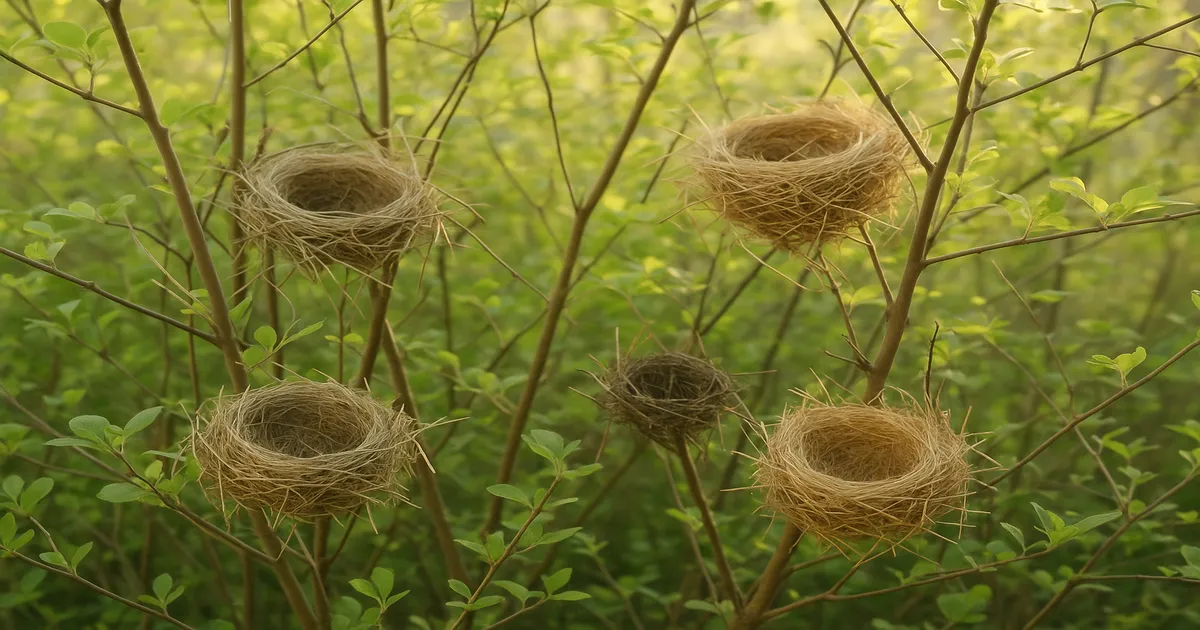
Quick Answer: Nest identification comes down to three things — structure and shape, the materials used, and where you found it. Most mystery nests belong to a handful of common builders: robins, orioles, swallows, sparrows, or cavity nesters like bluebirds and chickadees. Match those three factors and you’ll usually have your answer in minutes.
If you’ve ever stumbled across a beautifully woven pouch dangling from a branch and thought, does anybody know what bird made these nests? — you’re in good company. Nest identification is one of the most satisfying puzzles in birding, and it’s genuinely approachable once you know what to look for. This guide covers every major nest type you’re likely to encounter in North America, organized by architecture and by where you found it.
Quick Answer: How to Tell What Bird Built a Nest
The Three Questions to Ask First
Before anything else, ask yourself:
- What shape is it? Open cup, pendulous pouch, mud jug, stick platform, or a bare scrape in the ground?
- What’s it made of? Mud, grass, plant fibers, spider silk, sticks, or some combination?
- Where exactly did you find it? Height, substrate (tree fork vs. building ledge vs. ground), and surrounding habitat often narrow things down faster than anything else.
Location is the most underrated clue in nest ID. A mud-reinforced cup on a building ledge is almost certainly an American Robin (Turdus migratorius) or Eastern Phoebe (Sayornis phoebe). That same mud cup on a cliff face, surrounded by hundreds of identical ones? Cliff Swallow (Petrochelidon pyrrhonota). Same materials, completely different bird.
A Note on the Law
The Migratory Bird Treaty Act protects active nests of virtually all native North American bird species. Disturbing, moving, or destroying a nest with eggs or chicks is a federal offense. Even if a nest looks abandoned, wait until you’re certain the breeding season is over before touching it. Empty nests found in late fall or winter are generally safe to remove — but when in doubt, leave it alone.
Nest Identification Master Key
Find the description that best matches your mystery nest, then jump to the relevant section for more detail.
| Nest Type | Primary Materials | Typical Location | Most Likely Builder(s) |
|---|---|---|---|
| Open cup, grassy, on ground | Dry grass, plant fibers | Meadow, lawn edge | Killdeer, Horned Lark, Savannah Sparrow |
| Open cup, mud-reinforced | Mud, grass, plant fibers | Tree fork, building ledge | American Robin, Eastern Phoebe |
| Open cup, lichen exterior | Spider silk, lichen, plant down | Tree branch fork or limb | Ruby-throated Hummingbird, Blue-gray Gnatcatcher |
| Deep woven cup / pendulous pouch | Plant fibers, bark strips, hair | Branch tip, high in tree | Baltimore Oriole, Bullock’s Oriole |
| Cavity, excavated | Wood chips, no added lining | Tree snag, dead limb | Woodpeckers |
| Cavity, nest box or natural | Moss, grass, feathers | Nest box, tree hollow | Eastern Bluebird, Tree Swallow, Chickadees |
| Domed cup on ground | Grass, leaves | Dense ground cover | Ovenbird, Common Yellowthroat |
| Large platform of sticks | Sticks, branches | Tall tree, cliff, utility pole | Bald Eagle, Osprey, Great Blue Heron |
| Small twig platform, flimsy | Twigs only | Tree or shrub | Mourning Dove |
| Mud jug / gourd shape | Mud pellets, grass | Under eaves, cliff face | Cliff Swallow, Barn Swallow |
| Floating platform | Aquatic vegetation | On water surface | Pied-billed Grebe, Common Loon |
| Burrow in bank or ground | Soil, sometimes grass-lined | Earthen bank, flat ground | Belted Kingfisher, Bank Swallow, Burrowing Owl |
Does Anybody Know What Bird Made These Nests? Start Here.
Open Cup Nests: Robins, Hummingbirds, and More
Open cup nests are the most common type you’ll find, and they vary wildly in size, material, and craftsmanship.
American Robin: The Mud-Lined Cup
The robin’s nest is the benchmark for open cup identification. It’s built in three layers: coarse grass and twigs on the outside, a solid mud cup in the middle, and fine dry grass lining the interior. That mud layer is the giveaway — very few songbirds use structural mud the way robins do. Typical placement is 5–25 feet up in a tree fork, on a building ledge, or tucked against a porch light. Eggs are the iconic unmarked sky blue, usually 3–5 per clutch. Robins raise 2–3 broods a season, so you may find fresh nests from March through July across most of the continent.
Ruby-throated Hummingbird: The Lichen-Covered Thimble
The Ruby-throated Hummingbird (Archilochus colubris) builds the smallest open cup nest you’re likely to find — roughly walnut-sized, about 1.5 inches (3.8 cm) across. The outside is camouflaged with lichen flakes held in place by spider silk, which also lets the nest stretch as chicks grow. Look for it saddled on a downward-sloping branch, often over a stream or garden path, 10–40 feet up. If you find a tiny, lichen-covered cup that looks almost too perfect to be real, that’s your bird.
Blue-gray Gnatcatcher: Spider Silk and Lichen
The Blue-gray Gnatcatcher (Polioptila caerulea) builds a nest that’s easy to confuse with a hummingbird’s — same lichen exterior, same spider silk construction. The key difference is placement: gnatcatcher nests sit in a tree fork rather than saddled on a horizontal limb, and they’re slightly larger and more elongated. Both are extraordinary examples of avian engineering.
Savannah Sparrow and Horned Lark: Ground-Level Grass Cups
Ground-nesting sparrows like the Savannah Sparrow (Passerculus sandwichensis) and Horned Lark (Eremophila alpestris) build simple grass cups directly on or just below the soil surface. No mud, no spider silk — just woven dry grass tucked under a clump or in a small depression. The eggs are speckled for camouflage, and the nests are easy to walk right past.
Hanging and Woven Nests: Orioles
Baltimore Oriole: The Pendulous Pouch
No North American bird builds a more recognizable nest than the Baltimore Oriole (Icterus galbula). The female weaves a deeply pendulous pouch — roughly 3–4 inches (7.6–10 cm) wide and 4–8 inches (10–20 cm) deep — entirely on her own over about a week. Materials include plant fibers, bark strips, grapevine shreds, and hair, plus whatever string or yarn she can scavenge. Nests containing fishing line, twine, and strips of plastic bag are not unusual.
The nest hangs from the very tip of a drooping branch, typically 20–45 feet (6–14 m) up, with a strong preference for American elm, cottonwood, and willow. The opening faces upward. It sways in the wind, which looks precarious but isn’t — the weaving technique produces a surprisingly tough finished structure.
Oriole nests are often invisible during summer because they hang in full-leafed canopies. After leaf drop, they suddenly appear as gray, weathered pouches dangling from bare branch tips. These are almost certainly empty and legal to collect if you want a closer look.
Bullock’s Oriole and Orchard Oriole
Bullock’s Oriole (Icterus bullockii) builds a nearly identical pendulous pouch but is found in the West, typically along riparian corridors. Orchard Oriole (Icterus spurius) nests are shallower and more cup-like — still woven, but not as deeply pendulous as a Baltimore’s. East of the Great Plains, a hanging woven nest is Baltimore Oriole until proven otherwise.
Mud Nests: Swallows and Phoebes
Barn Swallow: The Half-Cup on a Beam
The Barn Swallow (Hirundo rustica) builds an open half-cup from hundreds of individually carried mud pellets, reinforced with grass and lined with white feathers. It’s almost always on a man-made structure — inside a barn, under a bridge, tucked into a culvert — with a strong preference for corners. The nest is about 3 inches (7.6 cm) wide and 2 inches (5 cm) deep. Pairs often reuse and refurbish it year after year.
Cliff Swallow: The Mud Gourd Under Eaves
Cliff Swallow nests are fully enclosed — a gourd-shaped mud jug with a small entrance tunnel projecting from the front. They’re almost always in colonies, sometimes numbering in the hundreds, plastered under building eaves or on cliff faces. A cluster of mud jugs under an overpass is Cliff Swallow (Petrochelidon pyrrhonota), full stop.
Eastern Phoebe: Moss and Mud on a Ledge
The Eastern Phoebe uses moss heavily alongside mud, giving its nest a greenish, organic look that sets it apart from a robin’s cleaner cup. Phoebes favor ledges on buildings, bridges, and rock outcroppings, and they return to the same site year after year. A mossy, mud-reinforced cup on a bridge beam is almost certainly a phoebe.
| Species | Shape | Colony? | Location |
|---|---|---|---|
| Barn Swallow | Open half-cup | Loose clusters | Inside structures, corners |
| Cliff Swallow | Enclosed mud gourd | Dense colonies | Under eaves, cliff faces |
| Eastern Phoebe | Open cup, mossy | Solitary | Ledges, bridge beams |
Cavity Nests: Woodpeckers, Bluebirds, and Nest Box Birds
Woodpeckers: The Original Excavators
Woodpecker cavities typically have no added nest material — just wood chips at the bottom. The entrance hole is round and cleanly chiseled. Downy Woodpecker (Dryobates pubescens) holes run about 1.25 inches (3.2 cm) across; Pileated Woodpecker (Dryocopus pileatus) holes are large and often rectangular, 3–4 inches (7.6–10 cm) wide.
Chickadees and Nuthatches
Black-capped Chickadee (Poecile atricapillus) and White-breasted Nuthatch (Sitta carolinensis) line their cavities with soft moss, plant fibers, and fur. The nest interior feels almost like a mattress. Entrance holes are small — around 1.1–1.25 inches (2.8–3.2 cm).
Eastern Bluebird and Tree Swallow: Nest Box Specialists
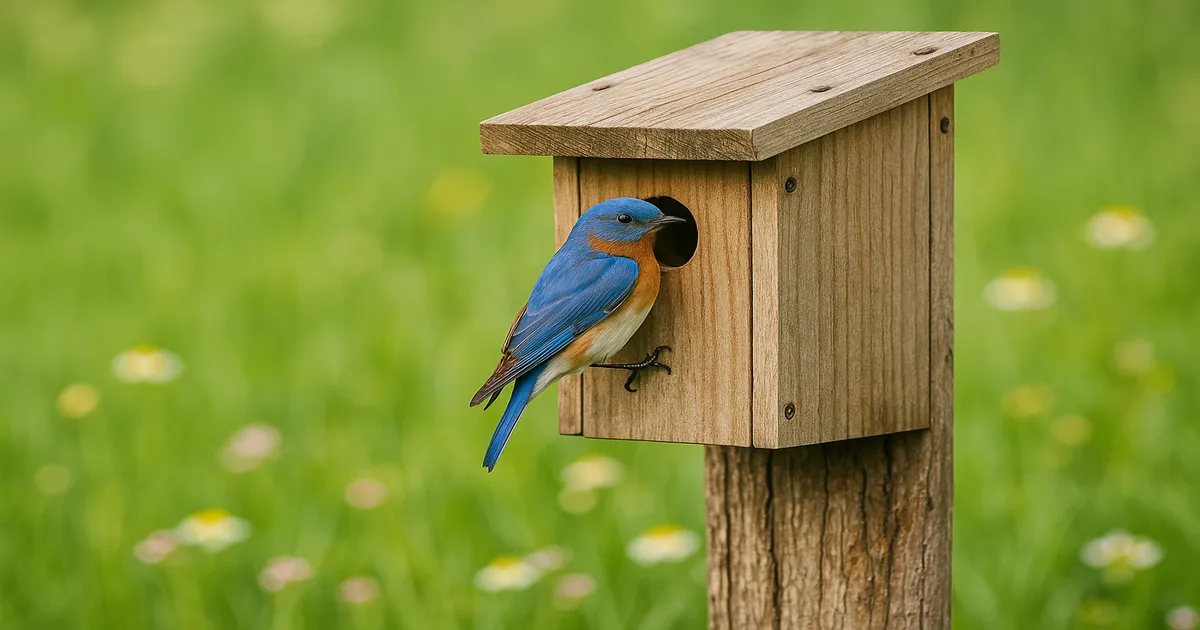
Eastern Bluebird (Sialia sialis) nests are neat cups of dry grass, sometimes with a few pine needles, in a nest box with a 1.5-inch (3.8 cm) entrance hole. Tree Swallow (Tachycineta bicolor) nests look similar but are heavily lined with feathers, often curved to form a loose dome over the eggs. Both are excellent reasons to put up a nest box.
House Wren: The Stick-Stuffer
House Wren (Troglodytes aedon) nests are unmistakable — the male fills every available cavity to the brim with small sticks, sometimes hundreds of them, before the female adds a soft grass and feather cup in the center. Open a nest box and find it completely jammed with sticks? House Wren. No other bird does this.
Large Platform and Ground Nests: Raptors, Herons, and Shorebirds
Bald Eagle and Osprey: Massive Stick Platforms
Bald Eagle (Haliaeetus leucocephalus) and Osprey (Pandion haliaetus) build the largest nests in North America. Eagle eyries are reused and added to each year; the largest on record weighed over a ton. Osprey nests are similarly massive stick platforms, typically on utility poles, channel markers, or dead snags near water. Both are unmistakable in scale.
Great Blue Heron: Colonial Stick Nests in Treetops
Great Blue Heron (Ardea herodias) nests in colonies called heronries, often with dozens or hundreds of pairs in the same stand of trees. Individual nests are flat stick platforms about 3 feet (0.9 m) across — they look impossibly flimsy for a bird this large. Heronries are noisy and pungent. You’ll smell one before you see it.
Mourning Dove: The Flimsy Twig Platform
The Mourning Dove (Zenaida macroura) builds the most minimal nest of any common backyard bird — a loose platform of a few dozen twigs, so sparse that eggs are sometimes visible from below. Look for it in a tree crotch or on a flat surface 5–25 feet up.
Killdeer: No Nest at All?
Killdeer (Charadrius vociferus) doesn’t really build a nest. It lays eggs in a simple scrape in gravel, sand, or bare dirt, sometimes with a few pebbles arranged around the eggs. The eggs are cryptically marked to blend into the substrate perfectly. If you nearly step on what looks like speckled stones in a gravel parking lot, look again.
Nest Identification by Location: A Practical Cheat Sheet
Photograph the nest from at least three angles — top, side, and interior — before trying to identify it. Interior lining material is often the deciding clue. A good pair of binoculars helps you examine nests that are out of reach without disturbing them. (Nikon Monarch M5 8x42)
On or Near Buildings
- Mud half-cup on a beam or in a corner → Barn Swallow
- Mud gourd cluster under eaves → Cliff Swallow
- Mossy mud cup on a ledge or bridge → Eastern Phoebe
- Mud-reinforced grass cup on a ledge or porch light → American Robin
In Trees and Shrubs
- Pendulous woven pouch at branch tip, high up → Baltimore Oriole (East) or Bullock’s Oriole (West)
- Mud-reinforced cup in a tree fork → American Robin
- Tiny lichen-covered cup on a branch → Ruby-throated Hummingbird or Blue-gray Gnatcatcher
- Massive stick platform, reused annually → Bald Eagle, Osprey, or Great Blue Heron
On the Ground
- Simple grass cup under vegetation → Savannah Sparrow, Horned Lark, or Song Sparrow
- Scrape in gravel with no added material → Killdeer or Piping Plover (Charadrius melodus)
- Domed grass structure in dense cover → Ovenbird (Seiurus aurocapilla) or Common Yellowthroat (Geothlypis trichas)
Near or Over Water
- Floating platform of aquatic vegetation → Pied-billed Grebe (Podilymbus podiceps) or Common Loon (Gavia immer)
- Large stick platform on a snag or channel marker → Osprey
- Burrow in an earthen bank → Belted Kingfisher (Megaceryle alcyon) or Bank Swallow (Riparia riparia)
In Nest Boxes or Tree Cavities
- Neat grass cup, minimal lining → Eastern Bluebird
- Grass cup heavily lined with feathers → Tree Swallow
- Cavity crammed with sticks, soft cup in center → House Wren
- Moss and fur lining, no added sticks → Black-capped Chickadee or White-breasted Nuthatch
- No lining, just wood chips → Woodpecker
For deeper dives into specific species, a dedicated nest field guide is worth having alongside any bird ID app. A Field Guide to Western Bird Nests by Hal Harrison and its eastern companion cover construction details, egg descriptions, and habitat notes that no app quite matches yet.
Frequently Asked Questions
Does anybody know what bird made these nests — is there an app for that?
Yes, several. Merlin Bird ID (Cornell Lab) has a nest identification feature, and iNaturalist lets you upload photos for community ID. Neither is perfect, but both are genuinely useful starting points. Your best results come from combining an app with the location and material clues in this guide.
How can I identify a bird nest by its shape and materials?
Start with the overall shape — open cup, pendulous pouch, mud jug, stick platform, or ground scrape — then look at the materials and the location. A mud-reinforced cup in a tree fork strongly suggests American Robin. A woven pouch hanging from a branch tip is almost certainly an oriole. Interior lining is often the tiebreaker between similar species.
Is it legal to pick up or keep a bird nest?
Empty nests found after the breeding season — typically late fall through winter — are generally legal to collect under the Migratory Bird Treaty Act. Active nests with eggs or chicks are federally protected and must not be disturbed. If you’re unsure whether a nest is active, leave it alone and check back in a few weeks.
Why do some birds reuse their nests?
Raptors like Bald Eagles and Ospreys return to the same eyrie year after year, adding material each season until the structure becomes enormous. Phoebes and Barn Swallows also reuse sites regularly. Most songbirds, however, build a fresh nest for each brood — partly because old nests accumulate parasites like mites and blowfly larvae that can harm chicks.
What’s the best way to attract nesting birds to my yard?
Put up nest boxes sized for your target species — a 1.5-inch entrance hole for bluebirds and Tree Swallows, a 1.125-inch hole for chickadees and wrens. Place them on a pole with a baffle to deter predators, face the entrance away from prevailing weather, and clean them out each fall. Leaving some areas of your yard a little wild — brush piles, native plantings, bare patches of soil — gives birds the materials they need to build. <!— affiliate: predator baffles such as Erva Torpedo Steel Squirrel Baffle