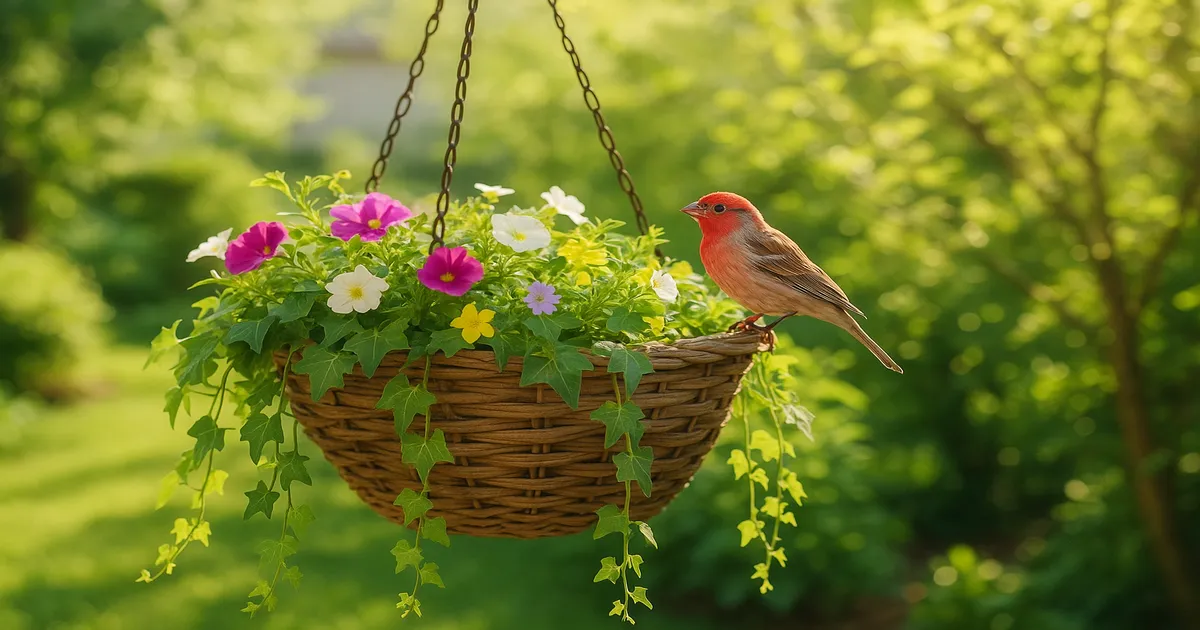
Quick Answer: Yes, it’s completely normal for House Finches to build two — or even three — nests in the same hanging plant. House Finches are prolific breeders that raise 2–6 broods per season, and they frequently return to the same planter, sometimes stacking the new nest directly on top of the old one. If a second nest is appearing in your basket, that’s a sign of success, not a problem.
If you’ve noticed what looks like a second nest forming in your hanging basket and wondered whether it’s normal for house finches to build 2 nests in the same hanging plant, the short answer is yes — and it happens constantly. House Finches (Haemorhous mexicanus) are among the most prolific backyard nesters in North America, and your planter has apparently passed their quality check twice over.
Identifying the House Finch Nesting in Your Planter
Before anything else, make sure you’ve got the right bird. A few other species will happily nest in hanging baskets, so a quick ID check is worth the effort.
Male House Finch
The male is about 5 to 6 inches (13–15 cm) long with a compact, chunky build and a short, curved bill. His most obvious feature is the red-orange wash on his forehead, eyebrow, throat, and breast — but the intensity varies quite a bit. Some males look almost orange; others lean toward a deeper red. Whatever the shade, he’ll have brown streaking on his flanks and belly. That streaking is the reliable mark that separates him from the Purple Finch (Haemorhous purpureus), whose flanks are largely unstreaked.
Female House Finch
The female is grayish-brown overall with heavy streaking on her underparts. The key thing to notice is what’s not there: no bold eyebrow stripe, no strong facial pattern. Just a plain, unassuming face. That plainness is your best field mark for separating her from the female Purple Finch, which has a striking white eyebrow stripe and a dark malar stripe.
Juveniles and Songs
Juveniles look a lot like adult females — streaked below, brownish above, slightly fluffy before their first molt. Young males start picking up red pigmentation in their first fall, but it often comes in patchy and dull.
The House Finch’s song is a cheerful, rambling warble that typically ends with a rising, buzzy upward slur — almost like a question. That quirky ending is one of the best audio clues for picking a House Finch out of a noisy spring morning. A good pair of binoculars (Nikon Monarch M5 8x42) will help you confirm field marks once you’ve heard the song and tracked the bird down.
Is It Normal for House Finches to Build 2 Nests in the Same Hanging Plant?
Yes — and understanding why helps explain a lot about how these birds operate.
How Many Broods Do House Finches Have Per Season?
A single pair can raise 2 to 6 broods in one breeding season. That season stretches from late February through August across much of the U.S., and even longer in warmer southern climates. That’s a lot of nesting activity packed into a few months, which is exactly why seeing multiple nests in one spot is so common.
Why They Return to the Same Hanging Basket
Once a location proves successful, House Finches are strongly inclined to use it again. They don’t need to scout for a new site, assess new predator risks, or haul materials somewhere unfamiliar. The hanging basket already worked — so they come back.
A hanging planter checks every box for a nesting House Finch. The dense foliage provides overhead cover, the basket’s rim gives structural support for a cup nest, and the whole thing is elevated and away from ground predators. Once a pair discovers a hanging basket, they treat it like prime real estate. They’re not wrong.
The female often starts building the new nest while she’s still feeding fledglings from the previous brood. At that point, the male takes over primary care of the fledglings — a well-coordinated handoff that keeps the reproductive season moving efficiently.
Stacking Nests: When the New Nest Goes on Top of the Old One
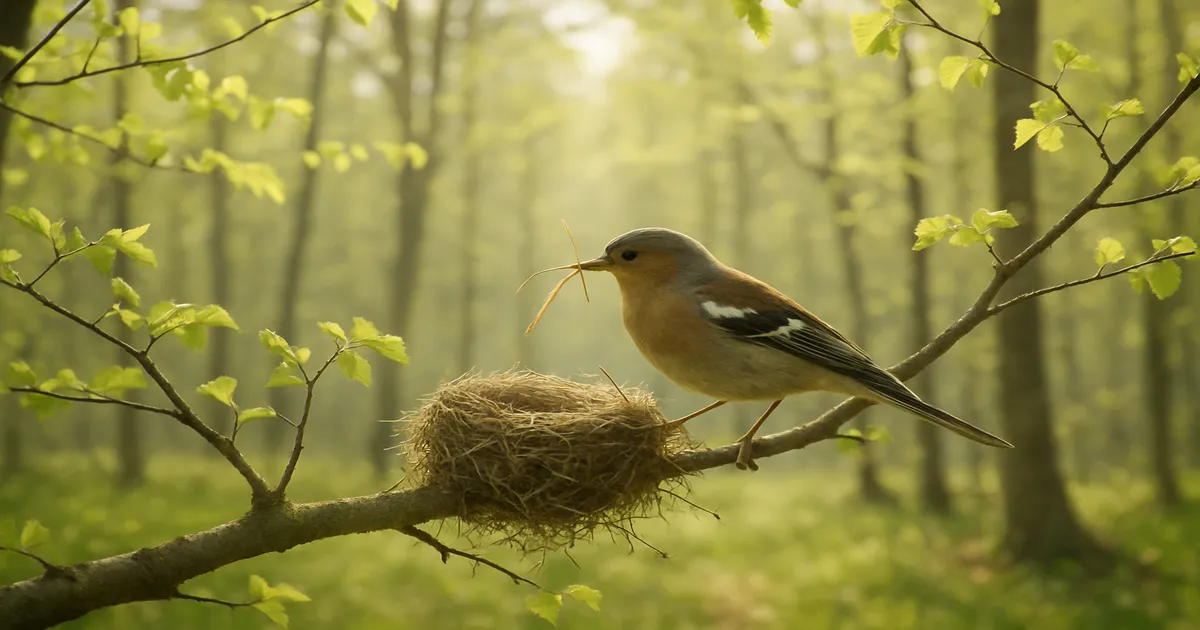
In a confined space like a hanging planter, the female will sometimes build the second nest directly on top of the first. It looks a little chaotic from the outside — a lumpy, layered construction — but it works fine. The old nest provides a ready-made foundation, and the female adds fresh material on top to create a clean cup.
Nesting Timeline
Here’s the full sequence for a single brood:
- Nest construction: 2–6 days
- Egg laying: 1 egg per day until the clutch is complete (typically 4–5 eggs)
- Incubation: 13–14 days (female does almost all of it)
- Nestling period: 12–19 days after hatching
- Fledgling dependency: 2–3 weeks after leaving the nest
Each complete nesting attempt takes roughly 4 to 6 weeks from start to fledging — which is why a pair can squeeze in multiple broods before fall.
What to Expect at Each Stage
Eggs and Incubation
House Finch eggs are pale bluish-green with sparse dark spotting — small, delicate, and easy to miss if you’re peering into a crowded basket. A typical clutch holds 4 or 5 eggs. The female incubates almost exclusively, sitting tight for 13 to 14 days while the male brings her food. Keeping a feeder stocked with black-oil sunflower seeds (Wagner’s Greatest Variety Mix 16 lb bag) nearby reduces how far he has to travel and keeps the pair close to the nest.
Nestlings and Fledglings
Newly hatched nestlings are blind, mostly naked, and completely dependent on their parents. They grow fast — both parents feed them regurgitated seeds, and within two weeks they’re feathered and nearly ready to go. Fledglings leave the nest at 12 to 19 days old, often before they’re strong fliers. You may see them hopping around on the ground or perching awkwardly nearby, calling persistently for food. The parents know where they are and are still feeding them. Resist the urge to “rescue” a fledgling that looks stranded.
When Does the Second Nest Appear?
Watch for the female to start gathering nest material while the first brood’s fledglings are still being fed by the male. If you notice fresh grass and twigs appearing in the basket before the young birds have fully dispersed, a second clutch is on the way.
How to Support Nesting House Finches Without Disturbing Them
Watering Your Hanging Plant During Nesting
Yes, you can keep watering — but do it carefully. Pour slowly at the very edge of the pot, directing flow away from the nest. A watering can with a long, narrow spout works much better than a spray nozzle here. Most incubating females will sit tight through careful watering once they’re used to your presence, especially once they’re deep into incubation and reluctant to leave the eggs.
How Close Is Too Close?
Stay at least 3 to 4 feet away and move slowly. If the female flushes and doesn’t return within a few minutes, you got too close. During incubation she’ll typically be more tolerant than during early nest construction.
Feeders and Water
A feeder close to your hanging basket genuinely helps. A tube feeder stocked with nyjer or sunflower seeds within sight of the nest reduces how far the male has to forage. A clean birdbath or dripper is equally attractive and supports the whole pair through the season.
What to Do If the Nest Is Abandoned
If there’s been no adult activity for several days and the eggs are cold, the nest is abandoned. Under the Migratory Bird Treaty Act, removing an inactive nest is legal. But wait until you’re certain — House Finches can look absent for stretches during the day and still be actively nesting.
House Finch Look-Alikes
House Finch vs. Purple Finch
The females are genuinely tricky. Focus on the face: the female Purple Finch has a bold white eyebrow stripe and a dark malar stripe — a strongly patterned look that the plain-faced female House Finch simply doesn’t have. On the males, Purple Finch color is a deeper raspberry-red that bleeds across the back and head, with little to no flank streaking. House Finch males have clearly streaked flanks and a more orange-red tone.
House Finch vs. House Sparrow
The female House Sparrow (Passer domesticus) can fool beginners. She’s chunkier, with a flatter head, a thicker bill, and a buffy eyebrow stripe — but she lacks the streaked underparts of the female House Finch. Male House Sparrows have a gray crown, chestnut nape, and black bib; there’s no real overlap with the male House Finch once you’ve seen both.
House Finch vs. Cassin’s Finch (Western Birders Only)
If you’re in the mountain West, Cassin’s Finch (Haemorhous cassinii) is worth knowing. The male has a brighter rose-red crown that forms a distinct cap, and the female is more crisply and finely streaked than the female House Finch. Cassin’s Finches tend to stick to higher-elevation conifer forests, so if your hanging basket is in a suburban yard, House Finch is the far more likely candidate.
House Finch Health and Feeder Hygiene
House Finch Eye Disease
Mycoplasmal conjunctivitis — House Finch eye disease — is caused by Mycoplasma gallisepticum. Affected birds show swollen, red, crusty eyes and may look lethargic or have trouble seeing. It spreads quickly at feeders. If you spot a bird with these symptoms, clean your feeders immediately with a 10% bleach solution and report the sighting to the Cornell Lab of Ornithology’s House Finch Disease Survey. There’s no treatment you can administer, but reducing transmission at feeders makes a real difference.
The eastern House Finch population was hit hard by this disease in the 1990s, losing an estimated 40–60% of birds in some areas. Populations have partially recovered, but the disease is now endemic across the continent.
Keeping Feeders Clean
Clean your feeders every 1 to 2 weeks — more often during wet weather when mold accumulates faster. Rake up spilled seed below feeders regularly. These aren’t just good habits; they’re meaningful conservation actions during nesting season when birds visit more frequently. Window strikes and outdoor cats are the biggest day-to-day threats to individual birds, especially newly fledged young. Keeping cats indoors from May through August — peak fledgling season — is one of the most effective things you can do. Window alert decals (WindowAlert UV Liquid Decal) on nearby glass can also cut collision risk significantly.
Frequently Asked Questions
Is it normal for house finches to build 2 nests in the same hanging plant?
Completely normal. House Finches raise 2 to 6 broods per season and consistently return to spots that have worked before. A hanging basket that produced one successful brood is a prime candidate for a second — and sometimes a third. The female may build the new nest right on top of the old one.
Will house finches reuse the same nest or build a new one?
They usually build a new nest for each brood rather than reusing the old one directly. In a hanging planter, though, they often build that new nest in the same location — sometimes stacking it on top of the previous nest, which serves as a ready-made foundation.
Should I remove the old nest before they build a second one?
Generally, no — at least not while the birds are still active nearby. House Finches will often incorporate the old nest into the foundation of the new one, and disturbing the area between broods can cause the pair to abandon the site. Once all nesting activity has definitively ended for the season, you can remove old nests to keep the planter tidy.
How long from egg to fledgling?
Eggs hatch after 13 to 14 days of incubation. Nestlings then spend another 12 to 19 days in the nest before fledging. After that, the young remain dependent on their parents for roughly 2 to 3 more weeks. From the first egg to full fledgling independence, you’re looking at about 6 to 8 weeks total.
Is it safe to water my hanging plant while house finches are nesting?
Yes, with care. Water slowly at the rim of the pot, keeping the stream away from the nest. Avoid spray nozzles. Most incubating females will tolerate careful, predictable watering once they’re used to your routine — slow movements and a consistent approach go a long way.