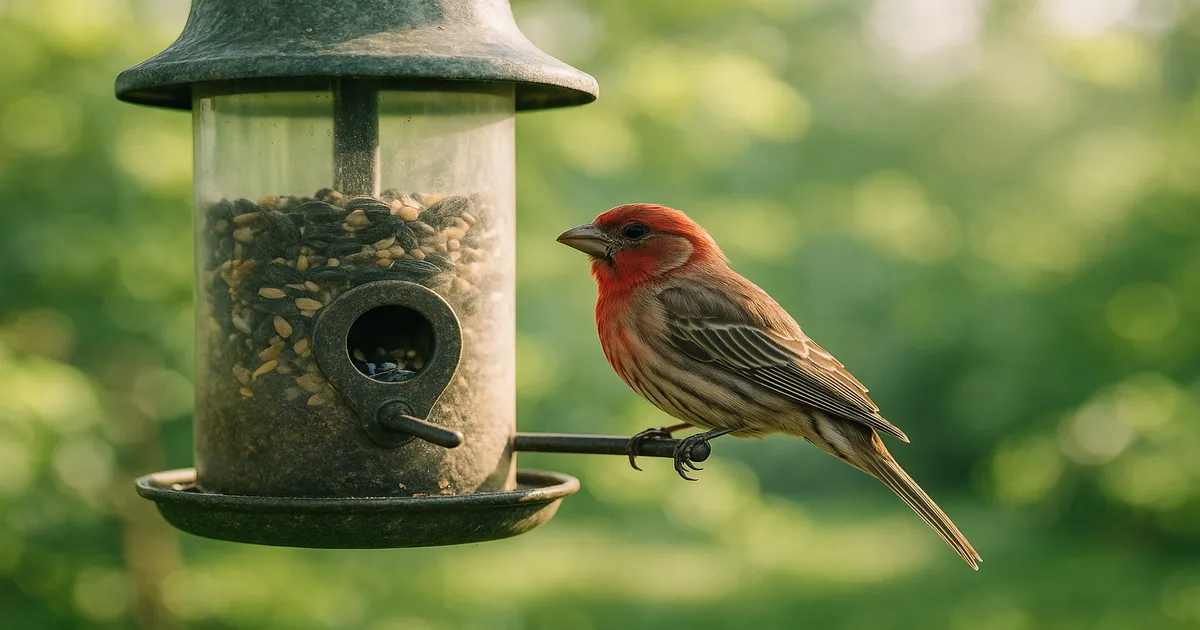
Quick Answer: The most likely answer to “what is wrong with this poor House Finch” is mycoplasmal conjunctivitis — a bacterial eye disease that causes swollen, crusty, or watery eyes and can leave birds effectively blind. If the bird’s eyes look normal but its head is bald, it’s probably just molting and will recover on its own. Either way, clean your feeders with a bleach solution today.
If you’ve spotted a House Finch (Haemorhous mexicanus) at your feeder looking puffy, squinty-eyed, or just plain wrong, you’re not alone. It’s one of the most common distress calls I hear from backyard birders. The good news: most conditions affecting House Finches are identifiable from a distance, and there are real steps you can take to help.
What Is Most Likely Wrong With a Sick-Looking House Finch?
The Most Common Culprit: House Finch Eye Disease
If the bird has swollen, red, crusty, or weeping eyes — one or both — you’re almost certainly looking at mycoplasmal conjunctivitis, also called House Finch eye disease. It’s a bacterial infection that swept through the eastern population starting in 1994 and caused one of the steepest wildlife population crashes ever recorded for a common North American songbird. More on this below.
Other Frequent Causes at a Glance
Use this quick checklist before reading further:
- Swollen or crusty eyes → House Finch eye disease (most likely)
- Bald or patchy head → Normal late-summer molt, or feather mites (usually harmless)
- Warty growths on feet or face → Avian pox
- Lethargic, fluffed feathers, no obvious eye symptoms → Salmonellosis or trichomoniasis
- Sitting stunned near a window → Window strike
- Visible wound or limping → Cat bite or other trauma
How to Confirm You’re Looking at a House Finch
Before diagnosing what’s wrong with this poor House Finch, make sure you’ve actually got one. Misidentification happens more than people expect.
Key Field Marks: Male, Female, and Juvenile
Adult males are easy once you’ve seen a few: rosy-red forehead, eyebrow stripe, throat, breast, and rump, set against a brown streaked back and heavily streaked flanks. The belly is white with distinct brown streaks. Females are entirely brown and streaked, with a plain, unpatterned face — no bold eyebrow stripe. Juveniles look like females but appear especially scruffy during their first fall molt, with young males showing blotchy, uneven patches of orange or red as adult plumage comes in.
The bill is short, conical, and slightly curved — built for cracking seeds. House Finches are compact birds, about 5 to 5.5 inches (12.7–14 cm) long, with a rounded body and a medium-length notched tail.
House Finch vs. Purple Finch vs. Cassin’s Finch
| Feature | House Finch ♂ | Purple Finch ♂ | Cassin’s Finch ♂ |
|---|---|---|---|
| Red area | Forehead, breast, rump | Entire head + back | Bright crimson cap only |
| Belly streaking | Heavy | Light or absent | Moderate |
| Bill size | Short, curved | Larger, curved | Larger; peaked crown |
| Typical habitat | Urban/suburban | Forest edges | Mountain conifers |
The easiest shortcut on males: look at where the red is. House Finch red is concentrated on the forehead, breast, and rump. Purple Finch males are washed in deeper raspberry-red across the entire head and back, with far less belly streaking. Female Purple Finches have a bold white supercilium that female House Finches simply don’t have. In the Rockies or Sierra Nevada, watch for Cassin’s Finch (Haemorhous cassinii) — it has a sharply defined crimson cap and a distinctly peaked crown. A good pair of binoculars (Nikon Monarch M5 8x42) makes these distinctions much easier to sort out from across the yard.
House Finch Eye Disease: The Number-One Health Threat
What Is Mycoplasmal Conjunctivitis?
The disease is caused by Mycoplasma gallisepticum, a bacterium previously known only to infect poultry. In the winter of 1994, birders around Washington, D.C. began noticing House Finches with badly swollen eyes at their feeders. Within a few years the disease had swept through the entire eastern population and has since been documented in western birds as well.
Symptoms to Watch For
You’ll often spot an infected bird because it’s sitting still while healthy birds bustle around it. Specific signs include:
- Eyes that appear swollen, red, watery, or crusted shut
- One or both eyes partially or fully closed
- Discharge or crustiness matted around the eye socket
- Fluffed feathers and general lethargy
- Disorientation — the bird may not react normally to your approach
In severe cases birds go effectively blind and can’t avoid predators. A House Finch sitting motionless on the ground near a feeder with crusted-over eyes is a bad sign.
How the Disease Spreads — and Why Feeders Are a Risk Factor
Mycoplasma gallisepticum spreads through direct contact: bird to bird, or bird to contaminated surface. Feeders, perches, and birdbaths are all transmission hotspots. House Finches are naturally gregarious — flocks of ten to twenty birds packed onto a single feeder are normal — and that close contact is exactly what lets this disease move fast.
Feeder hygiene isn’t optional here. It’s the single most effective thing a backyard birder can do to slow the spread.
The Population Crash
Between 1994 and 2004, eastern House Finch populations declined by an estimated 60% — driven largely by this one disease. That’s a staggering drop for a bird that was once among the most abundant feeder species in the East. Western populations have also been affected since the disease crossed the Rockies, though the decline there has been less severe. Overall population estimates still run into the hundreds of millions, but the eastern numbers are real and the trend is still negative.
Other Reasons a House Finch May Look Sick or Injured
Molting: Why Bald-Headed Finches Are Usually Fine
Every August I start getting messages from panicked birders who’ve spotted a House Finch with a completely bald, scaly-looking head. It looks alarming. It’s almost always fine. House Finches undergo a complete annual molt in late summer, and the head feathers sometimes drop all at once, leaving the bird looking like a tiny vulture for a few weeks. The feathers grow back. No intervention needed. Feather mites or lice can also cause patchy baldness, but these cases are usually self-resolving in otherwise healthy birds.
Avian Pox: Warty Growths on Feet and Face
Avian pox is a virus spread by mosquitoes and direct contact. It causes rough, warty growths — most commonly on the feet, legs, and around the face. Unlike eye disease, pox lesions are solid and raised, not wet or weepy. Mild cases often resolve on their own. Severe cases on the feet can cause birds to lose toes. There’s nothing you can treat from the outside; keep feeders clean and reduce standing water near your yard to cut down on mosquitoes.
Salmonellosis and Trichomoniasis
Salmonellosis shows up as a lethargic, fluffed-up bird that’s not moving much — but without the distinctive eye swelling of conjunctivitis. It spreads through fecal contamination at dirty feeders.
Trichomoniasis is caused by a protozoan parasite and is particularly nasty. It causes swelling in the throat and esophagus, making it hard for birds to swallow. Affected birds may look like they’re struggling to eat, regurgitating food, or have a wet, matted bill. Both diseases spread at feeders and birdbaths, which is yet another argument for regular cleaning.
Window Strikes and Cat Injuries
A House Finch sitting dazed on the ground directly below a window has almost certainly just hit the glass. These birds often recover within an hour if left alone somewhere safe, away from cats. Move the bird gently to a quiet, sheltered spot in a cardboard box and check back in an hour. Applying window collision deterrent film (WindowAlert UV Decals) to problem panes prevents repeat strikes.
Cat bites are a different story. Even if a bird that’s been grabbed looks physically fine, bacteria from the cat’s mouth — particularly Pasteurella multocida — enter the puncture wounds and cause fatal septicemia within 24–72 hours. Any bird that’s been in a cat’s mouth needs a wildlife rehabilitator, fast.
What to Do If You See a Sick House Finch
Step 1: Clean and disinfect your feeders immediately. Mix a 10% bleach solution — 1 part household bleach to 9 parts water. Disassemble feeders, scrub thoroughly, soak for a few minutes, rinse well, and let them dry completely before refilling. Do the same for birdbaths. Toss any seed that’s wet, clumped, or moldy.
Step 2: Take feeders down temporarily. Removing feeders for one to two weeks disperses the flock and breaks the transmission chain. Birds won’t starve — they’ll find food elsewhere. When you put feeders back up, keep them clean and consider spacing multiple stations apart to reduce crowding. Tube feeders are easier to disassemble and disinfect than platform feeders, which is worth factoring in when you restock.
Step 3: Know when to call a rehabilitator. Handling wild birds without a federal permit is illegal in the United States. If a bird is severely debilitated — unable to fly, completely unresponsive, or clearly in distress — contact a licensed wildlife rehabilitator. The National Wildlife Rehabilitators Association (nwrawildlife.org) can help you find one nearby. Don’t attempt to treat the bird yourself with antibiotics or eye drops.
Step 4: Report your sighting to Project FeederWatch. Cornell Lab of Ornithology’s Project FeederWatch has been tracking House Finch eye disease since 1994. A single observation from your yard is genuinely useful data. Log onto the Project FeederWatch website and submit a report. Citizen science from backyard birders has been central to understanding how this disease moves.
Feeding House Finches: Best Practices for a Healthy Flock
Black-oil sunflower seeds are the undisputed favorite — thin-shelled, high in fat, and easy to crack. Nyjer (thistle) and safflower are also excellent. Sunflower chips reduce mess and are eagerly taken. Skip cheap mixed seed bags heavy on milo and corn; House Finches largely ignore those fillers. A quality seed mix (Wagner’s Greatest Variety Wild Bird Food) goes a long way toward keeping birds on your feeders rather than scattering hulls everywhere.
At feeders, House Finches are sociable to the point of pushy. Brighter males tend to dominate, displacing females and juveniles. The birds linger — unlike more skittish species that grab a seed and go, House Finches will sit and feed for extended periods, which is part of why disease spreads so readily among them.
House Finches are also strongly drawn to moving water. A dripper or small fountain will bring them in reliably. Just clean and scrub the birdbath every two to three days and disinfect weekly — standing water is a significant transmission point for multiple diseases.
Conservation Status and How Backyard Birders Can Help
The House Finch holds an IUCN Least Concern designation, with overall population estimates between 267 and 400 million individuals. But “Least Concern” masks a real problem in the East, where Breeding Bird Survey data shows a significant decline since the mid-1990s driven primarily by eye disease. Western populations are stable to slightly declining.
Beyond disease, outdoor and feral cats are among the top predators of feeder birds. Window strikes kill hundreds of millions of birds annually across North America. Pesticide use reduces insect prey and can directly poison birds through contaminated seeds. None of these threats are going away on their own.
Project FeederWatch and Cornell Lab’s eBird platform both accept observations from anyone with a feeder or a pair of binoculars. Your data — especially sick bird reports — feeds directly into the research that tracks these trends. It takes five minutes and it matters.
Frequently Asked Questions About Sick House Finches
Why does my House Finch have swollen or crusty eyes?
Swollen, red, watery, or crusted eyes are the hallmark symptom of mycoplasmal conjunctivitis, caused by Mycoplasma gallisepticum. This disease has been spreading through North American House Finch populations since 1994 and remains the most common reason for visibly ill birds at feeders. Disinfect your feeders immediately with a 10% bleach solution and consider removing them for one to two weeks to slow transmission.
Is a bald-headed House Finch sick or just molting?
Almost certainly molting. A bald or patchy head in late summer (July–September) is a normal part of the annual feather replacement cycle and needs no intervention. The bare skin will look pink or dark and slightly scaly, but feathers grow back within a few weeks. If you see baldness combined with eye symptoms or extreme lethargy, that warrants a closer look.
Can House Finch eye disease spread to other birds at my feeder?
Mycoplasma gallisepticum can infect other finch species — American Goldfinches and Purple Finches have both been documented with the disease, though House Finches are by far the most commonly affected. The risk to species outside the finch family appears low, but regular feeder hygiene protects all your feeder birds regardless of species.
Should I take down my feeders if I see a sick House Finch?
Yes — temporarily. Removing feeders for one to two weeks disperses the flock and interrupts the transmission chain. Before putting them back up, scrub with a 10% bleach solution (1 part bleach, 9 parts water), rinse thoroughly, and let them dry completely. This is more effective than cleaning feeders while leaving them up.
How do I tell a House Finch from a Purple Finch?
On males, look at where the red is. House Finch males have red concentrated on the forehead, breast, and rump, with a heavily streaked belly. Purple Finch males are washed in deeper raspberry-red across the entire head and back, with much less belly streaking. On females, the eyebrow stripe is the giveaway — female Purple Finches have a bold white supercilium; female House Finches have a plain, unmarked face.