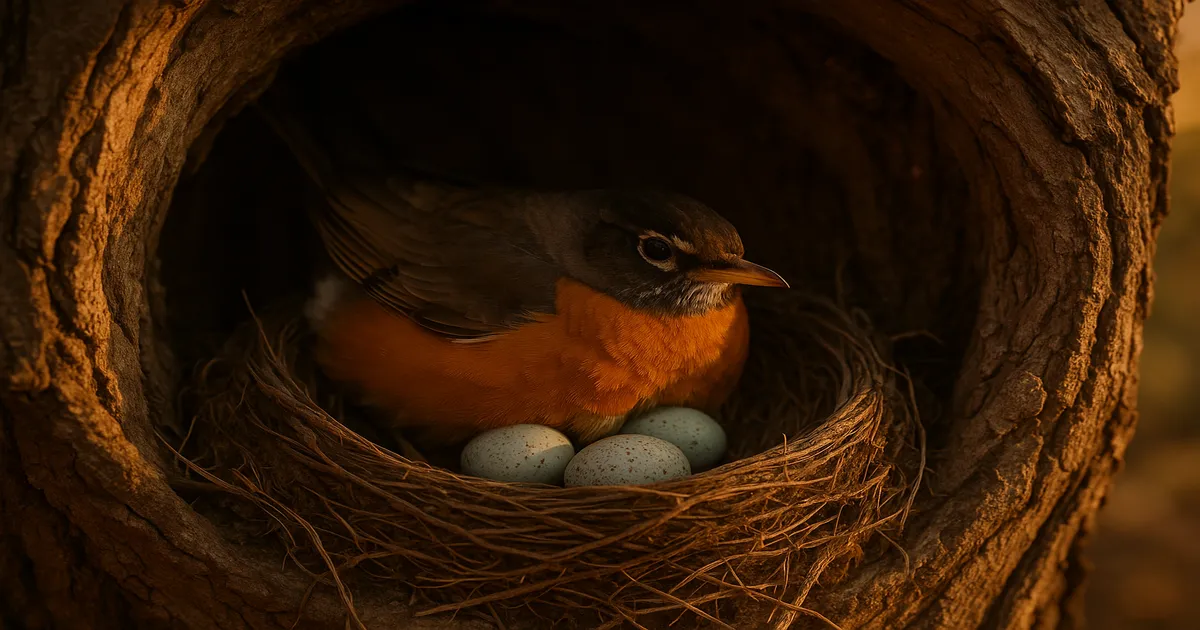
Quick Answer: No — robins don’t abruptly stop sitting on the nest the moment their eggs hatch. The female continues to sit overnight during the first week or so after hatching, now brooding rather than incubating, because newborn chicks can’t regulate their own body temperature. As the chicks grow feathers over days 6–13, she gradually spends less time on the nest at night. By the time they fledge at around two weeks old, neither parent is sleeping there at all.
If you’ve been watching a robin nest and noticed the female still hunkered down at night even after the chicks hatched, you weren’t imagining things. Whether robins stop sitting on their nests at night after the chicks hatch is one of the most common questions I get from backyard birders, and the short answer is: it’s a process, not a switch. Understanding why takes a quick look at how helpless those newly hatched birds really are.
Meet the American Robin
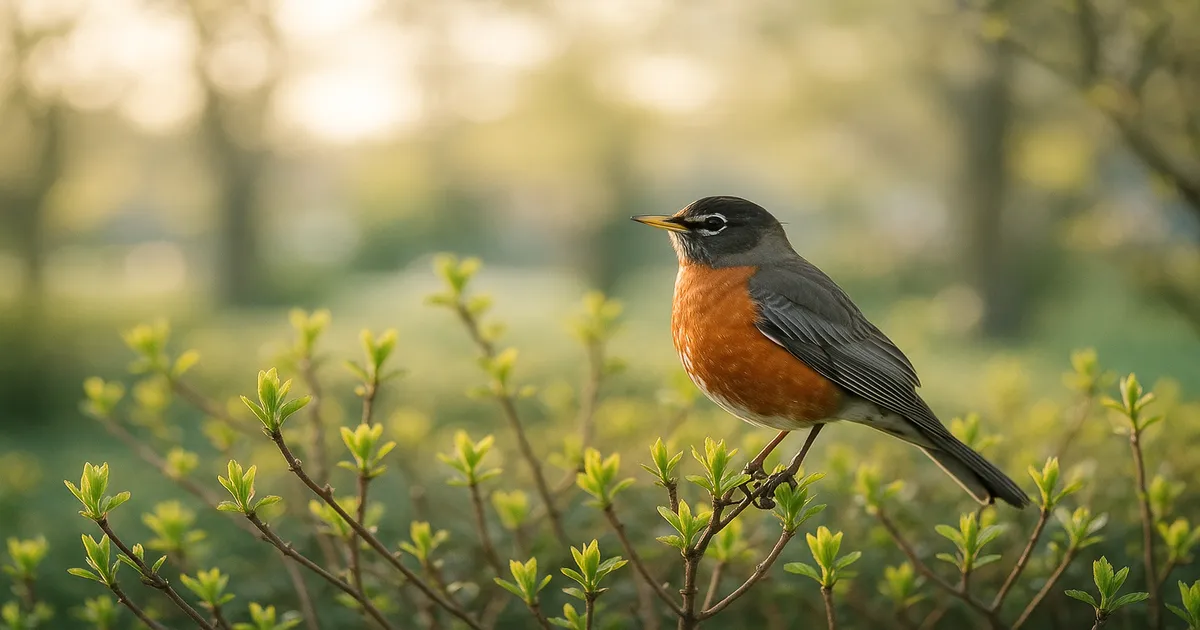
The American Robin (Turdus migratorius) is one of those birds almost everyone recognizes but fewer people look at closely. Worth knowing what you’re actually seeing before you start monitoring a nest.
Size, Shape, and Field Marks
Robins measure about 9–11 inches (23–28 cm) long with a wingspan of 12–16 inches (31–41 cm) and weigh roughly 2.7–3.0 ounces (77–85 g). They’re plump and upright, with long legs and that unmistakable run-stop-tilt-head posture when hunting earthworms on a lawn. The bill is yellow-orange and slightly curved — built for grabbing worms, not cracking seeds.
The male has a dark blackish head, vivid brick-red breast, and slate-gray back. The female follows the same basic pattern but is noticeably washed out: her head is dark gray rather than black, and her breast is a paler, muted orange-red. At a distance, head color is your quickest clue. Both sexes have a broken white eye ring — two white arcs, not a complete circle — and a white lower belly.
Juvenile robins have heavily spotted breasts on an orange-buff background, a classic thrush look that surprises people who’ve only seen adults. They molt into adult-like plumage by late summer of their first year. If you’re wondering whether a spotted bird is a Hermit Thrush (Catharus guttatus) or Wood Thrush (Hylocichla mustelina), check the size: both are noticeably smaller than a robin, and Wood Thrushes have bold dark spots on a white — not orange — breast. Varied Thrush (Ixoreus naevius) is the other common confusion species in the West; it has an orange breast, but look for the bold black breast band and orange eyebrow stripe.
Calls to Know Around the Nest
The robin’s song is the classic rising-and-falling caroling phrase — “cheerily, cheer-up, cheerio” — one of the first voices you’ll hear at dawn. Near the nest, the call that matters is the alarm: a sharp, staccato “tut-tut-tut” or rapid “tik-tik-tik” that means a predator (or an overly curious human) has gotten too close. If you hear it while approaching, back off.
American Robin Nesting: Nest, Eggs, and Incubation
How and Where Robins Build
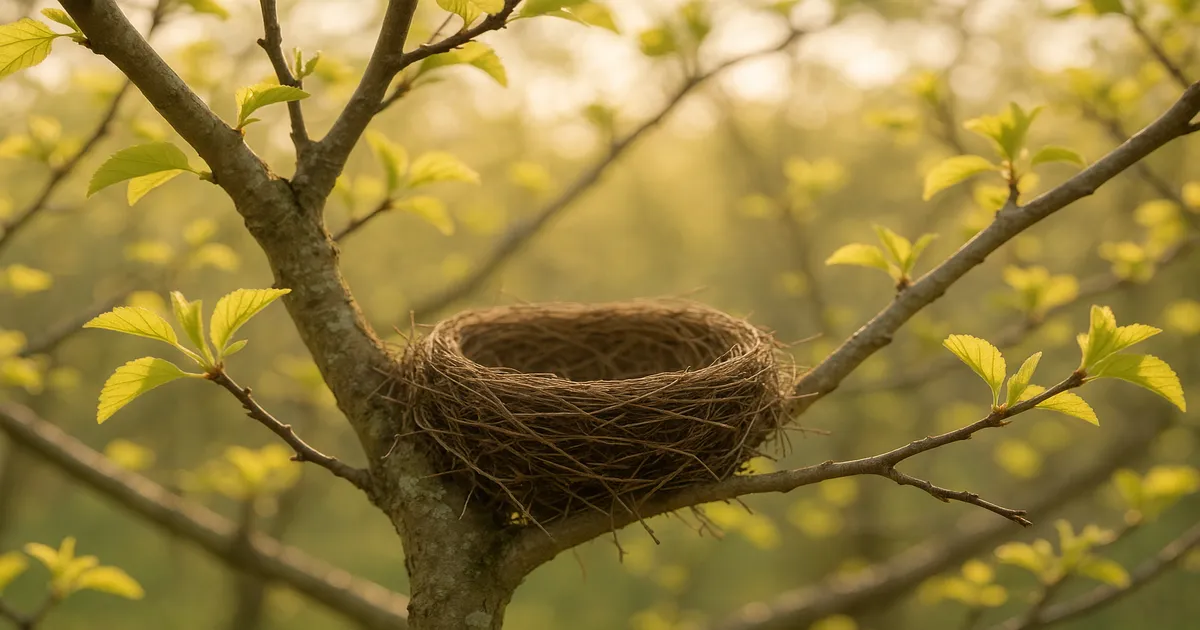
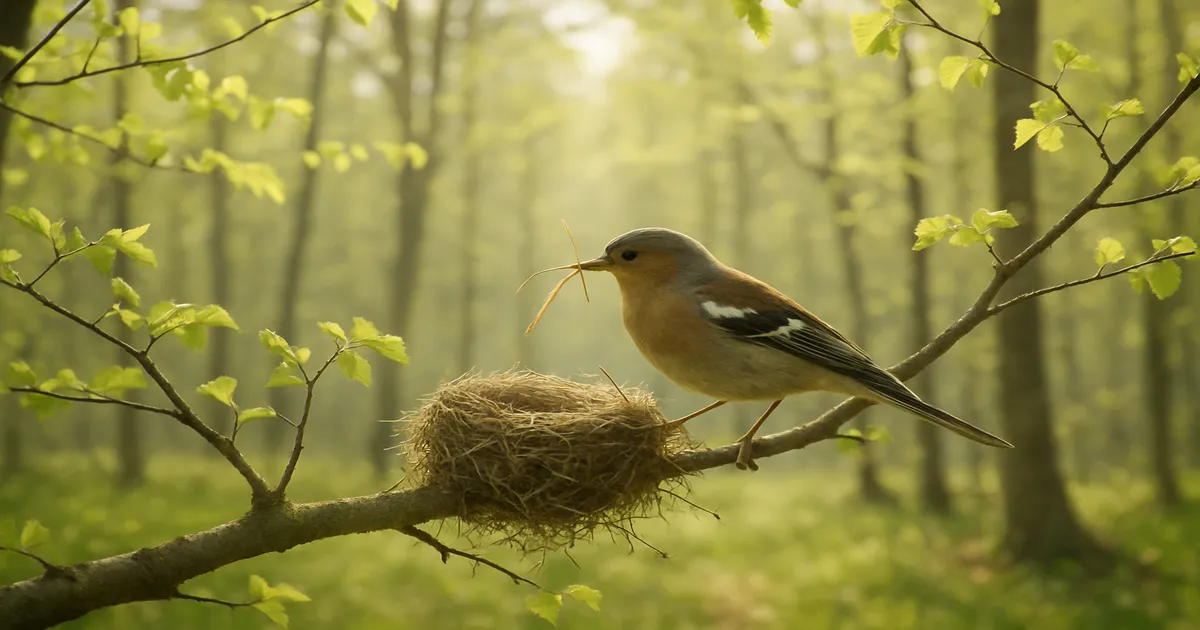
The female builds the nest almost entirely on her own over 2–6 days. It’s a sturdy mud-reinforced cup: coarse grasses and twigs on the outside, a layer of mud in the middle, and fine dry grass lining the inner cup. The outer diameter runs about 6 inches (15 cm) and the inner cup about 4 inches (10 cm). Typical placement is 5–15 feet up on a horizontal branch, building ledge, or windowsill — somewhere with a solid base and some cover overhead.
Clutch size is 3–5 eggs, almost always 4. The eggs are that instantly recognizable unmarked turquoise-blue — so distinctive that “robin’s egg blue” is a color in its own right. Eggs are laid one per day in the early morning.
Incubation: Who Sits and for How Long?
Incubation is performed almost exclusively by the female and lasts 12–14 days. She sits for long stretches during the day, leaves only briefly to forage, and stays on the nest throughout the night. The male doesn’t incubate — his job at this stage is to bring food to the female and defend the territory.
Embryo development requires a consistent egg temperature of around 98–100°F (37–38°C). If the eggs cool significantly, development stalls or the embryos die. The female’s body warmth is the only heat source, so continuous overnight sitting isn’t optional — it’s survival. That sets the stage for what happens after hatch.
Do Robins Stop Sitting on Their Nests at Night After the Chicks Hatch?
Brooding vs. Incubation: What’s the Difference?
Incubation is warming eggs to support embryo development. Brooding is warming live chicks that can’t yet generate their own body heat. From the outside, both look the same — female sitting on the nest — but the biological purpose has shifted.
Days 1–6: Chicks That Cannot Warm Themselves
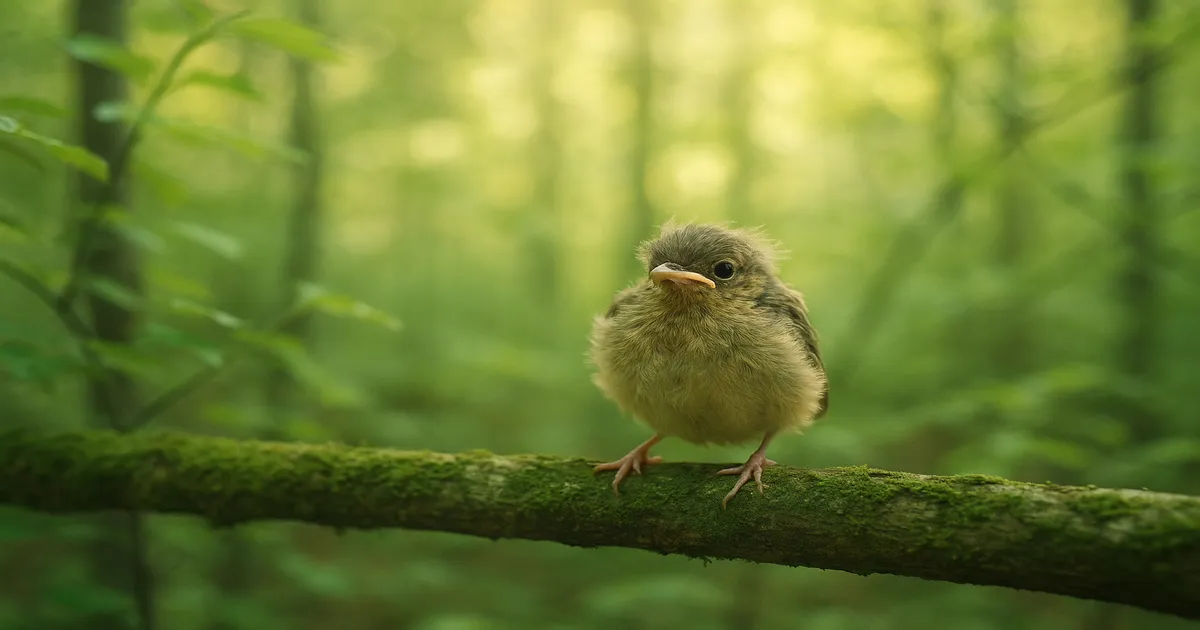
Newly hatched robins are altricial: naked, eyes closed, and completely unable to thermoregulate. In cool conditions, a chick left without the female’s warmth would become hypothermic within minutes. So for roughly the first six days after hatching, the female continues to sit on the nest at night just as she did during incubation. She also broods frequently during the day, especially in cold or wet weather. This is the direct answer to whether robins stop sitting on their nests at night after the chicks hatch — they don’t, not right away.
The Male’s Role During Brooding
The male doesn’t brood, but he’s far from idle. He takes on most of the food delivery during the early brooding phase, bringing earthworms and soft invertebrates while the female stays put. He also sings to defend the territory and perches near the nest to watch for predators. Clean division of labor for a species with a tight developmental timeline.
Cold and Rainy Weather: When the Female Stays Longer
Even as chicks get older and start growing feathers, a cold snap or several days of rain can push the female back into longer overnight brooding sessions. Don’t be surprised if she seems to “regress” during a cold week in May. She’s responding to what the chicks actually need, not following a rigid calendar.
The Gradual Transition: When Robins Start Leaving the Nest at Night
Days 6–13: Feathers and Self-Regulation
Around day 6, pin feathers start breaking through. By days 8–13, the chicks have enough feather coverage to start holding their own body heat. This is the window where the female’s overnight presence becomes progressively less necessary — and progressively less frequent. She doesn’t stop on a set day; she tapers off as the chicks demonstrate they can manage without her.
In mild weather, she may stop sleeping on the nest entirely somewhere between days 10 and 13. She’ll still visit constantly during the day to feed the rapidly growing chicks — studies have recorded up to 100 feeding visits per day for a nest with older chicks — but the nighttime sessions wind down and eventually stop.
Timeline: Robin Nighttime Nest Presence from Hatching to Fledging
| Days After Hatching | Chick Development | Female’s Nighttime Behavior |
|---|---|---|
| Days 1–5 | Naked, eyes closed, cannot thermoregulate | Sits on nest all night (brooding) |
| Days 6–9 | Pin feathers emerging, eyes beginning to open | Usually sits overnight; may leave briefly in warm weather |
| Days 10–13 | Feathers developing, thermoregulation improving | Often skips overnight in mild weather; returns in cold/rain |
| Days 13–16 (fledging) | Fully feathered, ready to leave | Neither parent sleeps in the nest |
If you’re watching a nest and the female is still there at night on day 8, that’s completely normal.
Fledging and What Comes Next
Chicks fledge at 13–16 days after hatching. They’re not great fliers at this point — they flutter to the ground and hop around in low vegetation — but they’re mobile, and neither parent returns to sleep in the nest after fledging. Both parents continue feeding fledglings for 2–3 weeks after they leave. The male typically takes on more of this responsibility as time goes on, while the female may already be building a new nest for the next brood.
American Robins raise 2–3 broods per season. The female often starts construction while the male is still feeding the previous brood’s fledglings. By July, some pairs are on their third clutch.
If you find a fully feathered robin chick hopping around on the ground, leave it alone. This is normal fledgling behavior, not abandonment. The parents know exactly where it is. Move it only if it’s in immediate danger — a cat nearby, or a busy road — and put it in the nearest shrub. Don’t put it back in the nest; it’s supposed to be on the ground.
Watching Robins Nest: Practical Tips
Reading the Nest Stage at a Glance
- Incubation: Female sits very still for long stretches; no chick heads visible; male brings food occasionally
- Early brooding: Female still sitting but shifts position more often; male makes more frequent food deliveries
- Late brooding/approaching fledge: Chick heads visible above the nest rim; both parents making rapid, frequent feeding trips; female no longer sitting between feedings
Keeping Your Distance
Robins tolerate humans better than many species, but repeated close approaches cause stress and can lead to nest abandonment — especially during incubation. Watching from 15–20 feet with binoculars (Nikon Monarch M5 8x42) gives you a clear view without pressuring the birds. If you hear the alarm call, you’re already too close.
Don’t set up a camera right at the nest without giving the birds a few days to acclimate. Avoid disturbing the area during the first week after hatch — that’s when brooding is most critical and disruption does the most harm.
Attracting Robins to Your Yard
Robins don’t use tube feeders. Skip the seed. What actually works:
- Birdbath with a dripper or mister — robins are strongly drawn to moving water
- Platform feeder or ground feeding area with live or dried mealworms
- Fruit: halved apples, soaked raisins, blueberries, grapes
- Pesticide-free lawn — earthworms are the real draw, and pesticides wipe them out
- Open-fronted nesting platform on a fence post or building — robins won’t use enclosed nest boxes, but they’ll readily adopt a simple shelf
Conservation: Threats and How to Help
The American Robin is listed as Least Concern on the IUCN Red List, with a population estimated around 300 million individuals. But “abundant” doesn’t mean “unthreatened.” Breeding Bird Survey data shows a stable-to-slightly-declining trend in recent decades.
The three biggest human-caused threats are cats, window strikes, and pesticides. Domestic and feral cats kill an estimated 1.3–4 billion birds annually in North America; ground-foraging robins are easy targets. Window strikes kill around 600 million birds per year in the U.S., and robins rank among the most frequently killed species. Pesticide use depletes earthworm populations and can directly poison robins — DDT’s catastrophic effect on robins in the mid-20th century was one of the documented cases in Rachel Carson’s Silent Spring.
American Robins are also a primary reservoir host for West Nile Virus, meaning the virus amplifies in robin populations before spreading to other birds and humans via mosquitoes. It’s a genuine population-level threat that doesn’t get enough attention.
Simple things that make a real difference:
- Keep cats indoors — the single highest-impact action most people can take for backyard birds
- Apply window collision deterrents on problem windows (WindowAlert UV Decals)
- Stop using lawn pesticides — let the earthworms thrive
- Plant native berry-producing shrubs like holly (Ilex spp.), serviceberry (Amelanchier spp.), and dogwood (Cornus spp.) for winter food
Frequently Asked Questions
Do robins stop sitting on their nests at night after the chicks hatch?
No. The female continues sitting on the nest at night after hatching, but now she’s brooding (warming chicks) rather than incubating eggs. Newly hatched robins can’t generate their own body heat, so her overnight presence is essential for the first week or so. She gradually stops as the chicks develop feathers and gain the ability to thermoregulate — usually by days 10–13.
How long does the female robin sit on the nest after the eggs hatch?
She broods chicks closely for the first 6 days after hatching, then tapers off as feathers develop. By days 10–13, she may no longer sit on the nest overnight in mild weather. Chicks fledge at 13–16 days, at which point she stops sitting on the nest entirely.
Where does the mother robin sleep when she has chicks?
During the first week or so after hatching, she sleeps on the nest, brooding the chicks. As the chicks feather out, she begins roosting elsewhere — typically in a sheltered tree or dense shrub near the nest. By the time the chicks are close to fledging, she’s no longer sleeping in the nest at all.
How can you tell if a robin nest has eggs or chicks?
The clearest sign of chicks is seeing small heads or open beaks above the nest rim when a parent arrives with food. During incubation, the female sits still for long stretches and the nest looks quiet. Once chicks hatch, feeding trips become much more frequent, and you may hear faint begging calls from inside the nest.
What happens to a robin nest after the chicks fledge?
Once all the chicks have left, neither parent returns to sleep in or use the nest. The female may renovate it or build a new one nearby for a second brood. Old robin nests deteriorate over the season and are rarely reused the following year, though some females return to the same general location.