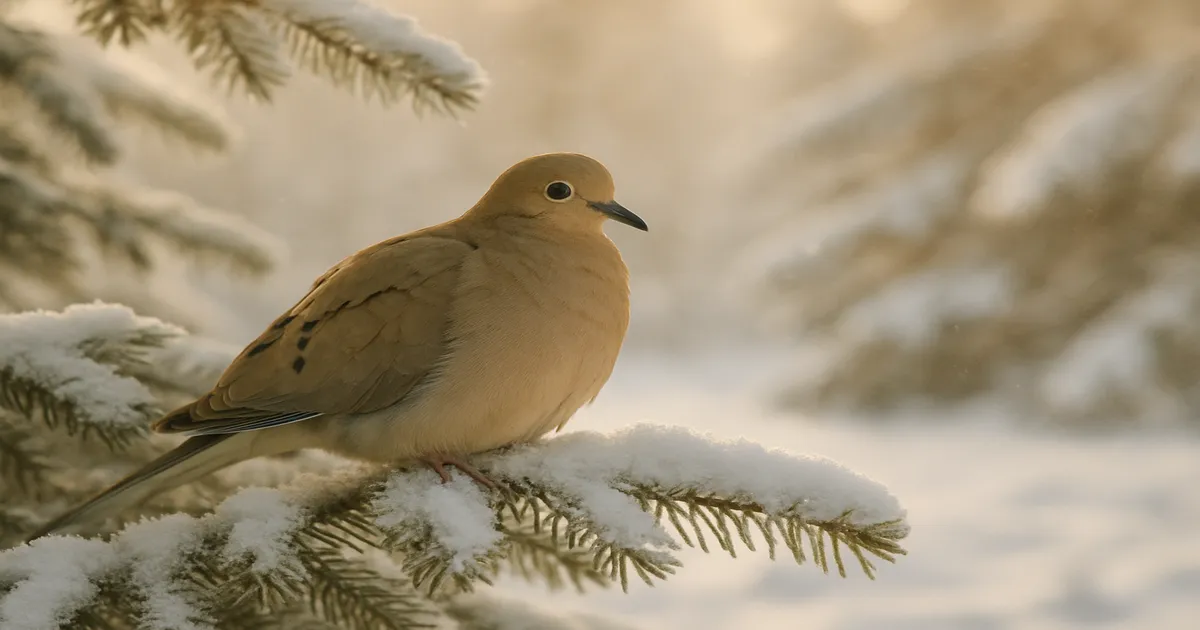
Quick Answer: Yes, mourning doves (Zenaida macroura) nest in snowy conditions regularly — it’s not a fluke. Northern-range birds routinely begin nesting in March and early April, when late-season snowstorms are still common, and incubating adults will sit tight on their eggs while snow piles up on their backs. This calculated risk pays off because mourning doves have one of the longest breeding seasons of any North American bird.
If you’ve spotted a dove hunched on a flimsy twig nest during a late-winter snowstorm and wondered whether something was wrong, relax — almost certainly nothing is. Mourning doves commonly nest in snowy conditions across the northern United States, and that stubborn, snow-dusted silhouette is a sign of a highly successful reproductive strategy, not a bird in trouble.
Do Mourning Doves Really Nest in Snowy Conditions?
Mourning doves nest earlier than almost any other bird in their range. In the northern U.S., March and early April nests are routine — snow and all. Both parents share incubation duties and don’t abandon the nest when the weather turns ugly. I’ve watched an incubating dove accumulate a visible cap of snow on its back without so much as shifting its weight, and that’s entirely normal.
The key is their breeding strategy. Mourning doves can raise 2–6 broods per year, so every extra week of breeding season translates directly into more offspring. Starting in late winter — even at some risk — is a genuine fitness advantage. If a nest fails in a bad storm, the pair typically re-nests within one to two weeks. The math works out in their favor.
Mourning Dove Identification
Size, Shape, and Field Marks
The mourning dove runs 11–13 inches (28–33 cm) long with a wingspan of 17–19 inches (43–48 cm) and weighs a surprisingly light 3.4–6.0 oz (96–170 g). The slender body and long, wedge-shaped tail are the first things to lock onto. In flight, white-tipped outer tail feathers flash distinctively, and the overall silhouette is far more tapered than a rock pigeon’s.
Up close, look for:
- Soft buffy-tan to pinkish-brown underparts
- Bold black spots scattered across the wing coverts
- A small iridescent pink-and-green neck patch
- Bright powder-blue bare skin ringing the eye
- A single black spot below and behind the eye
A good pair of binoculars (Nikon Monarch M5 8x42) makes picking out those field marks much easier, especially on birds perched high in conifers.
Male vs. Female vs. Juvenile
Males and females are close in size. Males show a more vivid iridescent neck patch, a bluish-gray crown, and brighter blue orbital skin. Females are slightly duller overall, with a brownish-gray crown and more muted neck iridescence. Juveniles are the easiest to separate — they look scaly, with pale feather fringes giving the breast and back a streaked appearance that fades through the first fall molt.
The Coo and the Wing Whistle
That slow, descending ooah-woo-woo-woo you hear on mild late-winter mornings is almost always a mourning dove, not an owl — a mistake new birders make constantly. They vocalize year-round, and hearing that call in February is often the first hint that nesting season is ramping up. The other unmistakable sound is the loud, whistling whirr of the wings on takeoff, produced by modified primary feathers and used as an alarm signal. Once you know it, you’ll never misidentify a flushed dove again.
Range and Habitat
Where Mourning Doves Live
Mourning doves breed across virtually the entire continental United States and into southern Canada, making them one of the most widespread birds on the continent. They’re also found throughout Mexico, Central America, and parts of the Caribbean, with introduced populations in Hawaii.
Southern birds — roughly from Virginia and Kansas southward — are year-round residents. Northern populations in the upper Midwest, Great Lakes, New England, and southern Canada are partially migratory, heading south in fall and returning in late February through April. Those early returnees often beat the last snowfall by days or weeks, which is exactly why early snow nesting happens.
Preferred Habitat
Mourning doves are birds of open and semi-open landscapes: suburban yards, farmland edges, open woodlands, desert scrub, roadsides. Dense forest interiors don’t work for them — you won’t find a nesting pair deep in unbroken woods. In cold-climate settings, early-season nests are disproportionately placed in dense conifers like spruce, arborvitae, and juniper, which provide meaningful overhead protection from precipitation and wind.
The Nesting Season: One of the Longest in North America
Across much of the U.S., mourning doves nest from February through October. In the southernmost states, nesting has been documented in every month of the year. Even in the northern tier, nesting can kick off in March, well before reliable warm weather arrives.
Most pairs raise 3–4 broods per year, though up to 6 has been documented. The entire nest cycle from egg-laying to fledging takes only about 25–30 days, which means a pair can realistically complete multiple successful nests between March and October. Starting in March instead of April means one additional brood slot. The cost — a higher chance of nest failure in bad weather — is real but manageable, since re-nesting happens fast.
Nesting in Snowy Conditions: What Actually Happens
Incubation Behavior During Snowfall
Both parents share incubation, with the male typically covering the day shift and the female taking over at night. During snowfall, incubating adults don’t retreat — they hunch down and stay put. Snow visibly accumulates on their backs. This isn’t distress; it’s the behavior working exactly as it should.
Adult body heat is sufficient to maintain egg temperature through moderate snow events. The eggs are tucked against the brood patch — bare, highly vascularized skin on the adult’s belly — and stay warm even when surrounding air temperatures drop well below freezing. Prolonged cold snaps with heavy wet snow are the real threat, since extended exposure can eventually overwhelm the adult’s ability to compensate.
Why Conifers Matter for Cold-Weather Nests
Early-season nests in northern areas are notably more likely to be placed in dense conifers than later nests. A thick spruce or arborvitae intercepts snow and breaks wind — meaningful advantages for a nest that’s essentially just a loose twig platform. Checking ornamental conifers in suburban yards in late February or March is one of the most reliable ways to find early nests.
When Snow Causes Nest Failure
Heavy, wet snowstorms and multi-day freezes do cause nest failures, especially early in the season when temperatures are most volatile. Recovery is quick, though. Pairs typically re-nest within one to two weeks, often in a nearby location. The flimsy nest construction — a loose platform of twigs, sometimes thin enough that eggs are visible from below — means there’s not much invested in any single attempt.
Nest Construction, Eggs, and Chicks
A mourning dove nest looks like a bird built it on its first try with no instructions: a flat, loosely assembled platform of twigs, pine needles, and grass, typically placed 3–25 feet (0.9–7.6 m) above ground. Despite appearances, it gets the job done — repeatedly.
The clutch is almost invariably exactly 2 eggs — plain white, unmarked, about 1.1 × 0.85 inches (28 × 22 mm). Incubation runs 13–15 days, with both parents sharing duties in a reliable day/night rotation. Both parents also produce crop milk — a protein- and fat-dense secretion from the crop lining — to feed hatchlings during the first few days of life. This “pigeon milk” is unique to the Columbidae family and fuels the nestlings’ rapid early growth.
Nestlings fledge in just 12–15 days after hatching. That fast turnaround is what makes 3–4 broods per year biologically feasible and why early nesting, snow risks included, pays off over a full season.
Attracting Mourning Doves to Your Yard
What They Eat
Seeds account for roughly 99% of the mourning dove’s diet. Wild food sources include foxtail grass, ragweed, pigweed, knotweed, and agricultural grains like corn, wheat, and millet. During egg-laying season, they’ll also actively seek out snail shells and eggshell fragments for calcium.
Best Seeds and Feeders
White proso millet is the top choice — if you want doves, millet is your best tool. Safflower seeds, hulled sunflower, and cracked corn round out the list. Skip tube feeders entirely; mourning doves are ground foragers with larger bodies, and a tube perch is awkward and impractical for them. A wide platform or tray feeder is the right call, or simply scatter seed on the ground or a flat surface. They’ll also clean up spilled seed beneath other feeders, which makes them easy guests to accommodate.
A quality wild bird seed mix with a high millet content keeps doves coming back reliably through winter.
Feeding in Cold and Snowy Weather
When snow covers natural seed sources, supplemental feeding matters. Keep the feeding area cleared after snowfall — mourning doves won’t dig through snow to find seed the way some other species will. Ground-level stations or wide platform feeders stocked with white proso millet and cracked corn can make a real difference for doves wintering in northern areas.
Conservation Status
The estimated North American population sits at 350–475 million individuals, giving the mourning dove IUCN Least Concern status. By most measures, the species is doing fine.
That said, Breeding Bird Survey data shows a gradual decline of roughly 0.7–1% per year since the 1960s, most pronounced in the eastern United States. It’s a slow trend, not a crisis, but it’s statistically real. Habitat loss — particularly the conversion of agricultural edges and open scrub to developed land — is the likely primary driver.
Mourning doves are also the most heavily hunted migratory bird in North America, with approximately 20 million birds harvested annually under seasons coordinated by the U.S. Fish & Wildlife Service via the Migratory Bird Treaty Act. Their high reproductive rate — those multiple annual broods — is exactly what provides resilience against that level of harvest.
Frequently Asked Questions
Do mourning doves commonly nest in snowy conditions, or is it unusual?
It’s common, not unusual — at least in the northern United States. March and early April nests are routine for northern-range birds, and late-season snowstorms are a normal part of that window. Incubating adults stay on the nest through snowfall and can accumulate visible snow on their backs without abandoning the eggs.
At what temperature is it too cold for mourning doves to nest?
There’s no hard cutoff. Mourning doves can incubate eggs in below-freezing conditions as long as an adult stays on the nest. The real danger isn’t a single cold night but a prolonged multi-day freeze with heavy wet snow that disrupts normal incubation shifts. Adults can maintain egg temperature in surprisingly cold conditions through direct body contact with the brood patch.
Will mourning doves abandon their nest if it snows?
Generally, no. Incubating adults are remarkably persistent and will remain on the nest through snowfall, sometimes with visible snow accumulation on their backs. Abandonment is more likely during prolonged severe weather — multi-day storms with heavy wet snow and sustained hard freezes — than during a typical late-season snow event.
What month do mourning doves start nesting?
In the southern United States, mourning doves can nest in any month. Across most of the continental U.S., nesting typically begins in February or March. Northern-range birds in the upper Midwest, Great Lakes, and New England usually start in March or April, though early March nests are documented even where late snowstorms are common.
How many broods do mourning doves raise per year?
Most pairs raise 3–4 broods per year, though 2–6 is the documented range depending on latitude and conditions. In the northern U.S., 3 successful broods in a season is a realistic and common outcome — which is a big part of why the species remains so abundant despite significant annual hunting harvest.