Quick Answer: If you’re watching Blue Jays and asking “what are these Blue Jays doing? They are not mobbing” — you’re probably right. A jay spread flat on the ground with wings extended is almost certainly anting or sunning, not injured. A loose group moving through trees in late winter is a courtship flock. And those birds making frantic, repeated trips from the oak tree in fall? That’s caching. None of these involve a predator, and none involve dive-bombing.
What Are These Blue Jays Doing? The Most Common Non-Mobbing Behaviors
- Anting/Sunning — Jay lies prostrate on the ground, wings fully spread, often near an ant mound. Looks alarming. Bird is fine.
- Courtship flocking — A group of 3–10 jays moves chaotically through trees in late winter, following a female. No predator involved.
- Acorn caching — Jays make frantic, repeated flights from oaks to hiding spots in September–November, carrying up to 5 acorns at once.
- Hawk mimicry — A jay screams a perfect hawk call from a treetop with no hawk in sight. Completely normal.
- Post-breeding flocking — Loose groups of 5–50+ birds drifting through the landscape in late summer and fall, calling softly.
How to Tell Mobbing Apart from Everything Else
Mobbing has three clear signatures: a focal predator the birds are fixated on, alarm calls (that sharp, repeated jay! jay!), and active dive-bombing or close passes at the target. If you don’t see all three, it’s not mobbing. Foraging flocks move freely. Courtship flocks follow a female. Caching jays are running a circuit between a food source and a hiding spot. None of these involve a predator, and none involve dive-bombing.
Identifying a Blue Jay: Field Marks, Crest, and Calls
Size, Shape, and Plumage
The Blue Jay (Cyanocitta cristata) is a sturdy, medium-large songbird — about 11–12 inches (28–30 cm) long with a wingspan of 13–17 inches (34–43 cm), weighing 2.5–3.5 oz (70–100 g). That heft is obvious when one lands on a feeder branch.
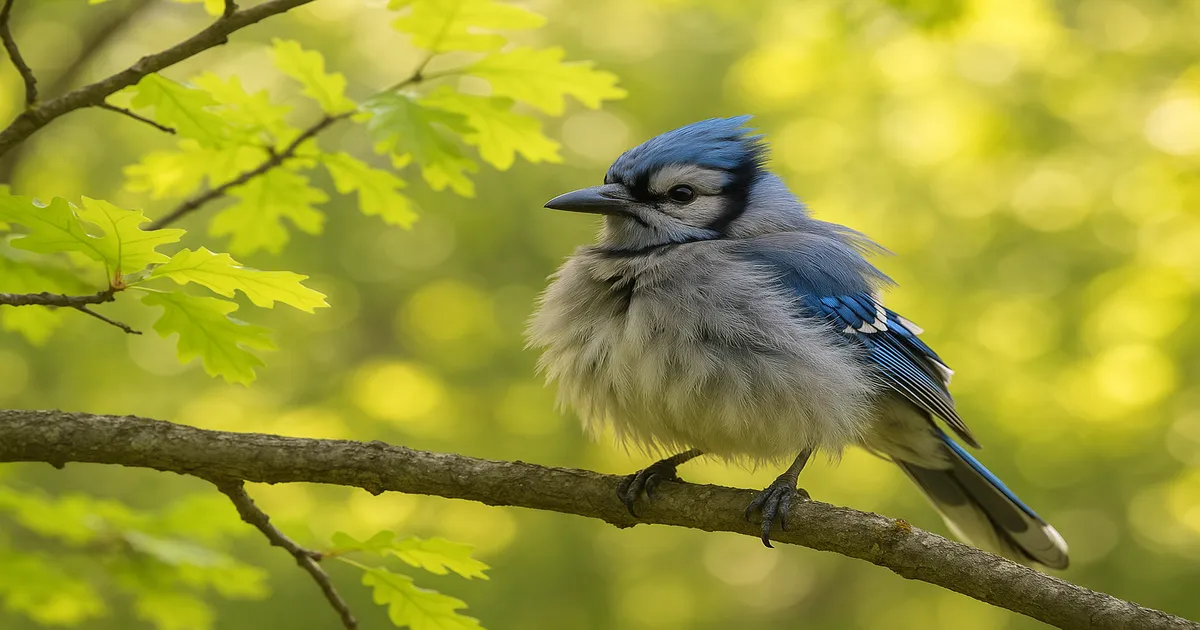
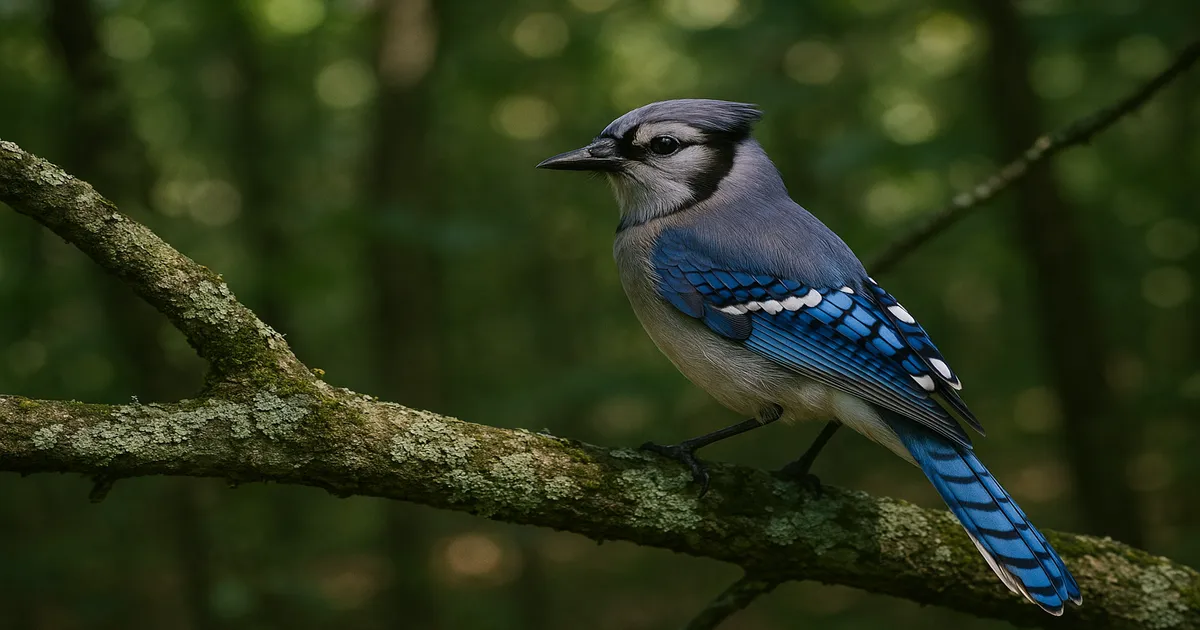
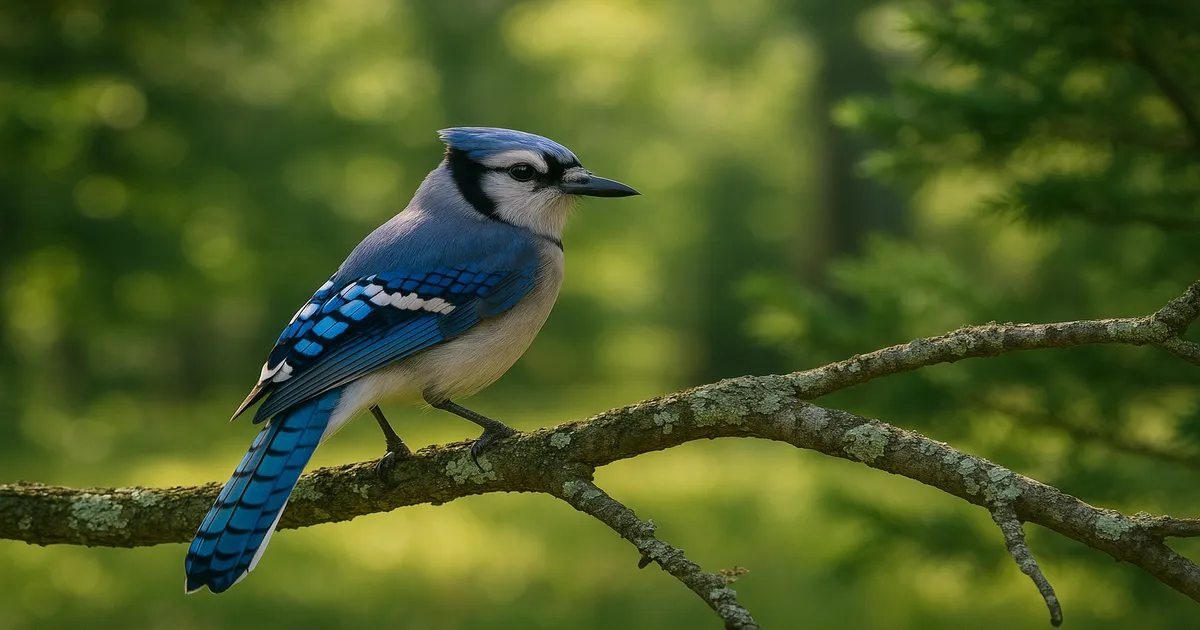
The field marks are unmistakable: brilliant blue crest, wings, back, and tail; bold white spots and black barring on the wings; white outer tail tips; white to pale gray underparts; and a black “necklace” that wraps from nape to throat. The bill is strong, straight, and black — built for cracking acorns.
What the Crest Position Tells You
A fully erect crest means the bird is alert, agitated, or asserting dominance. A flattened crest signals calm, submission, or appeasement. During courtship flocks, you’ll see crests going up and down constantly as birds interact. During anting, the crest is usually flat — the bird is relaxed, not distressed. Once you start reading crest position, you’ll find yourself doing it automatically.
Vocalizations: From Jay Screams to Hawk Mimicry
The vocal range is wider than most people realize:
- Classic jay! call — loud, harsh, descending. The alarm and contact call everyone knows.
- Bell/toolool call — a soft, liquid tull-ull between mated pairs. Easy to miss because it sounds nothing like a jay.
- Pump-handle call — rhythmic, creaking jeer-jeer-jeer, used in courtship flocks.
- Hawk mimicry — startlingly accurate Red-shouldered (Buteo lineatus), Red-tailed (Buteo jamaicensis), and Cooper’s Hawk (Accipiter cooperii) screams.
- Whisper song — a quiet, rambling mix of clicks and soft notes heard during courtship.
- Juvenile begging calls — thin, insistent wheeedle notes from fledglings.
Males, Females, and Juveniles
Males and females look identical in the field — Blue Jays are sexually monomorphic. Males average slightly larger, but you won’t see that without a direct side-by-side comparison. Juveniles in their first fall are close to adult plumage but may show duller blue tones, a less-defined necklace, and a shorter crest. By late fall of their first year, they’re essentially adult-looking. Fledglings are unmistakable — fluffy, short-tailed, with yellow gape flanges and a constant, demanding beg.
A good field guide keeps all of this straight. The Sibley Guide to Birds is the one I reach for when I want to settle a plumage question quickly.
Anting and Sunning: Why Blue Jays Lie Flat on the Ground
What Anting Looks Like — and Why It Looks So Alarming
You glance out at your lawn and there’s a Blue Jay spread flat on the grass, wings fully extended, head tilted sideways, completely motionless. Your first thought is that it’s dead or dying. I’ve had people call wildlife rehabilitators over this. The bird is almost certainly fine.
This is anting — one of the most dramatic and least-understood behaviors in the bird world. Blue Jays are among the most enthusiastic anters of any North American species.
In active anting, the jay picks up ants — particularly formic acid-producing species like carpenter ants — and rubs them deliberately through its feathers, especially under the wings and along the tail. Passive anting is the version that really alarms people: the jay simply lies prostrate on or near an ant mound and lets the ants crawl through its plumage, sometimes holding the pose for several minutes.
Sunning looks nearly identical — wings spread, tail fanned, bill open, eyes half-closed, bird oriented toward the sun. The leading explanations involve feather maintenance and ectoparasite control. Jays frequently combine sunning and anting in the same session, which makes the behavior even harder to parse from a distance.
Blue Jays have also been documented anting with walnut juice, mothballs, and other aromatic substances — a behavior called substitute anting. The common thread is pungent chemistry, which supports the formic acid hypothesis, though the full story isn’t settled.
Peak season is warm summer days, often late morning. Open areas — lawns, driveways, gravel paths — are the most common sites. Give the bird space and watch. It’ll be up and flying within a few minutes.
Courtship Flocks: The Jaying Party Explained
What a Courtship Flock Looks Like — and Why It’s Not Mobbing
A group of 3–10 Blue Jays moves through the trees in a loose, excited cluster — landing, pausing, flying, landing again — with no obvious destination and no obvious predator. It looks chaotic and purposeful at the same time. This is a jaying party, or courtship assembly, and it’s one of the most frequently misidentified behaviors in the backyard.
The key to understanding the flock’s movement is finding the female. She leads. When she lands, the males land around her. When she flies, they follow. The males compete through proximity, display, and calls — not through aggressive combat.
Watch closely and you’ll see constant head bobbing, crests rising and falling, and soft jeer-jeer-jeer pump-handle calls. During courtship, a male will approach the female and feed her bill-to-bill. To an observer this can look like one bird attacking another — the male lunges forward, the female crouches and flutters. It’s actually a bonding ritual that helps the female assess whether the male will be a reliable food provider during incubation.
This is definitively not mobbing. There’s no predator, no dive-bombing, and the group’s movement is driven entirely by where the female goes.
When Do Courtship Flocks Occur?
Earlier than you’d expect. In the South, courtship activity can begin in late January. Across most of the range, February through April is peak jaying party season. A decent pair of binoculars makes a real difference when you’re trying to track individual birds through a moving flock — I use an 8x42 for this kind of work. (Vortex Optics Diamondback HD 8x42)
Acorn Caching: Why Blue Jays Make Dozens of Frantic Trips
How Much Can a Blue Jay Carry?
Up to five large acorns in a single trip — two or three in the gular pouch, one in the bill, sometimes one tucked under the tongue. Watch a caching jay in flight and you’ll notice the difference immediately: the wingbeats are heavier, the flight path lower and more labored. A single Blue Jay may cache 3,000–5,000 acorns per season, and they remember where most of them are.
The gular pouch is an expandable throat sac unique to jays among North American songbirds. It’s not visible when empty, but a fully loaded jay has a noticeably bulging throat.
Caching is methodical. The jay selects a spot — a patch of lawn, leaf litter, a gap in the soil — and uses its bill to push the acorn in and cover it. If a Blue Jay notices another jay watching it cache, it will often return later and move the acorn to a new location. That’s not instinct. That’s a theory of mind — the bird is modeling what the watcher knows.
Blue Jays as Keystone Oak Dispersers
Acorns that never get recovered germinate where they were cached — often far from the parent tree. Blue Jays are estimated to have been instrumental in the northward spread of oak forests following the last glaciation. They are a keystone species for oak regeneration, and that’s not an overstatement.
Hawk Mimicry and Other Puzzling Vocalizations
Which Hawks Do Blue Jays Imitate?
The Red-shouldered Hawk is the most commonly mimicked species, and the imitation is close enough to fool experienced birders. Red-tailed and Cooper’s Hawk calls are also in the repertoire. I’ve been fooled more than once by a jay calling from dense foliage.
Three hypotheses get the most traction for why they do it: alerting flock members to a real hawk that’s present but not visible to the observer; clearing competitors from feeders, since other birds flush at hawk calls; and vocal practice, because corvids learn and rehearse vocalizations. The function is still debated. It may serve all three purposes depending on context. When you hear hawk screams and can’t find a hawk, check the treetops for a Blue Jay.
The bell call — that soft, liquid toolool — is the sound of a settled, bonded pair. You’ll hear it at feeders in late winter when a mated pair forages together. It sounds nothing like the classic jay screech, which is why most people don’t recognize it as a Blue Jay at all.
Fall Flocking, Migration, and Post-Breeding Gatherings
Do Blue Jays Migrate?
Some do, some don’t — sometimes the same individual in different years. Blue Jay migration is genuinely complicated. Young birds are more likely to migrate than adults, and acorn crop failures can push larger numbers south than usual. Coastal hawk-watch sites like Cape May, NJ and Hawk Mountain, PA record thousands of Blue Jays moving south in September and October in loose, low-flying flocks. A spotting scope set up at a hawk watch makes it much easier to pick out individual birds in a moving stream.
Post-breeding flocks are loose and conversational — birds call back and forth with soft contact notes, spread out across a woodlot or neighborhood, and move without tight coordination. Family groups often stay intact through early fall.
In years when northern acorn crops fail, Blue Jay movements can be dramatically larger than normal. Observers at inland sites may suddenly see dozens or hundreds of jays moving through in October where they’d normally see a handful.
Attracting Blue Jays: Feeders, Food, and Watching Behavior Up Close
Best Foods to Offer
| Food | Notes |
|---|---|
| Whole peanuts in shell | Top choice — triggers caching behavior immediately |
| Shelled peanuts | Slightly easier to eat; equally popular |
| Black-oil sunflower seeds | Reliable staple |
| Whole kernel corn | Excellent caching trigger |
| Acorns | Place directly on platform feeder |
Feeder Setup
Platform feeders are the right call for Blue Jays. Tube feeders frustrate them — they’re too big to perch comfortably and can’t manipulate seeds easily. A wide, open platform lets them load up their gular pouch and head off to cache, giving you a front-row seat to the whole behavior.
Put whole peanuts or corn on the platform and watch what happens. Within minutes you’ll have jays making trip after trip. You can observe the heavy-loaded flight, the bulging gular pouch, and the caching behavior in real time. It’s one of the most entertaining things you can do with a feeder.
Seasonal Behavior Calendar
Late January–April: Courtship begins earlier than most people expect. Whisper songs and courtship feeding appear in the South by late January; jaying parties form across most of the range by February and March.
March–May: Nesting season. Blue Jays go quiet. These bold, loud birds become secretive and nearly invisible around the nest. If the jays that were dominating your feeder in February suddenly disappear in April, they’re nesting nearby — probably within a few hundred yards.
June–July: Fledglings appear. Listen for thin, insistent begging calls. Adults are busy making foraging trips to feed young that are still dependent on them even after leaving the nest.
August–September: Post-breeding flocks form. Family groups drift through neighborhoods together. Caching begins in earnest as acorns start to mature.
September–November: Peak caching season. Watch for the heavy, bobbing flight of loaded jays. Migration is underway along the coast; inland observers may see irruption movements in poor mast years.
December–January: Winter flocks settle into territories. Mated pairs begin foraging together; listen for the bell call at feeders.
Frequently Asked Questions
Why is a Blue Jay lying flat on the ground with its wings spread? It’s almost certainly anting or sunning — both are normal feather-maintenance behaviors. The bird is not injured. Give it space and it will fly off within a few minutes.
What are these Blue Jays doing? They are not mobbing — so why are they moving in a group through the trees? If it’s late winter and the group has 3–10 birds moving chaotically with no predator in sight, it’s a courtship flock. Find the female — she’s the one the others are following. If it’s late summer or fall and the birds are spread out and calling softly, it’s a post-breeding foraging flock.
Why is a Blue Jay screaming hawk calls when there’s no hawk around? Blue Jays are accomplished vocal mimics. They imitate Red-shouldered, Red-tailed, and Cooper’s Hawk calls. The exact reason is debated — it may clear competitors from feeders, alert flock members to a hawk you can’t see, or simply be vocal practice. Possibly all three.
Do Blue Jays really steal eggs from other birds’ nests? Yes, but it’s far less common than the reputation suggests. In most dietary studies, eggs and nestlings make up less than 1% of Blue Jay diet. The behavior is real and memorable when it happens, which is why it looms so large — but Blue Jays are primarily seed and nut eaters.
Why do Blue Jays suddenly disappear from feeders in spring? They’re nesting. Blue Jays become remarkably secretive during the breeding season, often vanishing from feeders in April and May even when the nest is only a few hundred yards away. They’ll be back with fledglings in tow by midsummer.