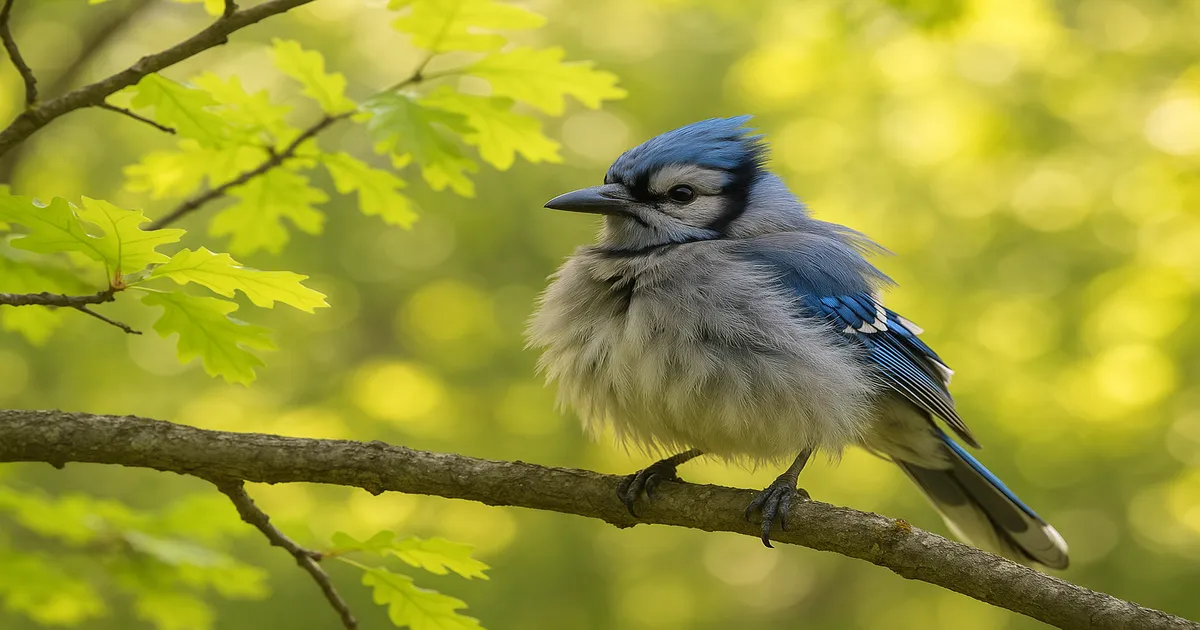
Quick Answer: A puffed-up Blue Jay is almost certainly thermoregulating — trapping warm air between its feathers to stay comfortable — or just resting. It might also be drying off after a bath, or doing something genuinely strange like rubbing ants through its feathers. Fluffing can occasionally signal illness, but the test is simple: a healthy bird is alert, crest active, and flies off when you approach. A sick bird looks dull-eyed, lethargic, and won’t move.
So you spotted a Blue Jay (Cyanocitta cristata) sitting on your fence looking like a small, blue-gray tennis ball, and now you’re wondering what the fluffier Blue Jay is doing. Good news: in the vast majority of cases, nothing is wrong. Feather fluffing is one of the most versatile tools in a bird’s behavioral toolkit, and Blue Jays use it constantly. Here’s what’s actually going on.
What Is the Fluffier Blue Jay Doing? 6 Common Reasons
1. Thermoregulation: The Built-In Down Jacket
This is the big one. When a Blue Jay raises its feathers, it creates tiny air pockets between the layers — the same principle as a down jacket. That trapped air warms against the bird’s body and insulates it from the cold outside. The result is a bird that looks noticeably rounder than usual.
You’ll see this most on cold mornings, overcast winter days, or any time temperatures drop. The jay isn’t sick or injured. It’s just warm.
2. Resting and Daytime Napping
Blue Jays aren’t active every second of the day. During midday lulls, they’ll perch quietly in a sheltered spot, fluff up, and half-close their eyes. A puffed jay with a drooping posture and slow blinking is doing the bird equivalent of sitting in a recliner. Even a resting jay will snap to attention if something moves nearby — that alertness is what separates normal rest from something worth worrying about.
3. Post-Bath Drying and Feather Maintenance
Blue Jays bathe enthusiastically — sometimes so enthusiastically they look like they’re trying to flood the birdbath. After a soak, they’ll perch and work through an extended fluffing, shaking, and preening session that can last several minutes. Feathers stick out at odd angles during this process. The bird is removing water and realigning the tiny barbules on each feather that give them their insulating and aerodynamic properties. Completely normal.
4. Sunbathing and Anting
On warm, sunny mornings, Blue Jays will sometimes spread out on a branch or the ground with wings partially open and feathers ruffled, soaking up the sun. It looks odd — almost like the bird has toppled over — but sunbathing likely helps with ectoparasite control and possibly vitamin D synthesis.
Anting is even stranger. A Blue Jay doing this will lie directly on an ant mound or pick up ants and drag them through its feathers. The formic acid from the ants may suppress feather mites and lice. A bird engaged in anting looks spectacularly disheveled — spread-eagled, feathers akimbo — and I’ve seen people genuinely convinced they were watching a bird die. It’s not. It’s self-care, corvid-style.
5. Aggression and Dominance Displays
A fluffed Blue Jay that’s also leaning forward, raising its crest sharply, and making noise is not cold or sleepy. It’s telling another bird — or possibly you — to back off. Fluffing makes the bird look larger, and combined with that raised crest and aggressive posture, it’s an effective threat display. You’ll see this regularly at feeders when multiple jays compete for prime spots, or when a jay is mobbing a predator.
6. Illness or Injury — When Fluffing Is a Warning Sign
A sick or injured Blue Jay will also fluff up, because a bird in distress is trying to conserve heat and energy. The difference is everything else that goes with it.
Red flags that mean something is wrong:
- Sitting on the ground and not flying when approached
- Dull, half-closed, or discharge-crusted eyes
- Visible discharge from the bill or nostrils
- Loss of balance, tilted head, or neurological tremors
- Complete unresponsiveness to movement or sound
The most common culprits are West Nile Virus (Blue Jays are among the most susceptible birds in North America), Salmonellosis from contaminated feeders, window strikes, and cat attacks. If you see these signs, see the section below on what to do.
How to Tell a Healthy Fluffy Blue Jay from a Sick One
Signs the bird is fine:
- Crest is active — raising and lowering in response to its surroundings
- Eyes are bright, round, and fully open
- Flies away when you approach within 10–15 feet
- Vocalizing normally
- Posture is upright, not hunched
Red flags that require action:
- Sitting on the ground rather than on a branch or feeder
- Won’t fly even when you walk directly toward it
- Eyes are dull, sunken, or crusted with discharge
- Head tilting or visible loss of balance
- Feathers look wet or matted, not just fluffed
What to Do If You Find a Sick or Injured Blue Jay
- Don’t try to hand-feed it or bring it inside. Well-intentioned care from untrained people usually does more harm than good, and in many areas it’s illegal to keep a wild bird without a permit.
- Keep pets away immediately. Even a brief cat encounter that leaves no visible wounds can introduce fatal bacteria.
- Contact a licensed wildlife rehabilitator. In the US, search the National Wildlife Rehabilitators Association directory or call your state wildlife agency. In Canada, contact your provincial wildlife office.
- If you must contain the bird temporarily, place it in a cardboard box with air holes, in a quiet, dark, warm spot — and get it to a rehabilitator the same day.
West Nile Virus is worth flagging specifically: Blue Jays are a sentinel species for WNV outbreaks, meaning they’re often the first birds to show up sick in large numbers during active transmission seasons (typically late summer). If you’re finding multiple sick jays in a short period, report it to your local health department or state wildlife agency.
Identifying the Bird: Blue Jay Field Marks
Size, Shape, and the Signature Crest
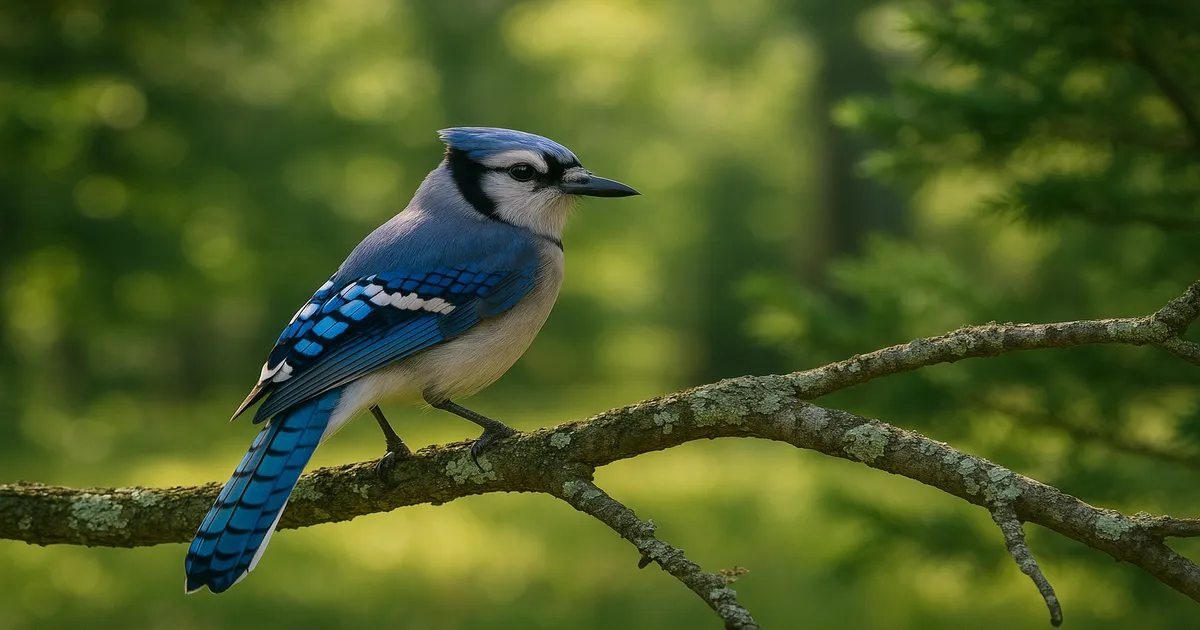
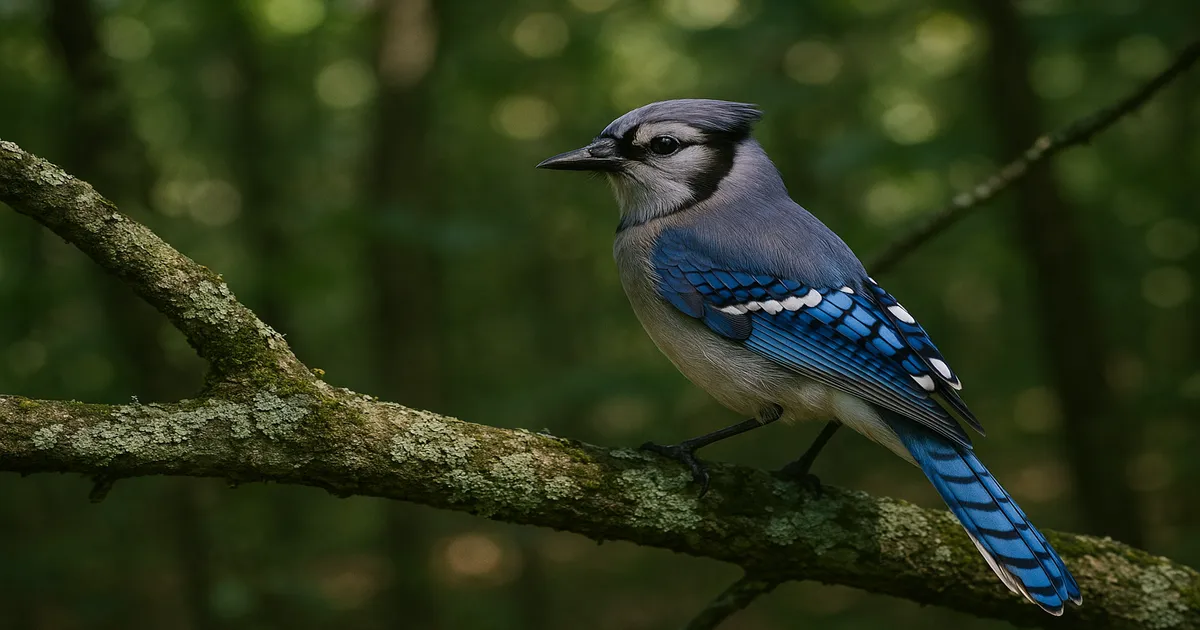
Blue Jays are big. At 11–12 inches (28–30 cm) long with a wingspan of 13–17 inches (34–43 cm), they’re one of the larger songbirds at a backyard feeder — noticeably bigger than an American Robin, roughly the size of a small crow. The body is stocky and broad-shouldered, with a long, rounded tail and that unmistakable erectile crest.
Plumage: Why That Blue Looks Different in Shade
The blue color isn’t pigment — it’s structural color, produced by microscopic air pockets in the feather barbs that scatter light. A wet Blue Jay or one sitting in deep shade can look surprisingly dull, even brownish. The brilliant azure only appears when light hits the feathers at the right angle.
Key field marks:
- Bold black necklace wrapping from the throat up the sides of the head
- White face contrasting sharply with the black collar
- White spots and black barring on the wings
- White corners on the tail, visible in flight
- Pale gray to white underparts
Males and females look identical in the field — Blue Jays are monomorphic, so you can’t reliably tell the sexes apart by sight alone. A good pair of binoculars helps you pick up these details from a comfortable distance. (Nikon Monarch M5 8x42)
The Crest as a Mood Indicator
Think of the crest as a real-time emotional readout. Fully raised means alert, excited, or aggressive. Flat against the head means relaxed or submissive. Half-raised is somewhere in between — curious, mildly alert. Once you start watching for this, you’ll find yourself reading a Blue Jay’s mood from across the yard.
Blue Jay Diet and Feeder Tips
What Blue Jays Eat
The diet is broad — insects, wild berries, corn, nuts, the occasional small frog — but acorns are the cornerstone. Blue Jays are also opportunistic, and yes, they occasionally raid other birds’ nests for eggs or nestlings. But this behavior shows up in less than 1% of diet studies, and the reputation Blue Jays have as nest predators is wildly overstated.
A single Blue Jay may cache 3,000–5,000 acorns in a single autumn, burying them individually across a wide area. The ones it doesn’t retrieve sprout. Oak forests expand in large part because Blue Jays carry acorns far beyond the parent tree’s canopy drip line. They’re not just birds — they’re foresters.
Best Foods and Feeders to Attract Blue Jays
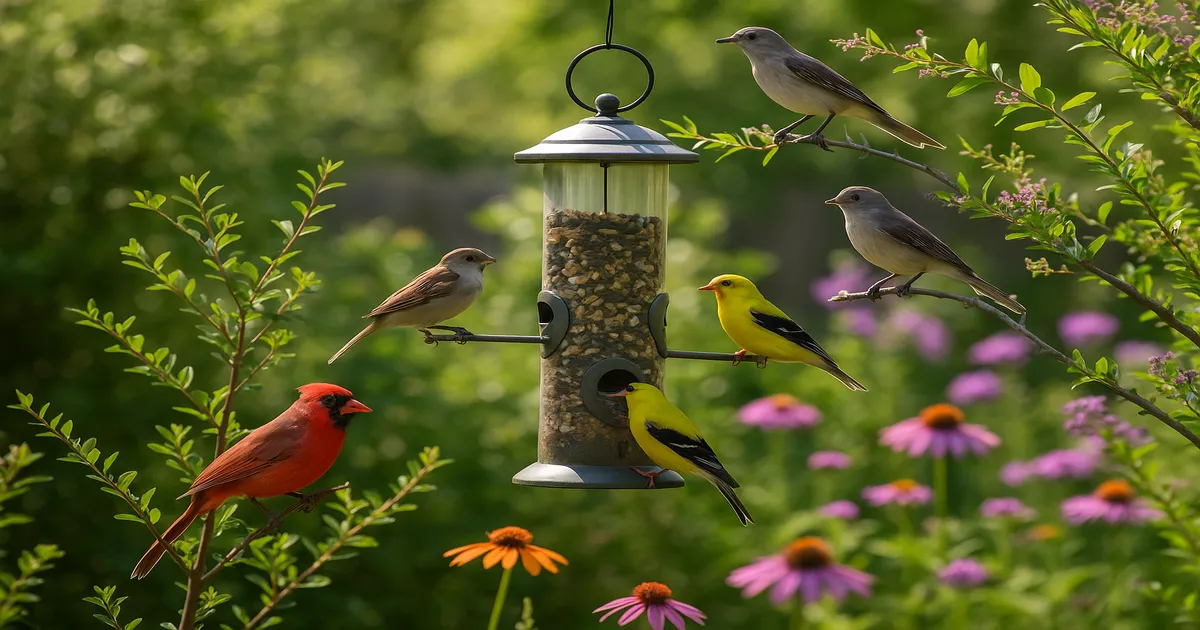
In-shell peanuts are essentially irresistible to Blue Jays. Black-oil sunflower seeds and whole-kernel corn are close seconds. Platform or tray feeders work best — Blue Jays are large birds that need room to land and maneuver, and they’ll often ignore tube feeders entirely.
A Blue Jay at your feeder will stuff multiple seeds or peanuts into its expandable throat pouch, fly off, bury them, and return for more. One bird can make a feeder look like it’s being emptied at an alarming rate. Those buried seeds are a winter food reserve — and the ones the jay forgets about may become next year’s plants.
Other Blue Jay Behaviors Worth Watching
Mobbing predators. Blue Jays are the self-appointed neighborhood watch of the bird world. When they spot a hawk, owl, or cat, they mob it — dive-bombing, screaming, and recruiting other species to join in. Other birds have learned to respond to Blue Jay alarm calls even across species lines. When jays start screaming, every bird in the area pays attention.
Hawk mimicry. Blue Jays are accomplished vocal mimics, and one of their most useful tricks is imitating the calls of Red-shouldered Hawks (Buteo lineatus) and Red-tailed Hawks (Buteo jamaicensis). The imitations are good enough to fool experienced birders for a split second. The apparent purpose: clear competing birds off a feeder before moving in. Whether this is intentional deception or learned association is still debated, but it works.
Bald-headed Blue Jays in late summer. Every August, I get questions from worried backyard birders who’ve spotted a Blue Jay with a completely bare, black, reptilian-looking head. It’s startling. It’s also completely normal. Blue Jays undergo a complete molt in late summer — typically July through September — and some individuals lose all their head feathers simultaneously rather than gradually. The feathers grow back within a few weeks.
Conservation: How to Help Blue Jays
Blue Jays are listed as Least Concern on the IUCN Red List, with an estimated population of 17–22 million birds. That sounds reassuring, but the North American Breeding Bird Survey shows a modest long-term decline of roughly 0.6–1% per year since the 1960s. Not alarming, but worth watching.
West Nile Virus remains the biggest ongoing threat. It arrived in North America in 1999 and hit Blue Jays hard — they’re among the most susceptible corvids. Window strikes kill an estimated 600 million to 1 billion birds annually across North America, and Blue Jays are regularly among the victims. Outdoor and feral cats are another major source of mortality, especially for fledglings that spend time on the ground.
Simple actions that make a real difference:
- Apply window decals or exterior tape to break up glass reflections — spacing needs to be no more than 2 inches (5 cm) apart to be effective
- Keep cats indoors, especially during fledgling season (June–July)
- Plant native oaks — even a single young tree in a suburban yard will eventually support Blue Jays and dozens of other species
- Clean feeders every two weeks minimum, more often in wet weather, to prevent Salmonellosis
- Participate in Project FeederWatch (Cornell Lab of Ornithology) to contribute population data
Frequently Asked Questions About Fluffy Blue Jays
Why is a Blue Jay sitting still and puffed up at my feeder?
Almost certainly thermoregulation or rest. Blue Jays fluff their feathers to trap warm air and create insulation, especially on cold or overcast days. If the bird is alert, upright, and flies off when you approach, there’s nothing to worry about.
Is a puffed-up Blue Jay sick?
Fluffing alone doesn’t indicate illness — it’s completely normal behavior. A sick Blue Jay will show additional signs: dull or closed eyes, sitting on the ground, unwillingness to fly when approached, loss of balance, or visible discharge. A healthy fluffy jay is alert and reactive; a sick one is not.
What does it mean when a Blue Jay raises its crest?
The crest is a direct indicator of emotional state. Fully raised means the bird is alert, excited, or aggressive — common during territorial disputes or predator encounters. A flat crest signals relaxation or submission. Half-raised usually means mild alertness or curiosity.
Why does my Blue Jay look bald and ragged in summer?
Normal late-summer molting. Blue Jays replace all their feathers once a year, typically July through September, and some individuals lose their head feathers all at once rather than gradually — leaving a bare, dark-skinned head that looks alarming but is completely harmless. The feathers grow back within a few weeks.
What is the fluffier Blue Jay doing when it lies flat on the ground with wings spread?
That’s anting — one of the stranger things you’ll see a jay do. The bird is either lying on an ant mound or actively rubbing ants through its feathers. The formic acid from the ants likely suppresses feather mites and lice. It looks exactly like a bird in distress. It isn’t. Once you’ve seen it a few times, you’ll recognize it immediately.