Quick Answer: If you’re asking “what is this bird?” in Wyoming, start with habitat. Wyoming hosts over 400 bird species across sagebrush steppe, mountain forest, riparian corridors, and grasslands. Pin down where you saw it, then match the field marks. This guide covers the most commonly seen — and most often misidentified — Wyoming birds, organized by habitat.
Trying to figure out “what is this bird?” in Wyoming is both thrilling and genuinely humbling. The state’s landscape variety is extraordinary — you can drive from sagebrush basin to alpine tundra in a single day — and the bird life shifts just as dramatically. Whether you spotted something large and spiky-tailed strutting through the sage or a bold gray bird raiding a picnic table at Yellowstone, habitat is your fastest shortcut to an ID.
What Is This Bird? Start With Wyoming’s Four Key Habitats
Before you open a field guide, ask yourself: Where exactly was I standing? A sparrow in dense sagebrush and a sparrow in a willow thicket are almost certainly different species. Wyoming’s major habitats each have their signature birds, and knowing which zone you’re in eliminates dozens of possibilities immediately.
- Sagebrush steppe — Green River Basin, Red Desert, Bighorn Basin
- Mountain coniferous forest — Yellowstone, Grand Teton, Wind River Range
- Riparian corridors — cottonwood and willow belts along rivers
- Mixed-grass prairie — eastern Wyoming, Thunder Basin
The 12 Most Commonly Seen (and Misidentified) Wyoming Birds
| Species | Primary Habitat | Standout Field Mark |
|---|---|---|
| Greater Sage-Grouse | Sagebrush steppe | Black belly patch + spiky tail |
| Sagebrush Sparrow | Dense big sagebrush | Single dark breast spot |
| Brewer’s Sparrow | Sagebrush/shrubland | Finely streaked crown, no breast spot |
| Clark’s Nutcracker | High-elevation pine forest | Pale gray body, black-and-white wings |
| Steller’s Jay | Mountain conifer forest | Dark crest, deep blue body |
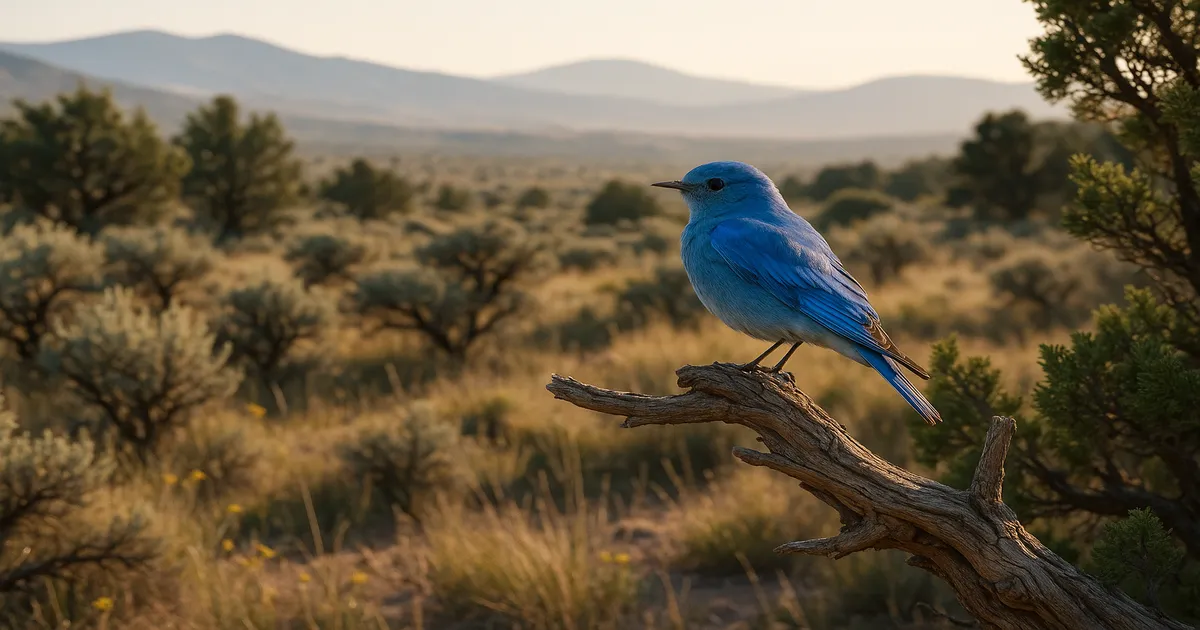
| Mountain Bluebird | Open mountain meadows | All-blue male, no rust on breast |
| American Dipper | Fast mountain streams | Constantly bobs; walks underwater |
| Western Meadowlark | Grasslands | Yellow breast with black V |
| Black-billed Magpie | Widespread, open country | Long iridescent tail, black-and-white |
| Sandhill Crane | Wetlands, agricultural fields | Red forehead patch, gray body |
| Osprey | Rivers and lakes | White underparts, dark wrist patches |
| Common Raven | Statewide | Wedge-shaped tail, deep croak |
Sagebrush Birds of Wyoming
Greater Sage-Grouse: Field Marks and the Lek Display
The Greater Sage-Grouse (Centrocercus urophasianus) is Wyoming’s most iconic sagebrush bird. Males are massive — about 26–30 inches (66–76 cm) long with a wingspan near 38 inches (97 cm), making them the largest grouse in North America. Once you’ve seen a displaying male, you won’t forget it.
Key field marks on a male:
- Bold black belly patch contrasting with white breast feathers
- Long, spiky, pointed tail fanned during display
- Olive-yellow air sacs on the chest, rapidly inflated and deflated to produce the booming display call
- White ruff around the neck, with mottled brown-black-white back and wings
That display call — a deep, resonant sequence of swishing, popping, and “womp-womp” notes — carries up to 2 miles across open flats at dawn. If you hear it in March or April before sunrise, you’re near a lek.
Females are genuinely cryptic. They’re considerably smaller (19–23 inches / 48–58 cm), mottled brown and buff throughout, with a less-defined black belly patch and a shorter, rounded tail. A flushing female can momentarily resemble a large hen pheasant, but the sagebrush context tells you immediately what you’re dealing with.
Quick look-alike comparison:
| Species | Key Difference |
|---|---|
| Sharp-tailed Grouse | Much smaller; white spots on wings; grassland/shrub edges, not pure sagebrush |
| Dusky Grouse | Forest bird; lacks black belly; male has reddish-purple air sacs |
| Wild Turkey | Bare red head; fan-shaped tail; different habitat entirely |
Sagebrush Sparrow vs. Brewer’s Sparrow
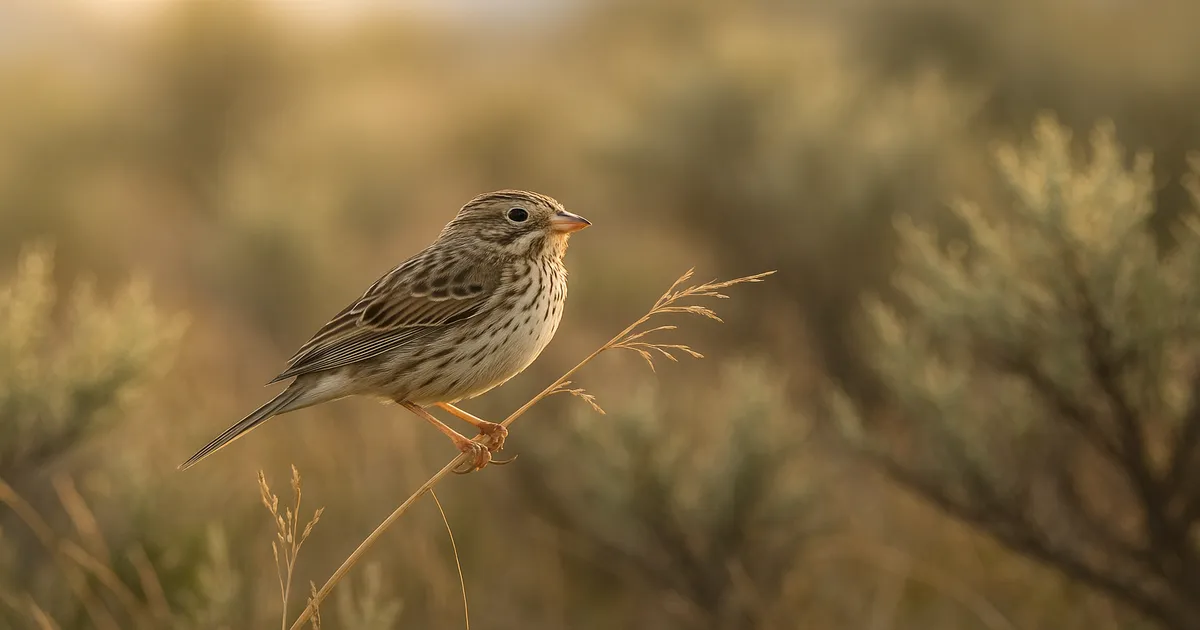
Both species live in Wyoming sagebrush, and both are small, brownish, and easy to overlook. The Sagebrush Sparrow (Artemisiospiza nevadensis) runs about 5.5–6.3 inches (14–16 cm) long — slender and upright, with a long tail it frequently cocks upward. Lock onto the single dark central breast spot on otherwise clean white underparts, paired with a white malar stripe bordering a gray cheek. That combination is definitive.
The behavior clinches it. When flushed, a Sagebrush Sparrow doesn’t fly — it runs, scurrying between sagebrush clumps in a way that looks exactly like a mouse. New birders lose them constantly because they expect the bird to take wing.
Brewer’s Sparrow (Spizella breweri) has no breast spot, a finely streaked crown, and is smaller and paler overall, with a shorter tail held flat. It’s also far more numerous — if you’re seeing dozens of small brown sparrows in the sage, most are Brewer’s. Sagebrush Sparrows tend to be more solitary and tied to taller, denser big sagebrush stands.
Mountain Forest Birds of Wyoming
Clark’s Nutcracker: The Gray Ghost of the High Peaks
Clark’s Nutcracker (Nucifraga columbiana) is crow-sized but stockier — about 11–12 inches (28–30 cm) — with a long, straight, chisel-like bill that immediately separates it from any jay. The body is pale gray overall, which makes it look almost washed-out against dark conifers.
The ecological story is worth knowing. Nutcrackers have a sublingual pouch that holds up to 95 pine seeds at a time. A single bird may cache 20,000–100,000 seeds per year, recovering them months later — sometimes under several feet of snow. The seeds it misses germinate, making Clark’s Nutcracker the primary dispersal agent for whitebark pine. That’s a keystone relationship, not a footnote.
In flight, the pattern is unmistakable: pale gray body, black wings with a large white secondary patch, black central tail feathers contrasting with white outer tail feathers. The call is equally diagnostic — a loud, harsh, grating kraak that carries well through the forest. If you hear something that sounds like a crow gargling gravel, look for a nutcracker.
Distinguishing from other corvids:
- Steller’s Jay: Dark crest, deep blue body — no gray
- Canada Jay: Softer gray, no black wings, shorter bill, much quieter
- Common Raven: All black, wedge-shaped tail, much larger
Other Mountain Species Worth Knowing
Mountain Bluebird (Sialia currucoides) males are an electric all-blue that stops people mid-stride — no rust on the breast, which separates them from Western Bluebird immediately. Williamson’s Sapsucker (Sphyrapicus thyroideus) is worth learning for its dramatic sexual dimorphism: males are black with a red throat and yellow belly, while females are brown-barred throughout and look like a completely different species. Steller’s Jay is common and loud in ponderosa and mixed conifer forests across the state.
How to Identify Any Wyoming Bird: A Field Method
Size, Shape, Then Color
Before color, before pattern — size and shape. Is it sparrow-sized, robin-sized, or crow-sized? Is the tail long and cocked, or short and flat? Does it have a round head or a crested one? Structural features hold up in poor light when color washes out. A good pair of binoculars makes this dramatically easier. (Nikon Monarch M5 8x42)
Scan for Field Marks in Order
- Overall body color (gray, brown, streaked, plain)
- Head pattern (supercilium, eye ring, cap color)
- Breast (streaked, spotted, plain, single spot)
- Wing bars (present, absent, one or two)
- Tail pattern (white outer feathers, banded, plain)
Bill Shape Narrows the Family Fast
Conical and stubby? Seed-eating sparrow or finch. Long and chisel-like? Woodpecker or pine-seed specialist. Hooked tip? Raptor or shrike. Thin and pointed? Warbler or vireo. Bill shape tells you what a bird eats, and that cuts the possibilities in half before you look at anything else.
Behavior Is a Field Mark Too
The Sagebrush Sparrow’s mouse-like running is a perfect example — the behavior is the ID. The American Dipper’s constant bobbing is so distinctive you’d name it correctly even in silhouette. How a bird moves tells you as much as how it looks.
Quick mental checklist for any unknown bird:
- Size? (sparrow / robin / crow / goose)
- Shape? (tail length, bill shape, body proportions)
- Habitat? (sagebrush / forest / water / grassland)
- Overall color?
- Standout marks? (breast spot, wing bars, eye ring)
- What was it doing?
Where and When to Find Wyoming’s Most Iconic Birds
Best Birding Locations by Habitat
Sagebrush species:
- Sublette County (Pinedale area) — among the best Sage-Grouse habitat in North America
- Sweetwater County — Farson, Eden Valley, Red Desert
- Bighorn Basin back roads — excellent for Sagebrush Sparrow, Brewer’s Sparrow, Sage Thrasher
Mountain species:
- Yellowstone National Park — Clark’s Nutcracker year-round; exceptional overall diversity
- Grand Teton National Park — mountain and riparian species, outstanding raptor migration
- Wind River Range — high-alpine species including Gray-crowned Rosy-Finch
- Bighorn Mountains — underrated, excellent conifer forest birding
Seasonal Timing
- February–March: Sage-Grouse leks begin; Great Horned Owls already on nests; Clark’s Nutcracker incubating
- April–May: Peak lek activity; Sagebrush Sparrow arrives; spring migration moves through riparian corridors
- May–June: Best overall diversity; breeding peaks statewide; slow dirt-road drives through sagebrush are incredibly productive
- July–August: Shorebird migration begins; post-breeding flocks forming
- September–October: Raptor migration; waterfowl build-up; sparrow migration peaks
- November–January: Sage-Grouse winter flocks; irruptive finches possible; Bald Eagles along rivers
Sage-Grouse Lek Viewing
Arrive before first light. Stay in your vehicle — it acts as a blind, and stepping out will flush the birds immediately. The Wyoming Game and Fish Department publishes lek locations and viewing guidelines; check their site before you go. Dress for serious cold even in April. A quality spotting scope is worth its weight here. (Vortex Optics Viper HD 20-60x80) The display typically wraps up by 8–9 a.m.
Yellowstone’s thermal areas attract American Dippers and unusual wintering waterfowl that use open water through deep winter. The Lamar Valley is outstanding for raptors and corvids. Grand Teton’s Snake River corridor is one of the best places in Wyoming for Bald Eagles, Osprey, and Harlequin Duck. Both parks have dense eBird hotspot coverage — browse recent checklists before you visit.
Conservation: Why Wyoming Matters
Wyoming holds an estimated 25–38% of the global Greater Sage-Grouse population, making it the single most important state on Earth for this species. The population has declined roughly 80% from historical numbers; the IUCN lists it as Vulnerable. Primary threats include sagebrush habitat loss from energy development, cheatgrass invasion (which replaces sagebrush with fire-prone annual grass), West Nile Virus, and climate-driven shifts in sagebrush distribution.
The Sage-Grouse is the flagship, but it shares its fate with Sagebrush Sparrow, Brewer’s Sparrow, Sage Thrasher, and dozens of other sagebrush-obligate species. Cheatgrass is the most insidious threat — once established, it burns readily, and sagebrush recovery after fire takes decades.
For Clark’s Nutcracker, the concern is tied directly to whitebark pine. White pine blister rust and mountain pine beetle have devastated whitebark pine across much of its range. No whitebark pine, no nutcracker. That’s how direct the dependency is.
The most useful thing a visiting birder can do is submit eBird checklists every time you go out. That data feeds directly into research and conservation planning. Supporting the Wyoming Wildlife Federation, The Nature Conservancy’s Wyoming program, and the American Bird Conservancy’s sagebrush initiatives also makes a tangible difference. And if you visit lek sites, follow the viewing guidelines — disturbance during breeding season has measurable population effects.
Frequently Asked Questions: What Is This Bird in Wyoming?
What is the large brown bird strutting through sagebrush in Wyoming? Almost certainly a Greater Sage-Grouse. Look for the black belly patch on males, or the mottled brown plumage and rounded tail on females. If you’re in sagebrush habitat and the bird is chicken-sized or larger, Sage-Grouse is the first call.
What is the gray bird with black-and-white wings at Yellowstone? That’s Clark’s Nutcracker. It’s common at Yellowstone and Grand Teton year-round, especially around campgrounds and trailheads where it’s learned that humans carry food. The pale gray body and bold black-and-white wing pattern are unmistakable.
What is the small brown sparrow running along the ground in Wyoming sagebrush? If it’s running rather than flying when flushed, it’s almost certainly a Sagebrush Sparrow. Check for the single dark breast spot on clean white underparts. Brewer’s Sparrow — the other common sagebrush sparrow — lacks that spot entirely.
What free apps help identify birds in Wyoming? Merlin Bird ID (Cornell Lab of Ornithology) is the best starting point — its Sound ID feature listens in real time and suggests species. eBird is the companion tool for logging sightings and checking what other birders have found nearby. Both are free and work offline once you’ve downloaded the relevant data packs. A printed field guide is still worth carrying.
When is the best time to go birding in Wyoming? May and June offer the best overall diversity, with breeding activity peaking statewide. For Sage-Grouse leks specifically, target late February through April — earlier in the season for the most dramatic displays. September and October are excellent for raptor migration and sparrows.