Quick Answer: The fastest way to identify a mystery bird sound is to open the Merlin Bird ID app and tap “Sound ID” — it listens in real time and names the bird within seconds. If you can’t do that right now, note the pitch, pattern, time of day, and habitat before you search. The rest of this guide walks through the most commonly heard mystery sounds in North America, organized by sound type.
If you’ve ever typed “does anyone know what this bird sound is?” into a search bar, you’re in good company. That question gets asked constantly — on Reddit, in Facebook birding groups, and in search engines — usually by someone standing in their yard at 2 a.m. wondering what on earth is making that noise. The good news: most mystery bird sounds come from a surprisingly short list of species, and with the right tools you can nail an ID in under a minute.
Does Anyone Know What This Bird Sound Is? Start Here
The Fastest Way to ID a Bird Sound Right Now
Download Merlin Bird ID (free, iOS and Android) from the Cornell Lab of Ornithology. Open it, tap “Sound ID,” and hold your phone toward the sound. Merlin listens passively and displays a live list of every bird it detects, with photos and audio samples you can compare on the spot.
It works. I’ve used it to identify a calling Eastern Screech-Owl at midnight and a singing Wood Thrush buried deep in a forest — without ever seeing either bird.
What to Note Before You Search
If Merlin isn’t available or the bird has gone quiet, jot down these details before you forget:
- Pitch: High and thin, or low and rich?
- Pattern: Repeated phrase, varied song, or a single chip?
- Quality: Whistled, buzzy, raspy, or mechanical?
- Time of day: Dawn, midday, dusk, or night?
- Season: Spring/summer or fall/winter?
- Habitat: Backyard, forest, wetland, open field?
Even two or three of these factors will dramatically shrink the list of possibilities. A loud, clear whistle repeated at dawn in a suburban yard in May? That’s almost certainly a Northern Cardinal before you’ve opened a single field guide.
How to Identify a Bird by Sound: A Practical Framework
Pitch and Tone
High, thin sounds — the seep of a waxwing overhead, the wispy chips of warblers — typically belong to smaller birds or to species making flight calls. Low, rich, resonant sounds belong to larger birds or to species with especially developed vocal anatomy, like thrushes and wrens. That single distinction eliminates half the field immediately.
Pattern and Rhythm
A sound that repeats the exact same phrase over and over is a huge clue. Eastern Whip-poor-wills do this relentlessly. So does the Tufted Titmouse with its peter-peter-peter whistle. A song that shifts and varies, stringing together different phrases, points toward mimics like the Northern Mockingbird or complex singers like the Wood Thrush.
Time of Day and Season
Most songbirds peak at dawn. Nocturnal sounds narrow the field considerably — owls, nightjars, and the occasional light-confused robin account for the vast majority of “what is that bird at night?” searches. Season matters just as much. A rich, varied song in May is likely a breeding bird. A thin chip in October is probably a migrant warbler moving through at night.
Habitat Context
A suburban backyard, a dense forest interior, and a cattail marsh each come with completely different species pools. Think of habitat as a pre-filter — it doesn’t tell you what the bird is, but it rules out a huge number of species before you’ve listened to a single recording.
Best Apps and Tools for Bird Sound Identification
Merlin Bird ID: Real-Time Sound ID on Your Phone
Merlin is the top recommendation, full stop. It’s free, built by the Cornell Lab of Ornithology, and the Sound ID feature works passively — you don’t have to tap anything once it’s running. It catches sounds you didn’t even notice. Available on iOS and Android.
BirdNET: AI-Powered Analysis for Recordings You’ve Already Made
BirdNET (a joint project from Cornell and Chemnitz University of Technology) analyzes audio recordings and generates a spectrogram you can review. It’s excellent for recordings you’ve already captured, and the web version at birdnet.cornell.edu lets you upload files from any device. Slightly more technical than Merlin, but very accurate.
Xeno-Canto and eBird: Community Sound Libraries
Xeno-canto is a crowdsourced global library with hundreds of thousands of recordings. Once you have a suspected ID, browse recordings from your region and compare. eBird pairs sound data with sighting records and range maps — if Merlin suggests a bird that eBird shows as extremely rare in your county, treat that ID with skepticism.
Loud, Whistled Bird Songs: What’s That Beautiful Whistling?
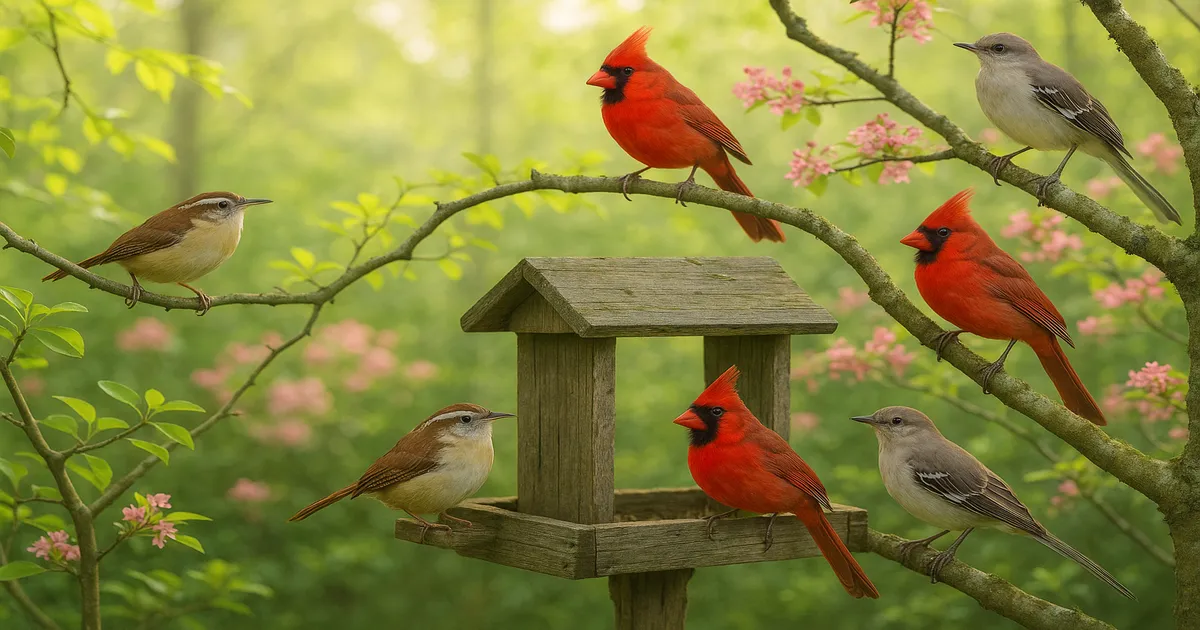
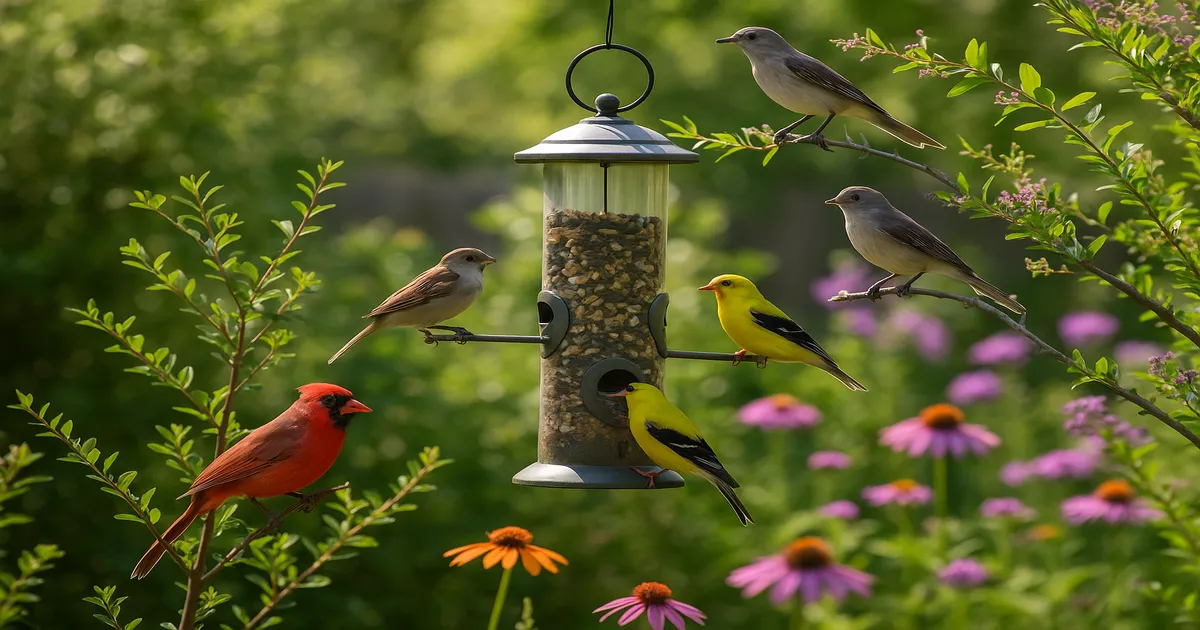
Northern Cardinal
The Northern Cardinal is responsible for an enormous share of “beautiful whistling in my yard” searches. The song is a loud, clear, descending series — often transcribed as cheer-cheer-cheer or birdy-birdy-birdy — with a purity of tone that carries a long way. Cardinals are year-round residents across the eastern U.S. and much of the South and Southwest.
One thing that surprises people: female cardinals sing too, which is unusual among North American songbirds. A female singing from inside a dense shrub is easily mistaken for a mystery bird because most people only expect the brilliant red male.
The song is that long, whistled phrase — multiple notes in sequence, often with a slurred quality. The call is a sharp, metallic chip, like someone tapping two coins together. Both sounds come from the same bird, but they serve completely different purposes.
American Robin
The American Robin has one of the most familiar songs on the continent — a rich, rolling series of phrases, often described as cheerily, cheer-up, cheerio. Robins are among the first birds singing in the dawn chorus, often starting before it’s fully light. About 10 inches (25 cm) long with a brick-red breast, dark back, and yellow bill, the robin is also one of the most abundant birds in North America.
Robins sing at night when artificial lights trick their circadian systems into treating nighttime as dawn. If you’re in a suburban area hearing that rich, caroling song at 1 a.m., a robin near a streetlight is the most likely explanation. The song is clearly musical and varied — if it’s a single phrase repeating relentlessly, keep reading.
Other Common Whistling Birds
| Species | Sound Description | Key Feature |
|---|---|---|
| Tufted Titmouse | Peter-peter-peter — clear, two-note whistle | Exact repetition; fast and emphatic |
| Carolina Wren | Tea-kettle, tea-kettle, tea-kettle — loud, ringing | Surprisingly loud for a tiny bird |
| White-throated Sparrow | Old Sam Peabody, Peabody, Peabody — thin, wavering | Plaintive quality; common in winter |
What Bird Is Making That Sound at Night?
Eastern Whip-poor-will: The Relentless Night Caller
If you’re hearing the same phrase repeated over and over — dozens, sometimes hundreds of times without stopping — from a forest edge at night, you almost certainly have an Eastern Whip-poor-will. The call is exactly what the name says: whip-poor-WILL, with heavy emphasis on the last syllable. At distance, the first syllable often drops out and you hear poor-WILL instead.
About 9.75 inches (25 cm) long, the Whip-poor-will is a master of camouflage — its brown-and-gray mottled plumage makes it essentially invisible against leaf litter. You’ll hear it far more often than you’ll see it. One fascinating detail: egg-laying is timed to the lunar cycle, with chicks hatching roughly 10 days before the full moon so that peak moonlight coincides with peak insect activity.
Whip-poor-will vs. Chuck-will’s-widow
The Chuck-will’s-widow is a closely related nightjar of the southeastern U.S. Its call is slower and lower-pitched, and the first syllable (“chuck”) is often inaudible — so you hear will’s-WID-ow. Range helps here: Chuck-will’s-widow is a bird of the Deep South and doesn’t reach most of the Whip-poor-will’s northern range.
Other Common Night Sounds
| Species | Sound | Key Feature |
|---|---|---|
| Barred Owl | Who cooks for you, who cooks for you-all | Classic eight-note phrase; very recognizable |
| Eastern Screech-Owl | Descending whinny or long tremolo | Eerie, horse-like quality; common in suburbs |
| Common Nighthawk | Nasal peent — buzzy, single note | Also produces a booming dive-display sound |
| American Robin | Rich, caroling song | Near artificial lights; musical, not repetitive |
Using Habitat and Range to Narrow Down the Sound
Backyard and Suburban Sounds
If you’re in a suburban yard and can’t identify what you’re hearing, it’s probably one of five birds: Northern Cardinal, American Robin, Mourning Dove, House Finch, or Northern Mockingbird. The Mourning Dove’s coo-OO-oo is frequently mistaken for an owl — it has that same hollow, mournful quality. The House Finch sings a long, rambling warble that sounds more complex than you’d expect from such a common feeder bird.
A good pair of binoculars helps enormously once you’ve tracked a sound to a general area.
Forest and Woodland Sounds
Dense forest brings a different cast of characters. The Wood Thrush’s ee-oh-lay — a flute-like, spiraling phrase — is one of the most beautiful sounds in eastern forests and one of the most commonly searched. Barred Owls call from forest interiors at night. On warm spring evenings near forest edges, the Whip-poor-will takes over.
Wetland and Waterside Sounds: Frogs vs. Birds
A quick note: many wetland “bird” sounds turn out to be frogs. Spring Peepers, American Bullfrogs, and Gray Treefrogs generate a lot of “what is that sound?” searches. If the sound is a continuous chorus rather than individual phrases, rule out amphibians first.
Genuine wetland bird sounds to know: the Red-winged Blackbird’s raspy konk-la-ree, the Common Yellowthroat’s witchety-witchety-witchety, and the American Bittern’s extraordinary pump-pump-pump — a deep, gulping sound like water being drawn from a well.
Open Fields and Meadows
Meadows in spring and summer bring Eastern Meadowlarks with their clear, descending whistle, and Bobolinks with their extraordinary, bubbling song that genuinely sounds like R2-D2 having a conversation. Both are getting harder to find as grassland habitat disappears.
Confirming Your ID with eBird Range Maps
Once you have a suspected species, go to eBird.org, search the species name, and click “Maps.” Filter by month to see where that bird has actually been reported in your area recently. If Merlin suggests a rare vagrant and eBird shows zero records in your county in the past five years, the ID needs a second look.
Seasonal Bird Sounds: What to Expect and When
Spring and Summer: Peak Breeding Song
April through July is when bird sound hits maximum intensity. Males sing to establish territories and attract mates, which means longer, more complex songs delivered more frequently. A bird that chips quietly in October may be singing elaborate phrases for hours in May.
The dawn chorus peaks in May across most of North America. American Robins typically lead it, often starting 30–40 minutes before sunrise. Cardinals, Song Sparrows, and House Wrens follow quickly. Sitting outside with a coffee at 5:30 a.m. on a May morning is one of the fastest ways to learn bird sounds — the repetition is relentless and the singers are often close enough to watch.
Fall and Winter: Contact Calls and Quieter Voices
Fall and winter bird sound is subtler. Breeding songs largely stop; what you hear instead are short contact calls — the chip notes birds use to stay in touch with flockmates. Mixed-species flocks of chickadees, nuthatches, and woodpeckers move through forests making a constant stream of soft chips. Overhead at night in October, you might catch the thin seep calls of migrating warblers — a phenomenon called nocturnal flight calls that dedicated birders track obsessively.
Year-Round Residents vs. Seasonal Visitors
- Year-round residents (in most of range): Northern Cardinal, American Robin, Barred Owl, Eastern Screech-Owl, Tufted Titmouse, Carolina Wren
- Seasonal visitors: Eastern Whip-poor-will (breeds April–September across eastern North America, winters in Mexico and Central America), White-throated Sparrow (winter visitor across much of the U.S.), Common Nighthawk (breeds spring through summer, migrates south in fall)
If you heard a sound in December that matches a Whip-poor-will, something else is going on — double-check the season before committing to an ID.
Frequently Asked Questions About Mystery Bird Sounds
What is the best free app to identify bird sounds?
Merlin Bird ID from the Cornell Lab of Ornithology is the best free option by a wide margin. Its Sound ID feature listens through your phone’s microphone in real time and identifies birds as they call, displaying results live on screen. Available on iOS and Android, it covers thousands of species worldwide.
What bird makes a loud whistling sound in my yard?
The Northern Cardinal is the most likely answer across most of the eastern and central U.S. Its song is a clear, loud whistle — often described as cheer-cheer-cheer or birdy-birdy-birdy — and both males and females sing. Carolina Wrens and Tufted Titmice are also common backyard whistlers, though their songs have a faster, more emphatic quality.
What bird sings loudly at night and keeps me awake?
Near forest edges, the Eastern Whip-poor-will is the most likely culprit — its call repeats incessantly and carries a long distance. In suburban and urban areas, an American Robin singing near a streetlight is the more common cause. Barred Owls and Eastern Screech-Owls also call at night, though their sounds are quite different from a melodic song.
How do I identify a bird I can hear but not see?
Open Merlin Bird ID and use the Sound ID feature — it’s built for exactly this situation. If you can’t use an app, note the pitch, rhythm, and quality of the sound, then search a library like Xeno-canto and compare recordings from your region. Adding habitat, season, and time of day to your search will get you to an answer much faster.
Does anyone know what this bird sound is — and it only happens at dawn?
Dawn sounds are almost always breeding males in spring and summer. The most common dawn singers in North American backyards are American Robin, Northern Cardinal, Song Sparrow, and House Wren. If the sound is coming from a forest edge and starts before first light, a Wood Thrush or Veery is worth considering. Run Merlin’s Sound ID for 10 minutes starting at first light and you’ll have a list of every species in earshot.