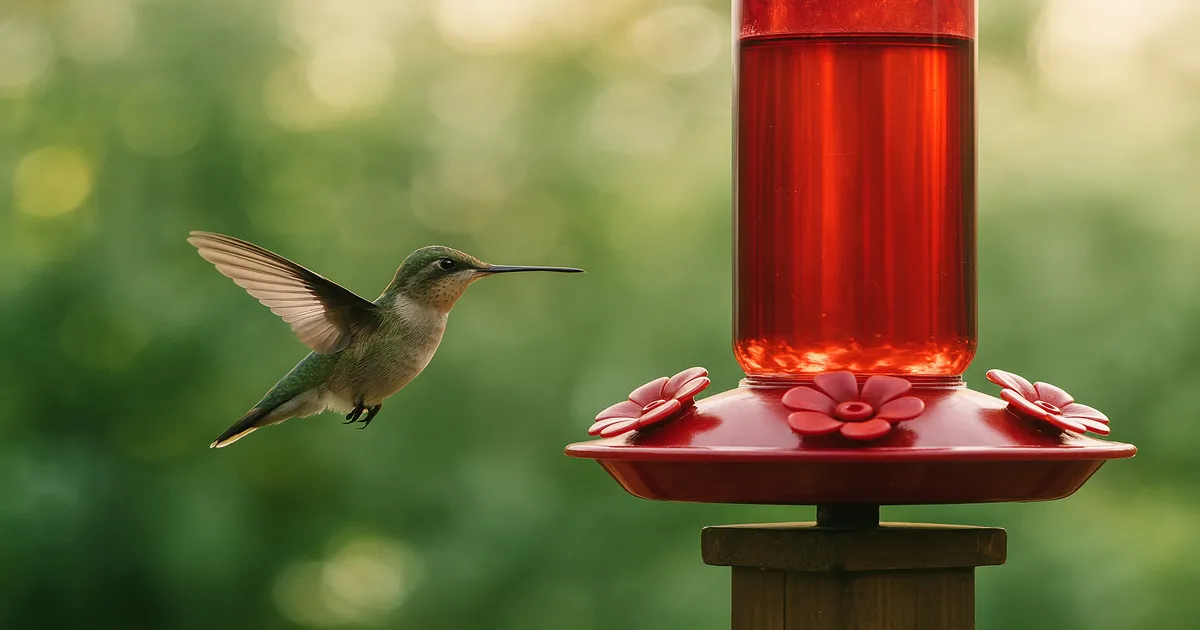
Quick Answer: Most puzzling hummingbird behaviors — hovering, sitting frozen, chasing other birds, or hanging upside down — are completely normal. Hovering means feeding, stillness means resting or torpor, chasing means territorial defense, and those dramatic dive-bombs are usually courtship. Once you know what to look for, hummingbird behavior clicks into place fast.
What Is This Hummingbird Doing? Common Behaviors at a Glance
The Seven Most Puzzling Things Hummingbirds Do
If you’ve ever frozen mid-sip of your morning coffee and whispered “what is this hummingbird doing?”, you’re in good company. These birds pack an enormous amount of behavior into a very small body, and a lot of it looks bizarre until you understand the logic behind it.
| What You’re Seeing | What’s Actually Happening |
|---|---|
| Hovering at a flower or feeder | Feeding on nectar |
| Sitting still for long stretches | Resting — completely normal |
| Hanging upside down, unresponsive | Torpor — a controlled sleep state |
| Chasing other hummingbirds | Territorial defense |
| Steep U-shaped dive over another bird | Courtship display |
| Female sitting on a tiny cup nest | Incubating eggs or brooding chicks |
| Darting after small flying insects | Hunting — protein is part of their diet |
Reassurance first: almost nothing you’re likely to witness is cause for alarm. Hummingbirds are just doing what hummingbirds do.
Identifying the Hummingbird You’re Watching
Size, Shape, and Tail
All hummingbirds share the same basic blueprint — torpedo body, needle bill, absurdly short legs, wings that blur into invisibility. But size varies more than you’d expect. The Calliope Hummingbird (Selasphorus calliope) is the smallest bird in North America at barely 3.25 inches (8.3 cm) and lighter than a penny. Rivoli’s Hummingbird (Eugenes fulgens) stretches to about 5.25 inches (13.3 cm). Most backyard birds fall somewhere in between, closer to the Ruby-throated Hummingbird (Archilochus colubris) at 3.75 inches (9.5 cm).
Tail shape is an underrated field mark. Forked tails point to Archilochus species — Ruby-throated and Black-chinned. Rounded tails suggest Anna’s or Costa’s. Male Rufous and Allen’s show a distinctively pointed outermost tail feather that’s visible in good light.
A good pair of close-focusing binoculars makes all the difference here. (Nikon Monarch M5 8x42)
Gorget Colors in Adult Males
The gorget — that iridescent throat patch — is the showiest field mark on adult males, but also the trickiest. Iridescent feathers shift color dramatically depending on light angle. A Ruby-throated’s gorget can look black, orange, or blazing ruby red depending on where the sun hits it. Always try to get the bird in direct sunlight before you call the color.
A few gorgets are genuinely distinctive:
- Anna’s Hummingbird (Calypte anna): rose-red gorget and rose-red crown — the only North American male with a fully colored crown
- Costa’s Hummingbird (Calypte costae): violet-purple gorget with dramatic extensions that flare outward like a handlebar mustache
- Calliope Hummingbird (Selasphorus calliope): streaked magenta-pink on white — looks like wine-colored brushstrokes, not a solid patch
- Rufous Hummingbird (Selasphorus rufus): orange-red gorget on a bright rufous-orange body — nothing else looks quite like it in North America
Female and Juvenile Hummingbirds
Female hummingbirds are genuinely hard. Even experienced birders hedge their bets. Most are green above and whitish to buffy below, with little or no gorget color. Your single most useful tool is location — if you’re in Ohio, it’s almost certainly a Ruby-throated. If you’re in the Sonoran Desert, your options multiply fast.
Beyond location, focus on:
- Tail pattern: how much rufous shows at the base of the outer tail feathers
- Bill length and curve
- Flank color: Rufous and Allen’s females often show a warm buff wash on the sides
- Supercilium: Broad-billed females (Cynanthus latirostris) show a pale eyebrow stripe that most other species lack
Juveniles resemble females and add another layer of difficulty. Young males begin showing scattered gorget spots in their first fall — often just a few iridescent flecks rather than a full patch.
Sounds and Wing Noises as Field Marks
Don’t overlook your ears. Several species are more reliably identified by sound than by sight.
- Broad-tailed Hummingbird (Selasphorus platycercus): males produce a loud, shrill, insect-like wing trill audible from over 100 feet away. In the Rockies, if you hear that trill, you don’t need to see the bird.
- Anna’s Hummingbird (Calypte anna): one of the most vocal hummingbirds in North America — males sing a scratchy, buzzy song year-round, plus a sharp metallic chip
- Black-chinned Hummingbird (Archilochus alexandri): wings produce a soft, dry buzz, slightly lower-pitched than Ruby-throated
- Costa’s Hummingbird: males give an eerie, looping whistle during courtship dives
Quick Species Lookup by Region
- East of the Mississippi: Ruby-throated (essentially the only breeding option)
- Pacific Coast: Anna’s year-round; Allen’s (Selasphorus sasin) in spring and summer; Rufous during migration
- Desert Southwest: Costa’s, Broad-billed, Anna’s, Black-chinned
- Rocky Mountains: Broad-tailed, Rufous, Calliope, Black-chinned
- Texas Gulf Coast: Buff-bellied (Amazilia yucatanensis), Ruby-throated during migration
A regional field guide is worth keeping near your feeder. (Sibley’s Birds of North America)
Hovering at Flowers or Feeders: Feeding Behavior Explained
How a Hummingbird’s Tongue Actually Works
The most common misconception is that hummingbirds drink nectar through their bills like a straw. They don’t. The tongue is forked and fringed along the edges — it laps nectar at up to 20 times per second, trapping liquid in the fringed tips with each stroke. It’s closer to a tiny, high-speed mop than a straw.
Why Hovering Costs So Much Energy
Hovering is one of the most metabolically expensive activities in the animal kingdom. A hummingbird in sustained hover burns energy faster than nearly any other vertebrate. To fuel that, a single bird needs to visit somewhere between 1,000 and 2,000 flowers every day — which is a big part of why they guard food sources so aggressively.
Hummingbirds use an asymmetric figure-eight wing stroke that generates lift on both the forward and backward stroke. That’s what makes true hovering possible and explains those 40–80 wingbeats per second you’re hearing as a hum.
Sitting Still or Appearing Motionless: Rest and Torpor
Why Hummingbirds Perch More Than You’d Expect
Here’s something that surprises most people: hummingbirds spend roughly 75–80% of their time perched. All that hovering is expensive, and they compensate by sitting still whenever they’re not actively feeding or defending territory. A hummingbird parked on an exposed twig isn’t sick — it’s doing exactly what it should be doing.
What Is Torpor? Is the Bird Okay?
If you find a hummingbird that seems completely unresponsive — especially at night or on a cold morning — it’s almost certainly in torpor. This is a deliberate, controlled state of hypothermia that hummingbirds enter to survive cold nights without starving. Body temperature drops from around 105°F (40.6°C) to near ambient air temperature. Heart rate plummets from roughly 1,200 beats per minute to around 50. Metabolic rate falls by up to 95%.
The bird is fine. It’s not dead. It’s running on the biological equivalent of airplane mode.
A torpid hummingbird will often hang upside down from its perch — their feet lock passively around a branch, so gravity pulls the body down. It won’t respond to nearby movement and may feel cool to the touch. An injured bird, by contrast, is more likely to be found on the ground and may show visible damage to wings or feathers.
If you find an unresponsive hummingbird:
- Leave it alone if it’s hanging from a branch — it will warm up naturally within 20–60 minutes after sunrise
- If it’s on the ground, gently place it on a sheltered branch out of direct wind and watch from a distance
- If it doesn’t recover within an hour of full daylight and warmth, contact a licensed wildlife rehabilitator
- Never try to force-feed a torpid bird
Chasing and Fighting: What Is This Hummingbird Doing to the Others?
Why Hummingbirds Are So Aggressive
Hummingbirds are solitary by nature. They don’t flock, they don’t share, and they have very little patience for competitors near a food source. Given that a single bird may need thousands of flower visits a day, defending a reliable patch is genuinely a matter of survival.
The Rufous Hummingbird has a well-earned reputation as the most aggressive species in North America. I’ve watched Rufous birds chase off Anna’s Hummingbirds twice their size without a moment’s hesitation. Adult males are typically the most dominant at feeders, but females defend territories too — don’t assume the bully is always a male.
A territorial hummingbird will perch at a high vantage point, surveilling its domain, then launch into high-speed pursuit the moment an intruder appears. Chases involve aerial pursuit, dive-bombing, and audible chattering or bill-snapping. Aggression peaks during breeding season and again during fall migration, when birds are fattening up for long flights.
Feeder Tips to Reduce Bullying
The single most effective strategy is placing multiple feeders completely out of sight of each other — around corners of the house, on opposite sides of the yard. One dominant bird can’t patrol two locations at once. Adding more feeders in the same spot rarely helps; the dominant bird just expands its patrol route. (First Nature 3055 32-oz Hummingbird Feeder)
Dive-Bombing and Aerial Displays: Courtship Behavior
The Male Courtship Dive
A male spots a perched female and climbs steeply — sometimes 50–150 feet (15–46 m) above her — then plunges in a steep U or J arc, pulling up sharply at the lowest point. He’ll repeat this several times. The whole display is fast and easy to miss if you’re not watching the right spot.
The sounds produced at the bottom of the dive are among the most distinctive in North American birding:
- Anna’s Hummingbird: a loud, explosive pop made by the outer tail feathers vibrating in the airstream — not a vocalization
- Costa’s Hummingbird: a prolonged, eerie looping whistle that carries surprisingly far
- Broad-tailed Hummingbird: a shrill wing trill throughout the dive
- Ruby-throated Hummingbird: uses a back-and-forth shuttle arc rather than a full plunge dive
Courtship or Aggression? How to Tell
Courtship dives are directed at a perched female and repeat over the same location, often in early morning. Territorial chases are linear pursuits directed at an intruder that’s moving away. If you see a bird diving repeatedly over the same spot while another bird sits still and watches — that’s courtship. If both birds are flying and one is fleeing — that’s aggression.
Nesting, Eggs, and Raising Chicks
What a Hummingbird Nest Looks Like
Hummingbird nests are extraordinarily easy to overlook. They’re roughly the size of a large thimble, placed on a horizontal branch, and covered on the outside with lichen that makes them look exactly like a branch knot. The best way to find one is to watch where a female repeatedly returns — she’ll give herself away.
The construction is genuinely clever: plant down for insulation, spider silk to bind everything together and anchor it to the branch. The silk is elastic, so the nest expands as the chicks grow. A nest that fits one egg snugly will stretch to accommodate two nearly-fledged chicks weeks later.
Eggs and Nestling Development
Clutch size is almost always exactly two eggs — consistent across all North American species. The eggs are white and roughly 0.5 inches (12 mm) long, about the size of a small jellybean. Incubation runs 14–19 days, and the nestling period lasts another 18–28 days before the chicks fledge.
The male’s involvement ends at mating. The female builds the nest alone, incubates alone, and raises the chicks alone. That bird sitting patiently on the eggs is always the female.
Catching Bugs and Other Surprising Behaviors
Why Hummingbirds Need Insects
Nectar is essentially sugar water — great for quick energy, useless for building muscle or growing feathers. Insects and spiders supply the protein and fat that hummingbirds genuinely need. A diet of pure nectar would be like trying to run a marathon on nothing but sports drinks.
Hummingbirds catch insects two ways. Hawking means snatching them in midair — a hummingbird darts from a perch, grabs a small fly or gnat, and returns, much like a flycatcher. Gleaning means picking insects and spiders off leaves, bark, or spider webs. They’ll also raid spider webs directly, both for the trapped insects and for the silk they use in nest construction.
Bathing and Feather Maintenance
Hummingbirds bathe by flying through mist, wet foliage, or shallow moving water — they rarely sit in a birdbath the way larger birds do. A misting sprinkler or a gentle dripper is far more attractive to them than a standard basin. After bathing, they perch and preen methodically, running feathers through the bill to realign the barbules that keep plumage waterproof and aerodynamic.
Migration: Why Your Hummingbird Suddenly Disappeared
This is one of the most common questions I get in late summer: my hummingbird was here every day, and now it’s gone — did something happen? Almost certainly not. Most North American hummingbirds are migratory, and they leave on a biological schedule that doesn’t care about your feeder. Ruby-throated Hummingbirds typically depart the eastern U.S. between late August and mid-October. Rufous and other western migrants move through on their own timetables.
Leave your feeder up for two to three weeks after your last sighting — it provides fuel for late migrants passing through. You won’t delay a resident bird’s departure; migration is triggered by day length, not food availability.
Frequently Asked Questions About Hummingbird Behavior
What is this hummingbird doing just sitting there?
Hummingbirds spend 75–80% of their time perched — this is completely normal. If the bird appears alert during the day, it’s resting between feeding bouts. If it’s unresponsive and hanging upside down, especially in cool weather, it’s in torpor and will recover on its own once temperatures rise.
Why do hummingbirds chase each other away from feeders?
They’re territorial and don’t share food willingly. A dominant bird — usually an adult male — will defend a feeder as an exclusive resource and chase off any competitor. Placing multiple feeders completely out of sight of each other is the most effective fix.
What does it mean when a hummingbird hovers in front of me?
It’s curious, or it’s deciding whether you’re a threat. Hummingbirds are bold and will investigate unusual objects near their feeding territory, including people. If you’re wearing red or holding something brightly colored, that increases the odds — they associate those colors with flowers. The bird is doing a quick threat-or-resource assessment, nothing more.
Is a hummingbird hanging upside down dead or sleeping?
Almost certainly in torpor — a deep, energy-conserving sleep state. Their feet lock passively around the perch, which can leave them hanging upside down. Give it time. If the bird is still unresponsive an hour after full daylight and warmth, contact a licensed wildlife rehabilitator.
Do hummingbirds eat anything besides nectar?
Yes — insects and spiders make up a significant part of their diet. Nectar provides energy, but protein and fat come from bugs. Watch for a hummingbird darting out from a perch to snatch insects in midair, or picking them off leaves and spider webs. It’s easy to miss because it happens fast.