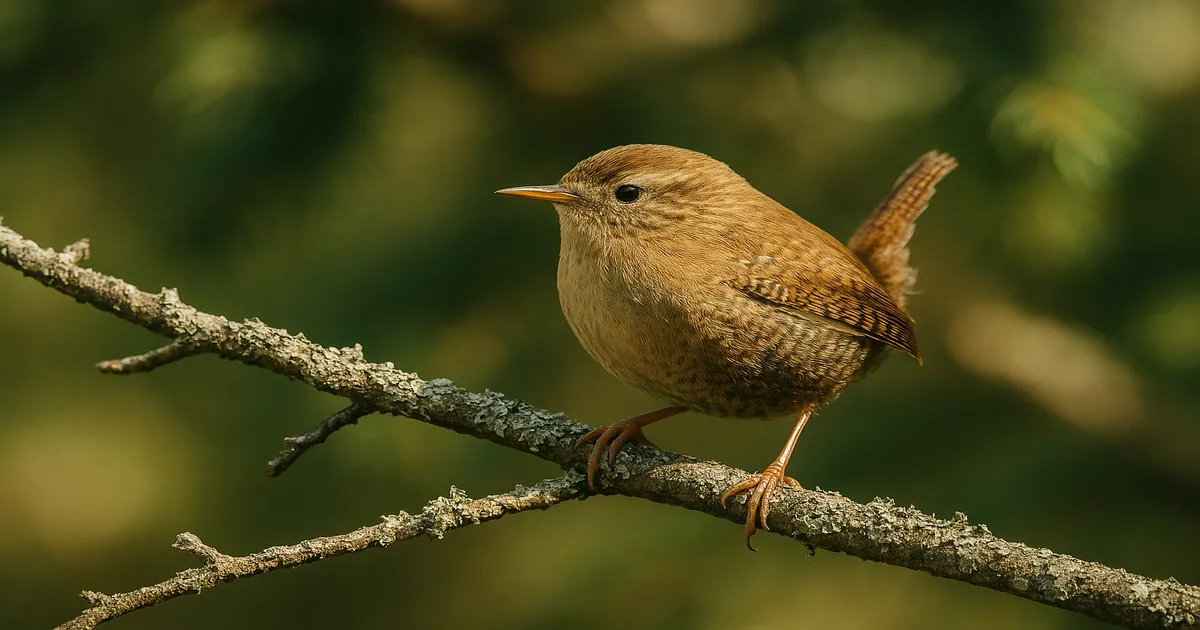
Quick Answer: If you’re watching a small brown bird pumping its tail straight up, bursting into song from a birdhouse, or scolding you from a thicket, you’re watching a wren. North America has 11 wren species, all sharing the same compact body and cocked tail, but each with distinct behaviors that tell you exactly what’s going on — once you know the code.
What Is This Wren Doing? Decoding Common Behaviors at a Glance
The Top 5 Things Wrens Do and What They Mean
You don’t need to identify the species to start reading the behavior. These are the five things wrens do most visibly, and what each one means:
| Behavior | What It Means |
|---|---|
| Tail cocked straight up | Normal resting posture; also a reliable family ID mark |
| Loud, persistent singing | Territorial advertisement or mate attraction |
| Rapid scolding chatter | Alarm — predator nearby, or you’re too close |
| Low, furtive creeping through vegetation | Foraging for insects in leaf litter or stems |
| Carrying sticks into every available hole | Male building “dummy” nests to attract a female |
How to Tell Which Wren Species You’re Watching
Wrens are small, brown, and secretive — no point pretending otherwise. But they’re surprisingly readable once you focus on three things: where you are, what habitat surrounds you, and which field marks are visible. Habitat alone eliminates most possibilities before you even raise your binoculars. (Nikon Monarch M5 8x42)
Meet North America’s 11 Wren Species
The Body Plan All Wrens Share
All 11 North American wrens belong to the family Troglodytidae. They share a compact, barrel-chested build with a thin, slightly decurved bill made for picking insects out of tight spaces. Plumage runs a tight palette of browns, tans, rufous, and buff — sometimes heavily streaked, never flashy.
Size, Shape, and the Signature Cocked Tail
The size range across the family is wider than most people expect. The Winter Wren (Troglodytes hiemalis) tops out around 3.9 inches (10 cm) — barely larger than a golf ball with feathers. The Cactus Wren (Campylorhynchus brunneicapillus) stretches to 8.7 inches (22 cm), closer in size to a small thrush. What unites them is the tail: nearly every wren holds it cocked upright at a sharp angle, and that single posture is the most reliable family field mark you can spot at distance.
Identifying the Four Most Common Wrens
House Wren: The Plain-Faced Backyard Singer
The House Wren is 4.3–5.1 inches (11–13 cm) long — small, warm brown above, pale grayish-buff below, with faint barring on the wings and tail. Its defining characteristic is what it lacks: no bold eyebrow stripe, no bright colors, no streaking on the face. That plain face is your best field mark. The song is an exuberant, bubbling cascade of churrs and trills that tumbles downward — one of the most complex songs per body size of any North American bird.
Carolina Wren: Bold Eyebrow, Booming Voice
The Carolina Wren runs slightly larger at 4.7–5.5 inches (12–14 cm) and is noticeably chunkier. The bold white supercilium is unmistakable, paired with rich rufous-brown upperparts and warm buffy-orange underparts. Its song — a loud, ringing teakettle-teakettle-teakettle — carries well over 100 yards. You’ll often hear a Carolina Wren for several minutes before you ever see it.
Bewick’s Wren: Long Tail, White-Tipped Feathers
The Bewick’s Wren (Thryomanes bewickii) measures about 5.1 inches (13 cm) but carries a proportionally longer tail than any other common wren. The outer tail feathers have white tips, visible when the bird fans or pumps it. The supercilium is bold and white, but the underparts are paler than a Carolina Wren’s — closer to whitish-gray. Bewick’s is now largely a western bird. If you’re east of the Mississippi, you’re almost certainly not looking at one; the species has essentially disappeared from the eastern U.S. since the mid-20th century, likely due to competition with the expanding House Wren and habitat loss.
Marsh Wren: Streaked Back, Cattail Specialist
The Marsh Wren is 3.9–5.5 inches (10–14 cm) long, and its back is the giveaway: bold white streaks on a dark brown-to-black background, unlike anything else you’ll find in a cattail marsh. Add a white supercilium and a streaked crown, and identification is straightforward — especially since this bird almost never leaves its marsh. The song sounds mechanical, a reedy gurgling rattle that males produce day and night during breeding season.
Quick ID Comparison: Side-by-Side Field Marks
| Species | Length | Supercilium | Underparts | Best Habitat Clue |
|---|---|---|---|---|
| House Wren | 4.3–5.1 in | None (plain face) | Pale grayish-buff | Suburban yards, nest boxes |
| Carolina Wren | 4.7–5.5 in | Bold white | Warm buffy-orange | Dense thickets, brush piles |
| Bewick’s Wren | 5.1 in | Bold white | Whitish-gray | Western chaparral, scrub |
| Marsh Wren | 3.9–5.5 in | White | White with buff flanks | Cattail marshes only |
The other seven at a glance: Cactus Wren is large with a heavily spotted breast. Winter and Pacific Wrens are tiny, dark, and stubby-tailed in dense conifers. Canyon Wren has a brilliant white throat against a rufous body. Rock Wren is pale gray with buffy tail corners. Sedge Wren is streaky-crowned in wet meadows — not cattails. A good regional field guide will save you a lot of squinting. (Sibley’s Birds of North America)
What Is This Wren Doing? Behavior Decoded
Why Wrens Cock Their Tails Straight Up
This is the question that sends most people searching online at 7 a.m. The short answer: we’re not entirely sure, but it’s consistent across the whole family and probably serves multiple functions. Thermoregulation, balance during foraging in dense vegetation, and intraspecies signaling have all been proposed. What’s certain is that a cocked tail is a wren’s default posture — it’s not alarm, it’s not display, it’s just Tuesday.
Singing From Dawn to Dusk
Male wrens sing to advertise territory and attract mates, and they do it with a commitment that’s almost exhausting to witness. A male House Wren will sing from dawn to dusk during breeding season, often perched just inside or just outside a nest cavity. Carolina Wren males have repertoires of 25–40 song types and belt them out year-round, not just in spring. If you hear a Carolina Wren singing in January, it’s not confused — it’s maintaining its territory.
Scolding Calls and Alarm Behavior
That rapid, harsh chek-chek-chek rattling out of a shrub? The wren has spotted you, a cat, a hawk, or a snake, and it wants everyone to know. Scolding calls serve as both an alarm to nearby birds and a direct challenge to the intruder. Wrens will sometimes follow a predator through dense cover, scolding continuously — a behavior called mobbing. Carolina Wrens have followed me halfway across my yard after I walked too close to a nest.
Furtive Low Movement: Foraging Like a Mouse
Wrens are insectivores, and they hunt like it. Watch a House Wren work through a brush pile and it moves almost like a small mammal — low, fast, vanishing into gaps and reappearing somewhere unexpected. Marsh Wrens work vertically up and down cattail stems; Canyon Wrens probe rock crevices with their distinctively flattened bills; Rock Wrens pick invertebrates off open talus. Each species has tuned its foraging style to its habitat.
The Rock Wren’s Distinctive Bobbing Display
The Rock Wren bobs up and down repeatedly, almost like it’s doing tiny squats on a boulder. No other North American wren does this with the same regularity, and it’s distinctive enough to help you ID the bird before you’ve sorted out the field marks.
Nesting Behavior: Cavities, Dummy Nests, and Fierce Territoriality
How House Wrens Choose and Defend Nest Cavities
Male House Wrens arrive on breeding grounds before females — typically late April to early May across most of their range — and immediately start claiming every available cavity. A single male will stuff sticks into a dozen boxes before a female arrives. This reduces the chance that parasites or competing species will use those cavities and gives the female real options to evaluate. She makes the final call on which nest to complete, lining her chosen cavity with grass, feathers, and plant fibers.
House Wrens are also notorious for puncturing the eggs of other cavity-nesting birds — bluebirds, chickadees, nuthatches — within their territory. It’s not malicious; it’s fierce competition for a limited resource. If you’re running a bluebird trail near wooded edges, House Wrens are a genuine management challenge.
Carolina Wren Pair Bonds and Year-Round Territory
Carolina Wrens mate for life and hold their territory as a bonded pair year-round. You’ll often hear both birds at once — the male singing while the female gives a chattering response. This year-round partnership is unusual among small songbirds and makes the Carolina Wren one of the easier wrens to observe consistently.
Marsh Wren Males: Polygyny and Nest Destruction
Marsh Wren males play by completely different rules. A single male may mate with multiple females and builds 20 or more dummy nests in his territory — one of the highest counts of any North American bird. More striking: Marsh Wrens actively destroy the eggs of neighboring Marsh Wrens. The cattail marsh in June is much more competitive than it looks.
Cactus Wren’s Thorny Fortress
The Cactus Wren builds a large, football-shaped nest — sometimes 12 inches (30 cm) long — deep inside a cholla cactus, with a small entrance tunnel on one side. The thorny cactus provides formidable predator protection, and pairs may maintain and reuse the structure for years. Cactus Wrens also build separate roosting nests outside breeding season, so an occupied-looking nest in a cholla doesn’t necessarily mean active breeding.
Attracting Wrens: Habitat, Feeders, and Nest Boxes
What Actually Draws Wrens to Your Yard
The single most effective thing you can do isn’t a feeder — it’s a brush pile. A loosely stacked pile of branches and logs in a corner of your yard creates instant wren habitat, giving them both foraging ground and cover. Dense native plantings work the same way: elderberry (Sambucus spp.), viburnum, and native shrub thickets provide insect-rich foraging and nesting cover. Leave leaf litter under shrubs rather than raking it bare.
A shallow birdbath placed near dense cover will also pull wrens in reliably. (Allied Precision Industries Heated Bird Bath Model 965) They bathe enthusiastically and often sun themselves afterward with wings slightly spread, which helps with feather maintenance and may help control feather parasites.
Do Wrens Visit Feeders?
Most wrens ignore seed feeders entirely. The Carolina Wren is the exception — it’s the most likely wren to visit a feeding station, and it’ll take suet crumbles and mealworms readily. A platform feeder near dense cover works far better than a tube feeder hung in the open.
Nest Box Specifications
Get the entrance hole right — it matters more than the box style:
- House Wren: 1.125-inch (2.86 cm) entrance hole; mount 5–10 feet high on a post or tree near a woodland edge
- Carolina Wren: 1.5-inch (3.8 cm) entrance hole; also accepts open-fronted boxes; place near dense shrubs at a similar height
House Wren boxes do best near woodland edges with some open area nearby. Carolina Wren boxes should sit close to thick cover — they won’t fly across an open lawn to reach a nest box.
Frequently Asked Questions
Why does the wren in my yard sing so loudly for such a small bird? Wrens produce some of the loudest songs relative to body size of any North American bird. A Carolina Wren’s song can carry 100+ yards. The volume is functional: dense vegetation muffles sound, so wrens have evolved to punch through it.
What is this wren doing when it bobs up and down on a rock? That’s a Rock Wren, and the bobbing is a species-specific display behavior. No other North American wren does it with the same regularity. If you’re seeing it, you’re almost certainly in rocky, open terrain in the West.
Why is the wren stuffing sticks into my birdhouse but never finishing the nest? A male House Wren builds multiple incomplete “dummy nests” in every available cavity before a female arrives. She’ll inspect each one and choose her favorite to complete. The others stay as loose stick piles.
Is it normal for a wren to scold me every time I go outside? Yes, especially if there’s a nest nearby. Wrens are bold about defending their territory and will scold persistently — sometimes following you across the yard. It’s not aggression so much as a very loud complaint.
Why did wrens disappear from my yard after being regulars? House Wrens are migratory and leave for the winter, so a sudden absence in September or October is normal. Carolina Wrens are year-round residents but can suffer heavy mortality during severe winters — a brutal cold snap can wipe out a local population fast. If yours vanished after a hard winter, give it a season or two; they typically recolonize from surrounding areas.