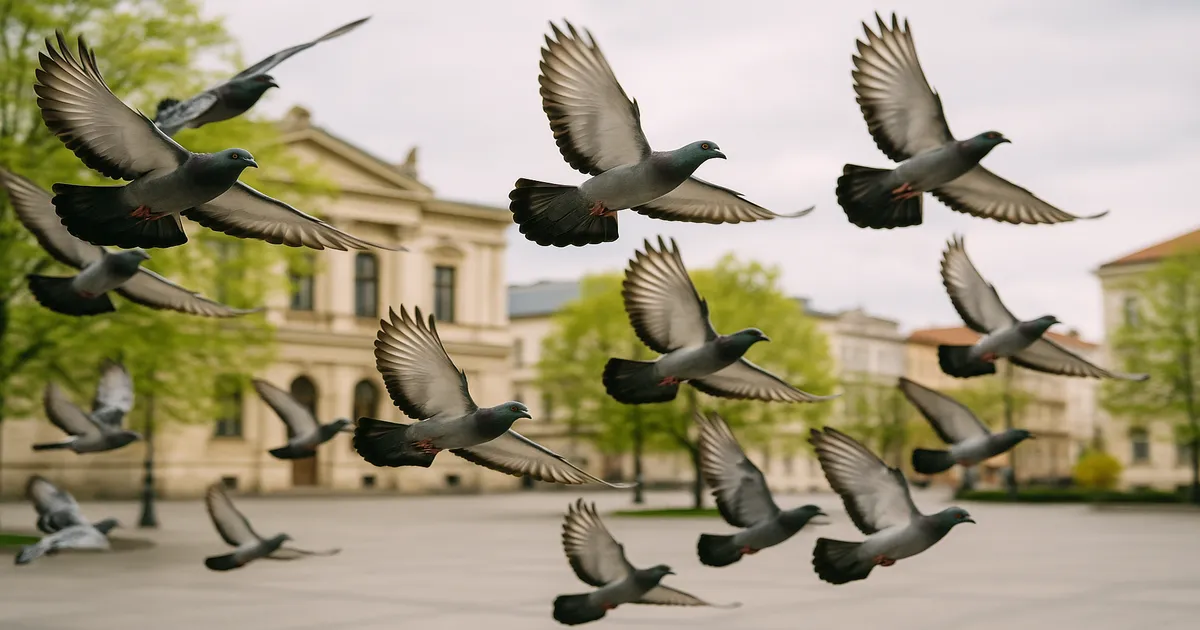
Quick Answer: The pigeons at your bus stop fly in synchronized, swirling patterns primarily as an anti-predator strategy — a tightly wheeling flock is nearly impossible for a Peregrine Falcon to target. No single bird leads; the pattern emerges from each bird following three simple rules relative to its nearest neighbors. Sudden disturbances like arriving buses trigger the most dramatic displays, and urban raptors keep this behavior genuinely sharp.
If you’ve ever watched the pigeons at your bus stop suddenly explode into a swirling, coordinated mass — banking left, then right, then settling back down like nothing happened — you’re watching one of urban nature’s best-kept secrets. Why do the pigeons at your bus stop fly in a pattern? The answer runs deeper than most people expect, touching evolutionary biology, aerodynamics, and some genuinely elegant mathematics. The bird doing all of this is the Rock Pigeon (Columba livia), and it’s considerably more interesting than its reputation suggests.
Meet the Bird: Identifying Your Bus Stop Pigeon
Size, Shape, and Key Field Marks
The Rock Pigeon is 11–14 inches (28–35 cm) long with a wingspan of 20–26 inches (51–67 cm) — noticeably chunkier than a Mourning Dove (Zenaida macroura). The body is compact and barrel-chested, with a small rounded head that bobs when walking. In flight, look for the white rump patch — it flashes clearly as the bird banks and is one of the most reliable field marks you’ll spot from a bus stop bench. The tail has a broad dark terminal band, and the folded wings show two dark bars.
Up close, the iridescent green-and-purple gorget on the neck is genuinely beautiful in direct sunlight. The bill is short with a soft white cere at the base, and the eyes are a vivid orange-red.
Plumage Variations: Why No Two Pigeons Look Alike
This is where Rock Pigeons get interesting. Centuries of domestication followed by feral breeding have produced extraordinary plumage polymorphism. In any urban flock you’ll likely spot:
- Blue-bar — the classic wild-type gray with two black wingbars
- Checker — dark checkered patterning on the wings
- Spread (dark) — nearly all dark gray to black
- Pied — irregular white patches on otherwise gray birds
- White — often mistaken for doves
- Red/tan — warm rusty-brown replacing the gray
This variation is the direct result of human selective breeding over millennia. It makes Rock Pigeons one of the best real-world subjects for watching the mechanics of natural selection play out in a city park.
Telling Males, Females, and Juveniles Apart
Sexes look nearly identical, which makes field identification tricky. Males tend to have a slightly more vivid gorget and are the ones doing the bowing, puffed-up courtship strut — if you see a pigeon persistently circling another with its chest puffed out, that’s almost certainly a male. Behavioral cues beat plumage every time with this species.
Juveniles are easier to spot: the gorget is dull and brownish rather than iridescent, the cere is underdeveloped, and the eyes are grayish-brown instead of orange-red. Rock Pigeons breed nearly year-round, so you may see juveniles at your bus stop in any season.
Sounds and Wing Clapping: What to Listen For
The classic vocalization is a soft, rolling coo-roo-coo — a bubbling, repetitive sound most people recognize immediately. Males produce a deeper, more emphatic version during courtship.
The sound that matters most for understanding flock behavior is the wing clap — a sharp crack produced when the wings strike together above the body during explosive takeoff. It’s loud enough to hear from across a street, and it functions as an alarm signal that propagates through the flock almost instantly. When you hear it, look up.
The Science Behind the Swirling Flock: How Pigeons Fly in Patterns
This is the part that genuinely surprised me when I first looked into it. What looks like choreography is something far more elegant.
Predator Avoidance: The Primary Driver
The swirling, wheeling flock is primarily an anti-predator adaptation. A Peregrine Falcon (Falco peregrinus) or Cooper’s Hawk (Accipiter cooperii) hunting a single pigeon has a reasonable chance of success. Hunting a tightly coordinated, unpredictably banking flock of 50 pigeons is a completely different problem — the raptor can’t lock onto a single target without the flock’s movement breaking its focus. This is the confusion effect, and it’s the foundation of why collective flight exists.
The Selfish Herd: Every Bird for Itself
In 1971, biologist W.D. Hamilton proposed the Selfish Herd Theory: each individual in a group is motivated to place other group members between itself and a predator. Every bird simultaneously trying to reach the center of the flock produces tight, swirling cohesion as an emergent result — not because the birds are cooperating, but because they’re all acting in pure self-interest. It’s one of those ideas that feels counterintuitive until it clicks.
How Pigeons at Your Bus Stop Fly in a Pattern: Three Simple Rules
Computational research by Vicsek et al. (1995) and later Ballerini et al. (2008) showed that all of this complexity emerges from just three rules each bird follows relative to its nearest 6–7 neighbors:
- Separation — don’t collide with your nearest neighbors
- Alignment — match their speed and direction
- Cohesion — stay close to the group
No leader. No master plan. No communication beyond what each bird can see happening immediately around it. The pattern is entirely emergent — a property of the system, not of any individual bird.
The Wave of Agitation: How a Turn Spreads Through the Flock
When one bird detects a threat and banks sharply, its nearest neighbors respond within milliseconds, triggering their neighbors, and so on. This wave of agitation propagates through the entire flock in a fraction of a second — far faster than any conscious decision-making could account for. It’s essentially a reflex cascade, which is why a flock of 60 birds can change direction simultaneously in a way that looks almost supernatural.
Aerodynamic Benefits of Flying in Formation
During commuting flights — not alarm flights — pigeons in loose V or echelon formations exploit the upwash from the wingtip vortices of the bird ahead. Research on Northern Bald Ibis (Geronticus eremita) published in Nature (2014) confirmed that birds time their wingbeats precisely to surf this upwash, with estimated energy savings of 20–30% for birds in optimal positions. It’s not just survival strategy — it’s fuel efficiency.
Why the Pigeons at Your Bus Stop Fly That Way Specifically
Daily Commutes and Alarm Flights
Urban pigeons maintain compressed home ranges and commute daily between roost sites — building ledges, bridge undersides, parking garage levels — and established feeding areas. The coordinated flights you see at your bus stop are often these arrival and departure commutes, not random movement. Morning flights tend to be purposeful and directional; late-afternoon returns can be the most dramatic, with the flock making several sweeping passes before settling.
A bus pulling in creates a sudden large moving object, a pressure wave, and noise — exactly the sensory profile of an approaching predator. A person moving quickly toward the flock triggers the same response. The result is the explosive alarm takeoff: wing clapping, instant vertical lift, the whole flock wheeling in tight formation. Within 30–60 seconds, if no actual threat materializes, they drift back down to the same spot.
Urban Peregrine Falcons: The Real Predator Keeping Pigeons Sharp
Peregrine Falcons are now established in most major North American cities. They nest on skyscrapers and bridge towers and hunt Rock Pigeons as their primary urban prey. The anti-predator flight behavior you’re watching at your bus stop isn’t a vestigial instinct from some ancestral cliff habitat — it’s being actively maintained by real predation pressure, right now, in your city. I find that genuinely remarkable every time I think about it.
Information Networks: How One Pigeon Finding Food Moves the Whole Flock
When one pigeon descends to a food source, others follow rapidly — a phenomenon called local enhancement. The flock functions as a distributed information network: more eyes scanning means faster detection of both threats and opportunities. Drop a single cracker near a bus stop pigeon and you’ll have a dozen birds seemingly from nowhere within seconds.
Rock Pigeon Biology: Diet, Drinking, and Breeding
What Pigeons Actually Eat
The natural diet is seeds and grains — wheat, corn, millet, sunflower, oats. In cities, that shifts heavily toward human food scraps: bread, crackers, pizza crusts, popcorn. These are nutritionally poor substitutes; urban pigeons eating primarily bread are essentially running on empty calories. They also regularly ingest grit and small stones to aid mechanical digestion in the gizzard.
How Pigeons Drink: A Genuinely Unusual Behavior
Most birds tilt their head back to let water run down their throat. Pigeons don’t. They immerse their bill and suck continuously, like a mammal drinking through a straw. It’s a small thing, but it’s genuinely unusual among birds and worth watching for near a puddle or fountain.
Breeding: Year-Round and Prolific
Rock Pigeons can breed in virtually any month in mild climates, with peak activity in spring (March–May) and fall (August–October). In warm urban environments, winter breeding isn’t unusual. Pairs raise 4–6 broods per year, with clutches of almost exactly 2 eggs. Incubation takes 17–19 days, shared by both parents. Both also produce crop milk — a protein- and fat-rich secretion from the crop lining — to feed squabs in the first days of life. Squabs fledge at roughly 25–32 days.
Rock Pigeons don’t migrate. The flock at your bus stop in January is the same flock that was there in July, living within the same compressed home range, using the same roost sites year-round.
Tips for Watching Pigeon Flock Behavior at Your Bus Stop
Best Times and What to Look For
Early morning departure flights and late-afternoon returns produce the most coordinated flock movements. The low-angle light makes the white rump flash and iridescent gorget genuinely striking. Two flight types tell very different stories:
- Explosive takeoff with wing clapping = alarm response. Something scared them — scan for a raptor, or note what sudden movement triggered it.
- Gradual, circling descent = food discovery. One bird spotted something worth eating; the rest are following via local enhancement.
Tracking the white rump patch in flight is a good exercise in field mark recognition — it’s visible from surprising distances and helps you follow individual birds within the swirling flock.
Gear Worth Having
You don’t need high-end optics to enjoy bus stop pigeons, but a decent pair of compact binoculars will reveal the gorget iridescence and eye color that make individual birds identifiable. A solid choice for close urban distances is the Nikon Prostaff P7 8x30. For something with a wider field of view that handles low urban light well, the Vortex Diamondback HD 8x42 is worth considering.
For identification and sound confirmation, Merlin Bird ID from the Cornell Lab of Ornithology is free, accurate, and has a sound ID feature that works even in noisy urban environments. Download it before you need it, not during the moment you’re trying to ID something.
If you want to go deeper on the species, David Gibbs’s Pigeons and Doves of the World is the definitive reference — more than you’ll ever need for bus stop birding, but genuinely fascinating if the plumage polymorphism section above hooked you.
Keeping a casual log of flock sizes and flight directions over a few weeks will reveal patterns you’d never notice otherwise — consistent departure directions, predictable return times, and the days when an unseen raptor sends everything skyward at once.
Frequently Asked Questions
Why do pigeons suddenly all fly up at once?
A sudden mass takeoff is an alarm response. One bird detected a real or perceived threat — a raptor, a fast-moving person, an arriving bus — and launched with an audible wing clap. That sound and motion trigger the same response in every nearby bird within milliseconds, producing the simultaneous explosion you see. It’s a reflex cascade, not a coordinated decision.
Is pigeon flock flying the same as a starling murmuration?
They operate on the same underlying rules — separation, alignment, and cohesion relative to nearest neighbors — but they’re not the same thing in practice. True murmurations involve tens of thousands of European Starlings (Sturnus vulgaris) producing extraordinarily fluid, shape-shifting clouds. Pigeon flocks are typically smaller, faster, and less fluid. Same software, very different hardware.
Do pigeons have a leader when they fly in a group?
No. There is no leader, no designated decision-maker, no bird giving directions. The coordinated pattern emerges entirely from each bird following three simple rules relative to its 6–7 nearest neighbors. What looks like choreography is the aggregate output of dozens of birds each making purely local decisions simultaneously.
Why do pigeons keep coming back to the same spot every day?
Rock Pigeons have excellent spatial memory and form strong learned associations with reliable food sources. Once a location — like a bus stop where people regularly drop food — is established in a flock’s mental map, they’ll return on a daily schedule. Their home ranges are so compressed that the bus stop may genuinely be the center of their entire world.
Are feral city pigeons the same species as homing pigeons?
Yes, exactly the same species: Columba livia. Homing pigeons and racing pigeons are selectively bred individuals from domesticated Rock Pigeon stock — not a separate species. The navigational ability is present in wild Rock Pigeons too; selective breeding simply amplified and refined it.