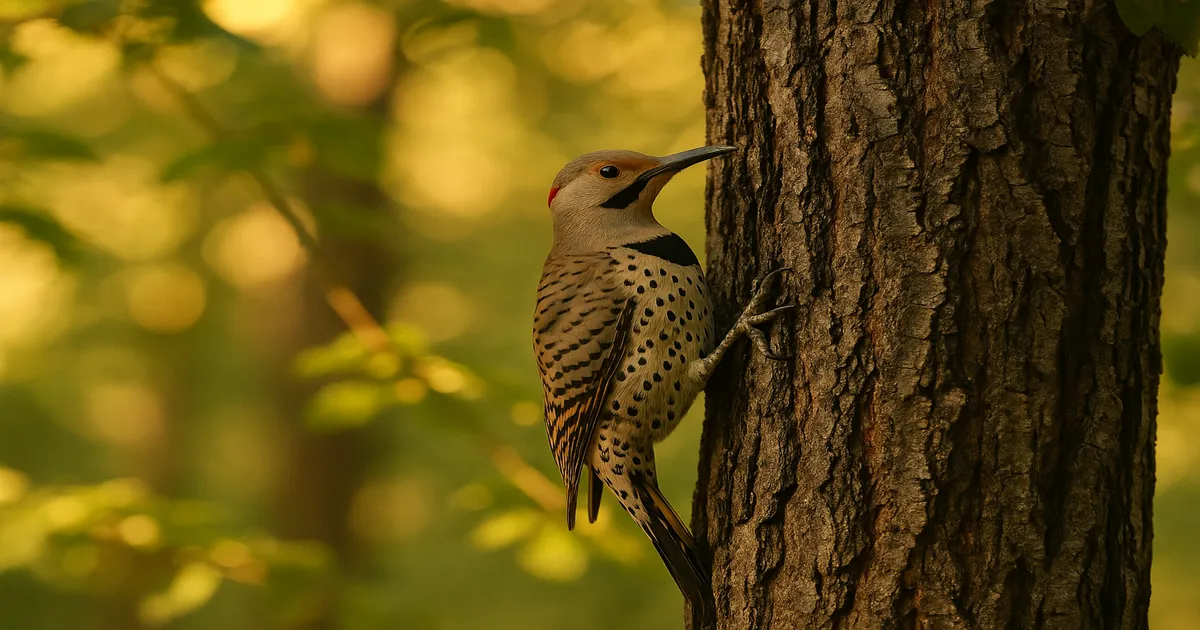
Quick Answer: If you’re watching a Northern Flicker and wondering what it’s doing, the answer is probably one of six things: foraging for ants on the ground, drumming on a resonant surface to claim territory, performing a bobbing courtship display, excavating a nest cavity, flashing its white rump in bounding flight, or visiting a suet feeder. The single fact that surprises most people: flickers spend more time on the ground than on tree trunks — the opposite of what you’d expect from a woodpecker.
If you’ve spotted a large, spotted woodpecker hopping across your lawn and asked yourself “what is this Northern Flicker doing?”, you’re in good company. The Northern Flicker (Colaptes auratus) is one of North America’s most behaviorally interesting birds, and it rarely does what people expect a woodpecker to do.
What Is This Northern Flicker Doing? The Six Most Common Behaviors
Here’s what you’re most likely witnessing:
- Ground foraging — probing the soil for ants, which make up the bulk of its diet
- Drumming — hammering on metal gutters, chimney caps, or hollow wood to broadcast territorial claims
- Fencing displays — two birds facing each other on a branch, bobbing and swaying in a ritualized courtship standoff
- Cavity excavation — chiseling a nest hole into a dead or dying tree
- Undulating flight — bounding through the air with that brilliant white rump flashing at every wingbeat
- Feeder visits — dropping in on suet cages, especially in winter
Most woodpeckers spend their lives clinging to bark. Flickers don’t follow that script. They’ve evolved to be ground foragers first, and that single behavioral quirk is responsible for most of the puzzled questions birdwatchers ask about them. Watching one work across a lawn, you might mistake it for a thrush — until it flies and that white rump patch gives the game away.
Northern Flicker Identification: How to Know What You’re Seeing
Size, Shape, and Key Field Marks
The flicker is a large, chunky woodpecker — about 12.2 inches (31 cm) long with a wingspan near 19.7 inches (50 cm), noticeably bigger than a robin. It looks substantial and barrel-chested in the field.
Key marks to lock onto:
- Brown ladder-back — bold black barring across the wings and back
- Spotted breast — pale buff with dense, round black spots
- White rump patch — unmistakable in flight, flashing with every undulation
- Red nape crescent — a bright red patch on the back of the head (both sexes, Yellow-shafted form)
- Yellow or salmon-red wing linings — visible in flight, definitive for subspecies ID
- Slightly decurved bill — gently downcurved, unlike the straight chisel bills of most woodpeckers
Yellow-Shafted vs. Red-Shafted: Which Form Is in Your Area?
The flicker comes in two main forms, once considered separate species. They intergrade across the Great Plains, so birds there can show mixed features.
| Feature | Yellow-shafted (Eastern) | Red-shafted (Western) |
|---|---|---|
| Wing/tail shaft color | Bright yellow | Salmon-red/orange |
| Male malar stripe | Black | Red |
| Face color | Gray | Brown |
| Throat color | Tan/buff | Gray |
| Range | East of the Great Plains | West of the Great Plains |
Male, Female, and Juvenile Differences
Sexing a flicker is one of the easiest tasks in North American birding: look for the malar stripe (the “mustache” mark below the bill). Males have one — black in Yellow-shafted birds, red in Red-shafted birds. Females lack it entirely. Juveniles look like dull versions of adults, with softer spotting and, in young males, a faint or incomplete malar stripe that fills in through late summer.
Calls and Sounds That Give It Away
You’ll often hear a flicker before you see it. Three sounds worth knowing:
- “Wicka-wicka-wicka” — a rapid, laughing call that carries a long way; once you know it, you’ll hear flickers constantly
- “Klee-yer” — a single, sharp, piercing note used year-round
- Spring drumming — less frequent than other woodpeckers, but loud and deliberate, often on metal surfaces
A good pair of binoculars helps you track the source of that call before the bird flushes. (Nikon Monarch M5 8x42)
Ground Foraging: The Behavior That Confuses Most Observers
The flicker’s slightly decurved bill isn’t built for chiseling bark — it’s built for probing soil. This is a genuine evolutionary departure from the woodpecker body plan, and it shapes everything about where and how the bird spends its time. Open lawns, park edges, and forest clearings are prime foraging real estate.
Once a flicker locates an ant colony, it deploys one of nature’s more impressive tools: a barbed, sticky tongue that can extend roughly 2 inches (5 cm) beyond the bill tip. That tongue reaches deep into ant galleries and pulls out prey in bulk. One flicker stomach was found to contain more than 5,000 ants.
Three distinct motions tell you what the bird is after:
- Raking — flipping leaf litter aside with the bill to expose insects underneath
- Probing — inserting the bill into soft soil or rotting wood to reach tunnels
- Digging — excavating small, shallow holes when ant colonies run deep
If you see a flicker making shallow pits in your lawn, that’s exactly what’s happening. It found ants.
Occasionally a flicker will press live ants directly against its feathers — a behavior called anting, shared with many bird species. Formic acid from the ants is thought to deter feather mites and other parasites. It looks strange, like the bird is rubbing itself with something invisible, and it’s worth watching if you get the chance.
One important seasonal note: when snow covers the ground and ant colonies go dormant, flickers shift to tree-trunk foraging in the manner of typical woodpeckers. Winter is the one time you’re likely to see them behaving like the textbook woodpecker they technically are.
Drumming, Calling, and Territorial Displays
Why Flickers Drum on Houses, Gutters, and Chimney Caps
Flickers don’t drum on your house because they think it’s a tree. They drum on it because metal gutters and chimney caps are extraordinarily loud — far more resonant than any dead snag — and the whole point of drumming is to be heard as far away as possible. It’s a territorial broadcast, and your house happens to be the best antenna in the neighborhood.
This behavior peaks between March and May, when males are establishing territories and advertising for mates. It’s maddening for homeowners and completely logical for the bird.
Territorial drumming is fast, rhythmic, and evenly spaced — a rapid mechanical rattle. Nest excavation sounds different: slower and irregular, with pauses as the bird repositions and assesses the wood. Steady machine-gun rattle on metal means territorial drumming. Intermittent tapping with variable rhythm means the bird may be actively digging.
The ‘Fencing’ Courtship Display Explained
Two flickers perch facing each other on a branch, then begin bobbing, swaying, and weaving their heads in a synchronized, almost hypnotic routine. Both birds may call repeatedly. It looks like an argument and a dance at the same time. New observers often think the birds are fighting — they’re not. They’re either competing for a mate or reinforcing a pair bond.
Activity ramps up sharply in late February and peaks through May. By midsummer, territorial pressure drops and the birds get noticeably quieter as they focus on raising young.
Nesting and Breeding Behavior
Flickers strongly prefer dead or dying snags with fungal heart rot — the decayed interior is soft enough to excavate efficiently. The entrance hole is roughly 3 inches (7.5 cm) across, and the cavity runs 13–16 inches (33–40 cm) deep. Both birds participate in excavation, though males typically do more of the work.
Nesting timeline:
- March–May: Cavity excavation begins (earlier in the South)
- April–June: Female lays 5–8 glossy white eggs
- 11–13 days: Incubation period; both sexes share the duty, with the male taking the night shift
- 24–27 days: Nestlings remain in the cavity before fledging
- Young birds stay near parents for several more weeks after leaving the nest
Once a flicker abandons a cavity, it becomes prime real estate for Eastern Screech-Owls, Wood Ducks, American Kestrels, flying squirrels, and a long list of other species that can’t excavate their own holes. Protecting flicker habitat is, in a real sense, protecting an entire community of cavity-dependent wildlife.
European Starlings (Sturnus vulgaris) are aggressive cavity competitors that will evict incubating flickers and take over nest holes. This is a significant driver of the flicker’s long-term population decline — not habitat loss alone, but the combination of habitat loss and a highly competitive invasive species claiming the remaining nest sites.
Attracting Northern Flickers: What Is This Northern Flicker Looking For at Your Feeder?
Best Foods and Feeder Styles
Suet is the single most reliable draw for flickers — particularly insect-blended or berry-blended varieties. After suet, mealworms (live or dried) are excellent, followed by peanuts and cracked corn scattered directly on the ground.
Tube feeders are poorly suited to flickers — the birds are simply too large and too accustomed to horizontal surfaces. What actually works:
- Large platform or tray feeders at or near ground level
- Suet cage feeders with a tail-prop extension — the extended backing lets flickers brace their tail while feeding, the way they would on a tree
- Food scattered directly on the ground — the simplest and often most effective option
Installing a Flicker Nest Box
Flicker nest boxes need to be sized appropriately: 3-inch (7.5 cm) entrance hole, 16–18 inches (40–46 cm) of interior depth, and filled with wood shavings so the birds have something to excavate into. Mount the box on a post or tree 6–20 feet up, away from areas with heavy starling activity if possible.
Yard Habitat Tips
The single best thing you can do for flickers is leave a dead tree standing if it’s safe to do so. Snags are irreplaceable nesting and foraging habitat. Beyond that: stop using lawn insecticides. Ant colonies are the flicker’s primary food source, and a pesticide-treated lawn is an ecological dead zone from the flicker’s perspective. Let the ants live and the flickers will follow.
Northern Flicker Look-Alikes: Ruling Out Similar Species
| Species | Size | Key Marks | Range | Foraging Location |
|---|---|---|---|---|
| Northern Flicker | 12.2 in (31 cm) | White rump, spotted breast, ladder-back | North America-wide | Ground & tree trunks |
| Gilded Flicker | ~11 in (28 cm) | Rufous-brown crown, saguaro habitat | Sonoran Desert | Ground & cacti |
| Pileated Woodpecker | 16–19 in (40–49 cm) | Red crest, black-and-white, huge | Eastern US, Pacific NW | Tree trunks only |
| Red-bellied Woodpecker | ~9.4 in (24 cm) | Red cap, ladder-back, no spots | Eastern US | Tree trunks |
Gilded Flicker (Colaptes chrysoides): Found in saguaro cactus country in southern Arizona and southeastern California. It has a rufous-brown crown instead of gray, yellow wing linings, and a red malar stripe. If you’re in the Sonoran Desert watching a flicker nest in a saguaro, you’re almost certainly looking at a Gilded.
Pileated Woodpecker (Dryocopus pileatus): Crow-sized, with a flaming red crest and bold black-and-white pattern. No brown barring, no spotted breast, no white rump — and it stays on trees. Once you’ve seen both species, you won’t confuse them.
Red-bellied Woodpecker (Melanerpes carolinus): Shares the ladder-back pattern but is noticeably smaller, lacks the spotted breast, and almost never forages on the ground. If the woodpecker you’re watching is on a tree trunk rather than a lawn, Red-bellied is worth considering in the East.
Conservation Status and How to Help
Despite its Least Concern status on the IUCN Red List, the Northern Flicker has lost roughly 49% of its population since 1966 — one of the steepest declines recorded for any common North American bird. Partners in Flight flags it as a species of moderate concern. The causes are layered: starling competition for nest cavities, widespread snag removal, pesticide-driven collapse of ant populations, and climate-related shifts in insect availability.
Flickers also rank in the top species killed by window strikes in North America. Their ground-foraging habit makes them unusually vulnerable to outdoor cats, and pesticides pose a double threat — direct secondary poisoning from eating contaminated insects, and indirect starvation as ant populations collapse in treated areas. Window collision film on large glass surfaces cuts strike risk significantly. (WindowAlert UV Decals)
The flicker is still a common bird in most of North America, but “common” is doing a lot of work there. The trend line is not encouraging, and small actions at the yard scale genuinely add up.
Frequently Asked Questions About Northern Flicker Behavior
Why is a Northern Flicker digging holes in my lawn?
It found an ant colony. Flickers are the most ant-dependent woodpecker in North America, and a lawn with active ant mounds is essentially a buffet. The shallow pits you’re seeing are where the bird probed or excavated to reach underground tunnels. This is normal, harmless, and actually beneficial — the flicker is doing pest control for free.
What is this Northern Flicker doing on my roof or gutters?
Drumming. Metal gutters and chimney caps produce far more sound than any dead tree, which makes them irresistible for territorial males trying to broadcast their presence as widely as possible. This peaks from March through May. The bird isn’t damaging the metal — it’s just using your house as a speaker.
Why is the Northern Flicker on the ground instead of a tree?
That’s exactly where it belongs. Unlike most woodpeckers, flickers evolved to forage on the ground, primarily for ants. Seeing one hop across a lawn isn’t unusual behavior — it’s the species doing what it does best. The slightly curved bill is adapted for probing soil, not chiseling bark.
Why are two Northern Flickers bobbing and swaying at each other?
That’s the fencing display — a ritualized courtship or territorial behavior where two birds face off on a branch and perform synchronized head movements. It looks like a standoff, and in a sense it is, but it’s not a fight. You’re watching either mate competition or pair-bond reinforcement, depending on the time of year.
Do Northern Flickers migrate?
Partially. Northern populations migrate south in fall, while birds in the southern and western parts of the range are largely year-round residents. Migration timing varies by region, but southward movement typically occurs September through November, with birds returning north from February onward. In winter, even resident birds shift their behavior significantly — moving to tree trunks and feeders when snow covers their preferred foraging ground.