Quick Answer: “Pileated woodpecker” can be pronounced either PIE-lee-ay-ted or PILL-ee-ay-ted — both are correct and used by professional ornithologists and experienced birders alike. The word comes from the Latin pileatus, meaning “capped,” referring to the bird’s spectacular red crest. Use whichever pronunciation feels natural; neither one marks you as a newcomer.
If you’ve ever searched “how to pronounce pileated woodpecker,” you’re in good company — it’s one of the most Googled bird questions around, and the answer is genuinely satisfying: you can’t get it wrong. Beyond the pronunciation debate, the Pileated Woodpecker (Dryocopus pileatus) is one of the most extraordinary birds on the continent. Crow-sized, jet black, and topped with a flame-red crest that looks almost cartoonishly dramatic in person, it’s the kind of bird that stops people mid-sentence.
How to Pronounce Pileated Woodpecker
PIE-lee-ay-ted or PILL-ee-ay-ted — Both Are Correct
The two accepted pronunciations are:
- PIE-lee-ay-ted — slightly favored in academic ornithology
- PILL-ee-ay-ted — equally common among field birders and naturalists
I’ve heard both at every level, from first-year birding students to veteran ornithologists at professional conferences. Nobody agrees, nobody cares, and that’s actually kind of freeing. Pick the one that rolls off your tongue and move on.
📣 Neither pronunciation is wrong. If someone corrects you at a bird walk, they’re the one with the problem.
For an audio reference, search “pileated woodpecker pronunciation” on YouTube — several short clips let you hear both versions back to back.
Where Does “Pileated” Come From?
The name traces to the Latin pileatus, meaning “capped” or “wearing a cap” — a reference to the bird’s towering red crest. The pileus was a brimless felt cap worn in ancient Rome. When early naturalists saw that blazing crest, the name was an obvious fit. It’s one of those cases where the etymology actually helps you remember the bird.
Pileated Woodpecker Identification
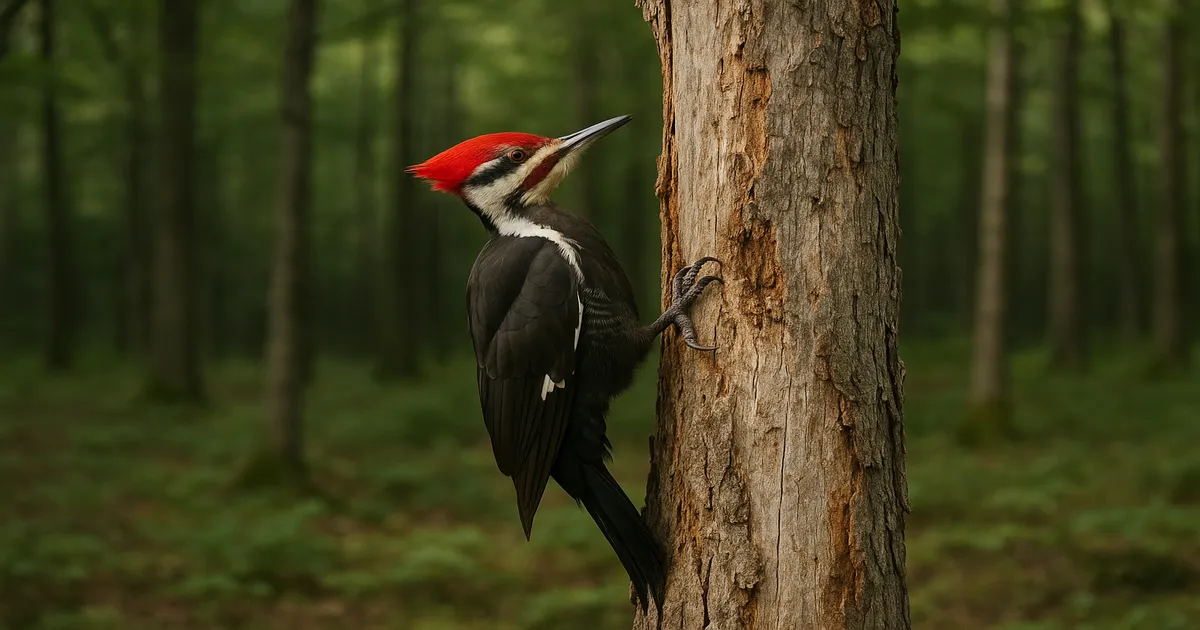
Size and Shape: North America’s Largest Woodpecker
The Pileated Woodpecker is genuinely large — about 16 to 19 inches (40–48 cm) long with a wingspan of 26 to 30 inches (66–76 cm). “Crow-sized woodpecker” is the most useful mental anchor for new birders. In flight, the long neck and massive chisel bill give it a slightly prehistoric silhouette that’s hard to mistake once you’ve seen it.
Key Field Marks
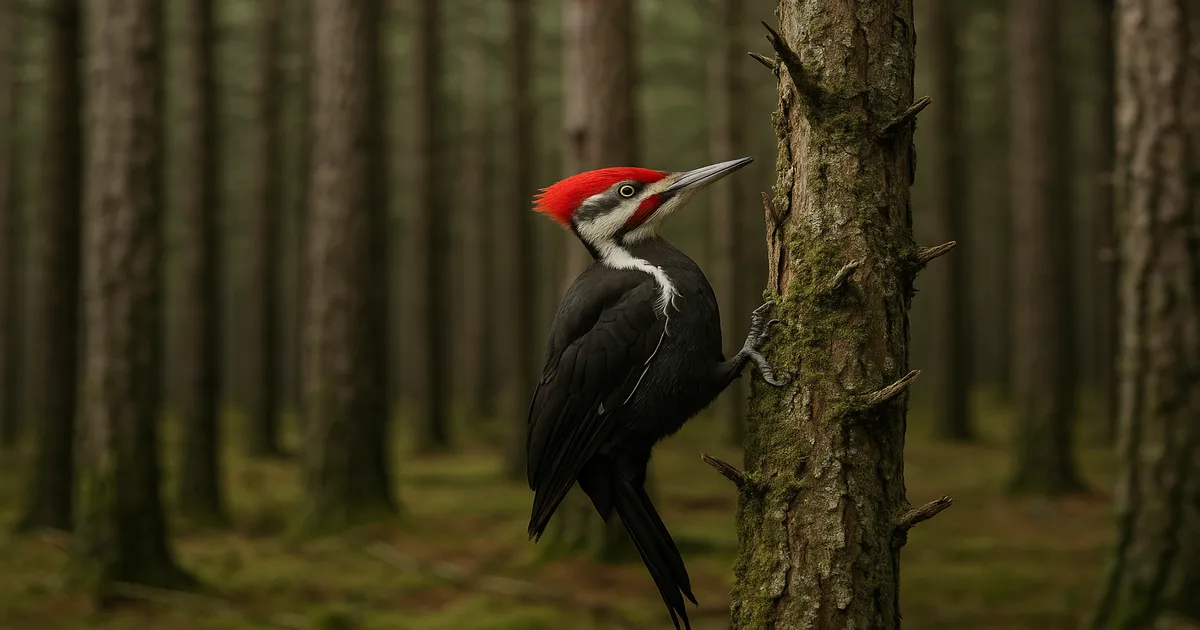
- Body: Predominantly glossy black across the back, wings, and underparts
- Crest: Tall, pointed, and flame-red — visible from a surprising distance
- White markings: Bold white stripes down each side of the neck and face; white flashes on the underwings in flight
- Bill: Long, powerful, and pale ivory-gray to yellowish — built for serious wood demolition
- Eyes: Yellow, giving the bird an intense, almost raptor-like expression
Male vs. Female
Males have a red crest that extends forward to the forehead, plus a bold red malar stripe (the “mustache” running from the base of the bill). Females share the same red crest, but their forecrown is black and both malar stripes are black rather than red. Everything else is essentially identical.
Juveniles
Young birds look much like adults at first glance, but their plumage is duller and browner rather than crisp glossy black. The crest is less developed and may appear shorter. Young males begin showing the red malar stripe fairly early, making sexing possible before they fully molt into adult plumage. By the end of their first year, they’re largely indistinguishable from adults.
Calls, Drumming, and Sounds
The Laughing Call
The Pileated’s primary call is loud, wild, and unmistakable — a rapid kuk-kuk-kuk-kuk with a slightly unhinged, laughing quality that most birders describe as sounding like a jungle bird. I’ve had people on walks stop dead and ask if there was a monkey nearby. Hearing this call is almost always the first sign of the bird’s presence, well before you get a visual. If you’re in mature eastern forest and something sounds like it doesn’t belong in North America, look up.
Spend a few minutes with recordings on Xeno-canto or the Cornell Lab’s Macaulay Library before your next outing in Pileated country. Knowing that call will find you more birds than any other single skill.
Drumming
The drumming is equally distinctive — slow, powerful, and resonant in a way that smaller woodpeckers simply can’t produce. It carries far through forest and has a deep, hollow quality when the bird is working a good snag. Late winter and early spring are peak drumming season as territorial activity ramps up.
Did the Pileated Inspire Woody Woodpecker?
Almost certainly. The Pileated’s laughing call is widely credited as the inspiration for Woody Woodpecker’s iconic voice, and the visual resemblance — large, black-and-white, red-crested — is hard to ignore. The character was created in 1940, when the bird’s calls would have been familiar background noise across much of rural North America.
Habitat and Range
Forest Requirements
Pileated Woodpeckers need mature forest — not just trees, but large old trees, abundant standing dead wood (snags), and fallen logs. They use deciduous and mixed forests across the East and Midwest, and coniferous forests in the Pacific Northwest and Canada’s boreal belt. Riparian corridors are reliably productive. They’ll use second-growth forest if the trees are large enough, and some have adapted to semi-rural wooded areas, but you won’t find them in young plantations or fragmented suburban woodlots.
Geographic Range
The Pileated is a year-round resident — it doesn’t migrate — across a broad swath of the continent:
- East: Atlantic Coast north through New England and into southeastern Canada, south to northern Florida and the Gulf Coast
- North: Across the Canadian boreal belt from Nova Scotia west through British Columbia
- West: Down the Pacific Coast from BC through Washington, Oregon, and into California’s coastal ranges and the Sierra Nevada foothills
- Absent from: The Great Plains, the arid Southwest, and the Rocky Mountain interior where mature forest is sparse
The encouraging news is that the species has been expanding its range in the Northeast and parts of the Midwest as forests have matured following a century of farm abandonment and regrowth.
Why Snags Matter
Standing dead trees aren’t a liability — they’re the whole point. Snags harbor the carpenter ant colonies and wood-boring beetle larvae that make up the bulk of the Pileated’s diet, and they’re where the bird excavates its nest cavities. Without large snags, there are no Pileated Woodpeckers. It’s that direct.
Diet and Feeding Behavior
Carpenter ants (Camponotus spp.) make up more than 60% of the Pileated’s diet. The bird’s long, sticky, barbed tongue is purpose-built for probing deep into wood galleries and extracting ants that other species can’t reach. This is why you’ll see Pileateds working the same snag over multiple days — they’re methodically following ant tunnels through the heartwood.
The excavation holes are one of the most reliable field signs in North American birding. Look for large rectangular or oval cavities, 3 to 6 inches (7–15 cm) wide, in dead or dying trees, often with pale wood chips scattered at the base. Finding a freshly worked snag is one of my favorite strategies for locating this species — set up nearby, wait, and there’s a solid chance the bird will return.
Beyond ants and beetle larvae, Pileateds eat wild fruits and berries in fall and winter — wild grape, elderberry, dogwood berries, and blackberries are all taken, along with occasional acorns and beechnuts.
Attracting Pileated Woodpeckers
Suet is the top attractant, full stop. Standard small suet cages won’t cut it — you need a large suet cage or a suet log feeder that can accommodate a crow-sized bird. A suet log feeder mounted near a mature tree trunk works particularly well. Peanuts and peanut butter mixes are solid secondary options.
Placement matters more than most people realize. A feeder near the trunk of a large mature tree, or at the edge of a woodland, will dramatically outperform one sitting in the middle of an open lawn. These are forest birds; they won’t cross a wide open space to reach a feeder that doesn’t feel safe.
If you have a dead or dying tree on your property that isn’t a safety hazard, leave it standing. A large snag does more for Pileated Woodpeckers — and for dozens of other cavity-nesting species — than any feeder ever will. If the tree must come down, consider leaving the lower trunk as a snag stub. Even partial habitat beats none.
A field guide with strong range maps and plumage illustrations is worth having before you head out. (Sibley’s Birds of North America) For backyard habitat, planting native fruit-bearing shrubs like elderberry and dogwood adds supplementary food and draws the bird in without a feeder at all.
Pileated vs. Ivory-billed Woodpecker
The Ivory-billed Woodpecker (Campephilus principalis) is the most famous look-alike question in North American birding. Here’s what separates them:
| Feature | Pileated | Ivory-billed |
|---|---|---|
| Back (perched) | All black | Large white patches |
| Wings (in flight) | White on underwing only | Extensive white on trailing edge |
| Female crest | Red | Black |
| Bill | Dark to yellowish-gray | Pale ivory-white |
The Pileated shows white only on its neck stripes and underwings. The Ivory-billed, when perched, has obvious white patches on its back — visible at a distance. In flight, the white trailing edge of the Ivory-billed’s wings is extensive and distinctive.
The last universally accepted Ivory-billed sightings date to the 1940s in Louisiana. Subsequent claimed sightings — including the widely publicized 2004 Arkansas reports — were never confirmed with definitive photographic or specimen evidence. The species was officially declared extinct by the U.S. Fish and Wildlife Service in 2023. Any large black woodpecker you see in North America today is a Pileated. That’s not a disappointment — it’s a testament to forest recovery that we have so many of them.
How to Find Pileated Woodpeckers
Best Times to Look
Early morning is the most productive time by a significant margin — birds are most vocal, most actively foraging, and easiest to track by sound. Winter is underrated as a viewing season; leafless trees open up sightlines dramatically. Late winter through early spring (February to April, depending on latitude) is peak calling and drumming season, which means peak findability.
Where to Go
You want mature forest with big trees and dead wood. Reliable spots include Great Smoky Mountains, Shenandoah, the Adirondacks, Great Lakes forests, and Appalachian ridges in the East; the Olympic Peninsula, Cascades, and Sierra Nevada foothills in the West. State parks and national forests with old-growth or mature second-growth almost always beat fragmented suburban woodlots.
Listen First, Then Look
Don’t walk into the forest scanning the canopy — walk in quietly and listen. The laughing call and resonant drumming will locate the bird for you. Once you hear it, stop, orient yourself, and wait. Pileateds are loud but not always fast-moving; stay still after hearing the call and there’s a good chance the bird works its way into view.
A good pair of binoculars with strong close-focus capability makes a real difference once you’ve got a visual. (Vortex Optics Diamondback HD 8x42) Also look for those large rectangular excavation holes in dead trees — a freshly worked snag is as good as a trail camera for knowing the bird is nearby. (Browning Strike Force Pro XD)
Conservation Status
The Pileated Woodpecker is listed as Least Concern on the IUCN Red List, with a North American population estimated at roughly 1.9 million individuals (Partners in Flight). Breeding Bird Survey data show stable to slightly increasing trends across most of the range — a genuine conservation success story after the severe declines of the 19th and early 20th centuries, when large-scale clear-cutting eliminated much of the old-growth forest the species depended on.
Mature forest loss remains the primary long-term threat. Forestry practices that remove snags and large dead wood directly eliminate nesting and foraging habitat. Habitat fragmentation limits territory availability and reduces connectivity between populations.
The most useful things you can do: leave dead trees standing, plant native fruit-bearing shrubs, and support forest conservation organizations that advocate for retaining snags and large woody debris. The species’ recovery over the past century proves that habitat improvements translate directly into population recovery.
Frequently Asked Questions
Is it pronounced PIE-lee-ay-ted or PILL-ee-ay-ted woodpecker?
Both are correct. PIE-lee-ay-ted is slightly more common in academic ornithology; PILL-ee-ay-ted is equally standard among field birders. The word comes from the Latin pileatus, meaning “capped” — a reference to the bird’s red crest. Use whichever feels natural.
What is the largest woodpecker in North America?
The Pileated Woodpecker, at 16 to 19 inches (40–48 cm) long with a wingspan up to 30 inches (76 cm). It’s roughly the size and weight of an American Crow. The Ivory-billed Woodpecker was slightly larger but is almost certainly extinct.
What does a pileated woodpecker sound like?
A loud, wild, laughing call — often written as kuk-kuk-kuk-kuk — that sounds almost tropical. It also produces slow, deep, resonant drumming on dead wood that carries long distances through forest. Both sounds are typically heard before the bird is seen.
How do you attract a pileated woodpecker to your yard?
Suet in a large suet cage or suet log feeder, placed near mature trees or a woodland edge, is the most reliable attractant. Peanuts and peanut butter mixes also work. More importantly, leave any dead trees standing — snags are the single most valuable thing you can offer.
How do you tell a pileated woodpecker from a crow in flight?
Look for the long bill, long neck, red crest, white underwing flashes, and a slightly undulating flight pattern. Crows have shorter, blunter bills, no crest, and all-dark wings. Once you’ve seen a Pileated in flight a few times, the silhouette is unmistakable.