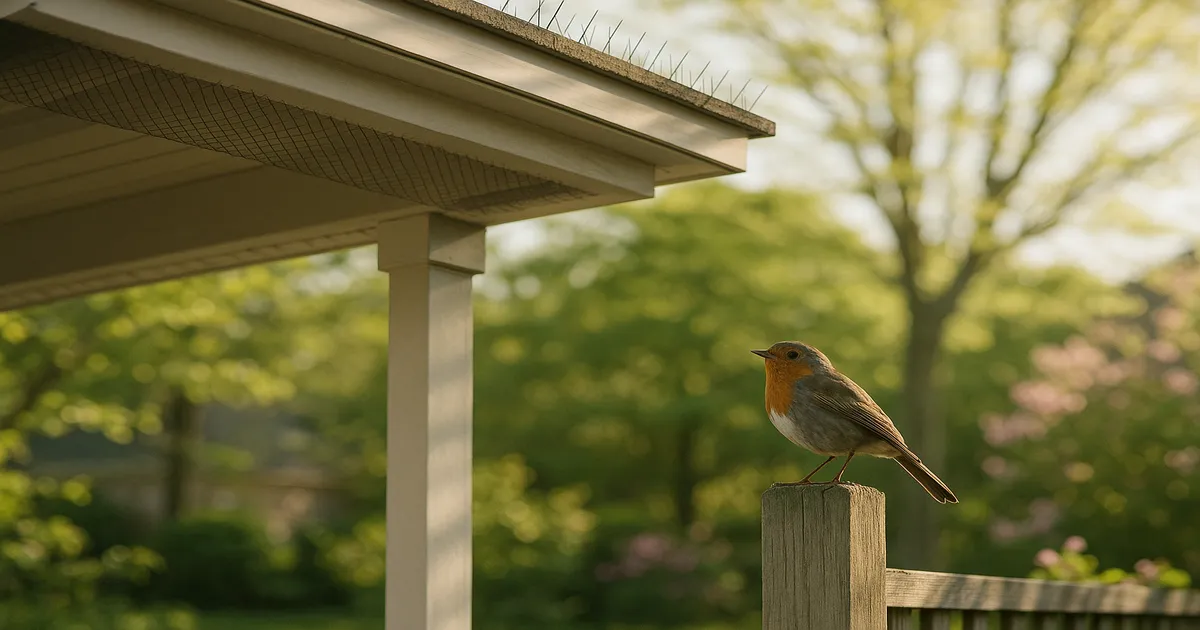
Quick Answer: The safest way to stop birds from making a nest on your front porch is to act before construction begins — ideally in January or February — using physical barriers like bird spikes or netting, visual deterrents, and simple habitat modifications. Once eggs or chicks are present, most species are federally protected under the Migratory Bird Treaty Act, and removing the nest is illegal. Identify the species first; it determines both your legal options and which deterrents will actually work.
Why Birds Choose Your Front Porch for Nesting
From a bird’s perspective, your front porch is a premium cliff face with a roof. Overhanging eaves replicate rocky ledges. Ceiling corners mimic tree cavities. Hanging baskets look like dense shrubs. Add protection from rain, wind, and most predators, and your porch checks every box a nesting bird is looking for.
Light fixtures are especially appealing — elevated, sheltered, and structurally solid. Rafters, beams, and decorative ledges offer flat or angled surfaces that birds instinctively associate with safety. The problem is that porches sit right next to your front door. What’s cozy for a House Finch is messy and disruptive for you.
When Nesting Activity Peaks
Most porch-nesting activity runs from February through May, though the exact window depends on species and region. Eastern Phoebes and American Robins are early movers — they may start scouting sites in late February across the South. Barn Swallows typically arrive March through May. House Sparrows, House Finches, and Carolina Wrens are year-round residents across much of the country and can attempt nesting earlier than most people expect.
The key point: birds scout locations before they build. Make your porch unappealing during that scouting phase and you’ll sidestep the problem entirely.
Identify the Bird: Common Porch-Nesting Species
Knowing who’s building isn’t just useful — it’s legally necessary. Different species have different deterrence vulnerabilities, and some nests are federally protected while others aren’t. A decent pair of binoculars makes identification much easier from a distance without disturbing the birds. (Nikon Monarch M5 8x42)
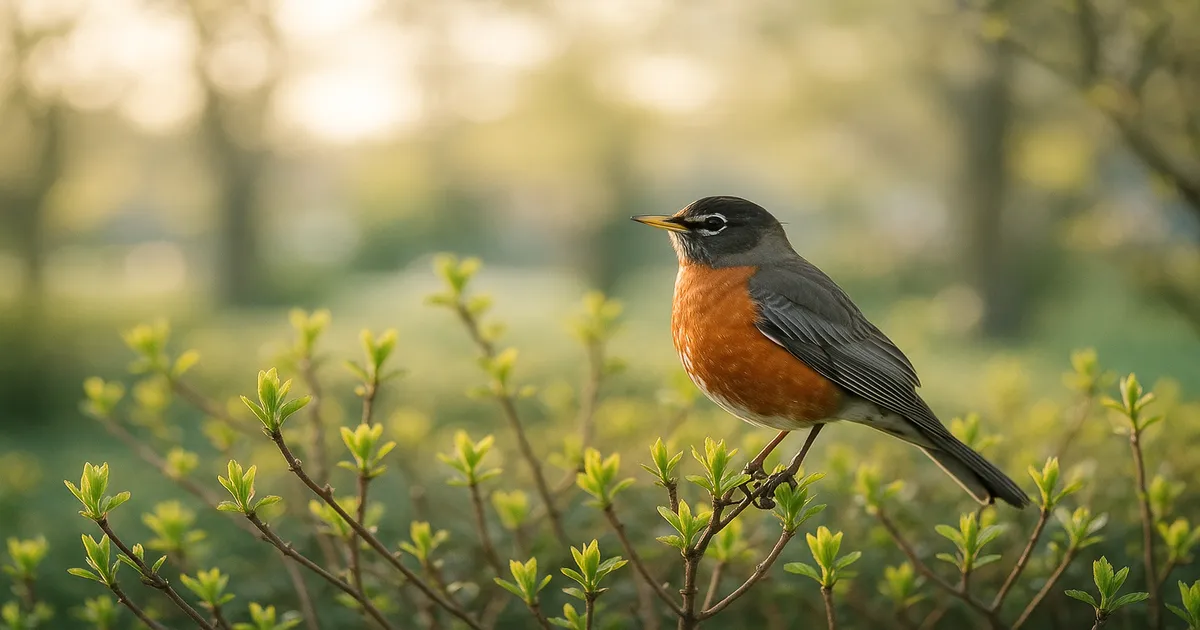
American Robin — About 10 inches long with a deep orange-red breast, dark back, and yellow-orange bill. Females are paler overall. Their nests are sturdy mud-and-grass cups, typically 4–6 inches across, placed on ledges, beam corners, or atop light fixtures. The mud lining is distinctive — no other common porch nester builds quite like this.
Barn Swallow — Slender, about 6.75 inches long, with iridescent steel-blue upperparts, a rusty-orange face and throat, and a deeply forked tail. You’ll rarely see one perched except near the nest. Their mud-and-grass cups are plastered directly to vertical surfaces under eaves or in ceiling corners, lined with feathers. Barn Swallows have strong site fidelity — if they nest on your porch this year, plan on seeing them again next spring.
House Sparrow — Males have a bold black bib, chestnut-brown back, and gray crown. Females are plain buffy-brown with a pale eyebrow stripe and no bib. About 6.25 inches long with a thick conical bill. Their nests are the messiest on this list: bulky domes stuffed with grass, feathers, string, and whatever debris is available. House Sparrows are non-native (introduced from Europe in the 1850s) and not protected under federal law.
House Finch — Males show red on the head, breast, and rump; intensity varies with diet. Females are plain brown with heavy streaking. About 6 inches long with a slightly curved bill and a lively warbling song ending in a buzzy “zreee.” They favor hanging baskets, wreaths, and light fixtures.
Eastern Phoebe — A medium-sized flycatcher, about 6.75 inches long, with a dark gray-brown head, whitish underparts, and no bold wing bars. The field mark that gives them away instantly is constant tail-pumping — they wag it up and down almost continuously. Their raspy “fee-bee” call is emphatic and easy to learn. Nests are mossy cups with a mud base, often plastered to porch beams or wall-beam junctions.
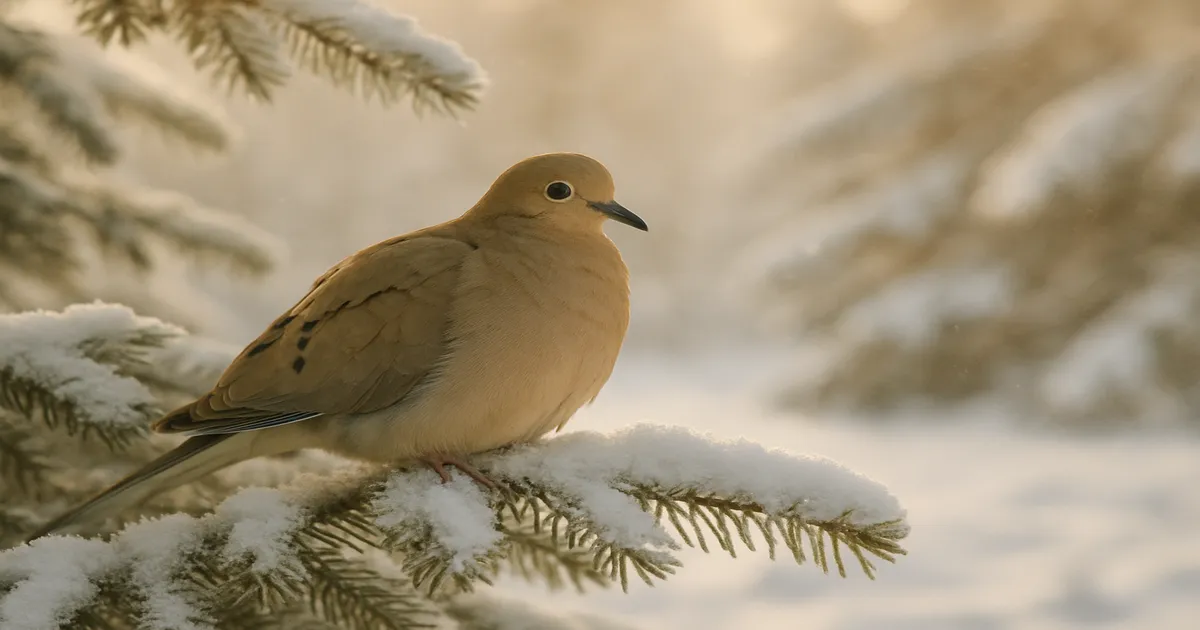
Mourning Dove — Slender, about 12 inches long, with a long pointed tail, small head, and warm tan-brown plumage. Their nests are notoriously flimsy — a loose stick platform where eggs are sometimes visible from below. Multiple broods per year makes them persistent.
Carolina Wren — Small but loud, about 5.5 inches long, with rich rufous-brown plumage, a bold white eyebrow stripe, and a cocked tail. Their “tea-kettle, tea-kettle, tea-kettle” song carries surprisingly far. They are the most creative porch nesters on this list — flowerpots, boots by the door, mailboxes, open shelves, coat pockets left on a hook. If there’s a cavity, a Carolina Wren will consider it.
Quick-Reference Table
| Species | Nest Type | Preferred Porch Location | Federally Protected? |
|---|---|---|---|
| American Robin | Mud-lined cup | Ledges, light fixtures, beam corners | Yes |
| Barn Swallow | Mud cup plastered to surface | Eave undersides, ceiling corners | Yes |
| House Sparrow | Bulky dome/cavity fill | Any gap, vent, or crevice | No |
| House Finch | Grass-and-twig cup | Hanging baskets, wreaths, fixtures | Yes |
| Eastern Phoebe | Mossy mud-base cup | Beams, rafters, wall junctions | Yes |
| Mourning Dove | Flimsy stick platform | Ledges, window boxes, baskets | Yes |
| Carolina Wren | Domed cavity nest | Pots, boots, shelves, any container | Yes |
Know the Law Before You Act
The Migratory Bird Treaty Act
The Migratory Bird Treaty Act (MBTA) makes it illegal to disturb, move, or destroy the active nest, eggs, or young of most native bird species — even on your own property. “Active” means a nest containing eggs or chicks. An empty nest under construction is a gray area, but once eggs are laid, your hands are legally tied for protected species.
All native species on this list — American Robin, Barn Swallow, House Finch, Eastern Phoebe, Mourning Dove, and Carolina Wren — fall under MBTA protection. House Sparrows and European Starlings are introduced species and are not protected, meaning you can legally remove their nests at any stage, including nests with eggs. That’s genuinely useful: House Sparrows are persistent, and immediate removal of nest material is the most effective way to discourage them. Still, check your state wildlife agency’s regulations, since a handful of states layer additional protections on top of federal law.
The clearest legal window for intervention is before any eggs are laid — during construction for non-protected species, or at any stage for House Sparrows. For all other species, wait until the nest is confirmed empty and abandoned after the breeding cycle ends.
How to Stop Birds From Making a Nest on Your Front Porch
Physical Barriers: The Most Reliable Long-Term Fix
Bird spikes are the gold standard for ledges and beam tops. Stainless steel holds up far better than plastic over time. Install them on any flat surface where robins, doves, or swallows have been landing. For eaves, bird netting stretched across the underside blocks swallows before they can plaster their first mud pellet. An angled board or length of PVC pipe set at roughly 45 degrees on a flat ledge eliminates the landing surface entirely — simple, cheap, and effective.
Visual Deterrents
Reflective flash tape and old CDs hung near problem areas can disrupt scouting birds during that critical pre-nesting evaluation window. Owl or hawk decoys can work, but only if you move them every few days. A stationary decoy is ignored within a week — birds aren’t fooled by a predator that never moves. Pinwheels and predator-eye balloons add movement and visual noise, and work best as a complement to physical barriers rather than a standalone fix.
Remove What Birds Actually Nest In
This is the simplest and most underrated strategy: take away the things birds want to nest in. Remove hanging baskets and decorative wreaths from February through July. Bring in boots, pots, and open containers stored on the porch. Seal gaps around vents, eaves, and soffits — a gap the size of a quarter is enough for a House Sparrow. Hardware cloth works well over vent openings.
Start in Late Winter — Not When You See the First Nest
January and February are your window. By the time you notice a nest being built, you may already be days from egg-laying. Install deterrents before birds start scouting and you’ll avoid the whole problem. Early action is far easier than managing an active nest situation.
Species-Specific Tips
Robins: Block the tops of light fixtures and ledge surfaces with spikes or angled boards. Also consider eliminating mud sources near the porch — a muddy garden bed right next to the front steps is an open invitation.
Barn Swallows: Install bird netting under eaves before March. This is non-negotiable if you’ve had swallows before. During scouting, foam or cardboard temporarily blocking ceiling corners can interrupt the process before the first mud pellet goes up. Once construction starts, you’re racing the clock.
House Sparrows: Remove nest material immediately and repeatedly — they’re persistent and you may need to clear the same spot several times over a few weeks. Seal every gap and crevice you can find.
House Finches: Take down hanging baskets and wreaths from late January through July. House Finches aren’t going to build on a bare hook.
Eastern Phoebes: Install slope covers or angled boards on beam tops. That said — phoebes eat enormous quantities of mosquitoes, gnats, and flies. Some homeowners decide the nest is worth tolerating for a few weeks, and honestly, that’s a reasonable call.
Mourning Doves: Spikes on window boxes and ledge surfaces work well. Their flimsy nests need a stable platform, so removing or covering flat surfaces is effective. Doves aren’t particularly attached to a specific site once it’s been made uncomfortable.
Carolina Wrens: Clear boots, flowerpots, and open containers from the porch during nesting season. If you must keep items outside, store them in a closed bin.
If a Nest Is Already There
If you find eggs or chicks from any protected species, leave the nest alone. Disturbing or removing it violates the MBTA, and the fines are real. The good news is the inconvenience is temporary.
Most songbirds fledge within 10–14 days of hatching. Add the incubation period — roughly 12–14 days for robins, 14–16 days for barn swallows, 13–15 days for mourning doves — and you’re looking at a full nesting cycle of about 4–6 weeks from egg-laying to fledging. Mark the date you first notice eggs and count forward. It goes faster than you expect.
Once the nest is abandoned — no adults returning, no chicks present — remove it wearing gloves, seal it in a plastic bag, and wash your hands thoroughly. Old nests can harbor mites and lice. Then clean the surface with a mild disinfectant and install your deterrents immediately. Don’t wait until February; do it the same week the nest comes down. Barn Swallows and Eastern Phoebes will return to the exact same spot next spring if you don’t modify it.
Coexistence: When Tolerating a Nest Makes Sense
A single Barn Swallow can consume 850 or more insects per day — mosquitoes, gnats, and flies make up a large portion of that diet. Phoebes, robins, and Carolina Wrens all take significant quantities of pest insects and grubs. If you have a summer mosquito problem, a nesting swallow pair is doing real work for you.
If you decide to tolerate a nest, a simple shelf or tray mounted below it catches the bulk of droppings. A drop cloth over porch furniture during the nesting period protects cushions and surfaces. It’s a minor inconvenience for a 4–6 week window.
The most elegant long-term solution is to give birds a better option elsewhere. A Carolina Wren or House Finch nest box mounted on a fence post or tree 10–20 feet from the porch gives them a suitable alternative that keeps them out of your hair.
Frequently Asked Questions
Is it illegal to remove a bird’s nest from my porch? It depends on whether the nest is active and which species built it. An active nest — one containing eggs or chicks — belonging to any native species is protected under the Migratory Bird Treaty Act. You cannot legally remove it until the young have fledged and the nest is abandoned. House Sparrow and European Starling nests are not protected and can be removed at any time.
What’s the fastest way to stop birds from nesting on my porch right now? If no eggs have been laid yet, remove any nest material immediately and install a physical barrier — spikes, netting, or an angled board — on the same day. Don’t wait. If eggs are already present in a protected species’ nest, you’ll need to wait out the breeding cycle, which typically runs 4–6 weeks from egg-laying to fledging.
Will wind chimes or aluminum foil keep birds away? Sometimes, briefly. Wind chimes add noise and movement that can deter scouting birds, but most birds habituate to them within a week or two. Reflective materials like foil or flash tape are more effective because they produce unpredictable light flashes, but they also lose effectiveness over time. Use them as a supplement to physical barriers, not a replacement.
How do I stop Barn Swallows specifically? They keep coming back every year. Barn Swallows have strong site fidelity — the same birds return to the same porch year after year. The only reliable fix is physical exclusion: bird netting installed under the eaves before they arrive in spring, typically before late March in most of the U.S. Once the netting is up, they’ll look elsewhere. Do it the same week the nest is removed in fall, not the following February.
Can I move a bird’s nest a few feet to a less inconvenient spot? For protected species, moving an active nest — even a short distance — is technically a violation of the MBTA. Some wildlife rehabilitators and state agencies will advise on a case-by-case basis, but the safest answer is no. For House Sparrows, you can move or remove the nest freely.