Quick Answer: Yes, a cowbird nestling can suffocate a bluebird nestling — and it happens more often than most nest box monitors realize. The Brown-headed Cowbird grows 2–3 times the size of Eastern Bluebird nestlings within just a few days of hatching, physically dominating the nest cup and pressing smaller chicks against the walls. This isn’t aggression — it’s a passive consequence of extreme size asymmetry in a very confined space, and enclosed nest boxes may actually make the crushing worse.
If you monitor a bluebird trail or maintain a backyard nest box, understanding whether a cowbird nestling can suffocate a bluebird nestling is something you genuinely need to get right. The mechanism is more insidious than most people expect. There’s no dramatic ejection, no obvious violence — just a rapidly growing chick slowly crowding out its nest-mates while the bluebird parents keep right on feeding it.
Here’s what’s actually happening inside that box.
Meet the Two Species: Brown-headed Cowbird and Eastern Bluebird
Identifying the Brown-headed Cowbird
The Brown-headed Cowbird (Molothrus ater) is about 7.5 inches (19 cm) long with a wingspan of roughly 12 inches (30.5 cm) — stocky and heavier than it looks. The adult male is unmistakable in good light: glossy iridescent black body, crisp chocolate-brown head, and a short thick finch-like bill that immediately separates it from the longer-billed blackbirds it often flocks with.
The female is a different story — drab grayish-brown overall, with faint breast streaking and that same blunt conical bill. She’s one of the most consistently misidentified birds at feeders. I’ve watched experienced birders call her a large sparrow or a female Red-winged Blackbird (Agelaius phoeniceus). Focus on the bill shape and the plain, unstreaked face — that’s what locks the ID.
Juveniles look similar to females but with buffy feather edges that give them a scaly appearance. One of the odder sights in summer birding is watching a juvenile cowbird — already larger than its foster parents — begging loudly from a bewildered Yellow Warbler (Setophaga petechia). The male’s song is a liquid, gurgling glug-glug-gleee; the female produces a dry, rattling chatter unlike almost anything else.
Identifying the Eastern Bluebird
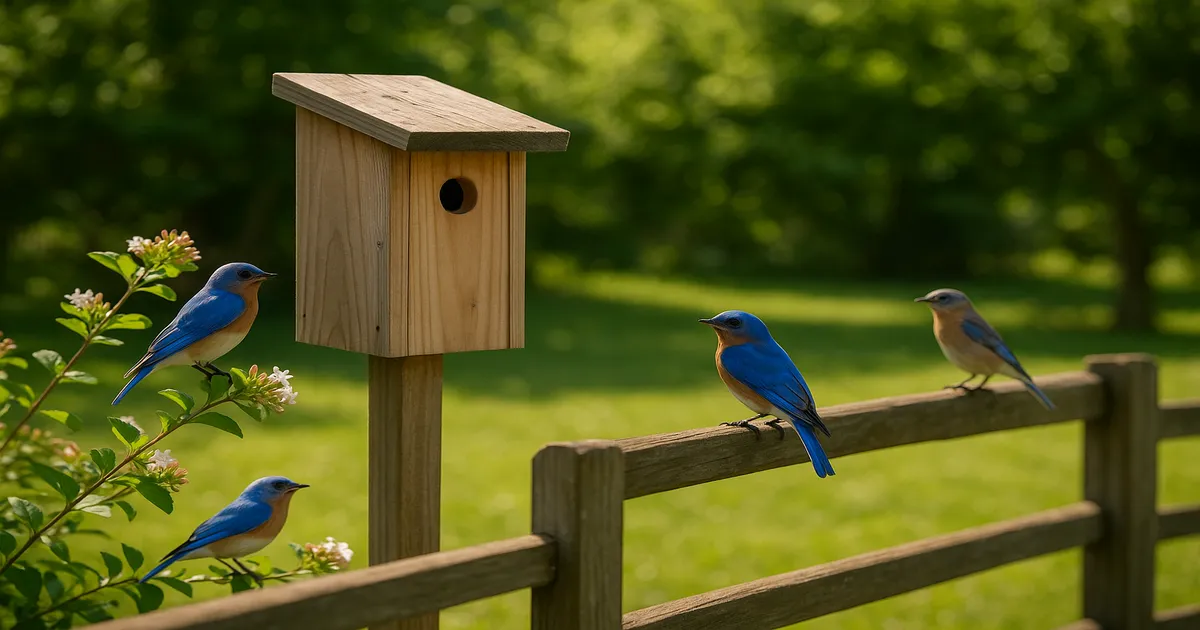
The Eastern Bluebird (Sialia sialis) is 6.3–8.3 inches (16–21 cm) long — noticeably lighter and more slender than the cowbird. The adult male is one of North America’s most recognizable birds: brilliant royal blue upperparts, warm rusty-orange breast, and a clean white belly. The female wears the same pattern in muted tones, with grayish-blue upperparts and a pale orange-buff wash on the breast.
Juveniles show the spotted breast typical of all thrush-family birds, with blue just beginning to appear on the wings. The bluebird’s bill is slender and slightly downcurved — built for snatching insects, not cracking seeds.
The size difference between adults is worth registering: the cowbird is heavier and bulkier even when the two birds are similar in length. That weight disparity foreshadows exactly what happens inside a nest box when a cowbird chick hatches alongside bluebird nestlings.
How Cowbird Brood Parasitism Works
The Brown-headed Cowbird never builds a nest, never incubates an egg, and never raises a chick. It is an obligate brood parasite — its entire reproductive strategy depends on other species doing all the parental work. Over 220 host species have been recorded, making it one of the most generalist parasites in the bird world.
Female cowbirds are methodical about it. They spend early mornings quietly watching potential host nests from concealed perches — a behavior called host nest prospecting — before making a rapid visit to lay a single egg, often removing one host egg in the process. A single female can lay up to 40 eggs per season. Cowbird eggs also have a thicker shell than most host eggs, making them harder for host birds to puncture and eject even when they try.
Some species have evolved egg-rejection behavior — Yellow Warblers will either toss the foreign egg or bury the entire parasitized clutch under a new nest floor. Bluebirds haven’t developed that defense. They’ll incubate the cowbird egg right alongside their own, feed the cowbird chick throughout the nestling period, and sometimes keep feeding it even after their own young have died. The bluebird’s lack of rejection behavior makes it a particularly vulnerable host.
Can a Cowbird Nestling Suffocate a Bluebird Nestling? The Mechanism Explained
A Head Start That Compounds Daily
Cowbird eggs hatch in approximately 10–12 days, typically 1–2 days before Eastern Bluebird eggs. That gap sounds small, but in the compressed timeline of nestling development it’s enormous. The cowbird chick arrives already ahead, and the advantage only grows.
Explosive Growth in a Confined Space
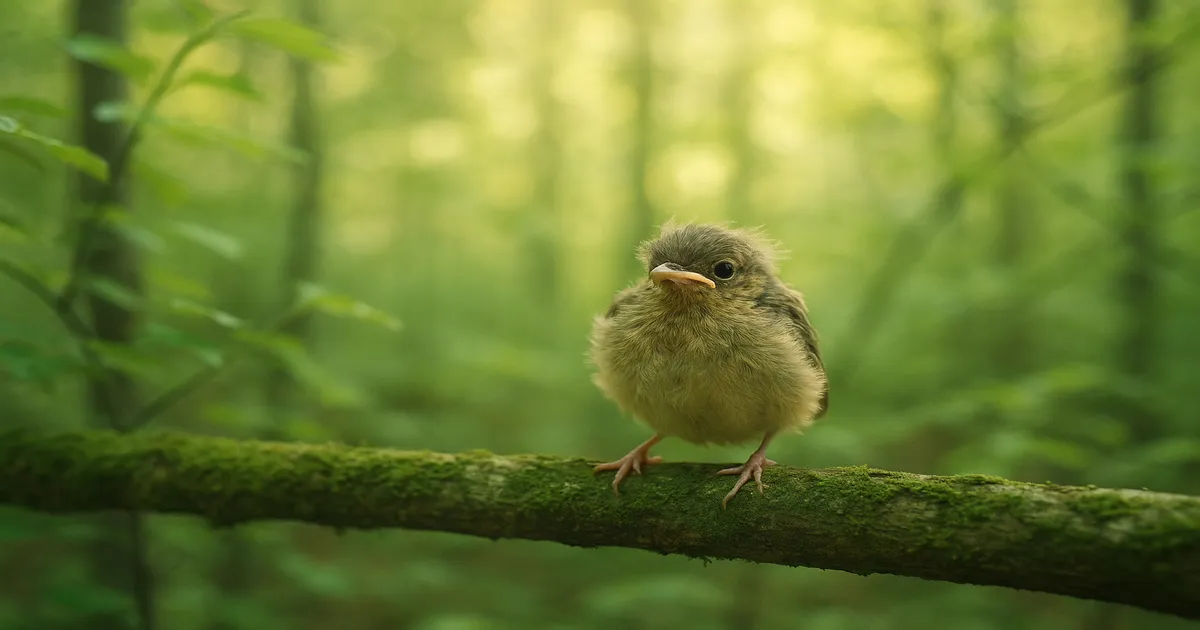
Within just a few days of hatching, a cowbird chick can be 2–3 times the mass of its bluebird nest-mates. This is not a subtle difference. The cowbird chick fills the nest cup in a way that bluebird chicks simply cannot match, pressing them against the walls and floor of the box.
This is also where the cowbird differs fundamentally from the Common Cuckoo (Cuculus canorus) of Europe. The cuckoo chick actively ejects host eggs and nestlings — it physically heaves them over the nest rim. The cowbird does nothing of the sort. It simply grows, and as it grows, it smothers. Researchers describe this as passive suffocation, and the enclosed walls of a nest box likely amplify the crushing effect compared to an open-cup nest where nestlings have slightly more room to shift.
A Double Threat: Smothering and Starvation
Bluebird nestlings face two simultaneous pressures. The cowbird chick begs louder and positions itself most advantageously at feeding time, capturing the majority of food the host parents bring. At the same time, it’s physically displacing the smaller chicks. In heavily parasitized nests, bluebird fledgling output can drop to zero — the parents invest an entire breeding attempt into raising a single cowbird.
Habitat Overlap: Where the Problem Is Worst
Bluebirds breed across eastern North America from southern Canada through the entire eastern United States and west to the Great Plains. They favor open woodlands, field edges, rural roadsides, orchards, and suburban areas with nest boxes — anywhere with short grass for foraging and a nearby cavity for nesting.
Cowbirds historically followed bison herds across open grasslands, but today they occupy virtually every open or semi-open habitat across the continental United States and most of Canada. Forest fragmentation has made things worse: as interior forests have been broken up by roads, farms, and development, cowbirds have gained access to host species that were previously out of reach.
Bluebird trail nest boxes are typically placed in open fields, along fence lines, and at forest edges — precisely the habitats where cowbirds thrive. If you’re managing a bluebird trail, cowbird encounters aren’t a matter of if, they’re a matter of when.
Recognizing a Parasitized Bluebird Nest Box
Bluebird eggs are pale blue (occasionally white) and unmarked. Cowbird eggs are white to grayish-white with brown speckles — visually distinct once you know what to look for. A good field guide (Sibley’s Birds of North America) kept in your monitoring kit makes egg identification faster and more reliable.
If you missed the egg stage, the nestlings will tell you. Watch for:
- One chick growing dramatically faster than its siblings — the size gap becomes obvious within days
- A single chick that seems to swallow the nest cup, filling it completely
- Bluebird nestlings pressed to the sides or corners of the box
- Reduced begging from bluebird chicks, which may already be weakened
Regular monitoring every 3–5 days during the breeding season is the single most effective tool for catching parasitism early. A reliable pair of binoculars (Nikon Monarch M5 8x42) helps you observe adult behavior near the box without disturbing the nest — useful for spotting a female cowbird prospecting nearby before she lays.
What Nest Box Monitors Can Do
The Legal Question
Brown-headed Cowbirds are native species protected under the Migratory Bird Treaty Act, which means removing their eggs without authorization is technically a federal offense. Federal depredation permits exist for specific conservation contexts. Before you act, contact your state wildlife agency or your local chapter of the North American Bluebird Society (NABS) to understand current regulations in your area. NABS is an excellent resource for guidance specific to nest box monitors.
Placement and Hardware
Placement matters more than most people realize:
- Avoid forest edges and shrubby cover where cowbirds like to perch and prospect
- Place boxes in open fields, at least 100 yards from woodland edges when possible
- Use the correct entrance hole size — 1.5 inches (3.8 cm) is standard for Eastern Bluebirds and physically excludes adult cowbirds from entering the box
A well-built nest box with a properly sized entrance hole, a predator guard on the mounting pole, and a side or front panel for monitoring access is the setup I’d recommend to anyone starting a bluebird trail. Pair it with a sturdy pole-mounted baffle to keep raccoons and snakes out as well.
The 1.5-inch hole is your first line of defense — it physically excludes adult cowbirds — but it isn’t a guarantee. A cowbird can still lay her egg in a rapid visit if she manages to position herself at the opening, which is another reason consistent monitoring beats any single hardware fix.
When to Contact a Wildlife Biologist
If you’re seeing high parasitism rates on your trail, reach out to NABS or your state wildlife agency. Bluebird societies often have regional coordinators who’ve dealt with exactly these situations and can give you practical, locally relevant advice.
Seasonal Timing: When Bluebirds Are Most at Risk
Cowbird egg-laying begins as early as late April in the South, peaks across most of the range in May and June, and can extend into July in northern areas. A single female can produce roughly one egg every 24 hours during peak season — which is how she parasitizes up to 40 nests in a breeding season.
Bluebirds are prolific nesters. In the Deep South, first eggs can appear as early as March; northern populations start in April or May. A successful pair raises 2–3 broods per season, sometimes 4. Each cycle runs roughly 30–37 days from first egg to fledging (13–16 days incubation, 17–21 days nestling period).
The first and second broods — typically underway in May and June — overlap directly with peak cowbird activity. These are the broods that need your closest attention. By late July, cowbird laying tapers off and later bluebird broods get something of a reprieve. Those six weeks from mid-May through late June are when I tell monitors to be especially vigilant.
Frequently Asked Questions
Do cowbird chicks push bluebird nestlings out of the nest?
No. This is a common misconception, probably because people are familiar with the European Common Cuckoo’s ejection behavior. Brown-headed Cowbird chicks do not actively push eggs or nestlings out of the nest. The harm is passive: they grow so fast and so large that they physically crowd out smaller nest-mates — which is exactly how a cowbird nestling can suffocate a bluebird nestling without any deliberate aggression.
How can I tell if there is a cowbird egg in my bluebird nest box?
Look for an egg that doesn’t match the others. Bluebird eggs are smooth and pale blue (rarely white) with no markings. A cowbird egg is white to grayish-white with brown speckles — it stands out clearly once you know the difference. Check your nest box every 3–5 days during the breeding season so you catch it at the egg stage when your options are still open.
Will bluebird parents abandon a parasitized nest?
Generally, no. Bluebirds lack strong egg-rejection instincts and will typically continue incubating a parasitized clutch and feeding the cowbird chick as if it were their own. Unlike some host species that desert parasitized nests entirely, bluebirds tend to commit — which is part of what makes the parasitism so costly for them.
Does a 1.5-inch entrance hole prevent cowbird parasitism?
It prevents adult cowbirds from entering the box, which is genuinely useful. But it doesn’t fully prevent parasitism — a cowbird can still lay her egg in a rapid visit if the hole is even slightly oversized or if she manages to position herself correctly at the opening. The 1.5-inch hole is an important deterrent, not a guarantee.
What happens to bluebird nestlings when a cowbird chick is in the same nest?
They face a double threat. The cowbird chick grows 2–3 times the size of bluebird nestlings within days, physically pressing them against the nest box walls — a passive suffocation effect that’s worsened by the enclosed space. At the same time, the cowbird outcompetes the bluebird chicks for food at every feeding. In heavily parasitized nests, the outcome is often zero bluebird fledglings from that entire breeding attempt.