Quick Answer: Costa Rica packs over 930 bird species into a country smaller than West Virginia, making it one of the world’s top birding destinations. From Resplendent Quetzals in the cloud forests to Scarlet Macaws on the Pacific coast, the country rewards birders at every skill level and every elevation. This bird watching guide to Costa Rica covers the best species, sites, seasons, and practical tips to help you make the most of your time there.
Costa Rica holds roughly 10% of all bird species on Earth — in a place you can drive across in a few hours. The secret is geography. The country sits at the junction of North and South America, funneling species from both continents into a mosaic of 12 distinct life zones stacked across an elevation range from sea level to 12,530 feet (3,819 m). About 26% of its territory is protected, a direct result of Costa Rica abolishing its military in 1948 and redirecting that budget toward conservation. For birders, the payoff is enormous.
Bird Watching in Costa Rica: What to Expect
No single factor explains the biodiversity here — it’s the compression. Lowland Caribbean rainforest, Pacific dry forest, and highland cloud forest all sit within a few hours’ drive of each other. That means you can tick species from multiple life zones in a single day, something genuinely hard to do anywhere else on the planet.
The current confirmed count sits at 930+ species, including roughly 200 North American migrants that winter here or pass through between October and April. Most of the iconic birds — quetzals, macaws, toucans — are resident year-round.
Must-See Birds: A Costa Rica Bird Watching Guide to Key Species
Resplendent Quetzal
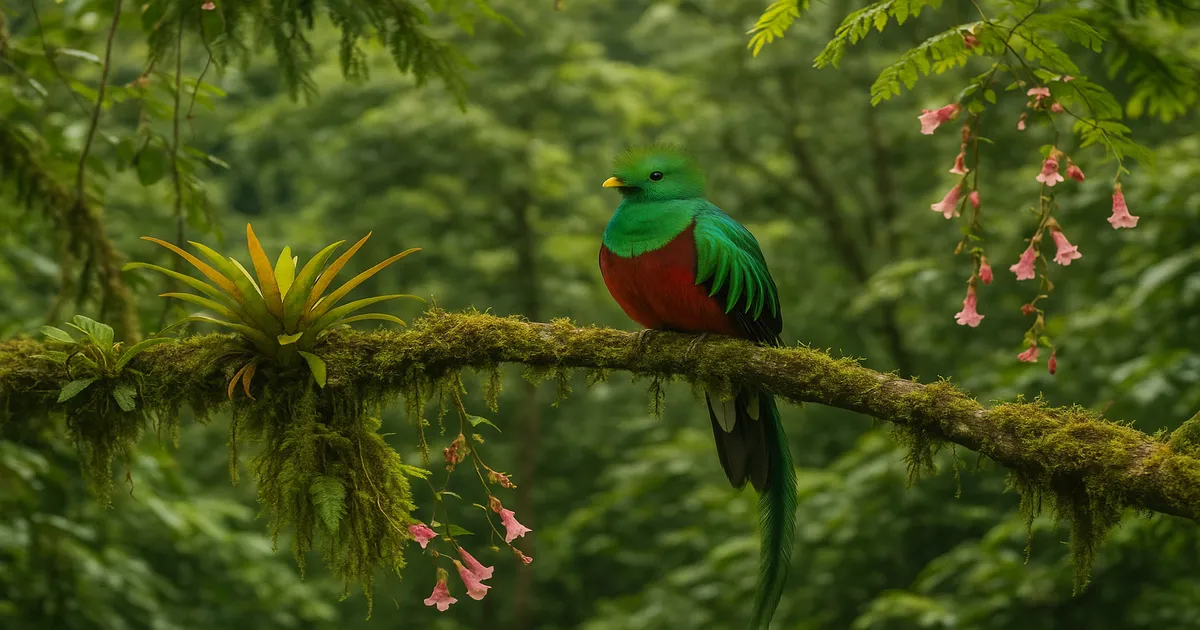
The Resplendent Quetzal (Pharomachrus mocinno) is the bird most visitors come specifically to see. The male’s body runs 14–16 inches (36–40 cm), but the elongated uppertail covert “train” adds another 24–30 inches (61–76 cm). That iridescent green plumage, crimson belly, and short yellow bill make him essentially unmistakable. Females are subtler — duller green above, brownish-gray chest, shorter tail — but still show a red belly. Listen for a deep, mellow two-note “ke-wow” at dawn; quetzals are most vocal in early morning and easiest to find when fruiting laurels are active.
Scarlet Macaw
At 32–36 inches (81–91 cm) with a wingspan up to 38 inches (97 cm), the Scarlet Macaw (Ara macao) is hard to miss. The tricolor wing pattern — scarlet body, yellow coverts, blue flight feathers — is diagnostic, as is the bare white facial patch. You’ll usually hear them first: that raucous “raaah-raaah” carries over a mile. Sexes look alike, though males average slightly larger.
Keel-billed Toucan
The Keel-billed Toucan (Ramphastos sulfuratus) is 17–22 inches (43–56 cm) with a bill up to 6 inches (15 cm) long. That bill is the whole story: green base, orange sides, red tip, blue ridge — all on a lightweight honeycomb keratin structure. The body is jet black with a bright yellow bib and red undertail coverts. Its call is a repetitive, frog-like “kreek-kreek-kreek” — locals call it “Dios-te-dé.” It perches conspicuously at canopy level, which makes it one of the easier iconic species to photograph.
Montezuma Oropendola and Three-wattled Bellbird
The Montezuma Oropendola (Psarocolius montezuma) is a colony nester with one of the most theatrical displays in the tropics. Males reach 20 inches (51 cm) and produce a liquid, gurgling “bloop-bloop-blooooop” while bowing forward dramatically. Look for hanging woven nest colonies — sometimes 100 nests in a single tree.
The Three-wattled Bellbird (Procnias tricarunculatus) is the cloud forest’s loudest resident. The male’s metallic “BONK” carries up to half a mile and stops conversations. That white head, chestnut body, and three dangling worm-like wattles make the male unmistakable. The female is olive-green with yellowish streaking — so different that new birders often don’t connect the two.
Harpy Eagle
The Harpy Eagle (Harpia harpyja) is 35–41 inches (89–105 cm) with a wingspan up to 88 inches (224 cm) and rear talons reaching 5 inches (13 cm). The divided facial disc, black chest band, and bicolored crest make it unmistakable — if you’re lucky enough to see one. Harpy Eagles are rare in Costa Rica and largely restricted to the Osa Peninsula. Don’t plan a trip around finding one, but keep your eyes on large emergent trees in Corcovado.
Hummingbirds
Costa Rica has over 50 hummingbird species. The Rufous-tailed Hummingbird (Amazilia tzacatl) is the one you’ll see everywhere — feeders, gardens, forest edges. At 3.7–4.3 inches (9.5–11 cm), it’s medium-sized, with a red bill tipped in black, glittering green gorget, and a distinctive rufous tail visible from any angle. It’s aggressive at feeders and will chase off larger species without hesitation. At higher elevations, watch for the Fiery-throated Hummingbird (Panterpe insignis) — a cloud forest endemic with a gorget that shifts from gold to violet depending on the light.
Clay-colored Thrush: Costa Rica’s National Bird
The Clay-colored Thrush (Turdus grayi) might surprise you as the national bird — it’s plain warm brown, 9–10 inches (23–25 cm), with a yellowish-green bill and faint throat streaking. No bold field marks. But its rich, melodious caroling at dawn and dusk is genuinely beautiful, and the bird is everywhere from gardens to forest edges. It earned its status through song, not spectacle.
Top Birding Sites in Costa Rica
San Gerardo de Dota: Best for Resplendent Quetzal
This is the most accessible quetzal habitat in the world. San Gerardo de Dota sits at roughly 7,000–9,800 feet (2,100–3,000 m) in the Talamanca highlands, a few hours south of San José. The valley’s fruiting laurel trees attract quetzals reliably, especially February through June during breeding season. You’ll also find Volcano Junco, Flame-throated Warbler, and Slaty Flowerpiercer — highland specialists you won’t see at lower elevations.
Monteverde Cloud Forest Reserve
Monteverde sits at 4,600–5,900 feet (1,400–1,800 m) and offers well-maintained trails and reliable sightings of Three-wattled Bellbird and Bare-necked Umbrellabird. Quetzals are present but less reliably than at San Gerardo de Dota. The best window is January through May.
Osa Peninsula and Corcovado National Park
Corcovado is widely considered one of the most biodiverse places on Earth. The lowland Pacific rainforest here holds abundant Scarlet Macaws, Great Curassow, and — rarely — Harpy Eagle. Access requires effort (boat or small plane to Puerto Jiménez, then a guided hike), but the payoff is a wilderness experience unlike anywhere else in Costa Rica. Stick to the dry season, December through April, when trails are passable.
La Selva Biological Station
La Selva has recorded 450+ species on-site, making it one of the most species-rich research stations in the world. Keel-billed Toucans are practically guaranteed; Sunbittern and Snowy Cotinga take more patience. It’s a working research station, so access involves booking through the Organization for Tropical Studies — worth the logistics.
Carara National Park
Carara sits at the boundary between dry and wet forest on the Pacific coast, which explains its exceptional diversity. The big draw is the dawn and dusk macaw flights — hundreds of Scarlet Macaws commuting between roost and feeding areas. It’s one of the most reliable macaw spectacles in the country and only about 90 minutes from San José.
Palo Verde National Park
During the dry season (December–April), receding water concentrates waterbirds at Palo Verde in Guanacaste in extraordinary numbers. Jabiru, Roseate Spoonbill, Wood Stork, and Black-bellied Whistling-Duck are all possible. Come in the wet season and much of this disperses — timing matters here more than at any other site.
When to Go: Seasonal Birding Calendar
Dry Season (December–April)
The dry season is when most birders visit. Trails are passable, waterbirds concentrate at Palo Verde, and North American migrants are still present through April. Quetzal breeding peaks February through June, so the February–April window hits multiple highlights at once.
October through April also brings a wave of familiar migrants from North America: Tennessee Warbler, Baltimore Oriole, Broad-winged Hawk, Swainson’s Hawk, and Eastern Kingbird are all regularly encountered.
Green Season (May–November)
The rainy season gets a bad reputation, but it’s underrated for birding. Resident species are still present, vegetation is lush, and crowds thin out considerably. The trade-off is trail access — some remote areas become difficult or impassable, and afternoon rain is reliable. May through July is excellent if you’re flexible and don’t need the wetland spectacles.
Practical Tips for Bird Watching in Costa Rica
Essential Gear
Dense forest birding puts a premium on close-focus capability and light-gathering power. An 8x42 binocular beats a 10x42 for most Costa Rica birding — the wider field of view helps you find fast-moving canopy birds faster. The Swarovski EL 8x42 is the gold standard, but the Nikon Monarch M5 8x42 is a strong mid-range option that handles the humidity well.
For a field guide, The Birds of Costa Rica by Richard Garrigues and Robert Dean is the standard reference — clear plates, accurate range maps, and compact enough to carry in the field. Pair it with the Merlin Bird ID app (free, works offline) for audio playback and quick ID confirmation.
A spotting scope is useful at Palo Verde for distant waterbirds. The Vortex Razor HD 65mm is a good choice — compact enough for travel, sharp enough for shorebirds at distance. Everywhere else, it’s extra weight you won’t need.
If you’re staying at a lodge with feeders — Rancho Naturalista is the obvious example — a camera with a 400mm+ lens will get more use than you expect. The Tamron 100-400mm f/4.5-6.3 is a travel-friendly option that handles hummingbirds and canopy toucans equally well.
Hiring a Local Guide vs. Self-Guided Birding
A good local guide will find you three times the species you’d find alone. That’s not an exaggeration — cryptic antbirds, roosting owls, and canopy species that never come low enough to see without knowing exactly where to look require local knowledge. For a first visit, hire a guide for at least a few days.
Self-guided birding works well at established sites like La Selva, Carara, and San Gerardo de Dota, where trails are marked and species are predictable. But for Harpy Eagle or Bare-necked Umbrellabird, you’re paying a guide to shortcut years of local experience.
Birding Etiquette in Protected Areas
- Stay on marked trails — off-trail movement in national parks is prohibited and damages habitat
- Avoid recorded calls during breeding season — it’s disruptive and increasingly discouraged at popular sites
- Keep groups small and quiet — large noisy groups suppress bird activity for everyone behind you
- Pack out everything — Costa Rica’s parks are well-maintained; keep them that way
Frequently Asked Questions
What is the best time of year for bird watching in Costa Rica? February through April is the sweet spot. Quetzals are in full breeding plumage with elongated trains, North American migrants are still present, waterbirds are concentrated at Palo Verde, and dry-season trails are accessible across the country.
Do I need a guide for bird watching in Costa Rica? Not always, but for a first visit it’s money well spent. Established sites like Carara and La Selva are easy to navigate independently. For cloud forest endemics or anything in Corcovado, a local guide will find you birds you’d otherwise walk past.
Where is the best place to see a Resplendent Quetzal in Costa Rica? San Gerardo de Dota in the Talamanca highlands is the most reliable spot in the country, and arguably the world. February through June, when quetzals are breeding and fruiting laurels are active, gives you the best odds.
How many bird species can I realistically see in one week? A focused week with a guide, covering two or three elevation zones, will typically yield 250–350 species. A casual week based at a single lodge might produce 100–150. Either way, you’ll see things you’ve never seen before.
Is Costa Rica good for beginner birders? Absolutely. Many of the most spectacular species — Scarlet Macaw, Keel-billed Toucan, Montezuma Oropendola — are large, conspicuous, and easy to identify. The density of birds at feeders and forest edges means beginners rack up impressive lists without needing advanced field skills.