Quick Answer: Winter Wren (Troglodytes hiemalis) and Pacific Wren (Troglodytes pacificus) were considered the same species until 2010 and remain nearly impossible to tell apart by sight alone. The most reliable way to separate them is by song — Winter Wren’s is lower-pitched and more musical, while Pacific Wren’s is higher-pitched and buzzier. Across most of North America, range alone will tell you which one you’re looking at.
If you’ve ever stood in a mossy, root-tangled forest trying to decide whether that tiny, tail-cocked bird is a Winter Wren vs Pacific Wren, you’re in good company. Even experienced birders get tripped up. These two species are so visually similar that the split took decades of genetic and vocal research to formalize — and the identification challenge hasn’t gotten any easier since.
Winter Wren vs Pacific Wren: A Quick Comparison
The 2010 Species Split
Before 2010, North American field guides listed a single species: the Winter Wren. That year, the American Ornithological Society split the complex into three — Winter Wren (eastern North America), Pacific Wren (western North America), and Eurasian Wren (Troglodytes troglodytes) of the Old World. The split rested on genetic analysis, subtle morphological differences, and — most compellingly — clear vocal differences.
The two North American species rarely interbreed, don’t look obviously different, and occupy largely separate ranges. But they’re not the same bird, and in the narrow zone where they meet, song is the only way to be sure.
The Single Most Reliable Way to Tell Them Apart
Song. Plumage differences exist, but they’re subtle enough that even a perfect photograph won’t always give you a definitive answer. A few seconds of song will.
| Feature | Winter Wren | Pacific Wren |
|---|---|---|
| Range | Eastern North America, Appalachians | Western North America, Alaska to California |
| Song quality | Lower-pitched, musical, bell-like | Higher-pitched, buzzy, more insect-like |
| Plumage tone | Slightly paler, grayer-brown | Slightly darker, richer rufous-brown |
| Supercilium | Pale buff, moderate | Often slightly more prominent |
| Habitat | Hemlock/spruce forest, Appalachian streams | Old-growth Pacific Northwest conifers |
| Overlap zone | Montana, Wyoming, southern Alberta/Saskatchewan | Same |
Plumage, Size, and Shape
Size and Shape: What to Look For First
Both species measure about 3.1–4.0 inches (8–10 cm) and weigh roughly 8–12 grams — less than half an ounce. They rank among the smallest birds in North America, which is part of what makes them so endearing and so hard to get a good look at.
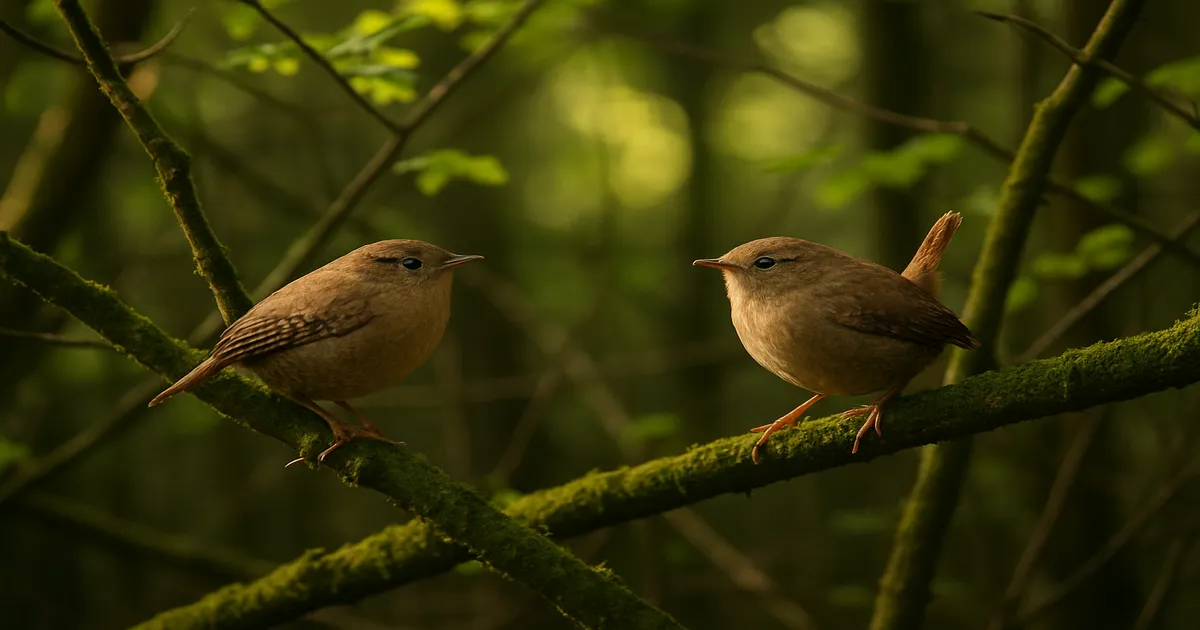
The body is unmistakably round, almost spherical. The tail is short and almost always cocked sharply upright — sometimes nearly perpendicular to the body — and that posture is your first clue you’re dealing with a wren at all. Add a slender, slightly decurved bill and strong legs built for scrambling through tangles, and you’ve got a bird that looks purpose-built to disappear into the undergrowth.
A good pair of close-focusing binoculars makes a real difference with these birds. (Nikon Monarch M5 8x42) They move fast and stay low, and you’ll want every millimeter of magnification you can get.
Why These Birds Fool Even Experienced Birders
Both species wear the same basic outfit: warm brown upperparts, buff to pale brown underparts with a rufous wash on the flanks, and heavy dark barring on the wings, flanks, belly, and tail. There’s a pale buff supercilium above a faintly darker eye stripe, and the throat and breast are noticeably paler than the sides.
Show a photograph of either bird to a skilled birder without range context, and the honest answer is usually “wren species, location unknown.” That’s not a failure of skill — it’s just the reality of this identification problem.
Subtle Plumage Differences
Pacific Wren tends to run darker and more richly colored, with deeper rufous-brown tones on the flanks and upperparts. Winter Wren is slightly paler overall, with a grayer-brown cast — most noticeable on the face and underparts. Pacific Wren also often shows a slightly more prominent and contrasting pale supercilium.
These differences are real, but treat them as supporting evidence rather than a verdict. Individual variation overlaps considerably, and the dark forest understory where these birds live will play tricks on your perception of color.
Males, Females, and Juveniles
Both species are monomorphic — males and females look identical in the field. There’s no plumage-based way to sex either species without a bird in hand.
Juveniles resemble adults but show slightly less crisp barring, a softer supercilium, and a buffer overall tone before their first molt in late summer. By fall, young-of-the-year birds are close enough to adult plumage that it rarely matters for identification.
Song and Calls: How to Identify Winter Wren vs Pacific Wren by Ear
Winter Wren Song
Winter Wren’s song is one of the more remarkable sounds in eastern North American forests — a long, rapid cascade of trills, warbles, and musical phrases that typically runs 5–10 seconds per bout. Compared to Pacific Wren, it’s slightly lower-pitched, with clearer, more distinct notes scattered through the performance. Birders often describe it as “bubbling” or “bell-like.” For a bird the size of a large moth, the volume is almost absurd.
Pacific Wren Song
Pacific Wren’s song covers similar ground — long, complex, rapid — but the texture is different. It runs higher in pitch and has a buzzier, less musical quality. Some birders describe it as slightly insect-like. The phrases tend to run together more rapidly, giving the overall song a more compressed feel compared to Winter Wren’s slightly more deliberate cascade.
Once you’ve heard both species back-to-back, the difference becomes fairly intuitive. Getting to that point takes deliberate listening practice — the Macaulay Library at Cornell Lab of Ornithology is the best place to start.
Call Notes
Both species give a sharp “chimp” or “chep” call, often doubled. Pacific Wren’s call is sometimes described as slightly softer or more liquid, but I wouldn’t stake an identification on call notes alone without supporting evidence. The calls are just too similar. When alarmed, both species produce a rapid rattling chatter that’s easier to recognize as “wren” than to assign to species.
Using Spectrograms and Audio Tools
In the overlap zone — or any time you’re uncertain — record what you’re hearing and compare it against the Macaulay Library. The Merlin Bird ID app has Sound ID built in and works well for these species in the field. Spectrograms are the gold standard when you need certainty; the visual difference between the two songs is clear enough that a spectrogram comparison will resolve most ambiguous recordings.
Range and Habitat
Winter Wren Range
Winter Wren breeds across eastern North America — from the Atlantic coast west through the Great Lakes and into the northern Great Plains, and north through Canada from Newfoundland to Manitoba. It also breeds in the Appalachian Mountains south into Tennessee and North Carolina, where cool, moist forest persists at higher elevations. In winter, northern populations move south and east across the southeastern United States, with some birds remaining year-round in the northern Appalachians and New England.
Pacific Wren Range
Pacific Wren occupies the western side of the continent, from Alaska (including the Aleutian and Kodiak Islands) south through coastal British Columbia, Washington, Oregon, and California, with inland populations along the Cascades, Sierra Nevada, and northern Rockies into Idaho and Montana. Coastal populations are largely year-round residents. Interior and high-elevation birds shift downslope in winter rather than making long-distance migrations.
The Overlap Zone
The two species meet in a relatively narrow band across Montana, Wyoming, and southern Alberta and Saskatchewan. This is where identification gets genuinely difficult, and where voice becomes non-negotiable. Hybridization has been documented in this zone but appears to be uncommon. Check eBird before you go — recent sightings will tell you which species is more likely at your specific location.
Preferred Habitats
Both species favor dense, moist forest with abundant fallen logs, root tangles, and deep leaf litter. Stream edges within forest are particularly productive.
Pacific Wren is more strictly tied to old-growth and structurally complex coniferous forest — particularly Sitka spruce (Picea sitchensis), western hemlock (Tsuga heterophylla), Douglas fir (Pseudotsuga menziesii), and western red cedar (Thuja plicata). It’s considered an indicator species for old-growth forest health in the Pacific Northwest. Winter Wren favors hemlock and spruce forests in the north and Appalachians but is somewhat more flexible in habitat, especially during winter.
Behavior, Nesting, and Seasonal Patterns
Foraging Style
Watch one of these birds forage and “mousy” is the word that comes to mind. They creep and scramble through logs, root tangles, stream banks, and leaf litter — rarely more than a foot or two off the ground — probing their slender bills into crevices, bark, and wet moss. They’ll cling to vertical surfaces, work along the undersides of logs, and occasionally dart out to snag a flying insect, but mostly they move through cover like small, feathered rodents.
Territorial Behavior and Nesting
Male wrens of both species are aggressively territorial during breeding season, defending areas of roughly 1–5 acres with persistent, far-carrying song. Both species are polygynous — a single male may mate with two or more females within his territory.
Males also build multiple domed “dummy” nests within their territory. Females inspect them before selecting one for actual egg-laying. It’s an unusual system that puts a lot of construction work on the male.
Winter Wren nests May through July across most of its range, slightly earlier in the southern Appalachians. Pacific Wren runs April through July, with coastal lowland birds starting earlier. Both species build domed moss nests with side entrances, placed in cavities, root tangles, under overhanging banks, or among fallen old-growth logs. Clutches run 5–7 white eggs with fine reddish-brown spotting. Incubation takes 14–16 days, nestlings fledge around 15–18 days after hatching, and most pairs attempt 1–2 broods per season.
Communal Roosting in Cold Weather
Both species are largely solitary outside of breeding season, but cold weather changes things. When temperatures drop, Winter Wrens in particular are known to crowd into cavities, nest boxes, or dense thickets — sometimes a dozen or more birds piling together to share body heat. It’s a striking behavior for a species that spends most of the year aggressively defending its own space.
Diet and Attracting Wrens
What They Eat
Both species are committed insectivores. Their diet includes beetles, flies and fly larvae, spiders, ants, caterpillars, millipedes, small earthworms, and springtails — the last of which becomes especially important in cold weather when larger insects are scarce. They can find invertebrates under snow, which is a genuinely impressive trick for a bird weighing less than a quarter.
Seeds and fruit show up occasionally in winter records, but neither species is going to show up at your sunflower feeder.
Attracting Wrens to Your Yard
Neither species is a typical feeder bird. Your best shot is suet — crumbled or in a low-mounted cage feeder placed near brush or a log pile. Dried mealworms placed on or near the ground can also work, particularly if wrens are already moving through your yard.
Habitat matters far more than feeders for these species. If you want to draw either wren in:
- Brush piles — the bigger and messier, the better
- Log stacks or woody debris left on the ground
- Dense shrubby cover near the ground, especially near a woodland edge
- A ground-level water source — a shallow dripper or basin near cover (Allied Precision Industries Heated Bird Bath Model 965)
- Leaf litter left undisturbed through winter
Pacific Wren is more strictly tied to mature forest and is genuinely unlikely to appear in a suburban yard. Winter Wren is somewhat more flexible, especially in winter, and shows up in brushy riparian areas and wooded backyards with some regularity.
Field Tips for Finding and Identifying Both Species
Best Times and Places
For Winter Wren, focus on eastern hemlock and spruce forests, especially along streams in the Appalachians. In winter, check brushy riparian corridors and dense thickets across the southeastern US. For Pacific Wren, old-growth coniferous forest in the Pacific Northwest is the target — look along stream corridors where the understory is densest.
Dawn is the best time for both. Males begin singing early, and song carries well in still morning air.
A good regional field guide is worth having in your pack. (Sibley’s Birds of North America (Second Edition))
Getting Good Views of a Secretive Bird
Don’t chase these birds. Find a spot near a fallen log or root tangle, stand still, and wait. They’ll often work their way into view on their own if you’re patient. Scan low — knee height and below is where most of the action happens.
“Pishing” can pull them into view, but use it sparingly. These birds are highly responsive, and overdoing it during breeding season causes real stress. A brief pish, then patience.
Ethical Birding
Skip the audio playback during breeding season. Both species respond aggressively to recordings of their own song — which means prolonged playback pulls males away from nesting duties and stresses birds that have better things to do. A brief listen to confirm identification is one thing; running a recording on repeat to get better photos is another.
Frequently Asked Questions
Are Winter Wren and Pacific Wren the same species?
No. They were considered the same species until 2010, when the American Ornithological Society split them based on genetic, morphological, and vocal evidence. Winter Wren (Troglodytes hiemalis) occupies eastern North America; Pacific Wren (Troglodytes pacificus) is found in the West. They look nearly identical but are genetically and vocally distinct.
How do you tell a Winter Wren from a Pacific Wren by song?
Winter Wren’s song is lower-pitched, more musical, and has clearer, more distinct notes with a cascading, bell-like quality. Pacific Wren’s song is higher-pitched, buzzier, and more rapid, with phrases that run together in a way some describe as slightly insect-like. Compare recordings on the Macaulay Library or use Merlin Sound ID — a few listens back-to-back and the difference clicks.
Where do Winter Wren and Pacific Wren ranges overlap?
The two species overlap in a relatively narrow zone in the northern Rocky Mountains and adjacent Great Plains — primarily Montana, Wyoming, and southern Alberta and Saskatchewan. In this area, voice is the essential identification tool. Hybridization has been documented but is uncommon.
What is the easiest way to identify a wren in the field?
The cocked tail is your first clue — both species hold their short tails sharply upright, which immediately marks them as wrens. From there, song is the most reliable tool for separating Winter Wren from Pacific Wren. If you can’t hear them singing, range context will resolve most encounters outside the overlap zone.
Do Winter Wrens and Pacific Wrens have any conservation concerns?
Neither species is currently listed as threatened or endangered. Both are listed as Least Concern by the IUCN. Pacific Wren’s dependence on old-growth forest makes it more sensitive to logging and habitat fragmentation in the Pacific Northwest, and it is sometimes used as an indicator species for old-growth forest health. Winter Wren populations appear stable across most of its range, though long-term monitoring through programs like the Breeding Bird Survey continues to track both species.