Quick Answer: The Willow Warbler (Phylloscopus trochilus) breeds across a vast Palearctic range — from Ireland east to Siberia — favouring open woodland edges, birch and willow scrub, heathland, and riparian corridors. It winters in sub-Saharan Africa and ranks among Europe’s most abundant migratory songbirds. It does not occur naturally in North America. The Chiffchaff (Phylloscopus collybita) is its closest look-alike; pale flesh-pink legs on the Willow Warbler are the quickest separator.
Willow Warbler Habitat at a Glance
The Willow Warbler is a Palearctic species, not a North American bird. If you’re reading this from the US or Canada, you’re probably planning a trip to Europe, studying the species, or simply curious. All perfectly valid. This guide covers habitat, identification, behaviour, and where to find one.
What Does a Willow Warbler Look Like?
Size, Shape, and Structure
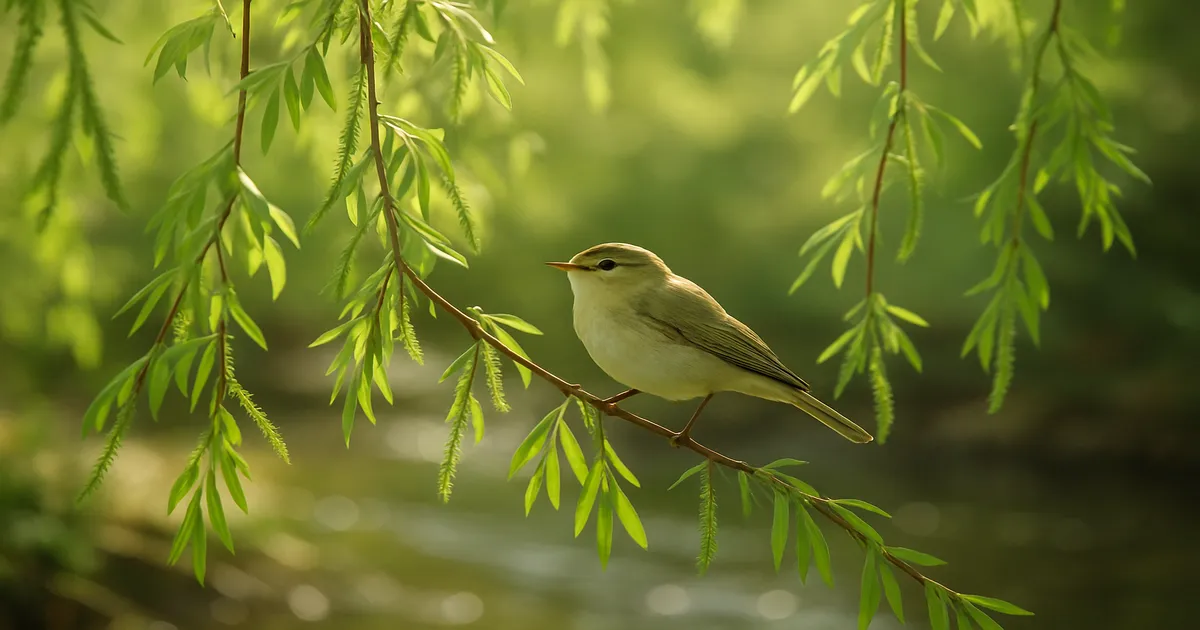
The Willow Warbler is a small, slender leaf warbler — about 4.5–5 inches (11–13 cm) long with a wingspan of roughly 6.7–7.9 inches (17–20 cm). Spring birds weigh as little as 0.25 oz (7 g), though pre-migratory individuals can nearly double that. A fine pointed bill and notably long primary projection give it a stretched, elegant look. It also has a habit of gently flicking its tail downward while perched — a useful behavioural cue before you’ve even clocked the plumage.
Plumage and Key Field Marks
- Upperparts: Olive-green to brownish-green, wearing warmer and browner by late summer
- Underparts: Pale yellowish-white with a soft yellow wash across the breast
- Supercilium: Prominent, clean, and often yellowish — one of the best field marks
- Eye stripe: A faint dusky line through the eye, contrasting with the supercilium above
- Legs: Pale flesh-pink — the single most reliable field mark
- Wing bars: None
Juveniles in fresh autumn plumage are noticeably more saturated yellow below, sometimes startlingly so compared to worn adults. Males and females are essentially identical in the field.
Willow Warbler vs. Chiffchaff
These two species overlap extensively in range and habitat, and silent birds test even experienced birders. Learn the differences before you go looking.
| Feature | Willow Warbler | Chiffchaff |
|---|---|---|
| Leg colour | Pale flesh-pink | Dark blackish |
| Supercilium | Prominent, often yellowish | Less distinct |
| Underparts | Clean pale yellow-white | Dirtier buff/brown-tinged |
| Primary projection | Longer | Shorter |
| Song | Cascading liquid descending phrase | Repetitive “chiff-chaff” two-note |
| Call | Soft hoo-eet | Sharper hweet |
Leg colour is the shortcut. Dark legs mean Chiffchaff; pale pink legs mean Willow Warbler. Song is completely diagnostic and the fastest separator in the field.
Other Similar Species
The Wood Warbler (Phylloscopus sibilatrix) is larger and bolder, with a vivid yellow throat contrasting against a pure white belly. The Arctic Warbler (Phylloscopus borealis) overlaps with Willow Warbler in parts of Siberia and shows a single prominent wing bar — the Willow Warbler has none. The Greenish Warbler (Phylloscopus trochiloides) also shows a faint wing bar and has a distinctive sharp pee-wee call. Neither Arctic nor Greenish is something you’ll encounter on a typical UK trip, but worth knowing if you’re heading further east.
A good field guide is invaluable for working through the Phylloscopus complex.
Willow Warbler Habitat: Where This Species Lives and Breeds
Core Breeding Habitat
This is the heart of the matter. The Willow Warbler is a bird of edges and structure. It doesn’t want dense closed-canopy forest, and it doesn’t want bare open ground. It needs a mosaic: low scrub, taller shrubs, scattered trees, and patches of open ground all within the same territory.
Classic willow warbler habitat includes:
- Open woodland edges where trees thin out into scrub
- Birch and willow scrub — young regenerating birchwood after disturbance is prime real estate
- Tall, dense hedgerows with adjacent rough grassland in lowland Britain and Ireland
- Garden edges and park margins where scrubby vegetation is present
The link between the bird’s name and its habitat is genuine. Riparian willows were clearly part of the original picture when the common name was coined.
Riparian and Scrub Habitats
Riverside corridors are strongly favoured. Willows, alders, and mixed scrub along streams and river margins tick all the right boxes. A small upland stream with willows leaning over the bank and rough grassland behind is about as good as it gets. Tall hedgerow systems with rough margins matter too, particularly in lowland agricultural landscapes — and their loss across much of lowland England over the past 50 years goes a long way toward explaining the population declines there.
Heathland, Upland, and Plantation Habitats
Heathland fringed with birch, gorse, or bracken is excellent willow warbler habitat, particularly in Scotland and northern England. Bracken-covered upland hillsides with scattered rowan, birch, and willow are heavily used — some of my most memorable encounters with singing males have been on Scottish hillsides where scrub gives way to open moorland.
Young conifer plantations before canopy closure are also actively colonised. Once the canopy shuts and ground vegetation dies out, the birds move on. The trees are still there, but the habitat has changed structurally, and that’s what counts.
Elevation and Habitat Mosaic
The species breeds from sea level up to around 6,500 feet (2,000 m) in suitable mountain scrub. In the Alps and Scandinavian fells, it occupies the scrub zone below the treeline. Altitude itself isn’t the limiting factor — structural variety is.
Wintering Habitat in Sub-Saharan Africa
On the wintering grounds, Willow Warblers use woodland savanna, miombo woodland, and forest edges across West, East, and southern Africa. They consistently avoid the dense interior of closed-canopy rainforest. The preference for structural variety and woodland edge mirrors the breeding habitat almost exactly.
Geographic Range and Migration
Breeding Range
The Willow Warbler has one of the largest breeding ranges of any Palearctic passerine — stretching from Ireland eastward across Europe and Asia to the Anadyr River basin in far eastern Siberia, a span of roughly 10,000 miles (16,000 km). Global population estimates run into the hundreds of millions. This species does not occur naturally in North America; vagrant records are exceptionally rare.
Migration Routes and Timing
The Willow Warbler is strictly migratory — no population winters in the breeding range. Adults begin departing from late July, making this one of the earliest autumn migrants through Britain. Juveniles follow through August and September, with most birds clear of Europe by October.
Western populations migrate on a broadly southwest-to-southeast axis, crossing Iberia and the western Sahara into West Africa. Spring arrival varies by latitude: southern Britain from late March, the bulk of the UK from mid-April, Scandinavia from late April through May, and Siberia not until late May or June.
Coastal migration watchpoints are the best places to witness the movement. Fair Isle (Shetland) is outstanding for both spring and autumn migrants; Dungeness (Kent) is excellent in autumn; Cape Clear (County Cork) is superb for westerly migrants. A compact, waterproof notebook is worth having at these sites — passage can be fast and you’ll want to log what you see.
Behaviour, Diet, and Breeding
Foraging
The Willow Warbler forages actively through the outer canopy and shrub layer, picking insects from leaf surfaces, stems, and buds — typically within 3–15 feet (1–5 m) of the ground during the breeding season. It hover-gleans frequently and occasionally makes short aerial sallies after flying insects. This foraging style is why habitat structure matters so much: the bird needs dense, insect-rich outer foliage within reach.
Song and Calls
The song is one of the finest sounds in European ornithology — a cascading, liquid phrase that descends in pitch and tempo, each repetition slightly different from the last. Once you know it, you’ll hear it everywhere in April and May. The call is a soft, disyllabic hoo-eet, subtly different from the Chiffchaff’s sharper hweet. Males arrive before females and defend territories of 0.5–2.5 acres (0.2–1 ha) through persistent song, with peak activity in the first two hours after dawn.
Nesting
The nest is a domed structure built on or very near the ground, tucked into a grass tussock, bracken clump, or low vegetation. Clutch size is typically 4–8 eggs (commonly 6), with incubation lasting around 13 days. Young fledge at 13–16 days. Two broods are possible in the southern part of the range; northern populations typically raise one.
Diet and Pre-Migration Hyperphagia
The diet is overwhelmingly insectivorous: small caterpillars, aphids, flies, beetles, spiders, and gnats. Fruit — particularly elderberries — is taken opportunistically during autumn migration, and nectar has been recorded on the African wintering grounds.
Before autumn migration, Willow Warblers enter hyperphagia, laying down fat reserves that can nearly double their body weight. A bird weighing 0.28 oz (8 g) in summer might reach 0.46 oz (13 g) before departure — a physiological transformation that underpins one of the most impressive migrations of any small European bird.
Will Willow Warblers Visit Garden Feeders?
Don’t expect one at your peanut feeder. The Willow Warbler is insectivorous and has no interest in seeds, nuts, or fat balls. If a migrant does pass through your garden, the best options are live or dried mealworms in an open dish at ground level , small soft berries, or open-dish suet insect mixes placed low. Insectivorous warblers want open access and low presentation — tube feeders with ports are useless to them.
If you genuinely want Willow Warblers on your land, habitat management is what matters. Let hedgerows grow tall and dense — a neatly trimmed 3-foot hedge is no use to them. Plant native willows and birches where space allows. Leave bracken and rough grass patches as potential nest sites. Reduce deer browsing pressure if you’re managing woodland, since deer suppress the shrub layer Willow Warblers depend on. Coppice restoration and scrub management on a larger scale are among the most impactful things landowners can do for this species.
Conservation Status and Population Trends
The Willow Warbler is listed as Least Concern by the IUCN globally, with a population in the hundreds of millions. The UK picture is more concerning: the species sits on the Amber List of Birds of Conservation Concern in Britain, reflecting significant declines in lowland England since the 1970s. Scottish and Scandinavian populations are holding up considerably better, which suggests the problem is tied to specific changes in lowland British landscapes rather than a range-wide collapse.
Key threats include loss of scrubby woodland edge and hedgerow removal, maturation of young plantations into closed-canopy forest, deer overgrazing, agricultural intensification, habitat degradation along migration routes and on African wintering grounds, phenological mismatch as climate change shifts insect emergence relative to the nestling period, and ground-nest predation by foxes, corvids, and mustelids.
Agri-environment schemes promoting scrub retention, hedgerow management, and woodland edge creation are the most direct interventions. Research into the African wintering ecology of different breeding populations is ongoing and should eventually clarify whether declines are being driven primarily by breeding-ground changes or pressures further along the annual cycle.
Where and When to See Willow Warblers
Late April through June is the sweet spot. Males sing persistently, territories are established, and the vegetation hasn’t yet become so dense that birds vanish into the canopy. Get out early — peak song activity is in the first two hours after dawn, and a still May morning with a singing Willow Warbler in birch scrub is hard to beat.
For autumn birding, August and September offer excellent views of juvenile migrants at coastal scrub sites. Birds can be remarkably confiding during migration, and the brighter yellow tones of fresh juveniles make them easier to pick out than worn summer adults.
Best habitats to search: birch and willow scrub (especially regenerating woodland after disturbance), heathland edges with scattered trees and bracken, riverside willows and alder carr, young plantation edges before canopy closure, upland bracken hillsides with scattered rowan and birch, and coastal scrub during migration.
Top UK sites: the Scottish uplands — Speyside, Deeside, and the Galloway hills — hold strong populations. For migration, Fair Isle, Dungeness, and Cape Clear are outstanding. In spring, almost any patch of suitable scrub in lowland Britain will hold singing birds, but coastal headlands concentrate migrants in a way that makes observation much easier.
A quality pair of binoculars is essential for picking out leg colour and supercilium detail in scrubby vegetation. (Swarovski EL 8x42) When you’re looking at a silent bird, check the legs first, assess the supercilium, then look at primary projection. Willow Warblers’ wings look noticeably longer than a Chiffchaff’s — a reflection of the long-distance migration they’re built for. And if you’re still unsure, wait for the bird to call.
Frequently Asked Questions
Where does the Willow Warbler live? The Willow Warbler breeds across the Palearctic, from Ireland and Britain east to Siberia, in open woodland edges, birch and willow scrub, heathland, and riparian corridors. In winter it moves to sub-Saharan Africa, favouring woodland savanna and forest edges.
What is the best habitat for Willow Warblers in the UK? Birch and willow scrub, heathland with scattered trees, tall hedgerows with rough margins, and young woodland edges before canopy closure. The Scottish uplands hold some of the strongest UK populations.
How do I tell a Willow Warbler from a Chiffchaff? Check the legs first. Pale flesh-pink legs mean Willow Warbler; dark blackish legs mean Chiffchaff. The Willow Warbler also has a bolder, more yellowish supercilium and longer primary projection. Song is the fastest separator: the Willow Warbler’s cascading liquid phrase is nothing like the Chiffchaff’s repetitive two-note call.
When do Willow Warblers arrive in the UK? The first birds reach southern Britain from late March, with the main arrival across the UK in mid-April. Northern Scotland and Scandinavia receive birds from late April through May. Most have left by October.
Are Willow Warblers in decline? Globally, no — the species is Least Concern with a population in the hundreds of millions. In lowland England, yes. UK populations have declined significantly since the 1970s, largely due to loss of scrubby woodland edge, hedgerow removal, and deer overgrazing. Scottish populations remain relatively stable.