Quick Answer: The name is always spelled Pileated Woodpecker — there’s no alternate spelling. The real question is pronunciation: both “PIE-lee-ay-ted” and “PIL-ee-ay-ted” are accepted by ornithologists and the Cornell Lab of Ornithology, so either way you say it, you’re right. This crow-sized, red-crested bird is the largest woodpecker in North America and one of the most dramatic things you’ll ever encounter in a North American forest.
Is It “Pileated” or “Pileated” Woodpecker?
The question “is it pileated woodpecker or pileated woodpecker” trips up birders at every level, and the answer is genuinely satisfying: you’re already right, whichever way you say it.
The word comes from the Latin pileatus, meaning “capped” or “wearing a cap” — a direct nod to that flaming red crest. Latin pronunciation rules pull the word one way, anglicized scientific English pulls it another, and neither camp has ever won the argument. Cornell’s own ornithologists use both pronunciations, often in the same conversation. I’ve heard seasoned field biologists correct each other in both directions, which tells you everything you need to know. Pick the one that feels natural and move on.
Pileated Woodpecker Identification: Key Field Marks
Once you’ve seen a Pileated Woodpecker (Dryocopus pileatus), you won’t confuse it with much. This bird is enormous, loud, and built like something out of the Cretaceous.
Size and Overall Appearance
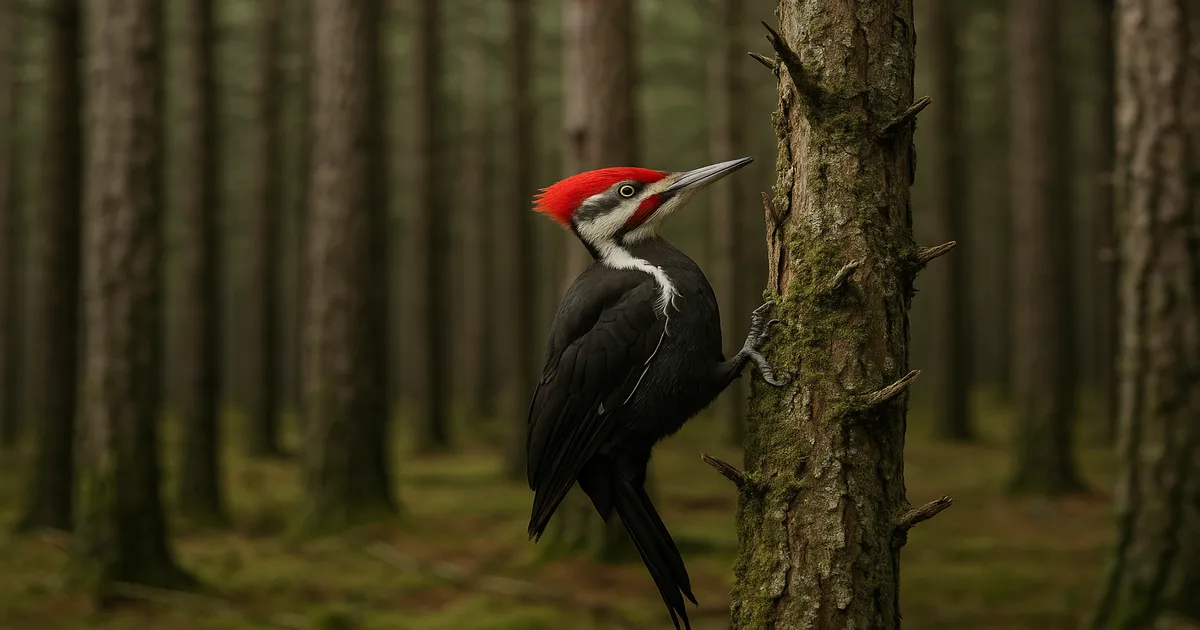
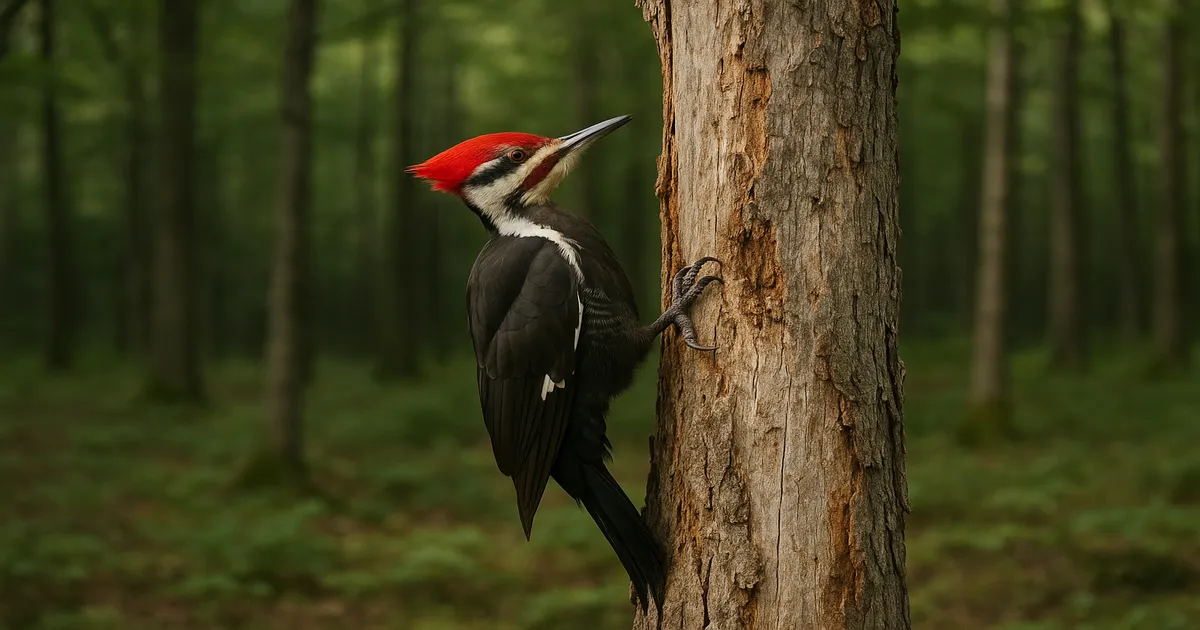
At 16–19 inches (40–49 cm) long with a wingspan of 26–30 inches (66–76 cm) and a weight of 8.8–12.3 oz (250–350 g), this is a crow-sized woodpecker — and it feels every bit that big when one lands nearby. The body is predominantly glossy black with bold white stripes running from the bill down the neck and onto the sides of the breast. The bill is a long, chisel-like pale ivory — roughly 1.5–2 inches (3.8–5 cm) of pure excavating power. Pale yellow eyes give the bird a striking, almost prehistoric expression.
The Red Crest
That brilliant red crest is the field mark. It’s tall, pointed, and — when the bird is agitated or displaying — raised into a blazing flame of color. The white neck stripes contrast sharply with the black body at any distance. In flight, large white patches flash on the underwings, making the bird unmistakable even as it disappears into the canopy.
A good pair of binoculars makes all the difference when you’re picking out these details at distance. (Nikon Monarch M5 8x42)
Male vs. Female vs. Juvenile
The sexes are straightforward once you know what to look for:
| Feature | Male | Female | Juvenile |
|---|---|---|---|
| Red crest | Full red, extends to forehead | Full red, stops short of forehead (brownish-black forehead) | Shorter, duller |
| Malar stripe | Red | Black | Less defined |
| Body plumage | Glossy black | Glossy black | Browner wash |
| Eye color | Pale yellow | Pale yellow | Grayish-brown initially |
Juveniles look like washed-out adults — browner overall, with a less vivid crest. By their first fall they’re close to adult appearance, but the malar stripe rule still applies for sexing them.
What to Look for in Flight
The flight style is distinctive: deep, rowing wingbeats with a slight rise-and-fall rhythm, more powerful and less undulating than smaller woodpeckers. Those white underwing patches flash with every stroke. If you see a large, mostly black bird crossing a forest opening and it looks like it’s actively hauling itself through the air, that’s your bird.
Pileated Woodpecker Calls and Sounds
You’ll usually hear a Pileated before you see one. The call carries an absurd distance through forest.
The Laughing Call
The primary call is a loud, wild, rising-and-falling kuk-kuk-kuk-kuk — irregular in rhythm, almost hysterical in quality. It’s the sound that inspired the Woody Woodpecker cartoon, and once you know that, the resemblance is impossible to un-hear. I describe it to new birders as a maniacal laugh echoing through the woods. That mnemonic hasn’t failed me yet.
Drumming
The drumming is slower and deeper than any other North American woodpecker — resonant rolls lasting 1–3 seconds on large dead wood. If you hear what sounds like someone knocking on a hollow door deep in the forest, go investigate. It’s a completely different sound from the rapid-fire hammering of a Downy or Hairy Woodpecker.
Contact and Alarm Calls
A single sharp kuk or cuk serves as an alarm note and contact call between mates. In flight, you’ll often hear a series of irregular wuk notes as the bird moves between trees. The Merlin Bird ID app has excellent recordings — worth a listen before your first field trip so the call is already in your head.
Habitat and Range: Where to Find Pileated Woodpeckers
Preferred Forest Types
Pileated Woodpeckers need big trees — specifically, mature or old-growth deciduous and mixed forests with large standing dead trees (snags) at least 12–24 inches (30–60 cm) in diameter. Without those snags, they can’t nest or forage effectively. They’ll also use riparian corridors, large wooded suburban parks, and maturing second-growth forest, as long as some old trees remain.
Geographic Range
This species doesn’t migrate — it’s a permanent resident wherever it lives. That range covers:
- Eastern U.S. and Canada — Atlantic Coast west to the Great Plains, south to northern Florida and the Gulf Coast
- Pacific Coast — northern California north through British Columbia to southeastern Alaska
- Rocky Mountain corridor — Idaho and Montana southward through suitable forest
The Great Plains, desert Southwest, and Arctic are all gaps in the range. Populations have expanded northward and into suburban areas as eastern forests have matured since the mid-20th century, so sightings in places that had none 40 years ago are increasingly common.
Signs of Pileated Activity
You don’t always need to see the bird itself. Look for:
- Rectangular excavations in dead trees — 3–8 inches (7–20 cm) wide, sometimes 24 inches (60 cm) deep
- Large piles of wood chips at the base of snags
- Irregular gouges at multiple heights on a single tree
Finding these signs in a woodlot is almost as exciting as the bird itself, and it confirms the species is actively using that area.
Behavior and Ecology
Foraging
The Pileated’s whole existence is organized around carpenter ants (Camponotus spp.), which make up an estimated 60% or more of its annual diet. It hammers rectangular cavities deep into decaying heartwood, then uses its extraordinarily long, barbed, sticky tongue to extract ants and larvae from galleries it couldn’t otherwise reach. Wood-boring beetle larvae (families Cerambycidae and Buprestidae) are a significant secondary food source, especially in winter when ants are less active. Come fall, Pileateds also supplement with elderberries, wild grape, poison ivy berries, dogwood fruits, acorns, and beechnuts.
Territory and Pair Bonds
Pairs are monogamous and maintain long-term bonds, defending territories of 100–200+ acres (40–80+ hectares) year-round through calling, drumming, and direct chasing. These are not sociable birds outside of their pair bond — don’t expect them at a mixed flock feeder station.
Nesting
Courtship ramps up from February through April. Both sexes excavate the nest cavity — typically in a large snag, 15–80 feet (4.5–24 m) up — with an entrance hole about 3.5 inches (9 cm) across. The female lays 3–5 white eggs, usually in March through May. Incubation runs 15–18 days, with the male taking night duty. Young fledge around June or July and stay with the parents through late summer before dispersing.
Ecological Role
Old Pileated cavities are some of the most valuable real estate in a forest. Wood Ducks (Aix sponsa), American Kestrels (Falco sparverius), Barred Owls, and other secondary cavity nesters depend on them — none of those species can excavate their own holes. The Pileated is one of the most ecologically important birds in North American forests, full stop.
Attracting Pileated Woodpeckers to Your Yard
Feeder visits are less frequent than from smaller woodpeckers, but when a Pileated shows up, it stays a while — a single bird can work a suet feeder for 30–60 minutes.
Suet is the clear winner. Plain beef suet or suet cakes containing nuts or insects are what you want. Skip nyjer, millet, and standard seed mixes entirely.
Feeder design matters as much as food. Pileated Woodpeckers must brace their stiff tail against a surface while feeding — that’s non-negotiable for this family. Use a large cage-style suet feeder with a tail-prop extension below the cage or a log-style feeder with suet plugs drilled into natural wood. Tube feeders simply don’t work for a bird this size.
Habitat beats hardware every time. Leave large dead trees standing if they’re not a safety hazard. Let fallen logs rot in place. Place feeders near the tree line rather than out in the open. If there are no Pileateds in the surrounding landscape, no feeder will bring them in — but if the birds are there, the right setup will eventually pay off.
Pileated Woodpecker vs. Similar Species
Ivory-billed Woodpecker
The Ivory-billed Woodpecker (Campephilus principalis) is almost certainly extinct — the last credible confirmed sighting was in 1944, and the U.S. Fish & Wildlife Service formally declared it extinct in 2023. The comparison still comes up, though. The Ivory-billed was slightly larger at 19–21 inches (48–53 cm), had a white bill, extensive white on the back when perched, and white secondary feathers forming a large trailing wing edge. The Pileated shows almost no white on the back when perched. The mnemonic I use: “The Lord God Bird has white on its back; the Pileated does not.” Their calls are also completely different — the Ivory-billed gave a distinctive kent note with a tin-trumpet quality, nothing like the Pileated’s laughing call.
American Crow
At a distance or in poor light, a flying Pileated can briefly suggest an American Crow (Corvus brachyrhynchos) — both are crow-sized and dark. But crows are all black with no red or white markings, have a thick curved bill rather than a chisel, and fly more steadily without those deep rowing wingbeats. The white underwing flash alone should end any confusion the moment you get a decent look.
Other Large Dark Birds
Double-crested Cormorants (Nannopterum auritum) occasionally cause confusion over water due to similar size and dark coloration. A cormorant flies with its neck extended and has a long hooked bill — a very different shape once you’re looking for it. No other living North American woodpecker comes close to the Pileated in size, so within that family, confusion really isn’t an issue.
Conservation Status and How You Can Help
The Pileated Woodpecker carries an IUCN Least Concern designation, and the North American Breeding Bird Survey shows a gradual population increase since the 1960s. Partners in Flight estimates roughly 2.6 million individuals continent-wide — a genuine rebound after severe declines caused by old-growth logging in the 19th and early 20th centuries.
The main ongoing threats are continued logging of mature forest (especially in the Pacific Northwest and boreal Canada), snag removal in managed forests and suburbs, and forest fragmentation. A few practical things make a real difference:
- Retain dead trees and snags on private land whenever safely possible
- Leave fallen logs to decay naturally
- Participate in eBird and the Christmas Bird Count — citizen science data directly informs conservation policy
- Install window collision deterrents on large glass surfaces near forest edges (WindowAlert UV Decals)
Frequently Asked Questions About Pileated Woodpeckers
How do you pronounce “pileated” in Pileated Woodpecker?
Both “PIE-lee-ay-ted” and “PIL-ee-ay-ted” are correct. Ornithologists and institutions including the Cornell Lab of Ornithology accept both. The word comes from the Latin pileatus, meaning “capped,” referring to the red crest. Use whichever feels natural — no one can legitimately correct you either way.
What is the largest woodpecker in North America?
The Pileated Woodpecker, at 16–19 inches (40–49 cm) long with a wingspan of 26–30 inches (66–76 cm). The Ivory-billed Woodpecker was slightly larger, but it is now considered extinct. No other living North American woodpecker comes close.
How do you tell a male Pileated Woodpecker from a female?
Look at the malar stripe — males have a red “mustache,” females have a black one. Males also have a fully red forehead; the female’s forehead is brownish-black even though her crest is otherwise red. Both sexes are otherwise very similar.
What does a Pileated Woodpecker sound like?
The primary call is a loud, laughing kuk-kuk-kuk-kuk that rises and falls in pitch — famously the inspiration for Woody Woodpecker. The drumming is slow, deep, and resonant, lasting 1–3 seconds. The Merlin Bird ID app has excellent recordings; hear it once and you’ll never forget it.
How do I attract a Pileated Woodpecker to my yard?
Suet in a large tail-prop or log-style feeder is your best bet — this species needs to brace its tail while feeding, so feeder design matters. Retaining large dead trees and snags is equally important. Proximity to mature forest is the single biggest factor; if Pileateds aren’t in the surrounding landscape, no feeder will bring them in.