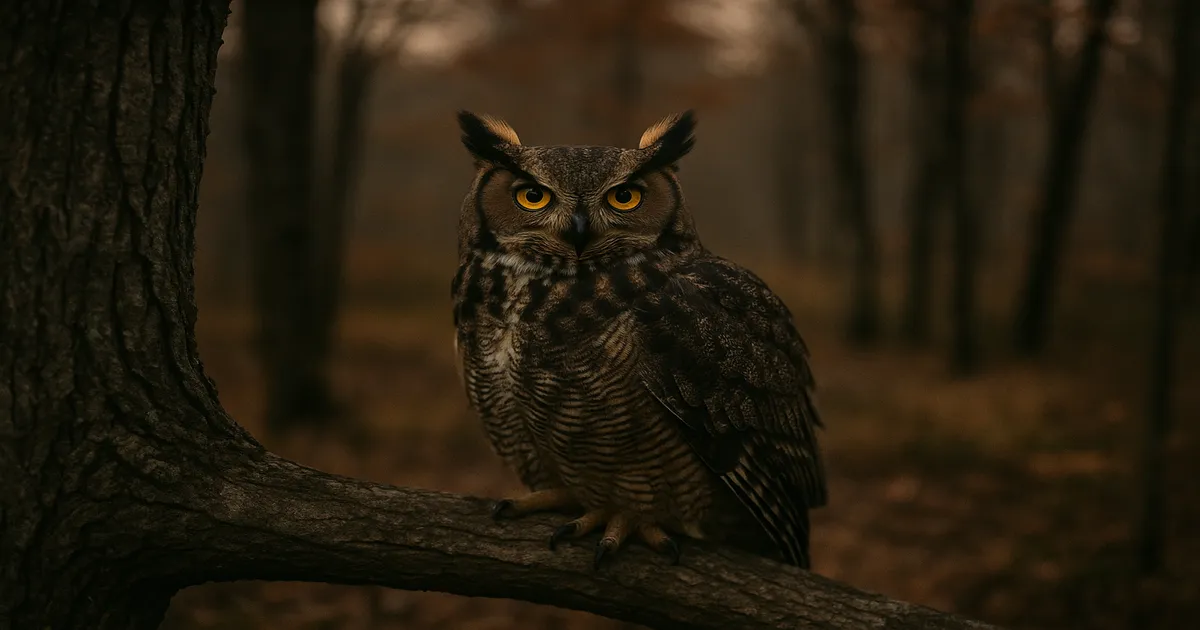
Quick Answer: The Great Horned Owl (Bubo virginianus) is identified by five unmistakable field marks: widely spaced ear tufts, large yellow-orange eyes, a rusty-brown facial disc with a dark border, a white throat patch, and heavily barred pale underparts. Adults measure 18–25 inches (46–63 cm) long with a wingspan of 36–60 inches (91–153 cm). It’s the most widely distributed true owl in the Americas and, once you know what to look for, one of the most satisfying birds to identify.
Great Horned Owl Identifying Characteristics at a Glance
The Five Field Marks to Know
You don’t need a field guide in hand to nail a Great Horned Owl identification — you need five things locked in memory:
- Widely spaced ear tufts — the “horns” that give it its name
- Large, piercing yellow-orange eyes — forward-facing and almost luminous
- Rusty-brown facial disc with a bold dark border — frames the face like a mask
- White throat patch — the “bib” visible even at distance
- Heavily barred pale underparts — fine, regular horizontal dark barring across the breast and belly
Get comfortable with these and you’ll have a confident ID in seconds, even in poor light. A good pair of binoculars makes all the difference when you’re picking out a distant bird in a dark tree. (Nikon Monarch M5 8x42)
How Big Is a Great Horned Owl?
Big. Genuinely big. Adults run 18–25 inches (46–63 cm) from bill to tail, with a wingspan of 36–60 inches (91–153 cm). That’s a bird that can look startlingly large on a fence post at dusk. The wide size range reflects real geographic variation — more on that in the subspecies section.
Physical Field Marks: A Head-to-Toe Identification Guide
Ear Tufts: The Signature “Horns”
Those dramatic feather clusters on top of the head aren’t ears — they’re called plumicorns, elongated feather tufts with no role in hearing. What makes them diagnostic isn’t just their presence but their placement: they sit wide apart, near the outer edges of the head. That wide spacing is what separates a Great Horned Owl from a Long-eared Owl (Asio otus), which has tufts set close together near the center of the crown.
One thing to watch for: in flight, or when the bird is alarmed and pressing flat against a branch, those tufts lie down completely. A perched bird in a defensive posture can look almost tuftless at a glance.
Eyes, Bill, and Facial Disc
The eyes are large, fixed, and blazing yellow-orange. Because the eye sockets are rigid, the owl can’t shift its gaze the way we can — instead, it rotates its entire head up to 270 degrees, which is both eerie and impressive to watch.
The facial disc is rich rusty-brown to warm buff, sharply edged with a dark brown to blackish border that acts like a picture frame. The bill is short, strongly hooked, and dark, but you’ll rarely notice it because it tucks neatly into the surrounding facial feathers.
White Throat Patch
The white bib is underrated as a field mark. It’s often the first thing I pick up on a distant bird in a dark tree — that small, bright rectangular patch of white pops against the mottled brown plumage. During vocalizations, the bird puffs it out dramatically, making it even more visible.
Upperpart and Underpart Plumage
The upperparts are a cryptic mix of brown, gray, black, and buff — mottled and barred in a pattern that mimics tree bark almost perfectly. A roosting Great Horned Owl pressed against a rough-barked trunk can be genuinely hard to spot, even when you know it’s there.
The underparts are different: pale whitish to buff with fine, regular horizontal dark barring across the breast and belly. This barring is more organized than the broken pattern above, which helps when you get a look at a perched bird’s front.
Legs, Feet, and Talons
The legs are fully feathered down to the base of the talons — that classic “fluffy pants” look. The talons themselves are massive and dark. Great Horned Owls can exert grip forces exceeding 300 pounds per square inch, which is why they can take prey considerably larger than themselves, including skunks, herons, and other raptors.
Tail and Wing Shape in Flight
In flight, look for broad, rounded wings — this is not a falcon silhouette. The tail is relatively short and barred with alternating pale and dark bands. The ear tufts flatten in flight, giving the bird a large-headed, almost neckless profile. Wingbeats are deep and deliberate, with occasional glides. Despite the size, the flight looks surprisingly buoyant.
Geographic Variation and Subspecies
Key Regional Forms
Great Horned Owls vary noticeably across their range, but the core great horned owl identifying characteristics stay consistent. Here’s what changes:
- Pacific Northwest birds (B. v. saturatus) run sooty and dark overall — the facial disc is deeper, the upperparts heavily saturated. An adaptation to dense, shadowed coastal forests.
- Great Plains and interior West birds (B. v. pallescens) are noticeably paler — washed-out gray and buff tones replace the warm browns, suiting the open, arid landscapes.
- Subarctic birds (B. v. subarcticus) can appear nearly white with pale gray barring. At a distance, they can briefly suggest a Snowy Owl (Bubo scandiacus). The key differences: Great Horneds still show ear tufts, yellow-orange eyes, and the characteristic facial disc. Snowy Owls have a rounder head, no tufts, and yellow (not orange) eyes.
- Eastern and southern birds are the classic warm rufous-brown form most North American birders know — rich tones, a deeply rusty facial disc, and crisp barring below.
Juvenile vs. Adult: Identifying Great Horned Owls by Age
What Young Birds Look Like
Hatchlings are covered in white down — nothing like the imposing adults they’ll become. By 4–5 weeks, a second coat of grayish-brown down appears with early feather development visible on the wings. At fledging around 9–10 weeks, the bird is a work in progress: retained down tufts mix with emerging contour feathers, giving the whole bird a disheveled, half-finished look.
How Juveniles Differ from Adults in the Field
A few reliable differences:
- Facial disc: Less sharply defined — the dark border is softer and less crisp
- Ear tufts: Present, but shorter and less dramatic than adults
- Overall texture: Messy, uneven plumage persists through the first winter, which is genuinely useful for aging birds
- Behavior: Juveniles turn up in odd places — roadsides, suburban yards — as they disperse from natal territories in late summer and fall
Male vs. Female: Size and Voice
Reverse Sexual Dimorphism
Male and female Great Horned Owls are identical in plumage — same pattern, same colors, no way to tell them apart visually. But females are substantially larger, running 10–40% heavier than males on average. Females typically weigh 2.5–5.5 lbs (1,140–2,500 g); males come in at 2.0–3.5 lbs (910–1,600 g). The size difference is visible when a pair perches together, but it’s a tricky call on a solo bird without a reference point.
Using Voice to Tell the Sexes Apart
Voice is the cleaner separator. The male produces a deeper, more resonant hoot; the female’s is pitched slightly higher. During the late-winter courtship duet — one of the great sounds of a clear February night — you can hear both birds calling back and forth, and the pitch difference is obvious once you’re listening for it. If you hear what sounds like two owls hooting together and one is noticeably lower, you’re hearing a mated pair, and the lower voice belongs to the male.
Calls and Vocalizations: Identifying Great Horned Owls by Sound
The Classic Territorial Hoot
The territorial hoot runs 4–5 syllables, deep and resonant: hoo-hoo-hoooooo hoo-hoo. The mnemonic “Who’s awake? Me too” captures the rhythm reasonably well. The middle notes often drop slightly in pitch, giving it a characteristic shape. It carries remarkably far on a still night — I’ve heard birds calling from well over half a mile away.
Duetting Pairs and Courtship Calling
From November through February, mated pairs duet frequently. The male calls, the female answers — sometimes overlapping — and the pitch contrast between them is the fastest way to confirm you’re hearing two birds rather than one. This is the best time of year to detect the species by ear, and one of the most atmospheric experiences in North American birding.
Alarm Calls, Bill-Clapping, and Juvenile Screech
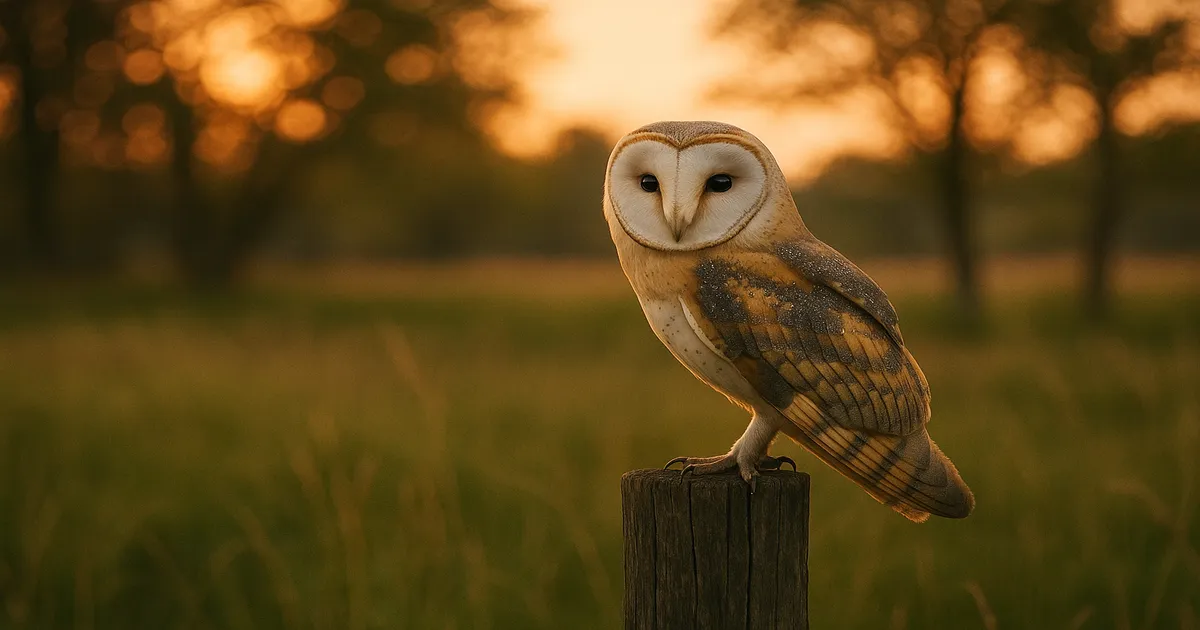
Disturbed birds produce a rapid series of barks and shrieks — nothing like the territorial hoot. Bill-clapping (a sharp, percussive snap) signals serious agitation. The juvenile screech is completely different: raspy, hissing, almost steam-kettle-like. It’s regularly mistaken for a Barn Owl (Tyto alba) or even a mammal, and I’ve watched it send new birders down completely wrong identification paths.
Calling peaks from late fall through early spring. Go out on a calm, clear night — wind kills owl calling — and listen from forest edges or anywhere with large trees. The first few hours after sunset are prime.
Habitat, Range, and Where to Find Great Horned Owls
Range and Habitat
The Great Horned Owl occurs in every U.S. state and every Canadian province and territory. Its full range runs from the northern treeline of Alaska and Canada south to Tierra del Fuego — the most widely distributed true owl in the Americas by a wide margin.
The species is a habitat generalist. It occupies coniferous, deciduous, and mixed forests; grasslands and agricultural fields with scattered trees; desert landscapes including saguaro forests and canyon country; wetlands and riparian corridors; and mountain forests up to and above 10,000 feet (3,050 m) in the West. Forest edges are especially productive — open hunting grounds adjacent to woodland cover is the sweet spot.
Great Horned Owls have also taken to cities and suburbs more successfully than almost any other large raptor. Parks, cemeteries, golf courses, and tree-lined neighborhoods all hold breeding pairs. If you live near a park with mature trees, there’s a reasonable chance a pair is somewhere nearby right now.
Finding Roosting Birds
This is primarily a non-migratory, year-round resident. The same pair will hold a territory through all four seasons, year after year. Juvenile dispersal in late summer and fall is the most common reason for out-of-range sightings.
Follow the crows. A loud, persistent mob of American Crows (Corvus brachyrhynchos) or Blue Jays (Cyanocitta cristata) converging on a single tree during daylight hours is one of the most reliable ways to find a roosting Great Horned Owl. The owl typically sits tight, rotating its head slowly to track the commotion, looking mildly irritated. Scan the trunk and major limbs carefully — the camouflage is excellent, but the ear tufts and yellow eyes usually give it away. A quality spotting scope helps when the bird is high in the canopy. (Vortex Optics Diamondback HD 20-60x85)
Behavior, Diet, and Ecology
Hunting and Diet
The Great Horned Owl is primarily a perch hunter — it sits on an elevated vantage point, watches and listens, then drops in a silent, powerful dive. It also courses low over open fields, particularly in grassland habitats, in a style that briefly resembles a Short-eared Owl (Asio flammeus).
The core diet is rabbits, hares, rats, mice, and voles. Beyond that, the menu is impressively broad: birds up to the size of Ospreys and Peregrine Falcons, other owls including Barred Owls, skunks, opossums, squirrels, reptiles, amphibians, large insects, and occasionally fish.
The near-silent flight is enabled by specialized wing feathers with comb-like leading edges and a velvety surface texture that breaks up turbulence. The facial disc funnels sound toward ear openings positioned asymmetrically beneath the feathers — one higher than the other — allowing precise three-dimensional sound location. A Great Horned Owl can strike prey in complete darkness by sound alone.
The Skunk Connection
The Great Horned Owl is one of the few regular predators of skunks — its limited sense of smell makes it essentially indifferent to the spray. If you’re walking through the woods and catch an unexplained whiff of skunk with no obvious source, look up. A roosting owl that’s recently taken a skunk will carry the odor on its plumage for days. Unconventional field technique, but it works.
Nesting
Great Horned Owls are among the earliest-nesting birds in North America. Eggs typically appear in January or February, sometimes as early as late December in the Deep South. They don’t build their own nests — they take over large stick nests built by Red-tailed Hawks, crows, herons, and squirrels, or use tree cavities, cliff ledges, and artificial nest platforms. Incubation runs 30–37 days, handled primarily by the female while the male brings food.
A large nest platform mounted high in a tree at the edge of open ground is worth trying if you want to attract a nesting pair. A field guide kept handy during the nesting season helps you track developmental stages as the owlets grow. (Sibley’s Birds of North America)
Conservation Status and Threats
The Great Horned Owl is assessed as Least Concern on the IUCN Red List. Partners in Flight estimates the North American breeding population at approximately 5.7 million individuals, with Breeding Bird Survey and Christmas Bird Count data both showing stable long-term trends. Forest fragmentation and suburban expansion — trends that harm many species — actually benefit this owl by creating the edge habitat it favors.
The species is resilient, but not without pressures. Secondary rodenticide poisoning is a real concern — owls that eat rodents killed by anticoagulant rodenticides accumulate the toxins and can die from internal bleeding. Vehicle strikes are the most common direct mortality cause, particularly for young birds hunting along roadsides at night. Localized habitat loss matters in some regions, especially where large trees suitable for nesting are removed. None of these threats currently endanger the species as a whole, but they’re worth knowing about if you’re managing land or making decisions about rodent control.
Frequently Asked Questions
What are the most distinctive great horned owl identifying characteristics?
The five most diagnostic great horned owl identifying characteristics are: widely spaced feather ear tufts (plumicorns), large piercing yellow-orange eyes, a rusty-brown facial disc with a bold dark border, a white throat patch visible at distance, and heavily barred pale underparts. These field marks hold consistent across all subspecies and age classes, making them reliable anchors for identification anywhere in the range.
How do you tell a Great Horned Owl apart from a Barred Owl?
The Barred Owl (Strix varia) lacks ear tufts entirely — that alone settles most confusions. Barred Owls also have dark brown eyes rather than yellow-orange, a different facial disc pattern without the bold dark border, and vertical streaking on the lower belly rather than clean horizontal barring throughout. The two species overlap widely in the East, but side by side they look quite different.
Do Great Horned Owls always show visible ear tufts?
No. The ear tufts flatten completely when the bird is in flight, alarmed, or pressing tight against a roost. A relaxed, alert bird will typically show them clearly, but a bird in a defensive posture or flying overhead may look essentially tuftless. When in doubt, focus on the other field marks: facial disc shape, eye color, and throat patch.
How do you find a Great Horned Owl during the day?
Follow mobbing crows or jays — a persistent, noisy mob converging on one tree is the single most reliable daytime locating method. Also check large conifers and dense deciduous trees near open areas, particularly along forest edges. Scan trunks and major limbs carefully; the cryptic upperpart plumage is excellent camouflage, but the ear tufts and yellow eyes usually give the bird away eventually.
When is the best time to hear Great Horned Owls calling?
Late fall through early spring, with November through February being peak activity. Go out on a calm, clear night — wind suppresses calling significantly — during the first few hours after sunset. Courtship duets between mated pairs, which begin as early as November in some areas, are the easiest vocalizations to detect because both birds call back and forth repeatedly.