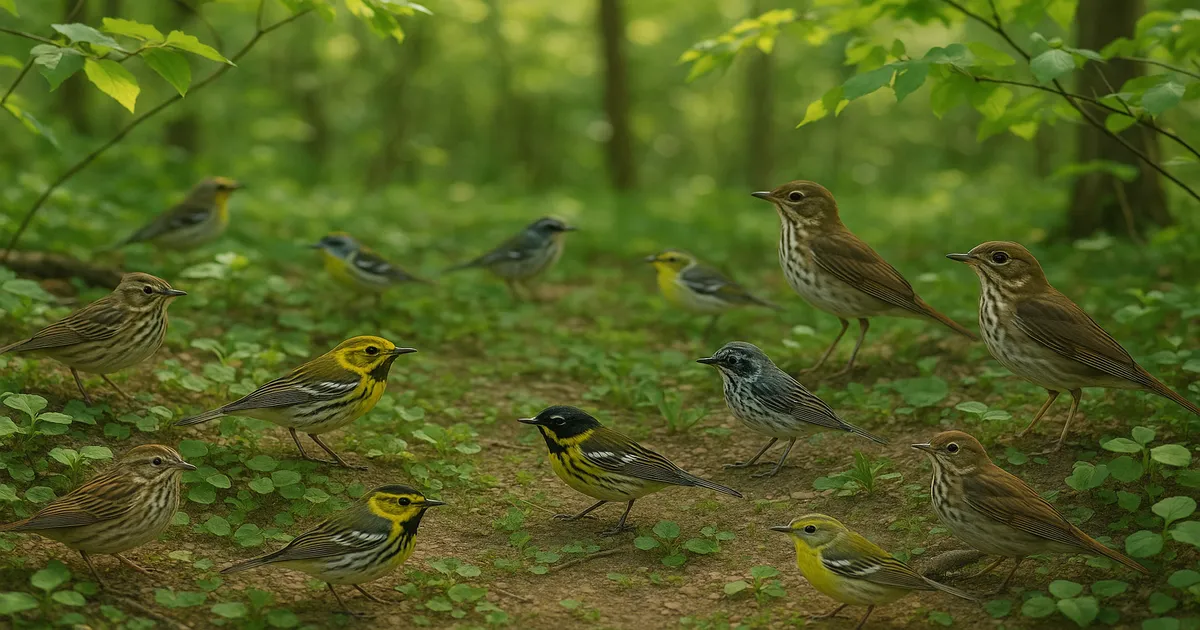
Quick Answer: Dozens of species share the same migration corridors at once, many in dull non-breeding plumage that looks nothing like your field guide photos. Before you reach for an app, lock in size, shape, and behavior — those three clues will narrow your ID faster than any plumage detail. This guide covers the five groups beginners encounter most during fall migration: warblers, sparrows, thrushes, shorebirds, and raptors.
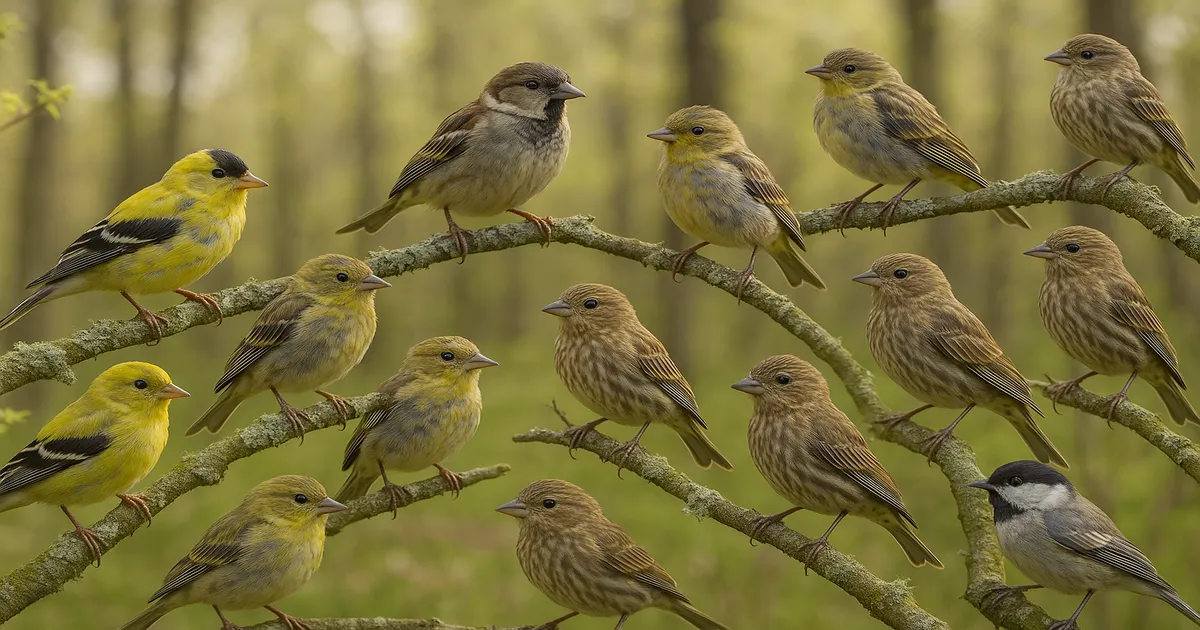
If you’ve ever stared up at a tree full of small brown birds and thought, “what are these migrating birds, and why do they all look identical?” — you’re in excellent company. Fall migration is genuinely hard. Birds that sang brilliantly and wore bold colors in May now creep through the understory in shades of olive, buff, and gray. Juveniles — often the most abundant birds you’ll encounter — look nothing like their parents. Add a dozen species packed into the same hedgerow simultaneously, and you’ve got one of birding’s best puzzles.
The good news: once you know what to look for, patterns emerge fast.
Quick Answer: How to Identify Migrating Birds at a Glance
Why Migration Makes Bird ID So Hard
Three things stack against you in fall. First, non-breeding (basic) plumage strips away the bright colors that make spring birds easy. Second, juveniles wear streaked, washed-out versions of adult plumage. Third, you’re often working fast — a warbler foraging in a canopy gap gives you maybe four seconds before it moves on.
The Golden Rule: Note Size, Shape, and Behavior First
Resist the urge to immediately flip through a field guide. Instead, ask yourself:
- How big is it? Sparrow-sized? Robin-sized? Crow-sized?
- What shape is the bill? Thin and pointed (insectivore), short and conical (seed-eater), or long and drooped (shorebird)?
- What is it doing? Pumping its tail? Fanning its wings? Scratching in leaf litter? Foraging on the ground or in the treetops?
Behavior and structure stay consistent across seasons. Plumage doesn’t.
Migrating Warblers: Cracking the Confusing Fall Warbler Code
Warblers (family Parulidae) are the group that most reliably sends birders into a mild panic every September. They’re small, they move fast, and fall plumage is genuinely drab. Five species are common enough — or distinctive enough in behavior — that they’re worth learning cold.
Yellow-rumped Warbler: The Butter Butt You’ll See Everywhere
At about 5.5 inches (14 cm), the Yellow-rumped Warbler is almost certainly the most abundant warbler you’ll encounter during fall migration. The field mark is foolproof: a bright yellow rump patch that flashes every time the bird flits away. Birders call it the “butter butt,” and once you’ve seen it, you’ll never mistake it.
In fall, both sexes go buffy-brown overall — but that yellow rump never fades. Eastern birds (the “Myrtle” form) show a white throat; western birds (“Audubon’s”) show a yellow throat and a bolder wing patch. The call is a sharp, hard tchek — learn it and you’ll hear yellow-rumps constantly from late September through November across most of the continent.
American Redstart: Fan That Tail and You’ve Found Your ID
Male American Redstarts are jet black with vivid orange patches on the wings and tail — genuinely unmistakable. Females and first-year males are gray-olive with yellow patches in the same spots, and beginners often think they’re looking at a different species entirely. The fix: watch behavior. Redstarts constantly fan their tails and droop their wings, flashing those patches to flush insects. That tail-fanning is as reliable as any plumage mark, regardless of sex or age.
Common Yellowthroat: Follow the Habitat to the Masked Warbler
The male Common Yellowthroat’s bold black mask and bright yellow throat make it one of the easiest warblers to identify. Females lack the mask and are much trickier — warm olive above, yellow throat, buffy flanks. The shortcut here is habitat: yellowthroats almost always stay low in dense marsh vegetation, wet thickets, or cattails. If you’re picking through reeds and find a plain olive-yellow warbler skulking near the ground, start with yellowthroat.
Tennessee Warbler vs. Orange-crowned Warbler: A Tricky Fall Pair
Both the Tennessee Warbler (Leiothlypis peregrina) and Orange-crowned Warbler (Leiothlypis celata) are greenish-yellow blobs in fall — genuinely one of the harder warbler separations. The single most useful mark: undertail coverts. Tennessee shows white undertail coverts; Orange-crowned shows yellow. Tennessee’s bill is also noticeably thinner and more sharply pointed. Check the undertail first and you’ll save yourself a lot of time.
Palm Warbler: The Ground-Walking, Tail-Pumping Warbler
The Palm Warbler behaves unlike most warblers — it forages on the ground, often along roadsides and open weedy areas, and pumps its tail constantly and emphatically. That tail-pumping alone is usually enough to call it. Yellow undertail coverts and a streaked breast are the supporting plumage marks; eastern birds are bright yellow below, western birds considerably duller. Look for them from late September through October in open scrub and coastal areas.
Migrating Sparrows: Sorting the Little Brown Jobs
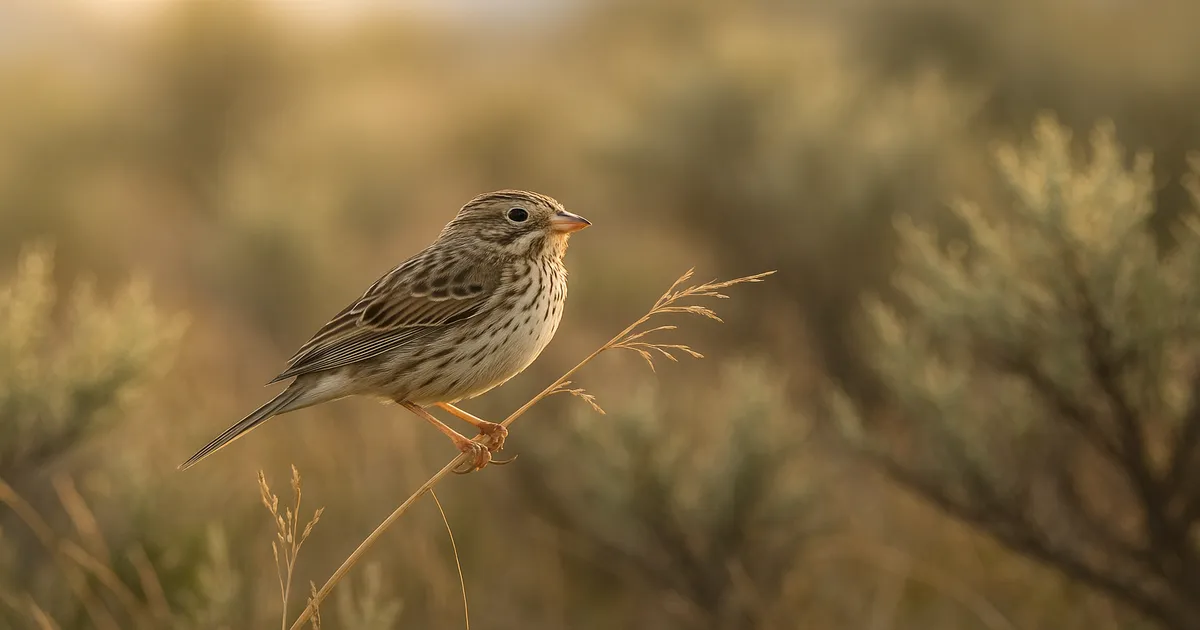
Sparrows get a bad reputation, and some of it is deserved. Dull plumage, high variability across subspecies, and streaked juveniles that look like four different species — it’s a lot. The single best advice: learn the calls. Sparrow chips are often more distinctive than their plumage, and a good field guide with audio — like the Sibley Guide paired with the Merlin app — makes a real difference.
White-throated Sparrow: Listen for ‘Old Sam Peabody’
At about 6.75 inches (17 cm), the White-throated Sparrow is a chunky, handsome bird. The white throat patch and yellow loral spot (between eye and bill) are the key marks. This species comes in two genetically distinct color morphs — white-striped (bold black-and-white crown) and tan-striped (softer brown-and-tan crown) — and both can show up in your yard at the same time.
The song is the famous, plaintive “Old Sam Peabody, Peabody, Peabody” — or “Oh sweet Canada” depending on who you ask. You’ll hear it on warm fall afternoons, and it’s one of those sounds that just feels like October.
White-crowned Sparrow: Bold Crown Stripes at Every Age
Adults are crisp and elegant: bold black-and-white crown stripes, clean gray breast, pink or orange-yellow bill. The trap for beginners is the first-winter bird, which replaces those black-and-white stripes with brown-and-tan ones and looks like a completely different sparrow. Focus on overall shape — upright posture, large head, pinkish bill — and the ID clicks.
Dark-eyed Junco: Flash of White in the Tail
The Dark-eyed Junco comes in six subspecies groups that look startlingly different from each other. The eastern “Slate-colored” form is dark gray with a white belly; the western “Oregon” form has a black hood and rufous-brown sides. What unites them all: white outer tail feathers that flash conspicuously every time the bird flies. Juncos also forage by double-scratching — hopping forward and kicking back with both feet to expose seeds — a useful behavioral clue when you’re watching a mixed flock.
Fox Sparrow: The Largest Common Sparrow
The Fox Sparrow is big — about 7 inches (18 cm) — with a heavy, triangular bill and vigorous scratching behavior in leaf litter. Eastern birds are richly rufous-red; Pacific Coast birds are sooty dark brown; interior western birds are gray-headed. The song is stunning: rich, melodious whistles that seem too beautiful for a bird you found in a hedgerow. Fox Sparrows are late migrants, often arriving at feeding stations in October and November after most warblers have already passed through.
Song Sparrow: Central Breast Spot and a Pumping Tail
The Song Sparrow is one of the most common sparrows you’ll encounter, and it has two reliable marks: heavy brown streaking on the breast that converges into a central spot, and a long, rounded tail that pumps up and down in flight. It’s variable across its enormous range, but those two features hold up almost everywhere.
Migrating Thrushes: Spotting Spotted Thrushes in the Understory
The Catharus thrushes are genuinely humbling. Four species — Hermit, Swainson’s, Veery, and Gray-cheeked — share spotted breasts, olive-brown backs, and a preference for forest understory. Even experienced birders pause on these.
Hermit Thrush: Rufous Tail, Hauntingly Beautiful Song
The Hermit Thrush’s key mark is a rufous-red tail that contrasts sharply with its olive-brown back. It also has a distinctive habit of slowly raising and lowering that tail — watch for it. The Hermit Thrush is the only spotted Catharus thrush that regularly winters in the lower 48 states, which is itself an ID clue: if you’re seeing a spotted thrush in December in the Southeast, it’s almost certainly this one. The song is widely considered the most beautiful of any North American bird — flute-like phrases, each at a different pitch, with an ethereal, spiraling quality.
Swainson’s Thrush: The Buffy Eye Ring
The Swainson’s Thrush is separated from the Hermit by its buffy eye ring and buffy lores, which give the face a warm, washed look. No rufous in the tail — it’s olive-brown all the way. The song spirals upward in pitch, the opposite of the Veery’s downward spiral. Swainson’s are peak migrants in May and again in September across much of the East.
Veery: Faint Spots, Downward-Spiraling Song
The Veery is warm tawny-brown above with much fainter spotting on the breast than other Catharus thrushes — almost ghost-like. The face is plain, with only an indistinct eye ring. If you’re lucky enough to hear it, the song settles it immediately: a downward-spiraling, ethereal veer-veer-veer that sounds like nothing else in the woods.
American Robin: The Familiar Thrush That Flocks in Winter
At about 10 inches (25 cm), the American Robin is the largest common thrush and the one everyone thinks they know. Juvenile robins have spotted breasts like their Catharus cousins, which surprises a lot of people. In winter, robins become highly nomadic, following fruit crops in flocks of hundreds to thousands — a dramatic and often overlooked migration spectacle.
Migrating Shorebirds: Peeps, Plovers, and How to Tell Them Apart
Shorebird ID in fall is one of birding’s steepest learning curves, and that reputation is earned. Fall birds wear plain non-breeding plumage, and the “peeps” — small sandpipers — can be nearly identical at a glance. Focus on structure first: bill shape, bill length, and body size are more reliable than plumage in this group. A spotting scope helps enormously on mudflats. (Vortex Optics Razor HD 27-60x85)
Semipalmated vs. Western Sandpiper: The Classic Peep Puzzle
The Semipalmated Sandpiper (Calidris pusilla) and Western Sandpiper (Calidris mauri) are both small, gray-brown in fall, and infuriatingly similar. The key: bill shape. The Semipalmated has a short, blunt-tipped bill; the Western’s bill is slightly longer with a subtle droop at the tip. The Western also tends to retain rusty tones on the back feathers longer into fall. Get a good scope view of the bill and you’ll sort most of them. Note that Semipalmated Sandpipers largely complete their southbound migration by early October, while Westerns linger later on the Pacific Coast.
Dunlin: The Drooped Bill That Gives It Away
The Dunlin (Calidris alpina) is larger than the peeps — about 8.5 inches (22 cm) — and its drooped bill tip is the structural giveaway. In breeding plumage, the black belly patch is unmistakable. In winter, it’s plain gray above and white below, but that bill shape is always there. Dunlin form enormous flocks in migration and are often the most abundant shorebird on a given mudflat from October onward.
American Golden-Plover: A Marathon Migrant Worth Knowing
The American Golden-Plover’s migration story is extraordinary: it travels up to 20,000 miles (32,000 km) round trip, including a non-stop oceanic crossing over the Atlantic in fall. In fall, look for spangled gold-and-black upperparts, a grayish-buff face with a strong supercilium, and — critically — no white rump (which separates it from the similar Black-bellied Plover, which shows a white rump in flight). Finding one in a plowed field or coastal grassland in September or October feels genuinely special.
Killdeer: The Double-Banded Plover in Your Parking Lot
The Killdeer is the entry point for shorebird ID, and I mean that as a compliment. It’s everywhere — parking lots, athletic fields, gravel rooftops — and its two black breast bands are unlike any other common plover. The bright orange-red rump flashes in flight. The call, a piercing kill-deer, kill-deer, is one of the most recognizable sounds in North America. Learn this bird cold and you have a solid reference point for everything else in the family.
Migrating Raptors: Reading Hawks in the Sky
Raptors at a hawkwatch site are often distant silhouettes. Plumage detail is secondary — what matters is wing shape and flight style, which are visible at range and consistent across ages and sexes.
The three main groups break down simply:
- Buteos (Red-tailed, Broad-winged, Red-shouldered): broad, rounded wings; soaring flight; stocky body
- Accipiters (Sharp-shinned, Cooper’s, Northern Goshawk): short, rounded wings; long tail; flap-flap-glide flight pattern
- Falcons (Peregrine, Merlin, American Kestrel): long, pointed wings; direct, powerful flight
Broad-winged Hawk: Kettles of Thousands in September
The Broad-winged Hawk is a small, stocky buteo — about 15 inches (38 cm) long — with a boldly banded black-and-white tail in adults. But the real draw is the migration spectacle. In mid-September, broad-wings form enormous kettles — spiraling flocks of thousands, sometimes tens of thousands of birds — riding thermals south. Hawk Mountain Sanctuary in Pennsylvania is the most famous watchsite, and a clear September day there is one of birding’s genuine highlights. A quality spotting scope makes a real difference when birds are high and distant.
Sharp-shinned Hawk: Small Accipiter, Big ID Challenge
The Sharp-shinned Hawk is North America’s smallest accipiter, but “small” is relative — females are significantly larger than males, to the point where a large female Sharp-shinned and a small male Cooper’s Hawk overlap in size. The classic marks: squared tail tip (vs. Cooper’s rounded tail), a smaller rounded head that barely projects beyond the wrists in flight, and a flap-flap-glide cadence that’s quicker and snappier than a Cooper’s. Sharp-shinneds peak at most eastern hawkwatch sites in early to mid-October.
Wing Shape and Flight Style: The Fastest Way to Group Raptors
Before you try to identify the species, identify the family. A broad-winged, soaring silhouette with a short tail is a buteo — probably a Red-tailed Hawk most of the year. Short rounded wings with a long tail doing a flap-flap-glide? Accipiter. Long pointed wings in direct, purposeful flight? Falcon. Place the bird in the right family first, and the species-level ID becomes much more manageable.
A good pair of binoculars is non-negotiable at any hawkwatch. (Nikon Monarch M5 8x42) The regulars at any hawkwatch site are almost always happy to teach — don’t be shy about asking.
Best Hawkwatch Sites and Peak Migration Windows
- Hawk Mountain Sanctuary, PA — Broad-winged peak: mid-September; Sharp-shinned peak: early October
- Cape May Point, NJ — Exceptional diversity; peak October through early November
- Hawk Ridge Bird Observatory, MN — Best site in the upper Midwest; peak mid-October for accipiters
- Manzano Mountains, NM — Premier western hawkwatch; peak September–October
Behavior and Habitat: The Fastest Shortcuts for Identifying Migrating Birds
Plumage is the last thing I look at, not the first. Habitat and behavior narrow your options before you even raise your binoculars.
Foraging Height and Microhabitat as ID Shortcuts
Where a bird forages tells you a lot:
- Dense marsh vegetation, low → Common Yellowthroat
- Ground, open areas and roadsides → Palm Warbler, Fox Sparrow, juncos
- Mudflats and shorelines → shorebirds (narrow further by bill shape)
- Parking lots and gravel → Killdeer
- Forest understory, leaf litter → thrushes, Fox Sparrow
Tail and Wing Movements: Behavioral Field Marks That Don’t Change with Season
Some behaviors are so consistent they function as field marks in their own right:
| Behavior | Species |
|---|---|
| Constant tail-pumping | Palm Warbler, Killdeer |
| Tail-fanning + wing-drooping | American Redstart |
| Slow tail-raise and lower | Hermit Thrush |
| White tail flash in flight | Dark-eyed Junco |
| Double-scratch in leaf litter | Fox Sparrow, Dark-eyed Junco |
| Flap-flap-glide | Accipiters |
Frequently Asked Questions: What Are These Migrating Birds?
Q: What are the most common migrating birds I’ll see in fall in the eastern US? Yellow-rumped Warblers, White-throated Sparrows, Dark-eyed Juncos, Hermit Thrushes, and Sharp-shinned Hawks are among the most reliably abundant. On any October morning in the Northeast, you can expect all five in a single outing.
Q: Why do migrating birds look so different from my field guide photos? Most field guides feature breeding (alternate) plumage, which is when birds look their best. By fall, adults have molted into duller non-breeding (basic) plumage, and juveniles — which make up a large portion of fall migrants — wear their own distinct first-year plumage. The Sibley Guide to Birds shows multiple plumages per species and is worth the investment for this reason.
Q: What’s the best app for identifying migrating birds? Merlin Bird ID (free, from the Cornell Lab of Ornithology) is the standard recommendation. Its Sound ID feature can identify birds by ear in real time, which is especially useful for sparrows and thrushes that stay hidden in dense cover. That said, use it to confirm an ID you’ve already started working out — not as a substitute for learning structure and behavior.
Q: When is the best time to watch fall migration? Shorebird migration peaks in July through September. Warblers and other passerines move most actively in September and October. Raptors peak at most eastern hawkwatch sites from mid-September (Broad-winged Hawk) through early November (Golden Eagle). The two or three days following a cold front with northwest winds typically produce the best fallout conditions.
Q: How do I attract migrating birds to my yard? Running a water feature — even a simple dripper or recirculating birdbath — is the single most effective thing you can do. Migrants are drawn to the sound of moving water. Native plantings with berry-producing shrubs (serviceberry, native viburnums, dogwoods) provide food. If you put out seed, white millet on a platform feeder attracts sparrows; black-oil sunflower seed brings in a wider mix.