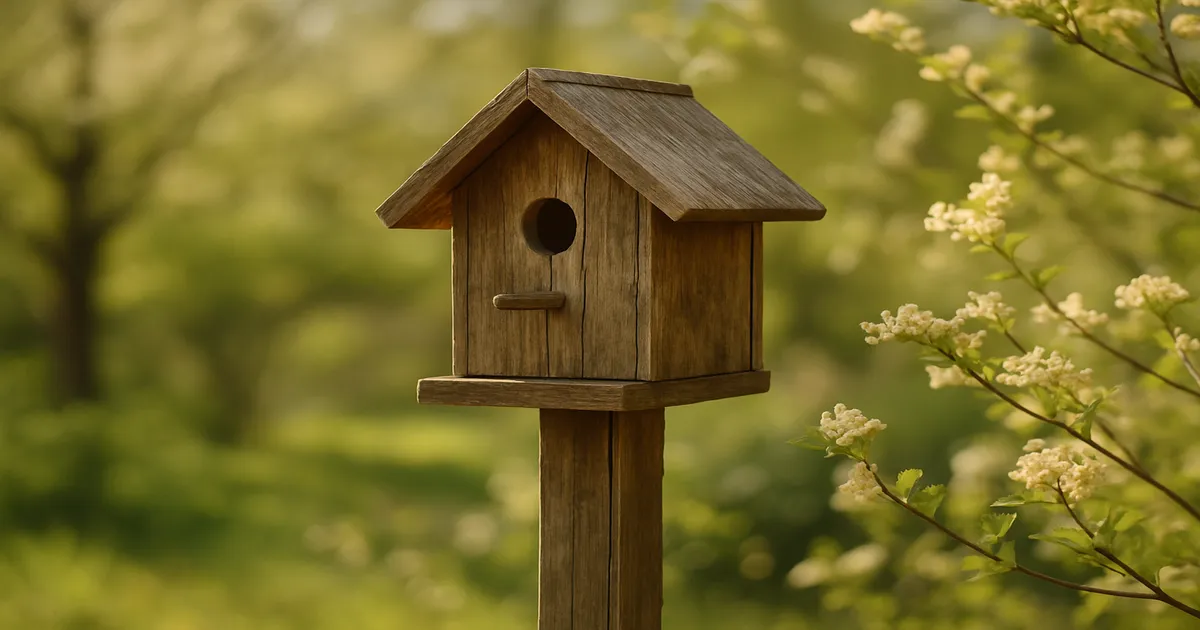
Quick Answer: To draw a birdhouse, start with a rectangle for the body, add a triangle on top for the roof, then draw a circle for the entrance hole. From there, add a perch rod, a mounting post, wood-grain detail lines, and finish by inking and coloring. The full beginner and intermediate tutorials below walk you through every step.
Learning how to draw a birdhouse is one of the most satisfying beginner art exercises around — you’re working with just a rectangle and a triangle, yet the finished result looks charming and complete. Whether you’re a kid working on a school project, an adult filling a nature journal page, or an illustrator sketching a logo concept, this guide covers everything from a simple flat 2D drawing to a proper 3D perspective construction.
How to Draw a Birdhouse in 7 Simple Steps
Here’s the core process at a glance. The detailed tutorials below go much deeper.
- Draw a rectangle for the main body
- Add a triangle centered on top for the roof
- Draw a circle near the upper center of the front face for the entrance hole
- Add a short horizontal line below the hole for the perch
- Draw a vertical line descending from the base for the mounting post
- Add detail lines — wood grain, hinges, a cleanout panel edge
- Ink the outline with a pen, erase pencil lines, then color
What Is a Birdhouse?
The Classic Shape Most People Picture
A birdhouse — also called a nest box — is a human-made structure that gives cavity-nesting birds a safe place to raise their young. It mimics natural tree hollows that are increasingly hard to find as old-growth forests disappear.
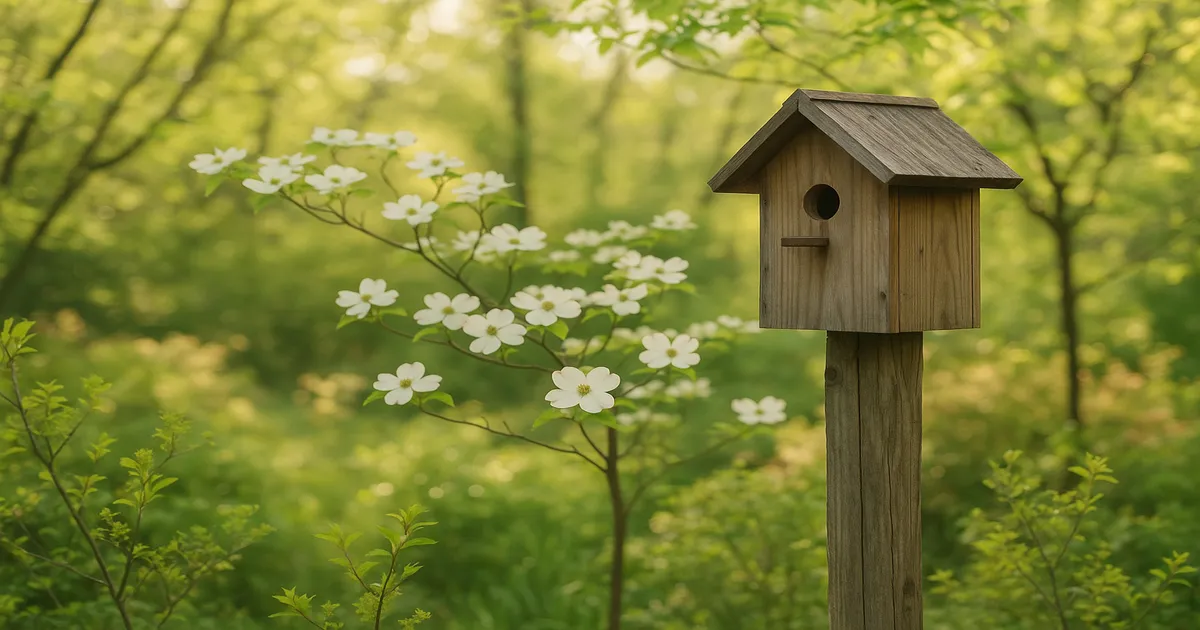
The shape most people instinctively sketch is the pitched-roof, single-hole, front-facing box on a post. That’s the one this guide focuses on first, because it’s both the most recognizable and the most beginner-friendly.
Common Birdhouse Styles You Can Draw
- Classic pitched-roof box — the iconic “schoolhouse” shape; easiest to draw
- Bluebird box — rectangular, clean lines, minimal decoration; great for realistic sketches
- Wren box — tiny and simple, perfect for a quick doodle
- Purple Martin house — multi-compartment apartment style; a fun challenge for intermediate artists
- Owl box — large, deep, and dramatic; works well in moody woodland scenes
- Duck box — wide entrance, often shown near water; a distinctive silhouette
Start with the classic pitched-roof style and branch out once you’re comfortable with the basic forms.
The Parts of a Birdhouse: Your Drawing Vocabulary
Before you put pencil to paper, know what you’re drawing:
- Roof — the triangular or gabled top section, often with an overhang
- Body — the rectangular main chamber
- Entrance hole — the circular opening near the top of the front face
- Perch — a small dowel rod below the hole (an artistic convention; more on this later)
- Mounting post — the vertical support below the box
- Ventilation slots — small gaps near the roofline (a realistic detail)
- Cleanout panel — a hinged side or front section for nest removal
What You Need Before You Start
Basic Supplies for Beginners
You genuinely don’t need much. A pencil, an eraser, and a black pen or marker will get you through the whole tutorial. For color, colored pencils work beautifully (Prismacolor Premier Soft Core 48-Pack), but washable markers or crayons are perfectly fine for kids.
A ruler helps keep the body and roof lines crisp. It’s not required if you prefer a loose, sketchy style, but straight lines make the structure read clearly — worth it for beginners.
Tools for More Finished Sketches
If you want to push toward a polished look:
- Fine-liner pens in 0.1 mm, 0.3 mm, and 0.5 mm
- Graphite pencils — HB for construction lines, 2B for general drawing, 4B for deep shadows
- Blending stump for smooth tonal gradients
- Watercolor set for nature-journal-style color washes (Winsor & Newton Cotman 24-Pan Set)
Finding Good Reference Photos
Working from reference makes a real difference, even for simple subjects. For birdhouses, NestWatch (nestwatch.org) — Cornell Lab of Ornithology’s nest box program — has excellent, clearly lit photos of real boxes. Wikimedia Commons has free-use photographs searchable by box style, and Pinterest is useful for stylized illustration references if you’re going for a cartoon or watercolor look.
How to Draw a Birdhouse: Beginner 2D Method
Step 1: Draw the Body
Draw a rectangle roughly 1.5 times taller than it is wide. A box that’s too wide looks like a mailbox; too narrow and it loses that cozy birdhouse feel. Keep your pencil lines light — you’ll erase the construction marks later.
Step 2: Add the Roof
Draw an isosceles triangle centered on top of the rectangle. The triangle’s base should be slightly wider than the rectangle on each side — that overhang is what makes it read as a real roof rather than just a hat. A steeper pitch looks dramatic; a shallower one feels rustic.
Step 3: Draw the Entrance Hole
Place the circle in the upper-center of the rectangle, roughly one-third of the way down from where the roof meets the body. Use a coin or compass for a clean circle, or freehand it for a looser style. The hole should feel proportionally small — think “golf ball on a dinner plate.”
Step 4: Add the Perch and Mounting Post
Draw a short horizontal line below the entrance hole for the perch, then extend a vertical line straight down from the center of the rectangle’s base for the mounting post.
A quick note: wildlife conservationists actually advise against perches on functional nest boxes because they give predators a foothold. But in drawings, the perch is a beloved visual shorthand. Keep it in your art; just skip it on any real box you build.
Step 5: Add Wood Grain and Details
This is where the drawing comes alive. Try horizontal curved lines across the body and roof for wood grain, a thin rectangular panel outline on the front for a cleanout door, and small circle dots at panel corners for hinge bolts. Adding a tiny bird perched on the roof or peeking from the hole is always a winning move — a simple Eastern Bluebird silhouette works perfectly.
Step 6: Ink and Erase
Go over your final lines with a black pen or fine-liner. Use a slightly thicker line for the outer silhouette and a thinner line for interior details. Once the ink is fully dry, erase all pencil construction lines.
Step 7: Color Your Birdhouse
Two approaches work well. Natural wood tones — warm tans, medium browns, and darker brown for shadows under the roof overhang — look grounded and realistic. Painted pastels — soft yellow, pale blue, sage green — read as charming cottage and suit children’s illustrations perfectly. Leave the entrance hole dark to suggest depth inside the box.
How to Draw a Birdhouse in 3D (Intermediate Method)
Two-Point Perspective Basics
Draw a horizon line across your paper — this represents eye level. Place two vanishing points near the outer edges of that line. Every horizontal edge of your birdhouse angles toward one of these two points; vertical edges stay perfectly vertical.
Start with a vertical line near the center of your page — the front corner of the box. From the top and bottom of this line, draw lines receding toward each vanishing point. Add a second vertical line to the right to close the front face, and another to the left to close the side wall.
Building the Roof in Perspective
Find the center of the front face and draw a vertical line up from it for the ridge peak. Connect that peak to the top corners of the front face, then extend the ridge line back toward the left vanishing point to find the rear peak. Connect everything to form the gabled roof.
Drawing the Entrance Hole as an Ellipse
In perspective, a circle becomes an ellipse — slightly squashed, wider than it is tall, positioned in the upper portion of the front face. The major axis tilts very slightly to follow the perspective plane. This is the detail that separates a convincing 3D birdhouse from a flat one. Get the ellipse right and the whole drawing snaps into focus.
Shading for Depth
Pick a light source — upper-left works well. The front face gets a medium tone, the side wall goes significantly darker, and the underside of the roof overhang gets the darkest value. Add a cast shadow on the ground below the post, angled away from your light source. Wood grain lines should converge slightly toward the vanishing point rather than running perfectly parallel.
Drawing Styles: From Cartoon to Realistic
Cute cartoon style — exaggerate everything. Steeper roof, bigger entrance hole (try a heart shape), brighter colors, bold outlines, minimal shading. Fast, fun, and perfect for greeting cards or bullet journal spreads.
Nature journal and watercolor style — start with a light, slightly wobbly pencil sketch. Lay in soft color washes and let them bloom. Add cherry blossoms or leafy branches around the box for a botanical feel. This style looks impressive with less technical skill than you’d expect.
Realistic pencil sketch — cross-hatching is your best friend. Run parallel lines along the wood grain direction, then add a second layer at a slight angle in shadow areas. Detailed roof shingles — small overlapping rectangles — add tremendous realism. This style rewards patience.
Graphic design or logo — reduce the birdhouse to its essential silhouette: roof triangle, body rectangle, circle. High contrast, no gradients. The negative space inside the entrance hole can even hold a letter or monogram.
Adding Birds and Backgrounds
An isolated birdhouse on white paper is fine for practice, but a simple background transforms it into a scene. Settings that work well include a white picket fence with garden flowers, a cherry blossom branch, an open meadow fence post, a pond edge for a wood duck box, or bare winter branches with snow on the roof.
Three species show up most often in birdhouse illustrations, and for good reason:
- Eastern Bluebird (Sialia sialis) — vivid blue upperparts, rusty-orange breast and throat, white belly; about the size of a large sparrow. One of the most beautiful small birds in North America, and a genuine nest box success story.
- House Wren (Troglodytes aedon) — tiny, warm brown overall with faint barring on wings and tail; often depicted with its short tail cocked upward. Easy to render as a small rounded shape.
- Black-capped Chickadee (Poecile atricapillus) — bold black cap and bib, bright white cheeks, gray back, buffy flanks. Graphic and recognizable even at thumbnail size.
Keep the bird proportionally small relative to the box. A wren at the entrance hole should look like it just barely fits — because in real life, it does.
The Real Birds Behind the Drawing
Which Species Use Nest Boxes
| Bird | Entrance Hole | Typical Art Setting |
|---|---|---|
| Eastern Bluebird (Sialia sialis) | 1.5 in (3.8 cm) | Open meadow, fence post |
| House Wren (Troglodytes aedon) | 1.125 in (2.9 cm) | Garden, shrubby yard |
| Black-capped Chickadee (Poecile atricapillus) | 1.125 in (2.9 cm) | Woodland edge, backyard |
| Tree Swallow (Tachycineta bicolor) | 1.5 in (3.8 cm) | Open field near water |
| Purple Martin (Progne subis) | 2.125 in (5.4 cm) | Open yard, apartment house |
| Wood Duck (Aix sponsa) | 4×3 in (10×7.6 cm) oval | Near pond or stream |
| Barn Owl (Tyto alba) | 6 in (15 cm) round | Barn, open farmland |
Why Birdhouses Matter: The Bluebird Story
Eastern Bluebird populations crashed through the mid-20th century. The culprits were habitat loss — fewer old trees with natural cavities — and fierce competition from two introduced species: the European Starling (Sturnus vulgaris) and the House Sparrow (Passer domesticus), both of which aggressively take over nest sites.
What reversed the decline? Nest boxes. Thousands of volunteers, organized through groups like the North American Bluebird Society and monitored through Cornell Lab’s NestWatch program, established bluebird trails across the continent. The species has made a remarkable comeback. If you want to do more than draw one, a cedar or pine nest box mounted on a smooth metal pole — with a baffle to stop predators — is one of the most effective things a backyard birder can do.
When you draw a birdhouse, you’re drawing a symbol of one of conservation’s genuine success stories. That’s not a bad thing to put on paper.
Frequently Asked Questions
What basic shapes do you need to draw a birdhouse?
Just two: a rectangle for the body and a triangle for the roof. The entrance hole adds a circle, and the perch and post are simple lines. The entire structure breaks down into elementary geometry, which is exactly why it’s such a useful subject for teaching drawing fundamentals.
How do you draw a birdhouse in 3D?
Use two-point perspective — draw a horizon line, place vanishing points at each end, and run all horizontal edges toward those points. The front corner of the box is a single vertical line, with planes extending left and right. The most common beginner mistake is drawing the entrance hole as a perfect circle; in perspective, it should be a slightly flattened ellipse.
Should a birdhouse drawing include a perch?
In a drawing, yes — it’s a classic visual element that reads instantly as “birdhouse.” On a real nest box, though, leave it off. Perches give predators a foothold directly below the entrance hole, which is the last thing a nesting bluebird needs.
What is the hole in a birdhouse called?
The entrance hole. On real boxes, the diameter is species-specific — 1.5 inches (3.8 cm) for bluebirds and tree swallows, 1.125 inches (2.9 cm) for wrens and chickadees, up to a 4×3-inch oval for wood ducks. In drawings, keep it proportionally small relative to the front face and it will look natural.
What birds can you add to a birdhouse drawing?
The three most popular choices are the Eastern Bluebird (blue upperparts, rusty-orange breast), the House Wren (small and brown with a cocked tail), and the Black-capped Chickadee (bold black cap, white cheeks, buffy flanks). All three genuinely use nest boxes, so including them adds ornithological accuracy to your illustration.