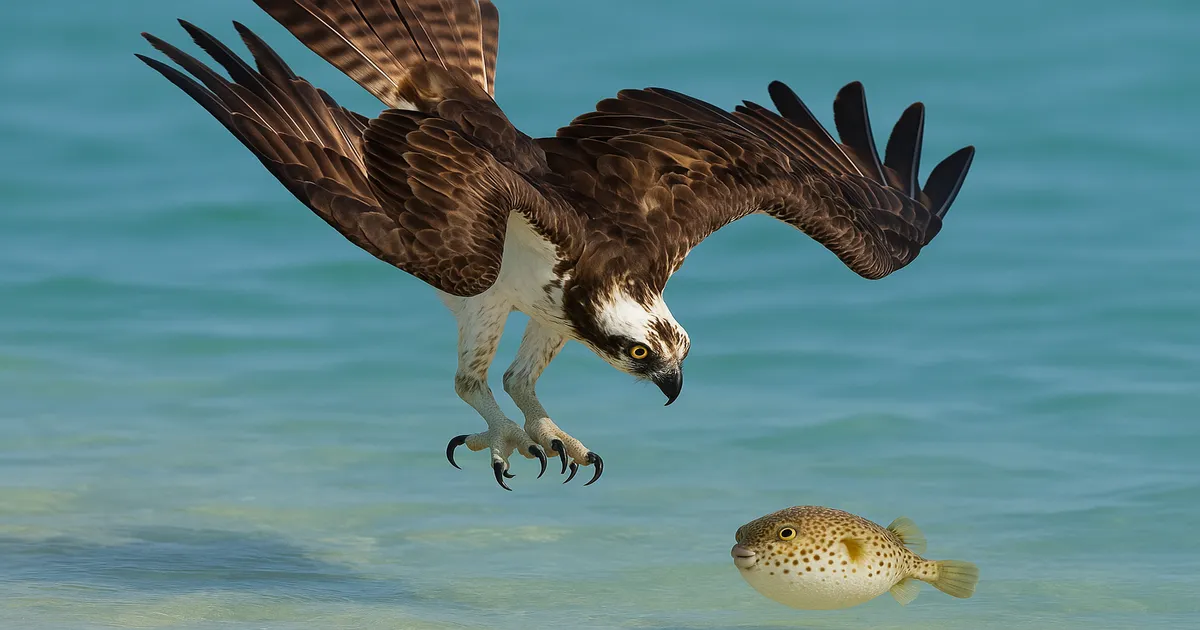
Quick Answer: A healthy adult osprey eating the flesh of a North American pufferfish is very unlikely to suffer significant toxic effects. Ospreys naturally avoid the most toxic parts of any fish, North American pufferfish carry far less tetrodotoxin than their Indo-Pacific relatives, and birds appear to tolerate TTX better than mammals do. The short version: the osprey will probably be just fine.
So you’ve watched an osprey (Pandion haliaetus) plunge into a coastal estuary and come up with something round, spiny, and unmistakably puffed — and now you’re wondering whether that bird just made a terrible mistake. Will this osprey be affected by the pufferfish’s poison? It’s a fair question, and the answer is genuinely interesting once you understand both animals.
Will This Osprey Be Affected by the Pufferfish’s Poison? The Science Explained
Pufferfish contain tetrodotoxin (TTX), one of the most potent neurotoxins on Earth. It blocks sodium channels in nerve cell membranes, causing paralysis and potentially respiratory failure in sensitive animals. It’s the same toxin that makes Japanese fugu preparation a matter of life and death.
But not all pufferfish are equally toxic, and not all animals are equally sensitive to TTX. For an osprey eating a North American pufferfish, several factors work together to make a serious toxic event unlikely — and understanding those factors tells you a lot about how fish-eating raptors operate at the top of aquatic food chains.
Osprey Identification: Knowing the Bird in Question
Size, Shape, and the Signature Bent-Wing Silhouette
The osprey is a large raptor — about 21–23 inches (53–58 cm) long, with a wingspan of roughly 59–71 inches (150–180 cm) and a weight of 2–4.4 lbs (0.9–2.0 kg). Females are noticeably larger than males, as is typical in raptors. In flight, the long, narrow wings are held in a characteristic crooked or bent shape that creates a distinct “M” silhouette visible from a remarkable distance. Lock that shape in your memory and you’ll never misidentify one again.
Plumage: Adults and Juveniles
Adults are dark chocolate-brown above and white below, with a bold dark eye stripe running from the bill through the eye to the back of the neck. That stripe on a white head is the go-to close-range field mark.
| Feature | Male | Female |
|---|---|---|
| Size | Smaller | Noticeably larger |
| Breast band | Faint or absent | More prominent, darker |
| Throat | Clean white | May show more streaking |
| Overall build | Slimmer | Bulkier |
Juveniles resemble adults but show pale buff tips on the back and wing feathers — a scalloped look — and an orange-red iris rather than the adult’s golden-yellow. That iris color is a surprisingly useful field mark when you have a perched bird close.
Calls
Ospreys are vocal and distinctive. The alarm call is a series of sharp, whistled kyew-kyew-kyew notes — high-pitched, almost gull-like, carrying well over open water. Near the nest during breeding season, they’re downright chatty.
Separating Ospreys from Similar Species
| Species | Key Differences |
|---|---|
| Bald Eagle (Haliaeetus leucocephalus) | Much larger; white head and white tail on adults; flat wings when soaring; yellow bill |
| Red-tailed Hawk (Buteo jamaicensis) | Shorter, broader wings; rusty tail; no dark eye stripe; not a water bird |
| Northern Harrier (Circus hudsonius) | White rump patch; low quartering flight over marshes; slimmer build |
| Double-crested Cormorant (Nannopterum auritum) | All dark; swims; neck outstretched in flight |
The hovering-then-plunge-dive is a near-certain clincher. No other large North American raptor does it regularly. If a big bird is hovering over water and then drops feet-first into it, you’ve got your osprey.
Pufferfish in North American Waters: The Toxic Prey
Which Species Do Ospreys Encounter?
The North American pufferfish an osprey is most likely to grab include:
- Northern Puffer (Sphoeroides maculatus) — Atlantic coast, common in estuaries from Florida to Maine
- Bandtail Puffer (Sphoeroides spengleri) — Gulf of Mexico and South Atlantic
- Checkered Puffer (Sphoeroides testudineus) — Warm coastal and estuarine waters
- Least Puffer (Sphoeroides parvus) — Gulf of Mexico
All four belong to the family Tetraodontidae and all carry TTX to varying degrees.
What Is Tetrodotoxin and How Does It Work?
TTX isn’t produced by the fish itself — it’s synthesized by symbiotic bacteria (Pseudoalteromonas and Vibrio species, primarily) living in the fish’s tissues. The pufferfish accumulates TTX over its lifetime, concentrating it especially in the liver, ovaries, skin, and intestines. Muscle flesh carries far lower concentrations. TTX blocks sodium channels in nerve cell membranes, shutting down the electrical signals nerves need to fire. Paralysis follows, and in severe cases, so does respiratory failure.
Are North American Pufferfish as Toxic as Asian Species?
No — and this matters a great deal. The Northern Puffer’s muscle is commercially sold in the U.S. under the name “sea squab” and is considered safe to eat. The flesh is fine; the viscera are not. North American Sphoeroides species carry TTX loads that are generally far lower than Indo-Pacific fugu (Takifugu rubripes), where a single fish can carry enough toxin to kill multiple people. The danger is real but considerably more modest on this side of the Pacific.
Where Ospreys and Pufferfish Share the Same Water
Ospreys are found on every continent except Antarctica — genuinely one of the world’s most cosmopolitan birds. Their one non-negotiable habitat requirement is clear, fishable water. Coastal bays, tidal rivers, estuaries, and mangroves all fit perfectly, and those are exactly the habitats where North American pufferfish are most abundant.
Most North American ospreys migrate, wintering in Central America, South America, and the Caribbean. Year-round residents along southern Florida, the Gulf Coast, and parts of coastal California have the highest cumulative exposure to pufferfish simply through repeated encounters over months rather than weeks.
The Chesapeake Bay, Gulf Coast, and Florida stand out as the highest-overlap regions. The Chesapeake alone supports one of the densest osprey breeding populations in the world, and its estuarine waters host Northern Puffers throughout the warmer months. If an osprey anywhere is going to grab a pufferfish, it’s probably here.
How Ospreys Hunt — and Why Pufferfish Aren’t on the Menu
The Plunge-Dive
Ospreys hunt by soaring and hovering at 30–100 feet (9–30 m) above the water, scanning for fish near the surface. When they spot prey, they commit to a feet-first plunge that can fully submerge the bird. The whole sequence — hover, tuck, drop, splash, emerge — takes only seconds and is one of the most dramatic sights in North American birding.
Several anatomical adaptations make this work: a reversible outer toe that lets the bird grip with two toes in front and two behind; spicules (spiny pads) on the toes for gripping wet fish; closable nostrils to prevent water inhalation; and dense, oily plumage that sheds water fast. After a successful strike, the osprey orients the fish headfirst in its talons — an aerodynamic adjustment you can spot from a distance and one of the most reliable in-flight ID tricks going.
What Ospreys Actually Eat
Fish make up roughly 99% of the osprey’s diet. They’re highly opportunistic — bluegill, bass, catfish, mullet, menhaden, flounder, trout — virtually any fish of the right size near the surface qualifies. They prefer fish in the 6–13 inch (15–33 cm) range.
Pufferfish aren’t typical targets. They’re slow-moving, often near the bottom, and not the near-surface schooling fish ospreys usually go for. Encounters are incidental — a puffer in the wrong place at the wrong moment.
Why This Osprey Will Probably Survive the Pufferfish’s Poison
Reason 1: Ospreys Eat the Flesh, Not the Toxic Organs
When an osprey catches a fish, it eats the muscle and typically discards the head, scales, and viscera — the parts where TTX concentrations are highest by a wide margin. This behavioral pattern alone dramatically reduces TTX exposure. The bird is essentially doing what a careful sushi chef does: keeping the safe part and leaving the dangerous part behind.
Reason 2: Birds Tolerate TTX Better Than Mammals
Avian sodium channel sensitivity to TTX appears to be generally lower than mammalian sensitivity, meaning birds can tolerate higher doses before experiencing effects. Some predators of toxic prey have evolved sodium channel mutations that reduce TTX binding. Whether ospreys specifically carry such adaptations isn’t well-documented, but the broader pattern of higher avian TTX tolerance is established.
Reason 3: The Dose Is Probably Too Low to Matter
TTX toxicity is strictly dose-dependent. A 2–4 lb raptor eating the muscle flesh of a North American pufferfish — already a low-TTX tissue from a relatively low-TTX species — may simply be well below any clinically meaningful threshold. The math works in the osprey’s favor.
Reason 4: No Documented Osprey Deaths from Pufferfish
There are no well-documented cases in the scientific literature of osprey mortality attributed to pufferfish consumption. That absence isn’t conclusive proof of safety, but it’s suggestive. Ospreys are among the most-studied raptors in North America. If pufferfish were killing them with any regularity, we’d know about it.
When Could a Pufferfish Pose a Real Risk?
Edge cases exist. A juvenile osprey — smaller, less experienced, potentially eating more carelessly — consuming a particularly toxic individual fish could face greater risk. Accidental ingestion of viscera is possible, if unlikely. And some individual pufferfish carry higher TTX loads than others. These scenarios aren’t zero-probability, but they’re not the typical interaction either.
Osprey Conservation: A Recovery Story Worth Knowing
The DDT Crash and the Road Back
The osprey’s recovery is one of conservation’s genuinely great stories. DDT and other organochlorine pesticides caused population crashes throughout the 1950s–1970s by thinning eggshells — the same mechanism that devastated Bald Eagles and Peregrine Falcons. The 1972 U.S. ban on DDT changed everything. Populations rebounded, and the osprey is now IUCN Least Concern, with an estimated North American population of around 500,000 individuals.
Modern Threats
DDT is gone, but the threat list isn’t. Mercury bioaccumulation in fish-eating birds is a significant ongoing concern — directly relevant to any discussion of osprey toxicology. Habitat loss from waterfront development, human disturbance at nest sites, and monofilament fishing line incorporated into nests (which can entangle and kill chicks) all remain active problems.
Nest Platforms: The Conservation Tool That Actually Works
Install a platform on a channel marker or a pole near good fishing water, and ospreys will find it. Nest platform programs across the Chesapeake Bay and Great Lakes have been extraordinarily successful — probably the single most effective osprey conservation tool ever deployed. It’s cheap, scalable, and it works. If you live near osprey habitat, putting up a platform is one of the most direct things you can do for the species.
How to Watch Ospreys in Coastal Habitats
Best Times and Seasons
- April: Peak spring migration across much of the eastern U.S.
- May–July: Breeding season; birds are on territory, vocal, and actively fishing
- September–October: Fall migration; Hawk Mountain, Cape May, and Kiptopeke record significant counts
Top Locations in North America
Hawk Mountain Sanctuary (Pennsylvania), Cape May Point (New Jersey), Kiptopeke (Virginia), and Corpus Christi (Texas) are all excellent during migration. For breeding season watching, the Chesapeake Bay region is hard to beat — nesting platforms are everywhere. Check eBird for local hotspots; the osprey sighting maps are dense and current.
Watching the Plunge Dive
Position yourself with open water in front of you and scan at mid-height — ospreys hover before diving, so they’re not at treetop level or right on the water. Watch for that hovering silhouette, then track the dive. If the bird comes up with something, look for the headfirst fish orientation as it flies away.
Gear for Coastal Raptor Watching
For perched birds at close range, a good 8x42 binocular is the right tool — you want bright optics and solid close-focus performance. The Vortex Viper HD 8x42 handles coastal glare well and focuses close enough for perched birds at 20 feet. For watching ospreys hovering and diving over open water at distance, a spotting scope earns its weight. The Vortex Razor HD 65mm with a 20–60x zoom eyepiece lets you track hovering birds without constantly re-finding them in the field of view. Round out your kit with a solid field guide — the Sibley Guide to Birds covers every North American species you’ll encounter in osprey habitat and has the best flight silhouette illustrations of any guide currently in print.
Frequently Asked Questions
Will this osprey be affected by the pufferfish’s poison?
Almost certainly not, in the typical scenario. Ospreys eat the muscle flesh of fish and discard the viscera, where pufferfish toxin concentrates most heavily. Combined with lower TTX levels in North American Sphoeroides species and apparent higher avian tolerance for tetrodotoxin, a healthy adult osprey is unlikely to be significantly harmed. Juveniles and edge cases carry slightly more risk, but confirmed mortality events simply aren’t documented.
What is tetrodotoxin and can birds be affected by it?
Tetrodotoxin (TTX) is a potent neurotoxin produced by bacteria living symbiotically in pufferfish tissues. It blocks sodium channels in nerve cells, causing paralysis and potentially respiratory failure. Birds can theoretically be affected, but evidence suggests avian sensitivity to TTX is generally lower than mammalian sensitivity, making birds more resistant to clinically significant effects.
Are North American pufferfish as dangerous as Japanese fugu?
Not even close. North American pufferfish in the genus Sphoeroides carry far lower TTX concentrations than Indo-Pacific fugu (Takifugu rubripes). The Northern Puffer’s muscle is commercially sold in the U.S. as “sea squab” and is considered safe to eat. The liver, skin, and ovaries are still toxic, but the overall danger level is considerably lower than Asian species.
What fish do ospreys normally eat?
Ospreys eat almost exclusively fish — roughly 99% of their diet — and are highly opportunistic about species. Common prey includes bluegill, largemouth bass, catfish, mullet, menhaden, flounder, and trout, depending on habitat. They prefer fish in the 6–13 inch (15–33 cm) range swimming near the surface, which is why pufferfish — slow-moving and bottom-oriented — aren’t typical targets.
Have any birds ever died from eating pufferfish?
There are no well-documented cases in the scientific literature of osprey mortality specifically attributed to pufferfish consumption. Anecdotal reports of other bird species encountering TTX-bearing prey exist, but confirmed mortality events in wild raptors from pufferfish are not established in the published record. This doesn’t guarantee zero risk, but it does suggest the interaction is far less dangerous than the toxin’s fearsome reputation might imply.